How EtG testing works in Oklahoma
Ethyl glucuronide (EtG) is a metabolite the body produces when it processes alcohol, and it shows up in urine long after the alcohol itself is gone — which is why Oklahoma courts and programs use it to check abstinence rather than impairment. A breath test answers whether you are drunk now; an EtG test answers whether you drank in the last few days.
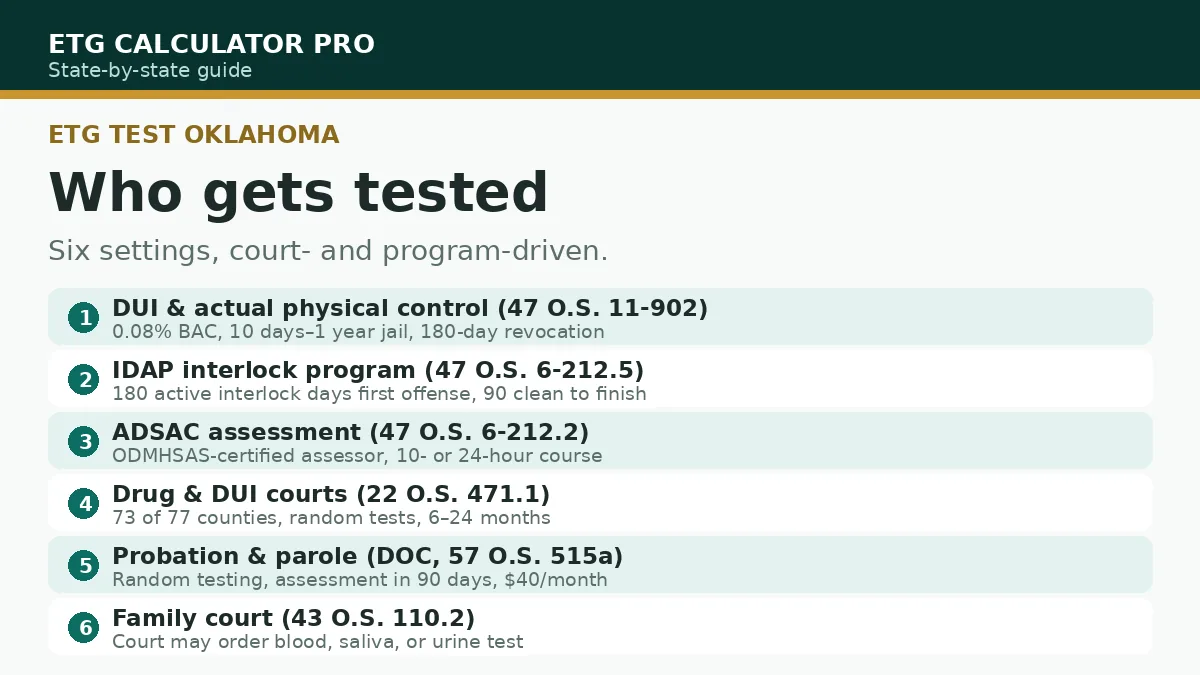
Oklahoma's testing system rests on the DUI statute (47 O.S. § 11-902), the Impaired Driver Accountability Program (47 O.S. § 6-212.5), the Drug Court Act (22 O.S. §§ 471.1–471.6), and the felony probation standards (57 O.S. § 515a). Add the ADSAC assessment system run by ODMHSAS, and testing in Oklahoma is a standing obligation that can follow a person from arrest through years of supervision.
Who gets tested in Oklahoma and why
DUI and actual physical control
Oklahoma prohibits driving, operating, or being in actual physical control of a motor vehicle with a blood alcohol concentration of 0.08% or more, or while under the influence to a degree that makes safe driving impossible, under 47 O.S. § 11-902. Actual physical control needs no movement: sitting in the driver's seat with the key in the ignition has been enough for a conviction (Hughes v. State). The same statute covers any amount of a Schedule I controlled substance in the system.
A first conviction is a misdemeanor: 10 days to one year in jail, a fine of up to $1,000, and a 180-day license revocation. A second DUI within 10 years is a felony — since January 1, 2026, a Class C2 felony carrying up to seven years in prison and a fine of up to $2,500, with a one-year revocation. A third DUI (a second felony DUI) brings one to 10 years in prison, a fine of up to $5,000, 240 hours of community service, and a two-year revocation. A blood alcohol concentration of 0.15% or higher makes the offense aggravated, with a 90-day interlock requirement and a year of supervision and periodic testing. Drivers under 21 face a zero-tolerance rule: any amount of alcohol can mean fines of $100 to $2,000, 20 to 480 hours of community service, and a revocation of 180 days to three years. Commercial drivers are held to 0.04%.
Refusing a blood or breath test has its own consequences under the implied consent law (47 O.S. § 751): a first refusal brings a six-month revocation, and repeat refusals within 10 years bring longer ones. Oklahoma also has a separate, lesser driving while impaired offense (47 O.S. § 761) for drivers impaired by alcohol or drugs below the DUI threshold.
IDAP: the way back to driving
Since 2019, Oklahoma has handled the license side of a DUI through the Impaired Driver Accountability Program (IDAP) rather than a Department of Public Safety hearing. The program is now run by the Board of Tests for Alcohol and Drug Influence (47 O.S. § 6-212.5). A driver has 30 days from the revocation notice to apply and must enroll within 45 days. The core requirement is an approved ignition interlock device in every vehicle the person drives: at least 180 active interlock days for a first offense, 365 for a second, and 730 for a third or subsequent offense, with the final 90 active days violation-free. The program charges a $150 administrative fee, and participants must also maintain SR-22 insurance.
Completing IDAP matters beyond the interlock: on presentation of the completion certificate, Service Oklahoma reinstates driving privileges, and the driving record is updated to show IDAP completion without a revocation. EtG testing fits here as the compliance check behind the interlock: a program that finds drinking through a urine test can extend the restriction or trigger a violation.
ADSAC assessment
Before a license can be reinstated, Oklahoma requires an alcohol and drug assessment and evaluation by an assessor certified by ODMHSAS (47 O.S. § 6-212.2). The assessment is an evaluation, not a class: a certified assessor reviews the person's substance-use history and the circumstances of the offense, then writes recommendations that become a condition of reinstatement. Those recommendations range from a 10-hour ADSAC course and a Victim Impact Panel up to outpatient or residential treatment and aftercare. The assessment fee is set by law at $160 for offenses after November 1, 2008. A DUI conviction also requires an assessment before sentencing, and the judge must include the assessor's recommendations in the sentence.
Drug courts and DUI court
Oklahoma's drug courts are court-supervised, treatment-focused alternatives to incarceration under the Drug Court Act (22 O.S. §§ 471.1–471.6). Adult drug courts have expanded to 73 of Oklahoma's 77 counties. The active treatment portion must last at least six months and no more than 24 months, and random substance-abuse testing is a required part of the model — frequent and unannounced, with urine the most common method, and testing heaviest in the early phases.
Oklahoma County runs a separate DUI Court, started in 2001, as a five-phase, post-plea, pre-sentence program with a minimum of 18 months: 12 months of active phases and six months of aftercare. Tulsa County's drug court typically runs about 18 months to three years. A positive test brings escalating sanctions — more frequent testing, or a short jail stay of up to five days — and the program ends only after sustained clean tests.
Probation and parole
Probation in Oklahoma is supervised by the Department of Corrections, and testing is built into supervision from the start. Under 57 O.S. § 515a, a person on felony probation must complete an approved substance abuse assessment within 90 days of intake when the court deems it appropriate, administered and scored by ODMHSAS-certified personnel, and the supervising agency may impose random substance abuse testing at any time. Supervision costs $40 a month unless the court finds a hardship.
The DOC's electronic monitoring program for DUI offenders (OP-061002) is explicit: no alcohol, avoid products containing alcohol and places where alcohol is the major item, and submit to urinalysis, breathalyzer, or other forms of drug detection; an interlock may also be required at the person's expense, with program fees of up to $300 a month. In the federal courts in Oklahoma, the standard drug and alcohol treatment condition caps testing at eight tests a month. Oklahoma's 24/7 Sobriety and Drug Monitoring Program Act (47 O.S. § 6-213) goes further, authorizing a court to require twice-daily testing at a central location, or continuous transdermal monitoring, as a condition of bond, sentence, probation, or parole.
Family court
Oklahoma's custody statutes let a court order testing directly. Under 43 O.S. § 110.2, in any action where custody or visitation is at issue, the court may order the mother, the child, or the father to submit to blood, saliva, urine, or any other test the court deems necessary to decide the child's best interests. Custody itself is decided under the best-interests standard in 43 O.S. § 112, and § 112.5 creates a rebuttable presumption against custody for a parent who is alcohol- or drug-dependent and can be expected to inflict serious bodily harm in the near future. Refusing a court-ordered test can be treated as a positive result. No Oklahoma custody statute names EtG specifically; the test is one way a court checks the abstinence it has ordered.
Cutoffs used in Oklahoma programs
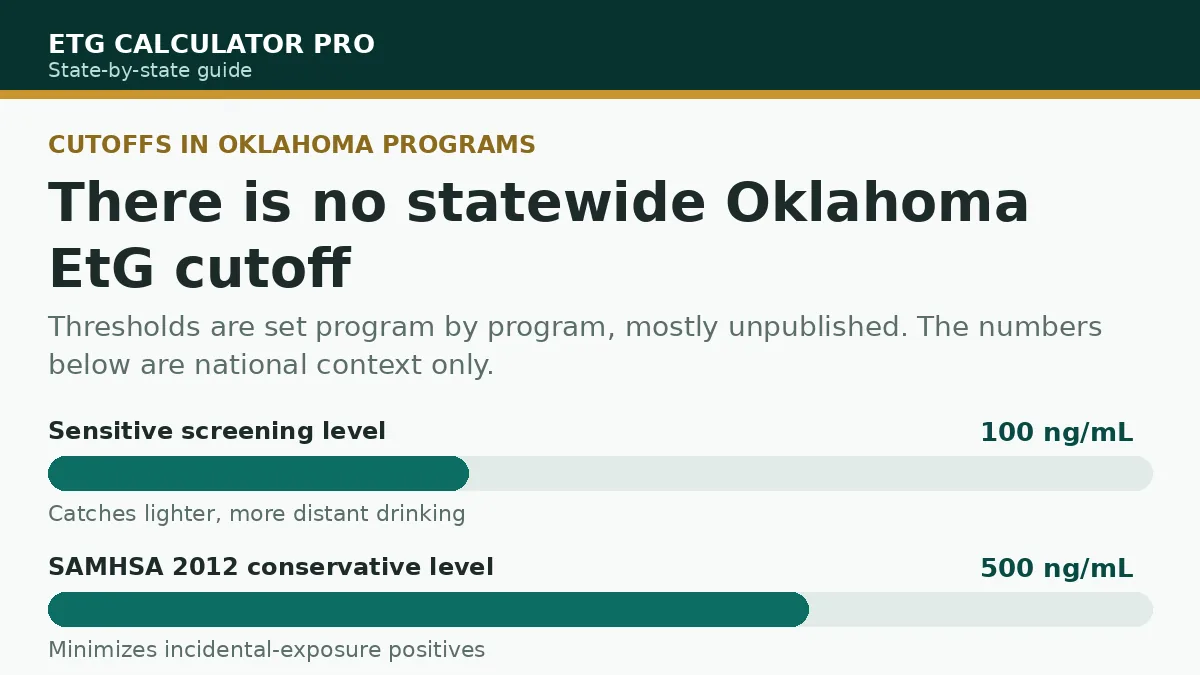
There is no statewide Oklahoma EtG cutoff: no statute, court rule, or state program document we checked names a threshold. Your paperwork names the only one that counts.
National context:
- 100 ng/mL — the sensitive level many labs use.
- 500 ng/mL — SAMHSA's 2012 conservative recommendation.
- Labs screen anywhere from 100 to 1,000 ng/mL.
Do not assume an Oklahoma program uses either number, and do not confuse the 0.08% and 0.04% BAC limits in Oklahoma law — or the zero-tolerance rule for drivers under 21 — with EtG cutoffs.
Detection windows in Oklahoma programs
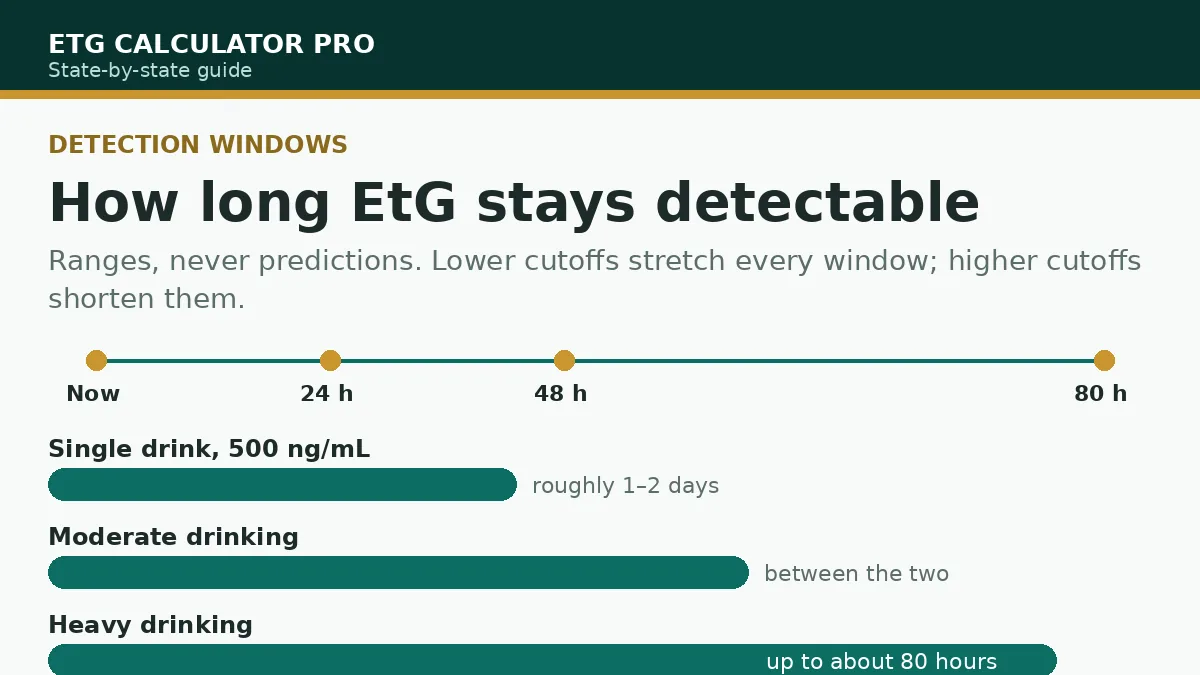
- Heavy drinking: up to about 80 hours after the last drink.
- A single drink: roughly 1–2 days at a 500 ng/mL cutoff.
- Moderate drinking: between those two.
The biggest lever is the cutoff: at 100 ng/mL the same episode stays detectable longer.
Try these ranges in our homepage calculator or our detection timeline calculator.
A realistic Oklahoma scenario
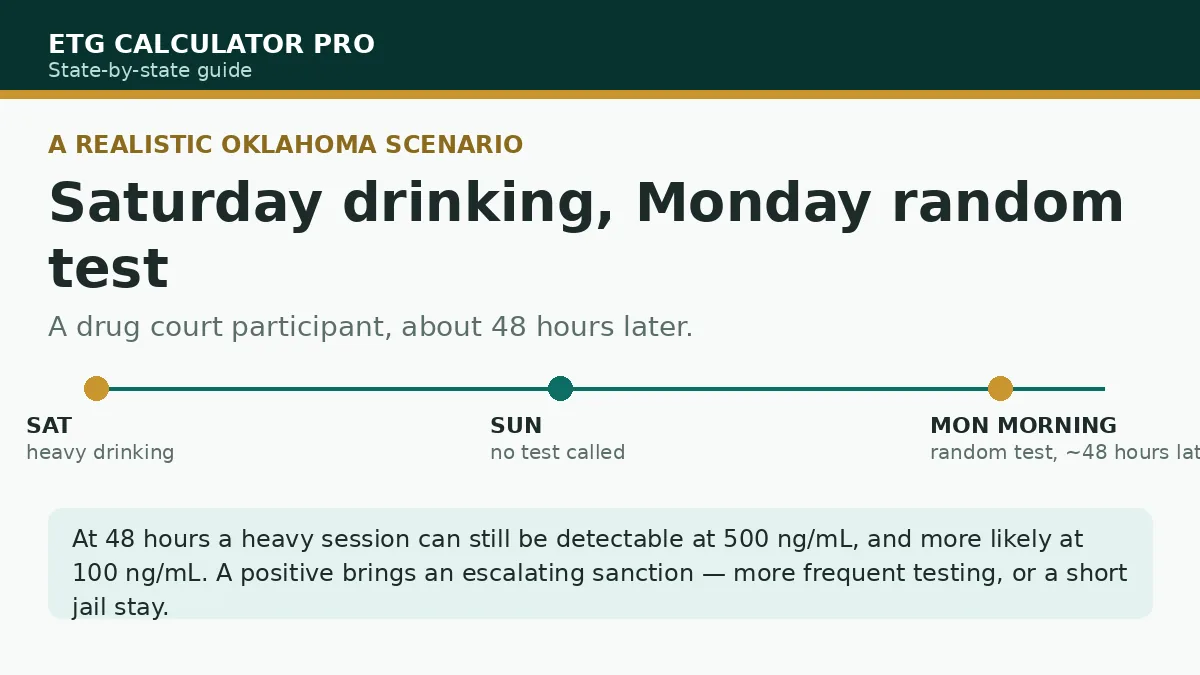
Consider a person in Tulsa County drug court who drinks heavily at a Saturday cookout. Sunday brings no test. On Monday morning the program calls a random test — about 48 hours after the last drink.
Forty-eight hours sits inside the published range for heavy drinking: at 500 ng/mL a heavy session can still be detectable, while a lighter one would likely have cleared. A positive would bring an escalating sanction — more frequent testing, or a short jail stay of up to five days — and a failed test in the program can delay graduation, which requires sustained clean tests.
A note on legal advice
This page is educational, not legal advice, and program rules change — including the 2026 felony-sentencing changes, which were still rolling out when this page was written. If you are subject to testing, your program's requirements — and an attorney if a violation is alleged — are what matter.
Frequently asked questions
Is there one Oklahoma EtG cutoff?
No. No Oklahoma statute, court rule, Department of Corrections standard, or ODMHSAS document we checked publishes a statewide EtG cutoff. Each court, drug court, probation officer, treatment program, and lab sets its own, mostly unpublished. Nationally the common levels are 100 and 500 ng/mL (SAMHSA, 2012); neither is an Oklahoma rule. Your program's paperwork names the only number that counts. And do not confuse the numbers that do appear in Oklahoma law — 0.08%, 0.04%, and zero tolerance for drivers under 21 — with EtG cutoffs: those are blood-alcohol thresholds for DUI charges, not urine concentrations.
What is IDAP and how does it work?
The Impaired Driver Accountability Program (47 O.S. § 6-212.5) is Oklahoma's route back to driving after a DUI-related license revocation. Since November 1, 2022 it has been run by the Board of Tests for Alcohol and Drug Influence. A driver has 30 days from the revocation notice to apply and must enroll within 45 days. The core requirement is an approved ignition interlock device in every vehicle the person drives: at least 180 active interlock days for a first offense, 365 for a second, and 730 for a third or subsequent offense, with the final 90 active days violation-free. The program charges a $150 administrative fee, and participants must maintain SR-22 insurance. On successful completion, Service Oklahoma reinstates driving privileges and the driving record is updated to show IDAP completion without a revocation.
What is an ADSAC assessment?
An ADSAC (Alcohol and Drug Substance Abuse Course) assessment is a state-required evaluation by an assessor certified by the Oklahoma Department of Mental Health and Substance Abuse Services, after an alcohol- or drug-related license revocation (47 O.S. § 6-212.2). It is an evaluation, not a class: a certified assessor interviews the person about their substance-use history and the offense, then writes recommendations that become a condition of license reinstatement. Recommendations range from a 10-hour ADSAC course and a Victim Impact Panel up to outpatient or residential treatment and aftercare. The assessment fee is set by law at $160 for offenses after November 1, 2008. A DUI conviction also requires an assessment before sentencing, and the judge must include the assessor's recommendations in the sentence.
Can you get a DUI in Oklahoma without driving?
Yes. Oklahoma prohibits driving, operating, or being in actual physical control of a motor vehicle while under the influence (47 O.S. § 11-902). Actual physical control needs no movement: sitting in the driver's seat with the key in the ignition has been enough for a conviction (Hughes v. State). The same statute also covers a blood alcohol concentration of 0.08% or more, any amount of a Schedule I controlled substance in the system, and driving while incapable of driving safely because of drugs or alcohol.
How do Oklahoma drug courts test participants?
Oklahoma drug courts test randomly, frequently, and without warning, with urine the most common method and testing heaviest in the early phases. Adult drug courts have expanded to 73 of Oklahoma's 77 counties under the Drug Court Act (22 O.S. §§ 471.1–471.6), and the active treatment portion must last at least six months and no more than 24 months. Oklahoma County's DUI Court is a five-phase, post-plea, pre-sentence program with a minimum of 18 months: 12 months of active phases and six months of aftercare. Tulsa County's drug court typically runs about 18 months to three years. A positive test brings escalating sanctions, such as more frequent testing or a short jail stay of up to five days.
Does Oklahoma probation use EtG testing?
Yes. Probation in Oklahoma is supervised by the Department of Corrections, and testing is built into supervision from the start. Under 57 O.S. § 515a, a person on felony probation must complete an approved substance abuse assessment within 90 days of intake when the court deems it appropriate, administered and scored by ODMHSAS-certified personnel, and the supervising agency may impose random substance abuse testing at any time. The DOC's electronic monitoring program for DUI offenders requires no alcohol, avoiding products containing alcohol, and submitting to urinalysis, breathalyzer, or other drug detection; an interlock may also be required at the person's expense, with program fees of up to $300 a month. In the federal courts in Oklahoma, the standard drug and alcohol treatment condition caps testing at eight tests a month.
Can an Oklahoma family court order EtG testing?
Yes, at the judge's discretion. Under 43 O.S. § 110.2, in any action where custody or visitation is at issue, the court may order the mother, the child, or the father to submit to blood, saliva, urine, or any other test the court deems necessary to decide the child's best interests. Custody itself is decided under the best-interests standard in 43 O.S. § 112, and § 112.5 creates a rebuttable presumption against custody for a parent who is alcohol- or drug-dependent and can be expected to inflict serious bodily harm in the near future. Refusing a court-ordered test can be treated as a positive result. No Oklahoma custody statute names EtG specifically; the test is one way a court checks the abstinence it has ordered.
Evidence and limitations
This guide summarizes primary research, public-health guidance, and Oklahoma public records. Group-level findings cannot predict one person's result.
- Oklahoma DUI Convictions, Jail Time, and Fines (Nolo, updated 2026-10-30) — actual physical control doctrine (Hughes v. State), first/second/third felony DUI ranges including the 2026 Class C2 reclassification (second DUI up to 7 years), aggregated felony DUI from November 1, 2026, aggravated 0.15% as a class B3 felony, underage DUI penalties, IDAP 90-day violation-free rule, assessment-before-sentencing requirement
- Okla. Stat. tit. 47, § 6-212.5 (2025) — Impaired Driver Accountability Program: transferred to the Board of Tests for Alcohol and Drug Influence for arrests on or after November 1, 2022; $150 administrative fee; ignition interlock required; 90-day violation-free period at the end of the program; completion certificate leads to Service Oklahoma reinstatement and a driving record updated to show IDAP completion without revocation
- Okla. Stat. tit. 47, § 6-212.2 (2024) — Required completion of alcohol and drug assessment and evaluation by ODMHSAS-certified personnel; 10-hour or 24-hour ADSAC course; a condition of license reinstatement
- Okla. Stat. tit. 57, § 515a (2022) — Felony probation supervision minimum standards: substance abuse assessment within 90 days of intake when the court deems it appropriate, administered and scored by ODMHSAS-certified personnel; random substance abuse testing; sanctions including increased testing
- Okla. Stat. tit. 43, § 110.2 — Blood, saliva, urine or any other tests, child custody or visitation: in any action where custody or visitation is at issue, the court may order the mother, the child, or the father to submit to blood, saliva, urine, or any other test the court deems necessary
- Okla. Stat. tit. 43, § 112 (2020) — Care and custody of children: custody guided by Section 112.5 and the best interests of the child
- Oklahoma Department of Corrections, OP-061002 — Rules and Conditions for the Electronic Monitoring Program for DUI Offenders: no alcohol, avoid products containing alcohol and places where alcohol is the major item, submit to urinalysis, breathalyzer, or other forms of drug detection; interlock may be required at the person's expense; program support fees up to $300 per month
- Oklahoma Department of Mental Health and Substance Abuse Services — Alcohol and Drug Substance Abuse Courses (ADSAC): assessment and intervention from a 10-hour DUI school and Victim Impact Panel up to residential treatment; ODMHSAS works with Service Oklahoma under 47 O.S. § 6-212.2; rules at Title 450 Chapter 21, effective September 15, 2023
- Drug/Alcohol Treatment Condition, U.S. District Court for the Northern District of Oklahoma — the defendant shall participate in a program of testing and treatment, including urinalysis or other types of drug testing consisting of no more than eight tests per month
- DUI & Traffic Laws in Oklahoma (2026) — per se vs impairment paths under 47 O.S. § 11-902, first/second/third penalties, implied-consent refusal lengths, ignition interlock under 47 O.S. § 754.1
- DUI Arrest in Oklahoma: What Happens Next (2026) — 30-day IDAP window from the revocation order, IDAP run by the Board of Tests, second DUI within 10 years a Class C2 felony with up to 7 years since January 1, 2026
- Oklahoma DUI Laws: Penalties and Felony Charges — 0.08% limit (0.04% commercial), 180-day / 1-year / 3-year suspensions, aggravated DUI at 0.15%, first refusal a six-month suspension
- Oklahoma DUI Laws: No More DPS Hearing — IDAP program lengths: no less than 180 active interlock days for a first offense, 365 for a second, 730 for a third or subsequent offense, with the final 90 active days violation-free; DPS implied-consent hearing eliminated in 2019
- IDAP in Oklahoma: How the Impaired Driver Accountability Program Works — enrollment within 30 days of the revocation notice, state-approved interlock provider, SR-22 insurance, completion certificate and final-90-days violation-free requirement for reinstatement
- Oklahoma Drug Court Requirements — eligibility under 22 O.S. § 471.2, random testing multiple times per week in early phases, urine the most common method, treatment standards set by ODMHSAS
- DUI Court in Oklahoma — Oklahoma County DUI Court started in 2001, five-phase model, minimum 18 months (12 months active phases plus 6 months aftercare), active treatment 6–24 months under 22 O.S. § 471.6, adult drug courts in 73 of Oklahoma's 77 counties (ODMHSAS)
- Understanding Oklahoma Drug Court — treatment levels one through four plus aftercare, usually six months to two years, aftercare an additional six to 18 months, random drug and alcohol testing throughout
- Drug Court in Oklahoma — Drug Court Act effective 1997, Tulsa County program typically 18 months to three years, positive test brings escalating sanctions including a short jail stay of up to five days
- Oklahoma Probation and Parole: Rules, Conditions & Rights — random substance abuse testing standard on supervision, urinalysis/breathalyzer/SCRAM, $40 monthly supervision fee (22 O.S. § 991d)
- Can Legally Using Marijuana Affect Child Custody? — judges may order drug testing on parents in custody cases and refusal may be deemed positive; rebuttable presumption against custody for an alcohol- or drug-dependent person expected to cause serious harm (43 O.S. § 112.5)
- ADSAC Assessment in Oklahoma — assessment fee $160 for offenses after November 1, 2008; the assessment is an evaluation, not a class; recommendations range from a 10-hour course and Victim Impact Panel to treatment or aftercare
- Determining Ethyl Glucuronide Cutoffs (PMC) — SAMHSA Advisory 2012 conservative 500 ng/mL recommendation; lab cutoffs 100–1,000 ng/mL; interpretation bands