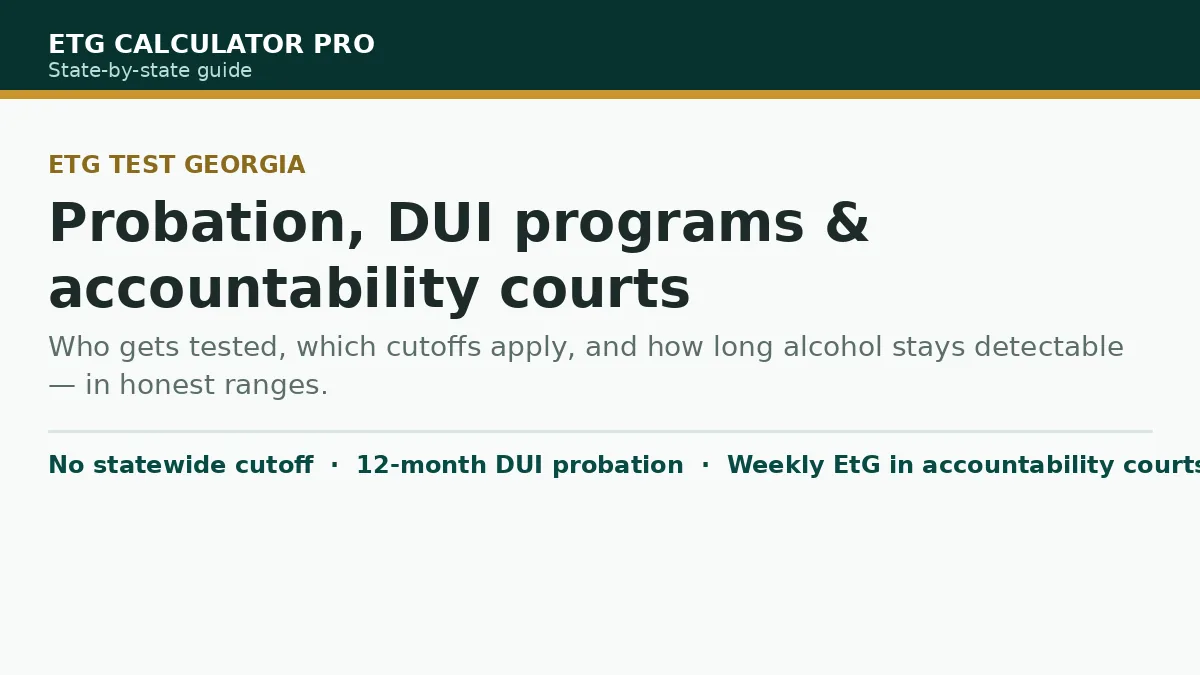
How EtG testing works in Georgia
Ethyl glucuronide (EtG) is a direct metabolite of alcohol found in urine after drinking. Georgia courts, supervision officers, and monitoring programs use it because it answers one question: has this person consumed alcohol since the last check-in? Breath tests catch only very recent use, and standard urine drug panels do not detect alcohol, so when abstinence is ordered, EtG fills the gap.
Testing in Georgia is court- and program-driven, not statewide. Felony supervision is a state function: the Department of Community Supervision (DCS) supervises felony probationers, while misdemeanor probation is generally handled at the county or municipal level. Conditions therefore vary by offense, county, court, and program.
One caveat: most Georgia sources describe testing generically, as drug testing, urinalysis, or drug and alcohol screening, not EtG by name. The exception is the Council of Accountability Court Judges' drug-testing guidance, which names EtG and EtS directly. Elsewhere, EtG applies where the program or lab specifies it.
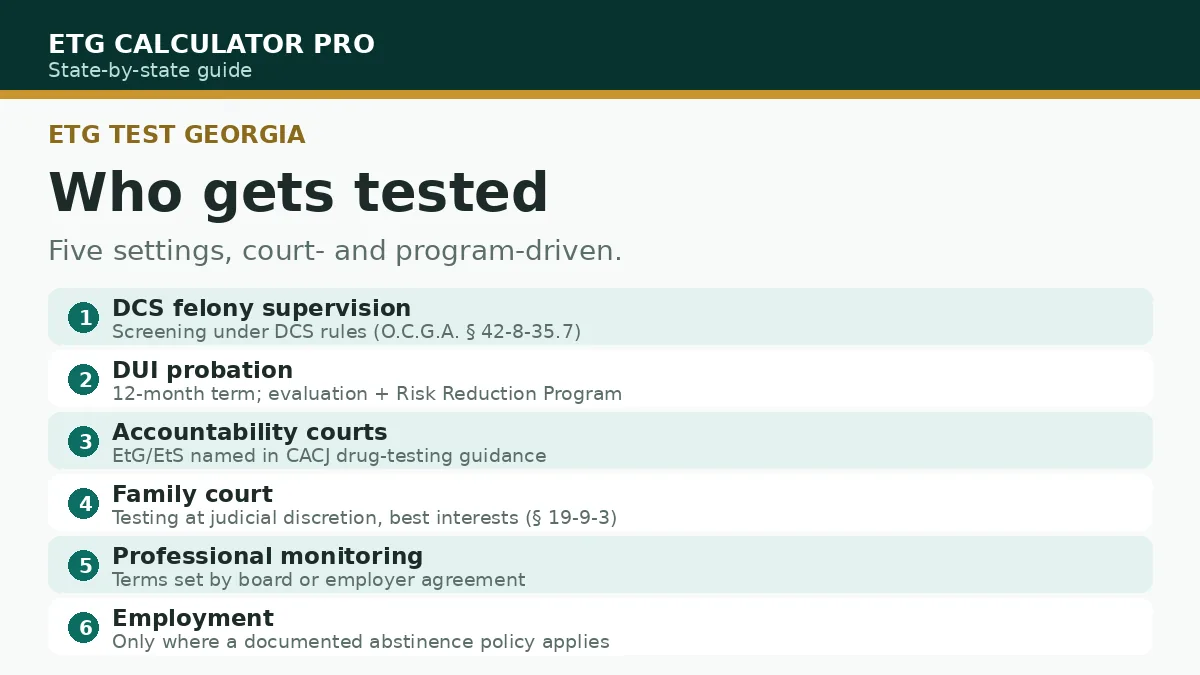
Who gets tested in Georgia and why
DCS felony supervision (Georgia probation)
Felony supervision is where most Georgia alcohol and drug testing happens. Under O.C.G.A. § 42-8-35, the court sets the terms of probation and may require the probationer to submit to evaluations and testing relating to rehabilitation, complete substance-abuse treatment as indicated by a risk and needs assessment, agree to graduated sanctions, and pay for the cost of drug screening. Special conditions a court may impose include alcohol and drug treatment. Under O.C.G.A. § 42-8-35.7, drug and alcohol screenings are administered under DCS rules unless the court or the State Board of Pardons and Paroles orders more frequent screening. A failed test does not automatically mean revocation: § 42-8-23 lets DCS use graduated sanctions for certain violations instead of immediately seeking revocation, and a violation hearing remains the forum where the result is tested.
DUI probation and the Risk Reduction Program
Georgia DUI law is O.C.G.A. § 40-6-391, and chemical testing for DUI cases is governed by § 40-6-392, which requires analysis by methods approved by the Georgia Bureau of Investigation's Division of Forensic Sciences. A first DUI conviction under § 40-6-391(c)(1) carries a 12-month probationary sentence, a minimum of 24 hours of actual incarceration, at least 40 hours of community service, a clinical drug and alcohol evaluation with any recommended treatment, and completion of the DUI Alcohol or Drug Use Risk Reduction Program, commonly called DUI school. Separately, the Department of Driver Services suspends the license for 12 months on a first conviction, with a limited driving permit commonly available after 120 days and full reinstatement after the Risk Reduction Program and the restoration fee. An ignition interlock device, where ordered, is a breath device, not a urine EtG test.
Accountability courts (drug courts and DUI courts)
Georgia's drug courts, DUI courts, mental health courts, and veterans courts sit inside the accountability court system, certified by the Council of Accountability Court Judges of Georgia (CACJ). The CACJ standards require each DUI and drug court to combine judicial supervision, treatment, and drug testing, with drug testing addressed in a written policies and procedures manual. The Council's drug-testing guidance is the most specific Georgia testing source we found: it names EtG and EtS as alcohol-use tests, notes urine as the typical matrix with weekly collection and testing, observes that twice-weekly urine testing covers a lot of ground, and warns that skipping weekend collection can make EtG the optimal choice because its window is longer than alcohol itself. Frequency, panel, and consequences are set by each court's own manual, not by a statewide rule.
Family court
In custody and visitation cases, testing follows the child's best interests. Under O.C.G.A. § 19-9-3, the judge may consider any evidence of substance abuse by either parent among the best-interests factors, and Georgia family courts may order one or both parents to submit to drug and alcohol testing, or order supervised visitation, where substance use is credibly at issue. Testing is not automatic: a judge will not normally order it unless there is a reason to believe a parent is abusing drugs or alcohol. A positive result alone does not decide custody; it is one factor the judge weighs, and a parent may agree testing terms into a parenting plan, such as testing before visits.
Professional monitoring and employment
Georgia licensing boards and employers run their own monitoring tracks, with terms set by the board or the employer agreement rather than by a statewide EtG rule. In employment, EtG testing appears only where a documented abstinence policy applies: safety-sensitive roles, return-to-work or last-chance agreements, or employer-specific programs. No general Georgia employment EtG requirement was found.
Cutoffs used in Georgia programs
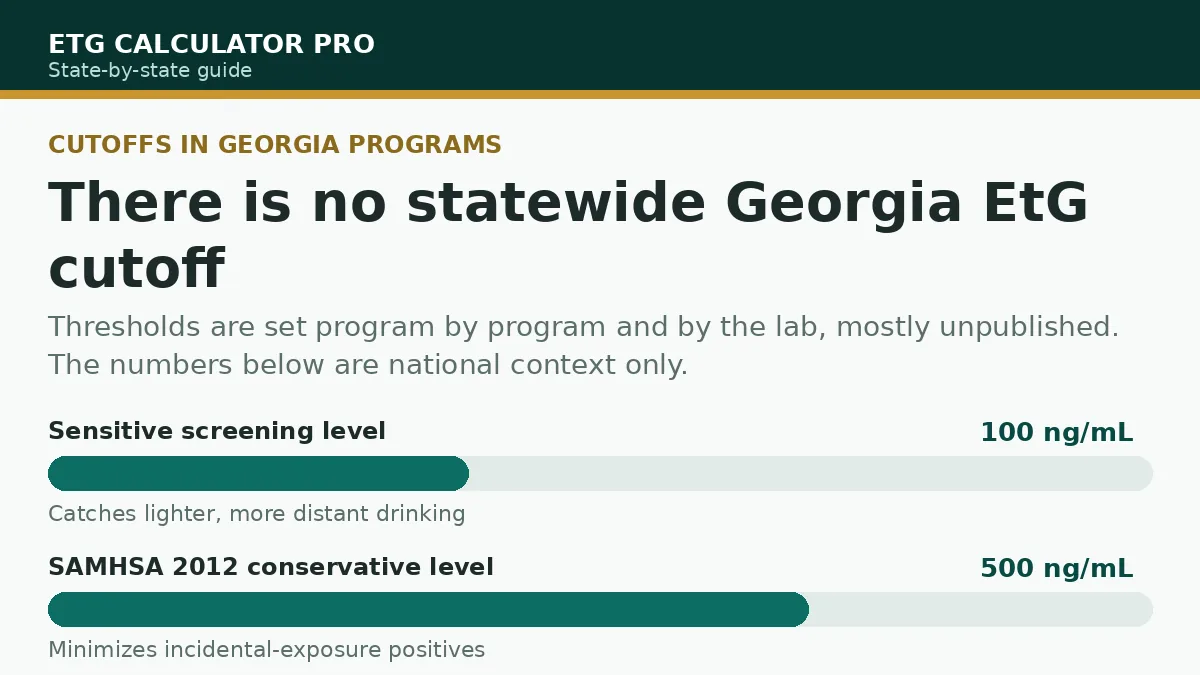
Here is the most important point on this page: there is no statewide Georgia EtG cutoff. We checked Georgia statutes, DCS supervision materials, CACJ accountability court standards and drug-testing guidance, DUI program rules, and family-court law; none names an EtG threshold. Thresholds are set program by program and by the lab, mostly unpublished. Your paperwork names the only cutoff that counts.
For national context:
- 100 ng/mL — the sensitive level many labs use; catches lighter, more distant drinking, but risks incidental-exposure flags.
- 500 ng/mL — SAMHSA's 2012 conservative recommendation, minimizing incidental-exposure positives.
- Labs screen anywhere from 100 to 1,000 ng/mL, depending on the program's goals.
Do not assume a Georgia program uses either number unless its paperwork says so; if it names none, ask in writing and keep the answer.
Detection windows in Georgia programs
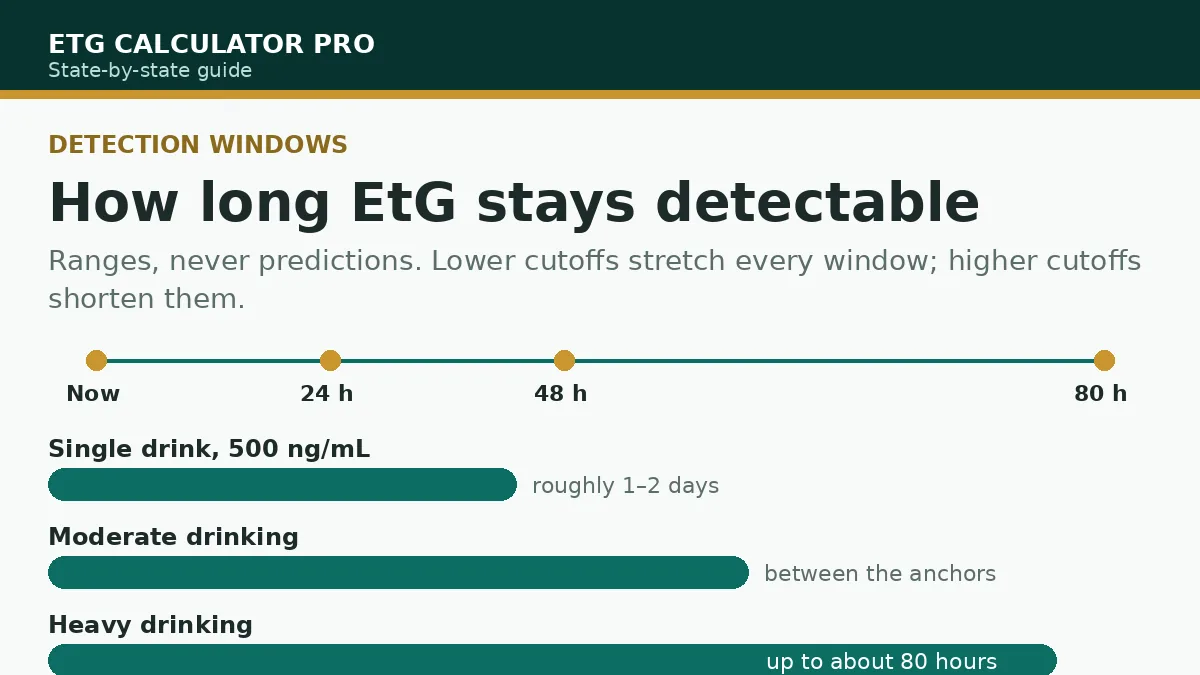
Detection windows are ranges, never predictions, depending on amount, timing, cutoff, hydration, and metabolism:
- Heavy drinking: up to about 80 hours after the last drink.
- A single drink: roughly 1–2 days at a 500 ng/mL cutoff; lower cutoffs extend the window.
- Moderate drinking: between those anchors.
The biggest lever is the cutoff: at 100 ng/mL, the same episode stays detectable longer than at 500 ng/mL.
Apply these ranges with our homepage calculator, the 100 ng/mL calculator, or our detection timeline tool.
A realistic Georgia scenario
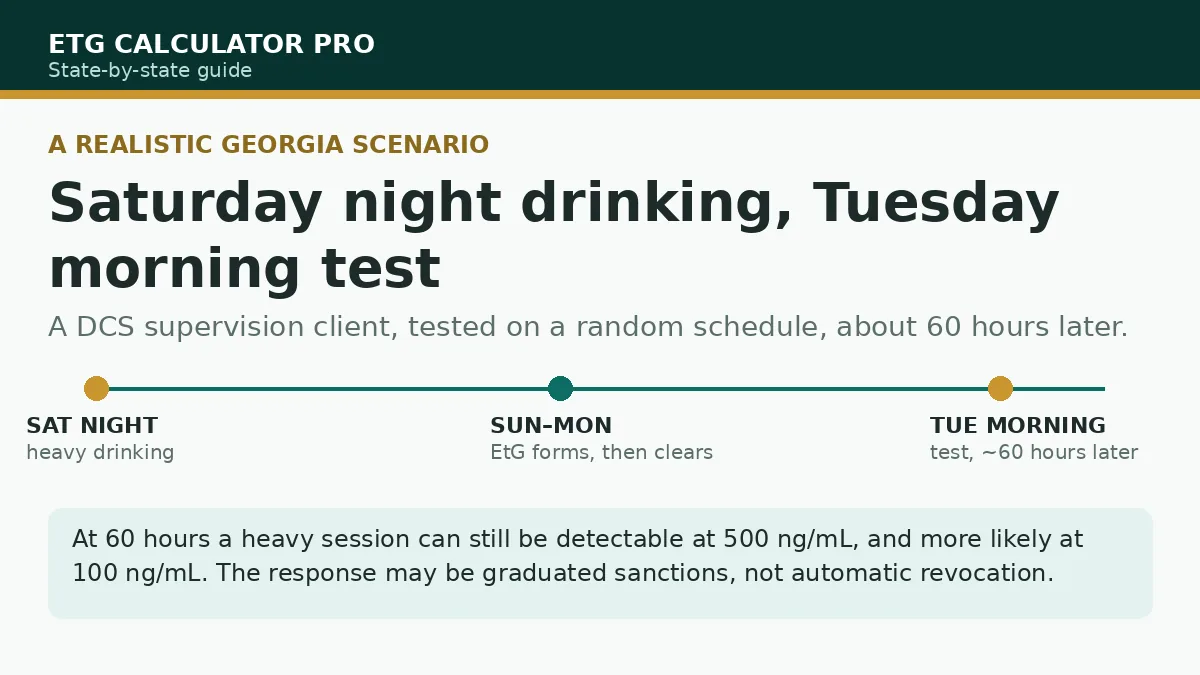
Consider a person on DCS felony supervision with an abstinence condition, tested on a random schedule: heavy drinking Saturday night, a test Tuesday morning, about 60 hours later.
Sixty hours sits inside the published range for heavy drinking, so the result could go either way. At 500 ng/mL, a heavy session can still be detectable at 60 hours, while a lighter one would likely have cleared; at 100 ng/mL, a positive would be more likely. A positive does not automatically end supervision: under the graduated-sanctions framework, the response may be another test, increased supervision, treatment, community service, or a violation hearing, depending on the terms, prior violations, and the judge's authority.
No pass-or-fail claim is possible from a timeline alone — cutoff, amount, and elapsed time shape the result.
A note on legal advice
This page is educational, describing how EtG testing works in Georgia DCS supervision, DUI programs, accountability courts, and family court, from published research, public-health guidance, and Georgia public records. It is not legal advice, and program rules change. If you are subject to testing, your program's requirements, and an attorney if a violation is alleged, are the authorities that matter.
Frequently asked questions
Is there one Georgia EtG cutoff?
No. No Georgia statute, court, probation department, DUI program, accountability court, or licensing board publishes a statewide EtG cutoff. Each court, program, and lab sets its own, mostly unpublished. Nationally the common levels are 100 and 500 ng/mL (SAMHSA, 2012); neither is a Georgia rule. Your program's paperwork names the only number that counts.
Does Georgia probation use EtG testing?
Georgia felony supervision runs through the Department of Community Supervision (DCS). Under O.C.G.A. § 42-8-35, a court may require a probationer to submit to evaluations and testing relating to rehabilitation, and under § 42-8-35.7 drug and alcohol screenings follow DCS rules unless the court or the State Board of Pardons and Paroles orders more frequent screening. Most sources describe testing generically, as drug testing or urinalysis. EtG applies where your program or lab specifies it.
What happens after a first DUI in Georgia?
Under O.C.G.A. § 40-6-391(c)(1), a first DUI conviction carries a 12-month probationary sentence, a minimum of 24 hours in jail, at least 40 hours of community service, a clinical drug and alcohol evaluation with any recommended treatment, and completion of a DUI Alcohol or Drug Use Risk Reduction Program. The Department of Driver Services separately suspends the license for 12 months, with a limited driving permit commonly available after 120 days. An ignition interlock device is a breath device, not a urine EtG test.
How do Georgia accountability courts test participants?
Georgia's accountability courts — including drug courts and DUI courts — are certified by the Council of Accountability Court Judges of Georgia, and their standards require drug testing as part of judicial supervision and treatment. The Council's own drug-testing guidance names ethyl glucuronide (EtG) and ethyl sulfate (EtS) as alcohol-use tests, notes urine as the typical matrix with weekly collection and testing, and notes that twice-weekly urine testing covers a lot of ground. Frequency and panel are set by each court's own policies and procedures manual.
Can a Georgia family court order EtG testing?
Yes, at the judge's discretion. Under O.C.G.A. § 19-9-3, a judge deciding custody in the child's best interests may consider any evidence of substance abuse by either parent, and Georgia family courts may order one or both parents to submit to drug and alcohol testing, or order supervised visitation, where substance use is credibly at issue. Testing is not automatic; it follows a finding or credible concern, and the order sets the terms.
How long after drinking can an EtG test detect alcohol in Georgia?
The biology does not change at the state line: up to about 80 hours after heavy drinking, roughly 1–2 days after a single drink at 500 ng/mL; lower cutoffs extend the window. These are research ranges, not predictions.
Evidence and limitations
This guide summarizes primary research, public-health guidance, and Georgia public records. Group-level findings cannot predict one person's result.
- O.C.G.A. § 42-8-35 — terms and conditions of probation: evaluations and testing, treatment, graduated sanctions, drug-screening costs
- O.C.G.A. § 42-8-35.7 — drug and alcohol screening of probationers under DCS rules unless more frequent screening is ordered
- Georgia Department of Community Supervision — Special Conditions of Supervision, including alcohol and drug treatment
- Council of Accountability Court Judges of Georgia — Drug Courts and Drug Testing Best Practices: EtG/EtS, urine matrix, weekly collection, twice-weekly urine testing
- Council of Accountability Court Judges of Georgia — Standards for Georgia Accountability Courts: DUI/drug courts combine supervision, treatment, and drug testing
- O.C.G.A. § 40-6-392 — chemical tests for alcohol or drugs: GBI Division of Forensic Sciences approved methods
- O.C.G.A. § 40-5-67.1 — implied-consent chemical testing framework for DUI cases (first-offense terms corroborated against § 40-6-391(c)(1) explainers)
- First DUI offense penalties in Georgia — 12-month probationary sentence, 24-hour minimum, 40 hours community service, evaluation, Risk Reduction Program (secondary explainer of § 40-6-391(c)(1))
- O.C.G.A. § 19-9-3 — child custody: best interests, including any evidence of substance abuse by either parent
- Substance abuse testing in Georgia custody cases — court-ordered testing and supervised visitation at judicial discretion (secondary explainer)
- Determining Ethyl Glucuronide Cutoffs (PMC) — SAMHSA Advisory 2012 conservative 500 ng/mL recommendation; lab cutoffs 100–1,000 ng/mL