How EtG testing works in Ohio
Ethyl glucuronide (EtG) is a direct metabolite of alcohol found in urine after drinking. Ohio courts, probation officers, and monitoring programs use it because it answers one question: has this person consumed alcohol since the last check-in? Breath tests catch only very recent use, and standard urine panels do not detect alcohol, so when abstinence is ordered, EtG fills the gap.
Testing in Ohio is court- and program-driven, not statewide. Probation runs through county departments and the Adult Parole Authority, and the sentence itself is called community control, so conditions vary by offense, county, and program.
One caveat: most Ohio sources describe testing generically, as drug testing or urinalysis, not EtG by name. EtG applies where the program or lab specifies it.
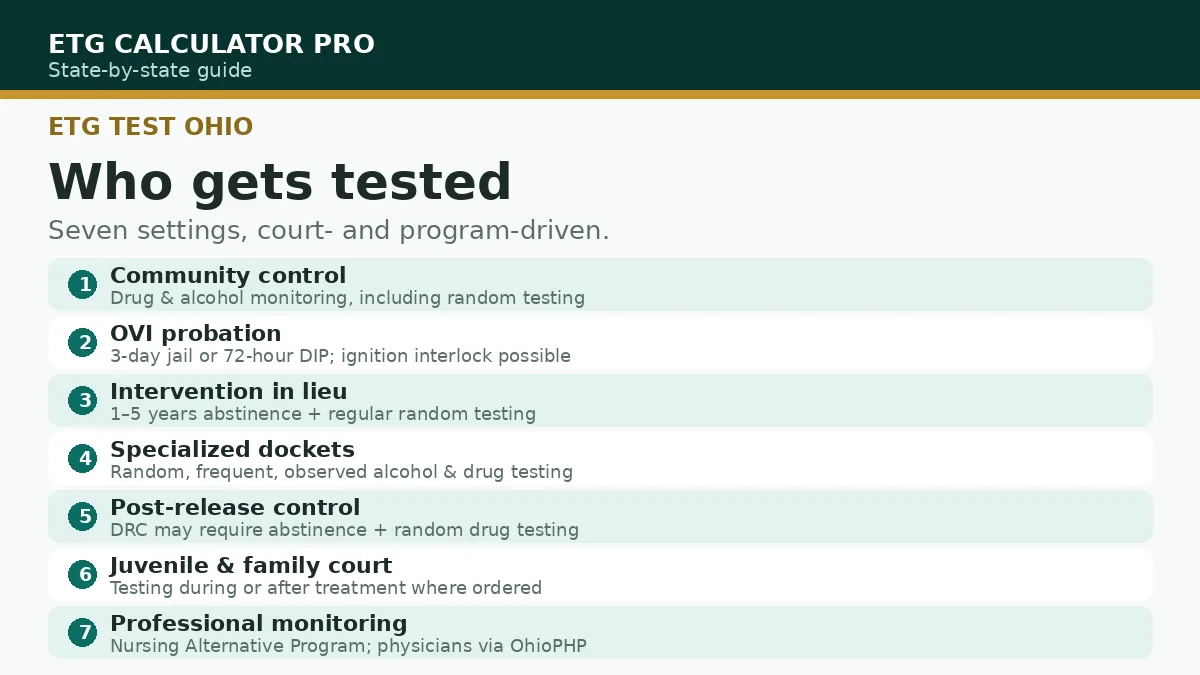
Who gets tested in Ohio and why
Community control (Ohio probation)
Community control is where most Ohio alcohol and drug testing happens. For felony offenses, section 2929.17 lists nonresidential sanctions including drug and alcohol monitoring with random drug testing, and house arrest with electronic or continuous alcohol monitoring. Section 2929.15 caps all community control sanctions at five years and lets the court require abstinence plus random drug testing. Section 2951.05 governs how testing runs: the supervising department arranges random testing, the lab reports results to it, and an offender who tests positive may be charged the fee.
OVI probation and driver intervention programs
Ohio calls the offense OVI, operating a vehicle under the influence, under section 4511.19. A first offense carries a mandatory three days in jail, which the court may instead satisfy with a certified 72-hour driver intervention program (DIP), a residential education program certified by the Ohio Department of Mental Health and Addiction Services. A high test, 0.17% or above, doubles the minimum to six days. A 72-hour DIP delivers at least 21 hours of programming: screening, alcohol and drug education including traffic safety, and small group discussion. Alongside jail or DIP, the court may impose up to five years of community control, require treatment or education, and require, as a condition, an ignition interlock device. An interlock is a breath device, not a urine EtG test; restricted license plates are a separate driving sanction.
Intervention in lieu of conviction
Ohio's distinctive diversion route is intervention in lieu of conviction, under section 2951.041. An eligible offender whose drug or alcohol use contributed to the offense may ask the court to pause the case and enter an intervention plan instead. The plan must require abstinence from illegal drugs and alcohol for one to five years, treatment and recovery support, and regular random testing, supervised by the county probation department or the Adult Parole Authority. Successful completion means dismissal, without adjudication of guilt, and the record may be sealed. Failure to comply brings a hearing on whether the offender failed a term of the plan.
Specialized dockets (drug courts and OVI courts)
Ohio's drug and OVI courts run as specialized dockets certified by the Ohio Supreme Court under Rules of Superintendence 7.20–7.32, with more than 250 statewide. Their testing standard is the strictest in the state: Standard 9 requires random, frequent, and observed alcohol and drug testing for every participant, under written collection and reporting policies and individualized testing plans. Testing must be random—the same odds of being tested on any day—frequent enough to detect use quickly, and directly observed by trained staff to prevent tampering. A positive, missed, adulterated, substituted, or diluted sample counts as a positive; the docket must be notified immediately, and a sanction or therapeutic adjustment must be immediately enforced by the docket judge.
Post-release control
After prison, the Department of Rehabilitation and Correction may impose post-release control. Under section 2967.131, it may require abstinence from drugs of abuse and random drug testing by a contracted or reputable public laboratory, with results reported to the Adult Parole Authority.
Family and juvenile court
In juvenile court, testing follows the child's case. Under section 2151.3514, when a court grants temporary custody or protective supervision for a child adjudicated abused, neglected, or dependent, and a parent's or caregiver's addiction was the basis, the court must order assessment and, if needed, treatment from a community addiction services provider, and may order alcohol or drug testing during, after, or both. Section 340.15 requires the public children services agency to refer the parent to a provider, which must carry out any testing the order requires. In domestic relations custody cases, courts may order testing when determining parental rights and responsibilities, with specifics set by the order.
Professional monitoring
Ohio's health licensing boards run their own monitoring tracks. The Ohio Board of Nursing's Alternative Program for Substance Use Disorder lets eligible nurses enter a confidential agreement: complete abstinence, random drug testing by the board-designated company, treatment-plan compliance, and ongoing reporting to a monitoring agent, generally for five years. For physicians, the State Medical Board of Ohio operates a confidential monitoring route—the One-Bite Program, expanded by House Bill 33 into a Confidential Monitoring Program effective October 3, 2023—coordinated by the Ohio Professionals Health Program, with evaluation and treatment set clinically, not by rigid minimums. Panel and frequency in both programs are set by the board and the individual agreement, not by a statewide EtG rule.
Employment
In employment, EtG testing appears only where a documented abstinence policy applies: safety-sensitive roles, last-chance agreements, or employer-specific programs. No general Ohio employment EtG requirement was found.
Cutoffs used in Ohio programs
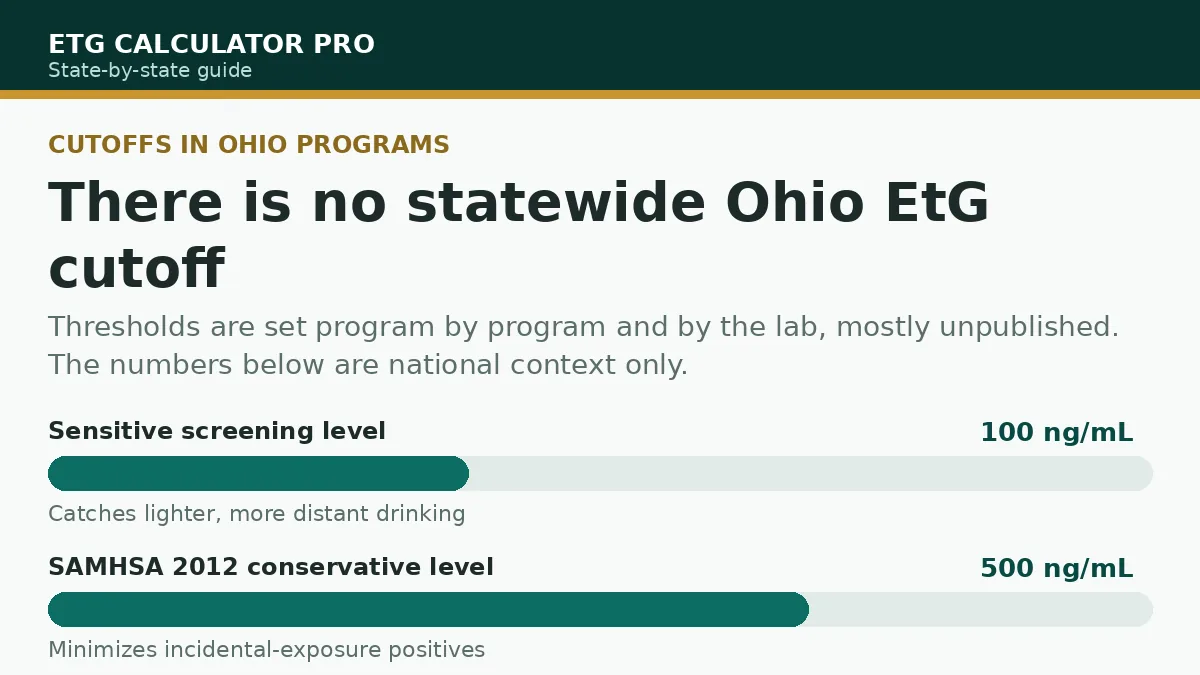
Here is the most important point on this page: there is no statewide Ohio EtG cutoff. We checked Ohio statutes, Supreme Court docket standards, corrections and post-release control law, OVI program rules, and licensing board materials; none names an EtG threshold. Thresholds are set program by program and by the lab, mostly unpublished. Your paperwork names the only cutoff that counts.
For national context:
- 100 ng/mL—the sensitive level many labs use; catches lighter, more distant drinking, but risks incidental-exposure flags.
- 500 ng/mL—SAMHSA's 2012 conservative recommendation, minimizing incidental-exposure positives.
- Labs screen anywhere from 100 to 1,000 ng/mL, depending on the program's goals.
Do not assume an Ohio program uses either number unless its paperwork says so; if it names none, ask in writing and keep the answer.
Detection windows in Ohio programs
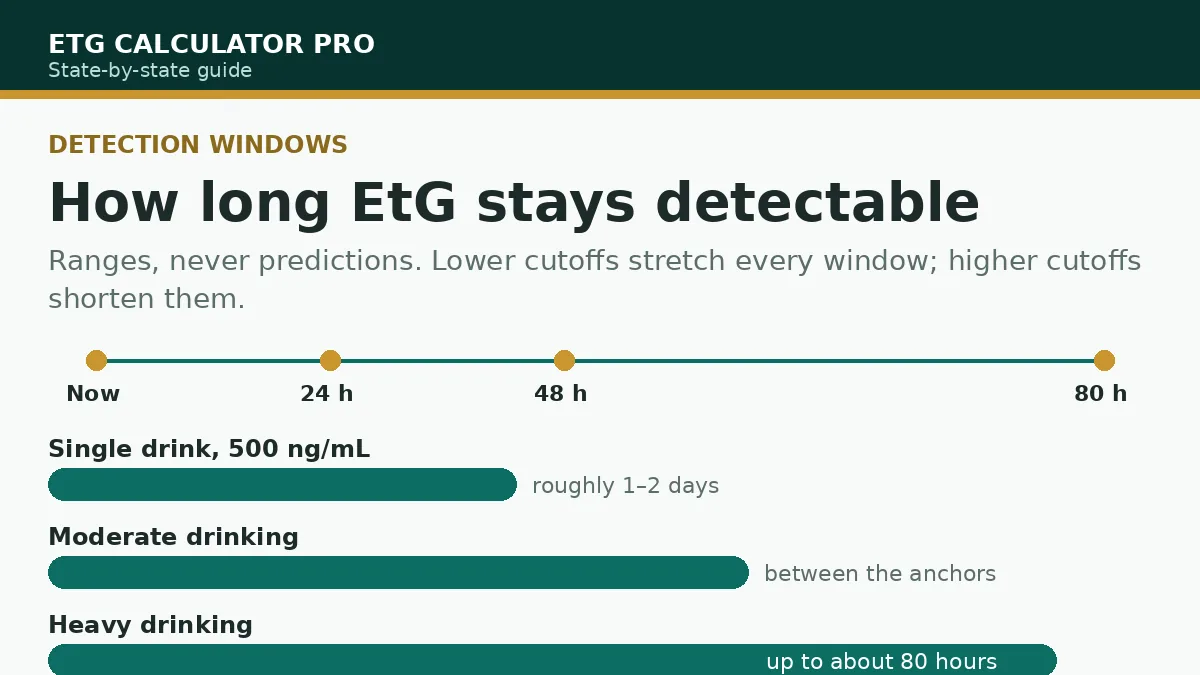
Detection windows are ranges, never predictions, depending on amount, timing, cutoff, hydration, and metabolism:
- Heavy drinking: up to about 80 hours after the last drink.
- A single drink: roughly 1–2 days at a 500 ng/mL cutoff; lower cutoffs extend the window.
- Moderate drinking: between those anchors.
The biggest lever is the cutoff: at 100 ng/mL, the same episode stays detectable longer than at 500 ng/mL.
Apply these ranges with our homepage calculator, the 100 ng/mL calculator, or our detection timeline tool.
A realistic Ohio scenario
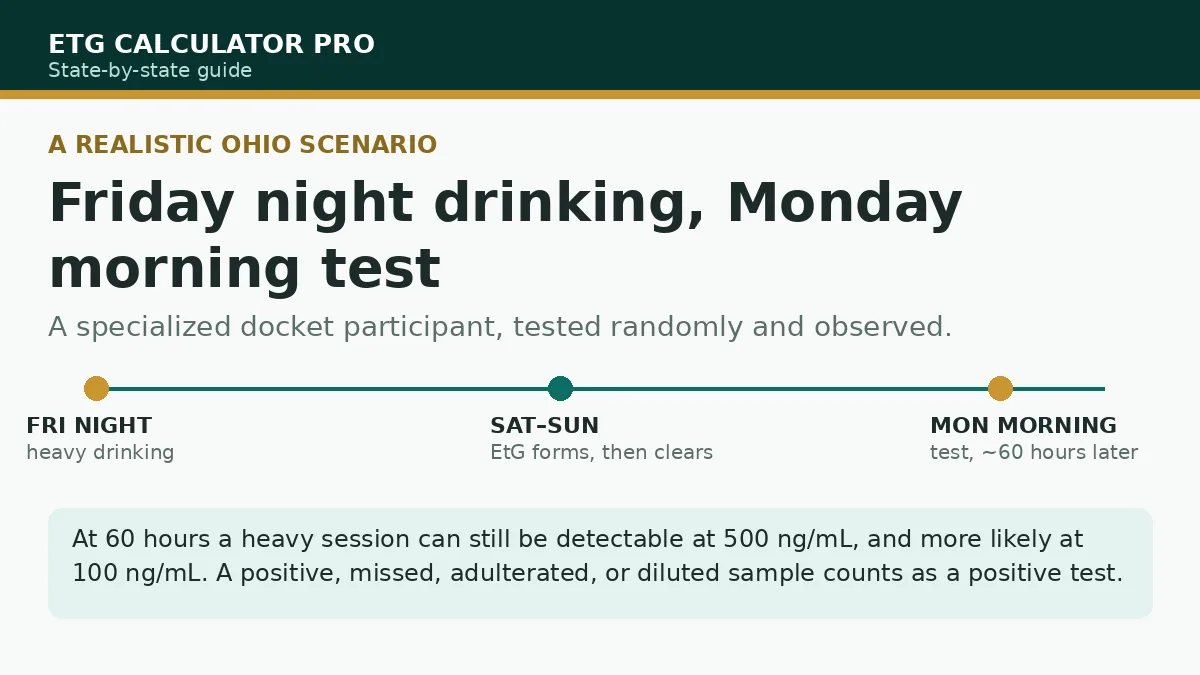
Consider a specialized docket participant, tested randomly, frequently, and observed: heavy drinking Friday night, a test Monday morning, about 60 hours later.
Sixty hours sits inside the published range for heavy drinking, so the result could go either way. At 500 ng/mL, a heavy session can still be detectable at 60 hours, while a lighter one would likely have cleared; at 100 ng/mL, a positive would be more likely. Under Standard 9, a positive, missed, adulterated, substituted, or diluted sample counts as a positive, with immediate notification and an immediate sanction or therapeutic adjustment.
No pass-or-fail claim is possible from a timeline alone—cutoff, amount, and elapsed time shape the result.
A note on legal advice
This page is educational, describing how EtG testing works in Ohio community control, OVI programs, intervention, specialized dockets, post-release control, and family and juvenile court, from published research, public-health guidance, and Ohio public records. It is not legal advice, and program rules change. If you are subject to testing, your program's requirements, and an attorney if a violation is alleged, are the authorities that matter.
Frequently asked questions
Is there one Ohio EtG cutoff?
No. No Ohio statute, court, probation department, OVI program, specialized docket, or licensing board publishes a statewide EtG cutoff. Each court, program, and lab sets its own, mostly unpublished. Nationally the common levels are 100 and 500 ng/mL (SAMHSA, 2012); neither is an Ohio rule. Your program's paperwork names the only number that counts.
Does Ohio probation use EtG testing?
Ohio calls its probation system community control. Under section 2929.17, a felony sanction can include drug and alcohol monitoring with random drug testing, and section 2951.05 requires probation departments to arrange random testing and report results. Most sources describe it generically, as drug testing or urinalysis. EtG applies where your program or lab specifies it.
What happens after a first OVI in Ohio?
A first OVI under section 4511.19 carries a mandatory three days in jail, which the court may instead satisfy with a certified 72-hour driver intervention program (DIP)—a residential program certified by the Ohio Department of Mental Health and Addiction Services. A high test, 0.17% or above, doubles the minimum to six days. The court may also impose community control, treatment, and, as a condition, an ignition interlock device—a breath device, not urine EtG testing.
What is intervention in lieu of conviction in Ohio?
Under section 2951.041, an eligible offender whose drug or alcohol use contributed to the offense may ask the court to pause the case and enter an intervention plan instead. The plan requires abstinence from illegal drugs and alcohol for one to five years, treatment and recovery support, and regular random testing. Successful completion means dismissal, without adjudication of guilt.
How do Ohio drug courts test participants?
Ohio's specialized dockets—drug courts, OVI courts, and others—operate under Ohio Supreme Court standards (Rules of Superintendence 7.20–7.32). Standard 9 requires random, frequent, and observed alcohol and drug testing, with written collection and reporting policies. A positive, missed, adulterated, or diluted sample counts as a positive, with immediate notification and an immediate sanction or therapeutic adjustment.
How long after drinking can an EtG test detect alcohol in Ohio?
The biology does not change at the state line: up to about 80 hours after heavy drinking, roughly 1–2 days after a single drink at 500 ng/mL; lower cutoffs extend the window. These are research ranges, not predictions.
Evidence and limitations
This guide summarizes primary research, public-health guidance, and Ohio public records. Group-level findings cannot predict one person's result.
- Ohio Revised Code § 2929.17 — nonresidential sanctions: drug and alcohol use monitoring, continuous alcohol monitoring
- Ohio Revised Code § 2929.15 — community control sanctions, five-year duration cap, random drug testing condition
- Ohio Revised Code § 2951.05 — random drug testing of offenders on probation, results to the supervising authority
- Ohio Revised Code § 2951.041 — intervention in lieu of conviction: 1–5 years abstinence, treatment, regular random testing
- Ohio Revised Code § 4511.19 — OVI: 3-day jail or 72-hour DIP, 6 days for a high test (0.17% or above)
- Ohio Administrative Code Rule 5122-29-12 — 72-hour residential driver intervention program standards (21 hours)
- Supreme Court of Ohio — Specialized Docket Standard 9, substance monitoring: random, frequent, observed testing
- Ohio Revised Code § 2967.131 — post-release control: abstinence and random drug testing conditions
- Ohio Revised Code § 2151.3514 — juvenile court: parent/caregiver assessment, treatment, and alcohol or drug testing
- Ohio Revised Code § 340.15 — children services referral and court-ordered testing during or after treatment
- State Medical Board of Ohio Confidential Monitoring Program (House Bill 33, effective October 3, 2023), coordinated by OhioPHP
- Determining Ethyl Glucuronide Cutoffs (PMC) — SAMHSA Advisory 2012 conservative 500 ng/mL recommendation; lab cutoffs 100–1,000 ng/mL