How EtG testing works in New Jersey
Ethyl glucuronide (EtG) is an alcohol metabolite found in urine after drinking. Courts and probation officers use it to answer one question: has this person consumed alcohol since the last check-in? Breath tests catch only very recent use, and standard drug panels do not detect alcohol, so EtG fills the gap.
Testing in New Jersey is court- and program-driven: probation is supervised by county probation officers under the Superior Court, DWI cases run through the municipal courts with the county IDRC, and recovery court cases run through a Superior Court judge and a team including the prosecutor and an evaluator.
An ignition interlock device is a different tool, not an EtG test, though a person can face both; screening is usually a rapid urine immunoassay, with lab confirmation when a result is contested.
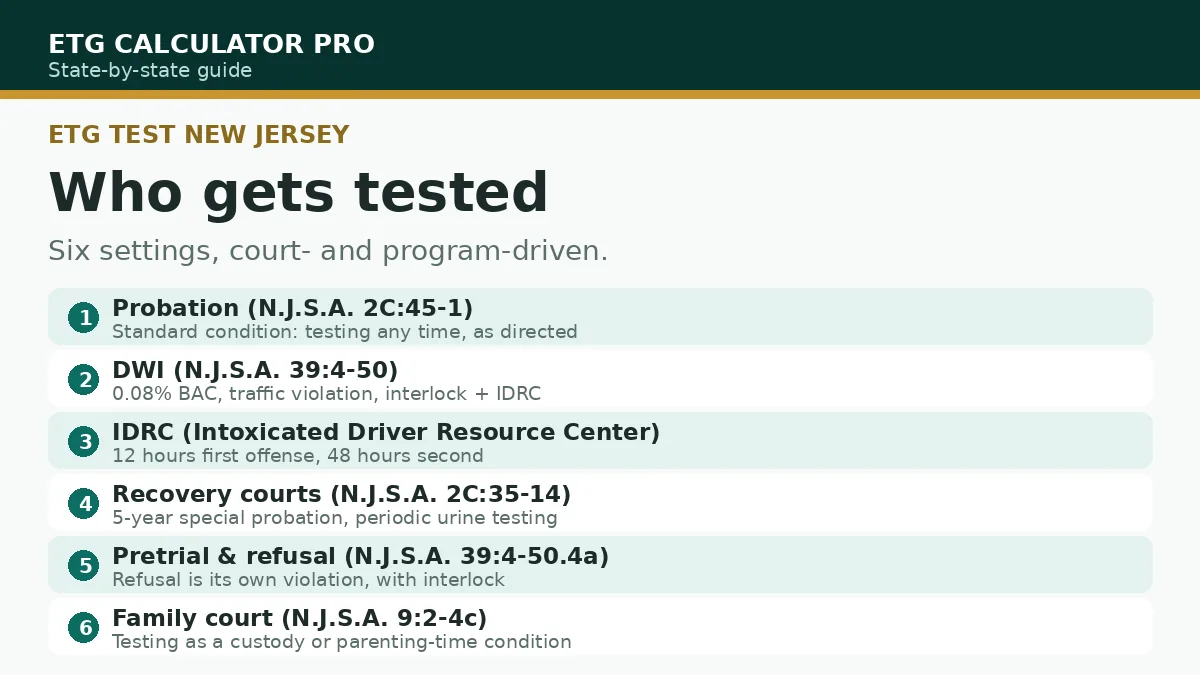
Who gets tested in New Jersey and why
Probation
When a New Jersey court suspends a sentence or places a person on probation, it attaches the reasonable conditions it deems necessary (N.J.S.A. 2C:45-1), including treatment and community service. Testing is a standard condition for every adult probationer under the Judiciary's Standard Conditions of Adult Probation — “You shall submit to drug or alcohol testing at any time, as directed by your probation officer.”
A failed test, or refusing one, is a probation violation: if the court finds a violation, it may impose any sentence authorized by law for the offense of conviction, up to the maximum term of incarceration — so a positive result can put the original sentence back on the table.
DWI
New Jersey prohibits driving while intoxicated under N.J.S.A. 39:4-50: operating a motor vehicle while under the influence of alcohol or drugs, or with a blood alcohol concentration of 0.08% or more. The limit is 0.01% for drivers under 21 (N.J.S.A. 39:4-50.14) and 0.04% for a driver operating a commercial motor vehicle (N.J.S.A. 39:3-10.13). A DWI is a quasi-criminal traffic violation under Title 39, not a criminal offense, but the penalties are still severe and rise with each offense and with the BAC reading.
For a first offense, the penalties split into tiers. With a BAC of 0.08% to under 0.10%, the fine is $250 to $400, the driver must complete 12 to 48 hours at the IDRC, and the license is forfeited until an ignition interlock is installed for three months; with a BAC of 0.10% or higher, the fine rises to $300 to $500 and the interlock to seven to twelve months. The Motor Vehicle Commission adds a $1,000-a-year insurance surcharge for three years. A second DWI brings a $500 to $1,000 fine, at least 48 consecutive hours in jail and up to 90 days, 30 days of community service, a one- to two-year forfeiture, the 48-hour IDRC program, and a two- to four-year interlock after restoration. A third brings a $1,000 fine, a mandatory 180 days in jail (up to 90 in inpatient rehabilitation), an eight-year forfeiture, and the same interlock term.
Refusing the breath test is a separate violation under N.J.S.A. 39:4-50.4a: a first refusal brings a $300 to $500 fine, a license forfeiture until an ignition interlock is installed, a nine- to fifteen-month interlock, and IDRC attendance. A second refusal brings a one- to two-year forfeiture, and a third an eight-year forfeiture. For drivers under 21, a BAC of 0.01% to under 0.08% brings a 30- to 90-day license forfeiture, 15 to 30 days of community service, and IDRC attendance; a commercial driver convicted of DWI also loses the commercial license for one year on a first offense.
The IDRC
The Intoxicated Driver Resource Center is the program almost every DWI defendant will meet: every person convicted of DWI must satisfy the IDP and IDRC requirements. A first offender is detained, educated, and evaluated for at least six hours each day on two consecutive days — a total of 12 hours — at the county IDRC. A second offender is generally scheduled for the 48-hour program: 48 consecutive hours of detention, classes, and screening at one of three regional facilities.
The IDRC screens each participant, refers those who need it to treatment or a self-help program, and reports non-compliance to the sentencing court and the Intoxicated Driving Program. Failing to appear, complete a prescribed program, or pay the fees on time extends the license suspension and can add two days in jail. The program fee varies by county — current guides list roughly $230 to $280 for the 12-hour program — and the MVC does not restore the license until the IDRC requirements are met.
Recovery courts
New Jersey's recovery courts — formerly called drug courts — are a specialized term of probation in the Superior Court for non-violent offenders whose crimes were driven by drug or alcohol dependence. Admission runs under N.J.S.A. 2C:35-14 (special probation, for people who would otherwise face prison) or N.J.S.A. 2C:45-1 (general probation). The court must find a diagnosed substance use disorder, an offense committed under the influence or to support the habit, no firearm, and no danger to the community.
Special probation runs for five years, and the statute requires periodic urine testing for drug or alcohol usage throughout that period. Participants attend treatment, undergo random tests, meet probation officers, and appear frequently before the judge; clinical treatment generally lasts one to two years. Failing a test or committing a new crime can bring sanctions, including jail, and a participant who does not complete the program is sentenced to the alternative prison term. On successful discharge, the court may expunge the person's New Jersey criminal records without a fee.
Family court
In custody and parenting-time cases, New Jersey courts decide on the best interests of the child under N.J.S.A. 9:2-4c, weighing the parents' ability to agree and cooperate, willingness to accept custody, any history of domestic violence, the safety of the child, the child's needs, and each home's stability. The Judiciary's custody-investigation standards direct that reports to the court include the results of any drug and alcohol screening reports ordered by the court.
Where a parent's substance use bears directly on the child's safety, the court may order testing — including EtG testing — as a condition of custody or parenting time, or condition parenting time on treatment and staying alcohol-free. A history of substance abuse is one factor among many, not an automatic loss of custody, and courts look at current circumstances and the parent's ability to provide a safe, stable environment now.
License restoration
Getting a license back runs through the Motor Vehicle Commission, and nothing is restored until every court and MVC suspension is satisfied and the IDRC requirements are met. The driver must also install the interlock where ordered — failure to install it can add a further one-year suspension — and pay the restoration and program fees. New Jersey offers no hardship or conditional licenses: the interlock is the only way to keep driving.
Cutoffs used in New Jersey programs
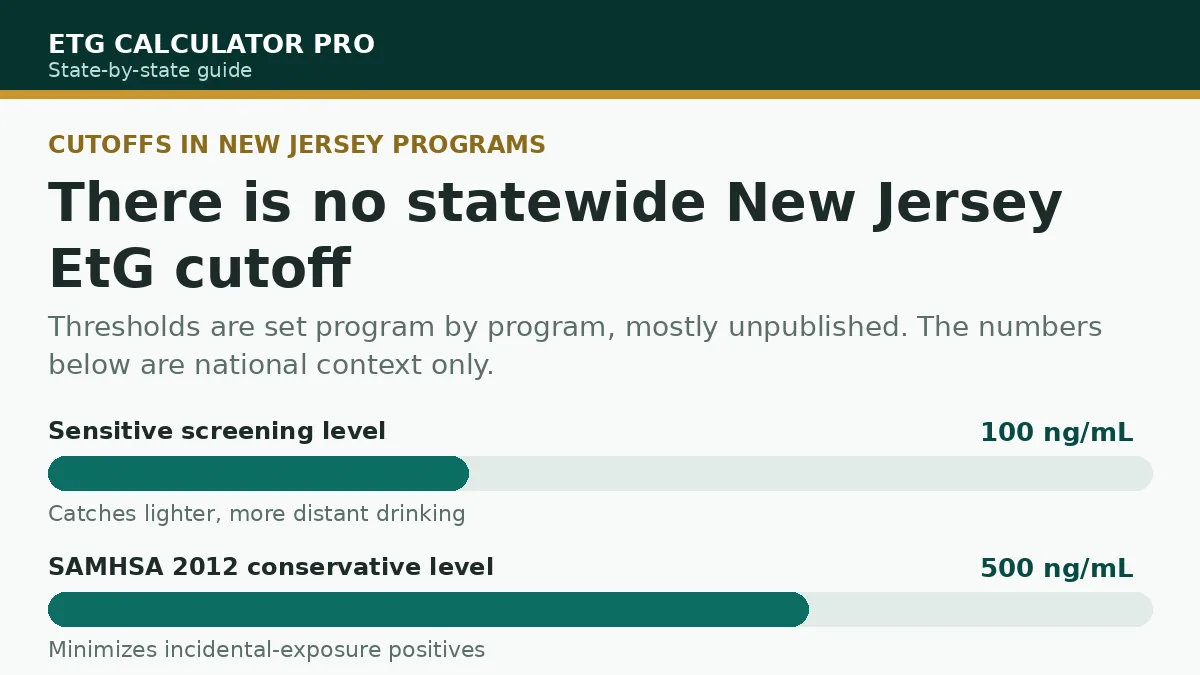
There is no statewide New Jersey EtG cutoff: no statute, Judiciary standard, or state program document we checked names a threshold. Thresholds are set program by program — your paperwork names the only cutoff that counts.
National context:
- 100 ng/mL — the sensitive level many labs use.
- 500 ng/mL — SAMHSA's 2012 conservative recommendation.
- Labs screen anywhere from 100 to 1,000 ng/mL.
Do not assume a New Jersey program uses either number unless its paperwork says so, and do not confuse the 0.08%, 0.10%, and 0.01% BAC figures in New Jersey law with EtG cutoffs. SAMHSA's bands add context: above 1,000 ng/mL may indicate heavy or very recent drinking, while 100 to 500 ng/mL may indicate older drinking or incidental exposure — possibilities, not proof.
Detection windows in New Jersey programs
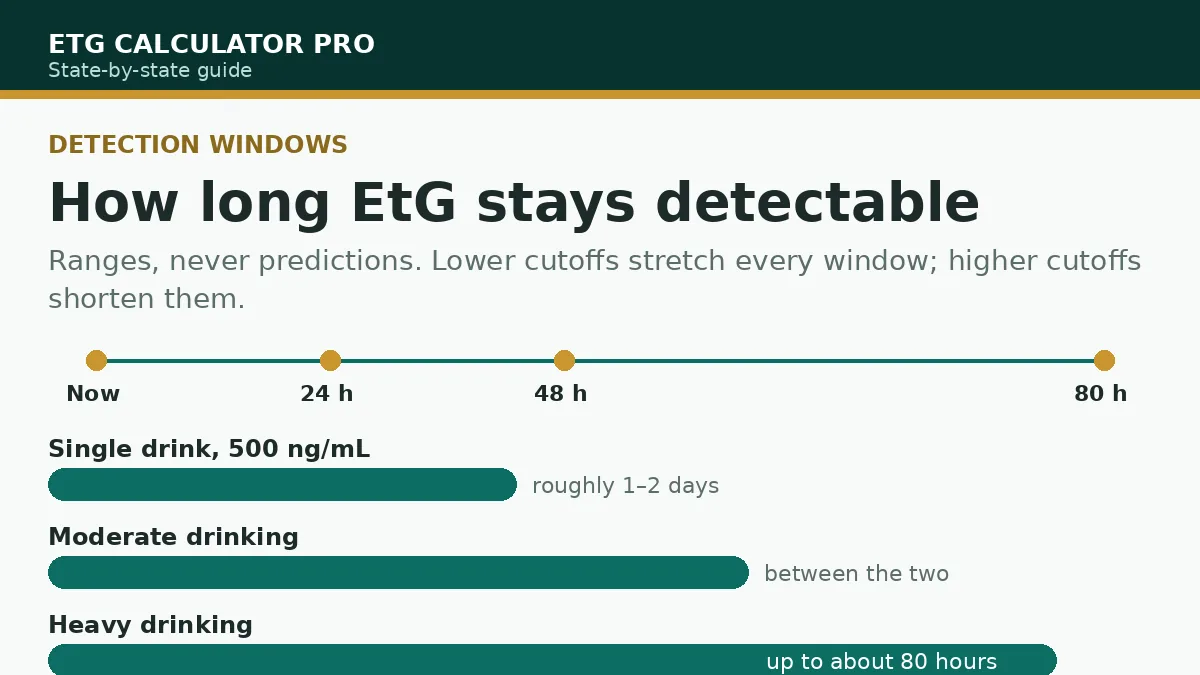
- Heavy drinking: up to about 80 hours after the last drink.
- A single drink: roughly 1–2 days at a 500 ng/mL cutoff.
- Moderate drinking: between those two.
The biggest lever is the cutoff: at 100 ng/mL the same episode stays detectable longer. One caution: an NIH-funded study found EtG detection sensitivity poor after 48 hours at every dose and cutoff tested.
Try these ranges in our homepage calculator or our detection timeline calculator.
A realistic New Jersey scenario
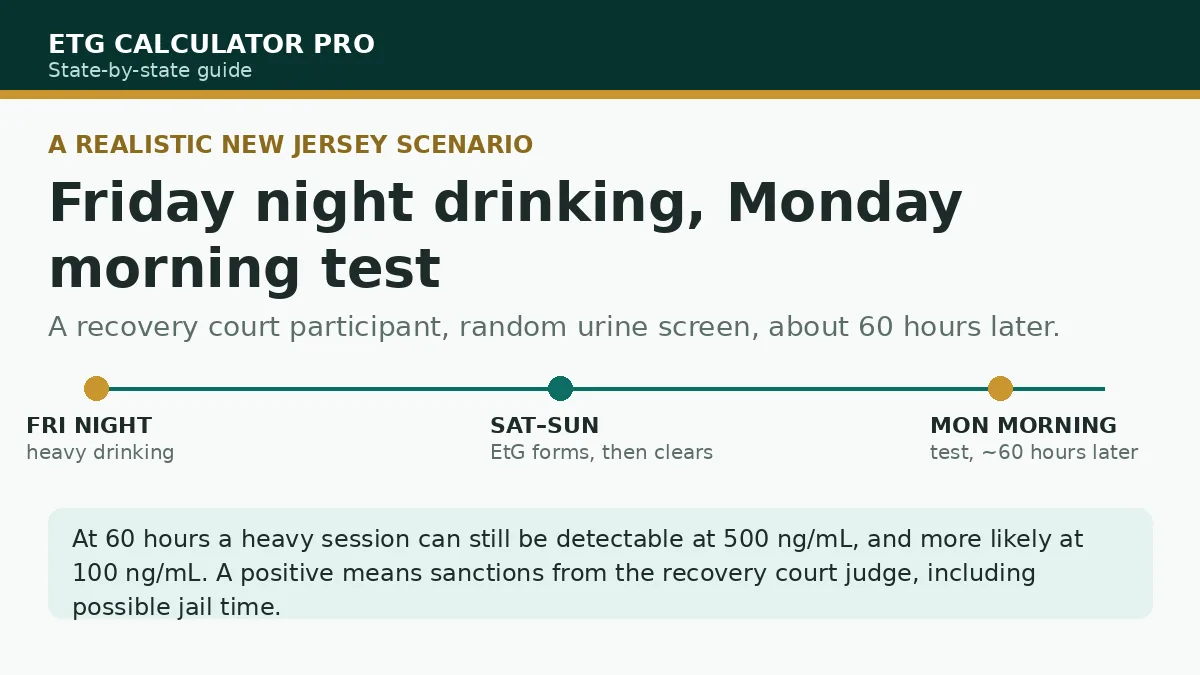
Consider a recovery court participant in Essex County on five years of special probation who drinks heavily on a Friday night and faces a random urine screen on Monday morning, about 60 hours later.
Sixty hours sits inside the published range for heavy drinking: at 500 ng/mL a heavy session can still be detectable, while a lighter one would likely have cleared; at 100 ng/mL a positive is more likely. A positive would mean sanctions from the recovery court judge, including possible jail time, with the alternative prison term still hanging over the sentence.
No pass-or-fail claim follows from a timeline alone.
A note on legal advice
This page is educational, not legal advice, and program rules change. If you are subject to testing, your program's requirements — and an attorney if a violation is alleged — are what matter.
Frequently asked questions
Is there one New Jersey EtG cutoff?
No. No New Jersey statute, court rule, Judiciary standard, or state program document we checked publishes a statewide EtG cutoff. Each court, program, and lab sets its own, mostly unpublished. Nationally the common levels are 100 and 500 ng/mL (SAMHSA, 2012); neither is a New Jersey rule. Your program's paperwork names the only number that counts. And do not confuse the numbers that do appear in New Jersey law — 0.08%, 0.10%, and 0.01% BAC — with EtG cutoffs: those are blood-alcohol thresholds for DWI charges and penalties, not urine concentrations.
Does New Jersey probation use EtG testing?
Yes. When a New Jersey court suspends a sentence or places a person on probation, it attaches the reasonable conditions it deems necessary (N.J.S.A. 2C:45-1), and the Judiciary's Standard Conditions of Adult Probation make testing a standard condition: “You shall submit to drug or alcohol testing at any time, as directed by your probation officer.” If the court finds a violation of probation, it may impose any sentence authorized by law for the offense of conviction, up to and including the maximum term of incarceration. In recovery court, the testing duty is written into the statute itself: special probation under N.J.S.A. 2C:35-14 “shall include periodic urine testing for drug or alcohol usage throughout the period of special probation.” A positive test — or refusing one — can be treated as a violation.
What is the IDRC, and what does it require?
The IDRC is the Intoxicated Driver Resource Center, and it is mandatory for everyone convicted of DWI in New Jersey under N.J.S.A. 39:4-50. A first offender is detained, educated, and evaluated for at least six hours each day on two consecutive days — a total of 12 hours — at the IDRC in the county where the case was heard. A second offender is generally scheduled for a 48-hour program: 48 consecutive hours of detention, classes, and screening at one of three regional facilities. The program screens each person and refers those who need it to treatment or a self-help program. The IDRC reports non-compliance to the sentencing court and to the Intoxicated Driving Program, and failing to appear or complete the program extends the license suspension and can add two days in jail. The program fee varies by county and program — current guides list roughly $230 to $280 for the 12-hour program. Your license is not restored until the IDRC requirements are met.
What are the penalties for a first DWI in New Jersey?
A first DWI under N.J.S.A. 39:4-50 is a traffic violation under Title 39, not a criminal offense — but the penalties still stack up. With a BAC of 0.08% to under 0.10%, the fine is $250 to $400, the court may impose up to 30 days in jail, and the driver must complete 12 to 48 hours at the IDRC; the license is forfeited until an ignition interlock device is installed, and the interlock stays on for three months. With a BAC of 0.10% or higher, the fine rises to $300 to $500 and the interlock period to seven to twelve months. On top of the court penalties, the Motor Vehicle Commission adds a $1,000-a-year insurance surcharge for three years. The 2019 interlock reforms that set this structure are currently scheduled to expire on January 1, 2029, unless the Legislature extends them.
What happens on a second or third DWI in New Jersey?
A second DWI brings a fine of $500 to $1,000, at least 48 consecutive hours in jail and up to 90 days, 30 days of community service, and a license forfeiture of one to two years, plus the 48-hour IDRC program and an ignition interlock for two to four years after restoration. A third or subsequent DWI brings a $1,000 fine, a mandatory 180 days in jail — up to 90 of which the court may allow to be served in an approved inpatient rehabilitation program — and an eight-year license forfeiture, plus an interlock for two to four years after restoration. The $1,000-a-year, three-year insurance surcharge applies again. An offense more than ten years after a first offense is penalized as a first offense.
What are New Jersey recovery courts, and how does testing work there?
New Jersey's recovery courts — formerly called drug courts — operate in the Superior Court as a specialized term of probation for non-violent offenders whose crimes were driven by drug or alcohol dependence. Admission runs under N.J.S.A. 2C:35-14 (special probation for people who would otherwise face prison) or N.J.S.A. 2C:45-1 (general probation). The court must find a diagnosed substance use disorder, an offense committed under the influence or to support the habit, no firearm, and no danger to the community. Special probation runs for five years, and the statute requires periodic urine testing for drug or alcohol usage throughout that period. Participants attend treatment sessions, meet regularly with probation officers, and appear frequently before the recovery court judge; clinical treatment generally lasts one to two years. Failing a test or committing a new crime can bring sanctions, including jail. On successful discharge, the court may expunge the person's New Jersey criminal records without a fee.
Can a New Jersey family court order EtG testing?
Yes, at the judge's discretion. New Jersey custody and parenting-time decisions are made under the best-interests standard in N.J.S.A. 9:2-4c, weighing factors including the parents' ability to agree and cooperate, each parent's willingness to accept custody, any history of domestic violence, the safety of the child, the child's needs, and the stability of each home. The Judiciary's custody-investigation standards direct that reports to the court include the results of any drug and alcohol screening reports ordered by the court. Where a parent's substance use bears directly on the child's safety, the court may order testing — including EtG testing — as a condition of custody or parenting time, or condition the parent's time with the child on treatment and staying alcohol-free. Testing follows a request and a reason, and a positive result is one factor among many.
Evidence and limitations
This guide summarizes primary research, public-health guidance, and New Jersey public records. Group-level findings cannot predict one person's result.
- N.J.S.A. 39:4-50 — Driving while intoxicated (statute text): unlawful to operate a motor vehicle while under the influence of intoxicating liquor or drugs, or with a blood alcohol concentration of 0.08% or more; first offense, BAC 0.08% to under 0.10%, fine of $250 to $400 and detainment of 12 to 48 hours at the Intoxicated Driver Resource Centers, with a three-month license forfeiture; BAC 0.10% or higher, fine of $300 to $500 and a license forfeiture of seven months to one year
- N.J.S.A. 2C:45-1 — Conditions of suspension or probation: when the court suspends a sentence or places a person on probation, it shall attach such reasonable conditions as it deems necessary to insure that he will lead a law-abiding life; the court may require treatment, education, community service, and other conditions reasonably related to rehabilitation
- New Jersey Judiciary Directive #3-07 — Standard Conditions of Adult Probation: “You shall submit to drug or alcohol testing at any time, as directed by your probation officer”; if the court finds a violation of probation, it may impose any sentence authorized by law for the offense of conviction, up to and including the maximum term of incarceration
- N.J.S.A. 2C:35-14 — Rehabilitation program for persons with a substance use disorder (special probation): a term of five years; as a condition of special probation the court shall order treatment and compliance with program rules, “which shall include periodic urine testing for drug or alcohol usage throughout the period of special probation”
- New Jersey Judiciary — Recovery Courts Work (CN 10844, May 2026): recovery courts operate within the Superior Court for non-violent drug-addicted offenders; distinct phases of intensive drug and alcohol treatment and recovery; participants attend treatment sessions, undergo random substance use tests, meet regularly with probation officers, and appear frequently before the recovery court judge; clinical treatment generally lasts from one to two years
- New Jersey IDRC: Requirements, Fees & County Directory (2026) — every DWI conviction requires attendance at the Intoxicated Driver Resource Center; a first offender spends two consecutive days of at least six hours each at the IDRC, a second offender is generally scheduled for a 48-hour program, and anyone who skips it faces an indefinite license suspension and can be ordered to spend two days in jail; the 12-hour program is held at the IDRC for the county of residence, and second offenders attend one of three regional 48-hour programs
- NJ IDRC: What to Expect, Bring, and How to Prepare — the IDRC is mandatory for anyone convicted of driving while intoxicated under N.J.S.A. 39:4-50; first-time offenders spend 12 hours over two consecutive days at a county IDRC facility, while second offenders are detained for 48 continuous hours at a regional site; the IDRC program fee is $264; the Motor Vehicle Commission imposes a $1,000 annual surcharge for three years after a first or second DWI conviction
- Intoxicated Driver Resource Center — the IDRCs are units of, or contractors to, the 21 counties; a first offender is detained, educated, and evaluated for at least six hours each day on two consecutive days; a second offender is detained, educated, and evaluated during 48 consecutive hours in a regional facility; a third offender is sentenced to 180 days in jail and scheduled for a 12-hour IDRC follow-up; failing to appear or complete the program extends the license suspension and can add two days in jail
- Atlantic County IDRC — the 12-hour program is a two-day educational and screening program for people convicted of operating under the influence, refusal, underage drinking, drunk boating, and fatal accidents; attendance is mandatory as it is court ordered in lieu of jail; the IDRC reports non-compliance to the sentencing court and the Intoxicated Driving Program
- NJ DWI Penalties (2026) — penalties under N.J.S.A. 39:4-50 and the refusal statute N.J.S.A. 39:4-50.4a; first offense, BAC 0.08% to under 0.10%: fine $250 to $400, up to 30 days in jail, license forfeited until an interlock is installed, interlock for three months; BAC 0.10% to 0.15%: interlock seven to twelve months; second offense: $500 to $1,000, 48 hours to 90 days in jail, 30 days of community service, license forfeiture one to two years, interlock two to four years; third offense: $1,000, 180 days in jail, eight-year forfeiture, interlock two to four years; the 2019 interlock reforms are set to expire on January 1, 2029
- NJ DWI Penalties Chart: 1st, 2nd and 3rd Offense — a second offense adds at least 48 hours in jail and a license loss of one to two years; a third offense means at least 180 days of incarceration, up to 90 of which may be served in an approved inpatient program, and an eight-year license loss; interlock credit toward the license forfeiture applies for offenses on or after April 3, 2025
- What Happens When You Get a DUI in NJ — New Jersey uses the terms DUI and DWI interchangeably for the same offense; a DWI is classified as a traffic violation under Title 39, not a criminal offense; a second offense brings fines of $500 to $1,000, 30 days of community service, at least 48 consecutive hours up to 90 days in jail, and a one- to two-year license forfeiture; a third offense brings a $1,000 fine, a mandatory 180-day jail sentence, and an eight-year license forfeiture
- New Jersey DWI Laws — New Jersey calls drunk-driving offenses DWI (Driving While Intoxicated), not DUI; the governing statute is N.J.S.A. 39:4-50; adults 21 and older: 0.08% BAC; drivers under 21: 0.01% BAC under the zero-tolerance law; a first refusal under N.J.S.A. 39:4-50.4a carries a $300 to $500 fine, a $1,000-a-year three-year surcharge, license forfeiture until an IID is installed, a mandatory nine- to fifteen-month IID, and IDRC attendance
- N.J.S.A. 39:4-50.4a — Refusal to submit to test; penalties (statute text): a first refusal forfeits the right to operate a motor vehicle until the person installs an ignition interlock device; a second refusal brings a forfeiture of one to two years after interlock installation; a third refusal brings an eight-year forfeiture; fines of $300 to $500 for a first offense, $500 to $1,000 for a second, and $1,000 for a third
- Under-21 DWI in New Jersey (N.J.S.A. 39:4-50.14) — applies to any driver under 21 with a 0.01% to 0.07% BAC; penalties include a 30- to 90-day license forfeiture or postponement, 15 to 30 days of community service, and IDRC attendance or an alcohol education and highway safety program; a BAC of 0.08% or higher is prosecuted under the adult DWI law
- Commercial Drivers and DUI in New Jersey — for commercial drivers the BAC standard is 0.04 percent under N.J.S.A. 39:3-10.13; a first DWI conviction brings a one-year suspension of the commercial driver's license, and a second brings permanent revocation
- DWI FAQs and Penalties — N.J.S.A. 39:4-50 sets a BAC limit of 0.08% for drivers 21 and older and 0.01% for drivers under 21; first-offense fines of $250 to $400 for a BAC of 0.08% to 0.10% and $300 to $500 for 0.10% or higher; IDRC fees of $230 to $280; a $1,000 annual surcharge for three years; a second offense brings a one- to two-year license suspension and an interlock for two to four years after restoration
- New Jersey Judiciary Directive #12-19 — Revised Standards for Child Custody and Parenting Time Reports: the safety of the child is the first and foremost consideration; reports cover the statutory factors in N.J.S.A. 9:2-4c, including the parties' ability to agree and cooperate, willingness to accept custody, history of domestic violence, the safety of the child, the child's preference, the needs of the child, and the stability of the home environment; reports include the results of any drug and alcohol screening reports ordered by the court
- The Impact of Drug and Alcohol Abuse on Child Custody in NJ — when a parent abuses drugs or alcohol, the court may request drug and alcohol testing to ensure sobriety; random testing helps provide reassurance that the parent is committed to staying sober; a parent may be required to show counseling, a completed rehabilitation program, or regular support-group attendance
- New Jersey Recovery Court — formerly called Drug Court; a specialized term of probation for people exposed to prison whose crimes were motivated by drug addiction; admission is governed by N.J.S.A. 2C:35-14 (special probation) and N.J.S.A. 2C:45-1 (general probation); the court must find a diagnosed substance use disorder, an offense committed under the influence or to support the habit, no firearm, and no danger to the community
- NJ Recovery Court Program — the recovery court model formed in 1996 when Camden and Essex Superior Courts started accepting participants; by September 2001 the program was expanded statewide; a person must enter a guilty plea and receive an alternative prison sentence, then is sentenced to probation with the special condition of completing the recovery court program; failing a drug test or committing a new crime can bring sanctions including jail; on successful discharge the court may expunge the person's records under N.J.S.A. 2C:35-14(m)
- Clearing a Drug Charge in NJ — Recovery Court (N.J.S.A. 2C:35-14) is five years of special probation after a conviction; residential treatment of at least six months is required for second-degree, school-zone, and some repeat distribution cases; early discharge is possible after two years of exemplary progress; on successful discharge the court may expunge all prior New Jersey criminal records without a fee
- Alternative Sentencing for NJ DWI — IDRC programs are mandatory education and evaluation under N.J.S.A. 39:4-50; New Jersey does not allow hardship or conditional licenses, and the only way to continue driving is through ignition interlock installation; non-compliance with the IDRC adds two days of jail
- Determining Ethyl Glucuronide Cutoffs (PMC) — SAMHSA Advisory 2012 conservative 500 ng/mL recommendation; lab cutoffs 100–1,000 ng/mL; interpretation bands