How EtG testing works in California
Ethyl glucuronide (EtG) is a direct metabolite of alcohol found in urine after drinking. California courts, probation officers, and monitoring programs use it because it answers one question: has this person consumed alcohol since the last check-in? Breath tests only catch very recent use, and standard urine drug panels do not detect alcohol, so when a judge orders abstinence, EtG fills the gap.
Testing in California is court- and program-driven, not statewide. Probation is administered county by county, so conditions vary with the offense, the county, and the program.
One honest caveat: most California sources describe testing generically, as drug testing or urinalysis, rather than naming EtG. EtG applies where the program or lab specifies it.
Who gets tested in California and why
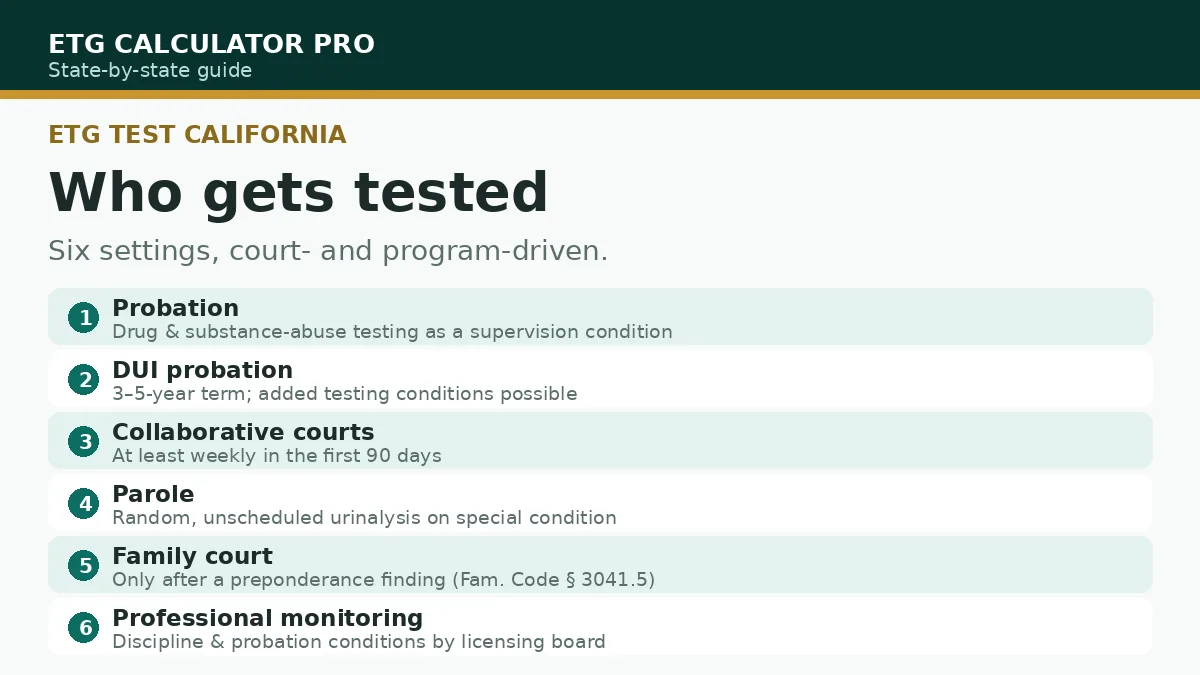
California probation
Probation is where most California alcohol and drug testing happens. For drug offenses the law is explicit: under Penal Code section 1203.1ab, a court granting probation for a controlled-substance offense must require, when recommended by the probation officer, that the person not use or be under the influence of any controlled substance and submit to drug and substance-abuse testing as directed by the probation officer.
Proposition 36 sharpened that framework for nonviolent drug possession: under Penal Code section 1210.1, the person receives probation, must complete an appropriate drug treatment program, and the court must impose appropriate drug testing, monitored through a dedicated court calendar and a collaborative-court model with testing commensurate with treatment needs. Health and Safety Code section 11551 adds periodic testing by a city or county health officer, or an appointed physician, for probationers believed to use controlled substances, and extends it to parole.
DUI probation and DUI programs
California DUI probation has the most precisely written terms in the state. Under Vehicle Code section 23600, a person convicted of DUI and granted probation serves not less than three nor more than five years, with mandatory conditions: not driving with any measurable amount of alcohol in the blood, submitting to a chemical test of blood, breath, or urine if arrested for another DUI, and committing no criminal offense. Courts can add further conditions, including testing.
Alongside probation, the court refers the person to a licensed DUI program: a first offender below 0.20% blood alcohol for at least three months and 30 hours; at 0.20% or above, or after a refusal, at least nine months and 60 hours; a second offender for 18 months; a wet reckless plea, 12 hours. These programs deliver education, group counseling, and individual interviews, not laboratory testing. EtG enters separately, when abstinence monitoring is ordered. An ignition interlock device is a breath device, not a urine EtG test.
Collaborative and drug courts
California's collaborative courts are the most testing-intensive setting in the state. Judicial Council guidance for adult collaborative treatment courts treats alcohol and other drug testing as essential and mandatory in pre-plea diversion drug court programs, administered randomly or at scheduled intervals, no less frequently than once per week during the first 90 days of treatment. A positive, missed, or adulterated sample triggers immediate notification of the probation officer and the court, and an interim hearing. Participants are not considered to have completed the program without consistently negative results for four months.
Parole
On parole, the urinalysis regime is written into regulation. Under Title 15, section 3620 and the Department of Corrections and Rehabilitation operations manual, a person with a narcotics-related conviction within five years of incarceration, or a history of alcohol or substance abuse, may have a special parole condition requiring urinalysis testing at the parole agent's direction. The test is a random, unscheduled urine sample, collected with less than 72 hours' notice, and the agent may order one at any time on reasonable suspicion. Confirmed positives must be addressed by intervention or sanctions.
Family court
Family court has the strongest procedural protections around testing. Under Family Code section 3041.5, a custody, visitation, or guardianship court may order testing only after a judicial determination, based on a preponderance of the evidence, of habitual, frequent, or continual illegal drug use or habitual or continual alcohol abuse. A drug-related conviction within five years can count as evidence. The court must order the least intrusive method, testing must follow federal employee drug-testing standards, a positive result may be challenged at a hearing, and a positive result alone cannot justify an adverse custody decision.
Professional monitoring
California's professional monitoring has a distinctive history. The Medical Board of California's Physician Diversion Program, which facilitated random drug testing, worksite monitoring, and treatment-provider reports, was abolished effective July 1, 2008, after a State Auditor review found it had not provided consistently effective oversight. Physician monitoring today runs through discipline and probation, with conditions that can include random drug testing, worksite monitoring, and biological fluid testing under the board's uniform standards. Other health licensing boards run their own programs, with panel and frequency set by the board and the individual order.
Employment
In employment, EtG testing appears only where a documented abstinence policy applies — safety-sensitive roles, last-chance agreements, or employer-specific programs. No California general-employment EtG requirement was found.
Cutoffs used in California programs
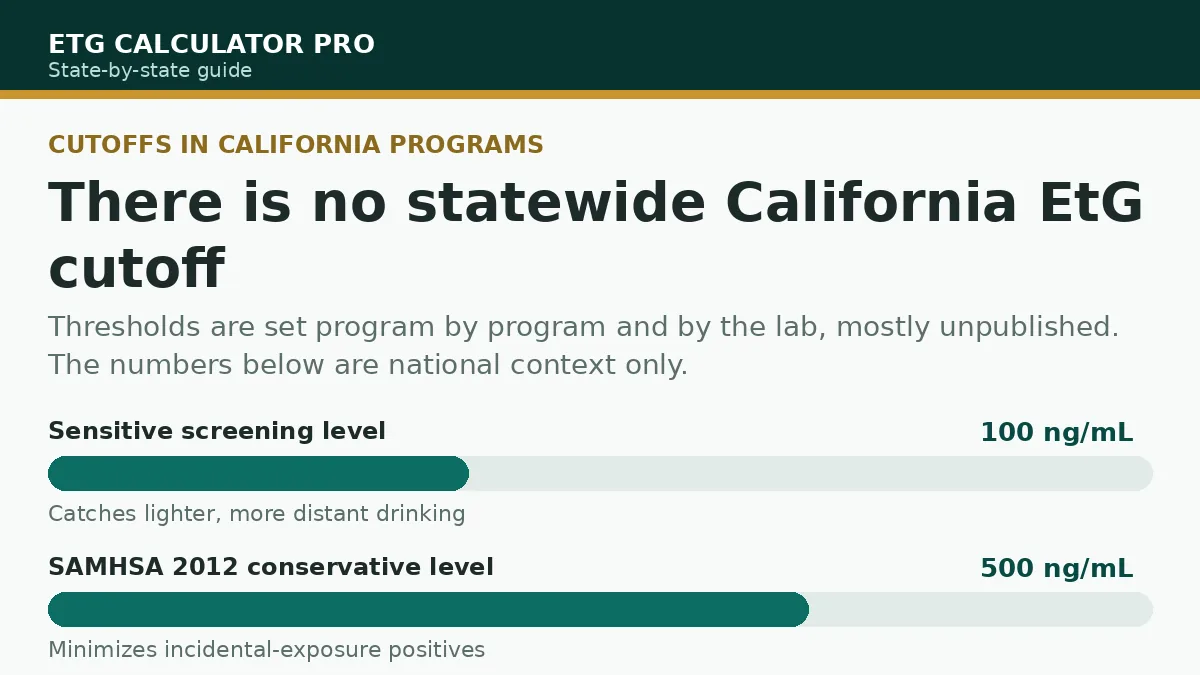
Here is the most important point on this page: there is no statewide California EtG cutoff. We checked California statutes, Judicial Council guidance, corrections regulations, DUI program law, and Medical Board materials; none names an EtG threshold. Thresholds are set program by program and by the testing lab, mostly unpublished. Your paperwork names the only cutoff that counts.
For national context:
- 100 ng/mL — the sensitive level many labs use. Catches lighter, more distant drinking, but risks incidental-exposure flags.
- 500 ng/mL — SAMHSA's 2012 conservative recommendation, chosen to minimize incidental-exposure positives.
- Labs across the country screen anywhere from 100 to 1,000 ng/mL, depending on the program's goals.
Do not assume a California program uses either number unless its paperwork says so; if it names none, ask in writing and keep the answer.
Detection windows in California programs
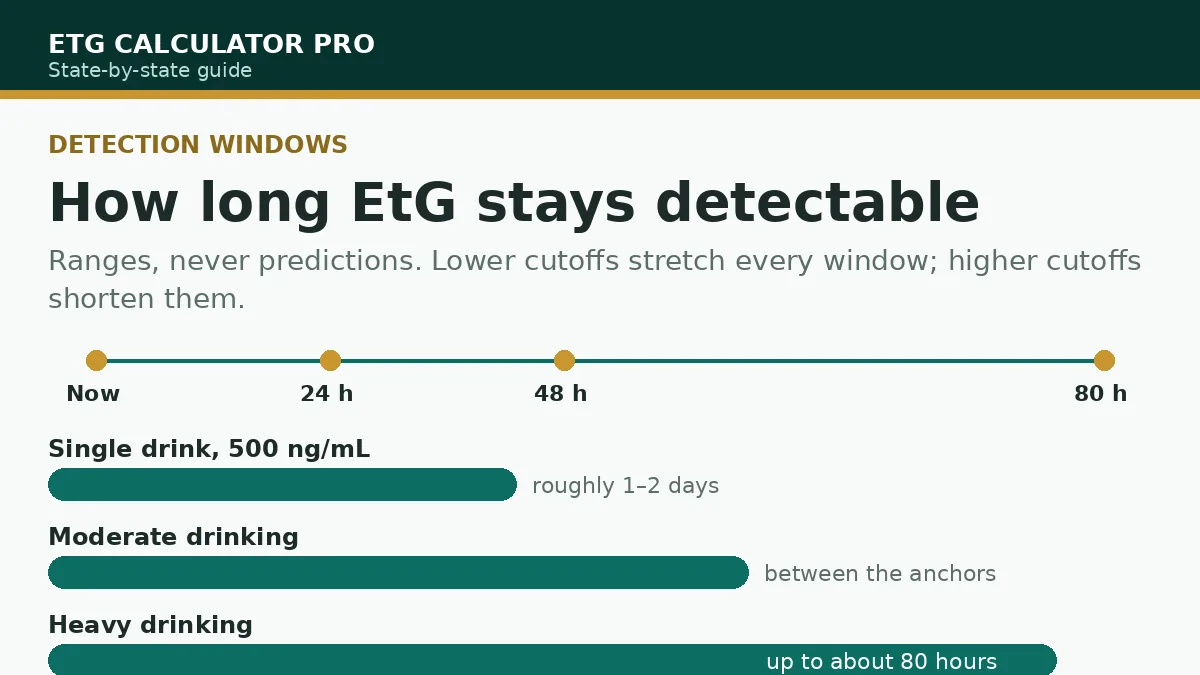
Detection windows are ranges, never predictions. They depend on amount, timing, cutoff, hydration, and metabolism:
- Heavy drinking: up to about 80 hours after the last drink.
- A single drink: roughly 1–2 days at a 500 ng/mL cutoff; lower cutoffs extend the window.
- Moderate drinking: between those anchors.
The biggest lever is the cutoff: at 100 ng/mL, the same episode stays detectable longer than at 500 ng/mL.
Apply these ranges with our homepage calculator, the 100 ng/mL calculator, or our detection timeline tool.
A realistic California scenario
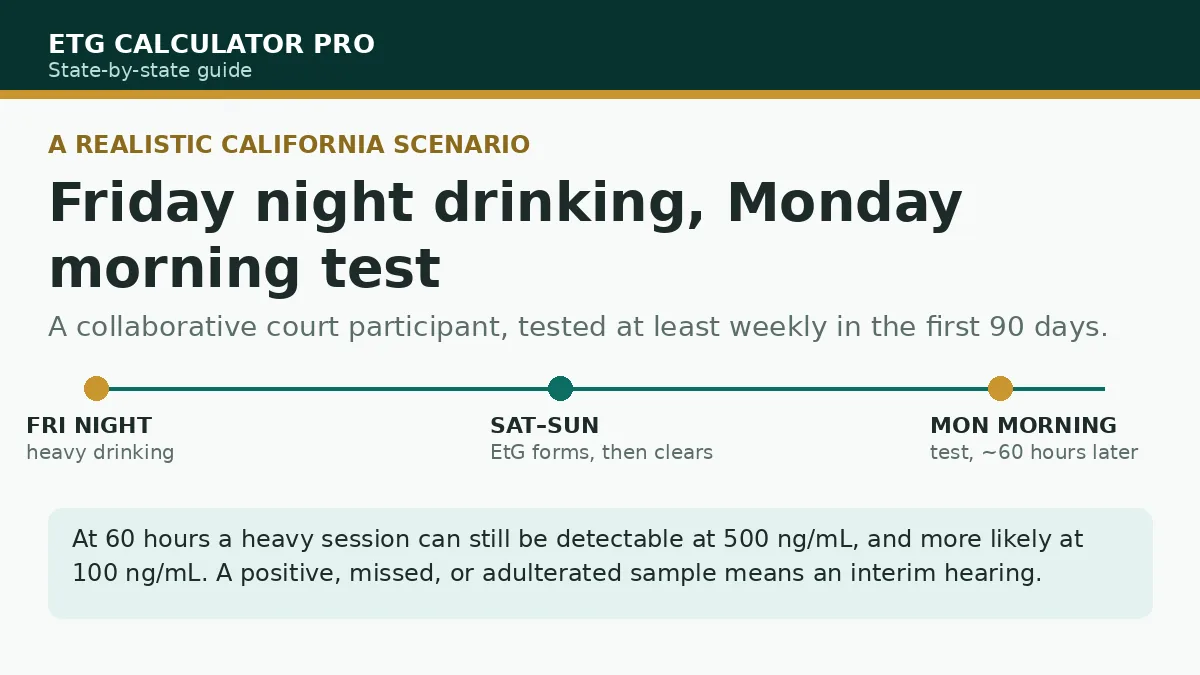
Consider a collaborative treatment court participant, tested at least weekly during the first 90 days: heavy drinking Friday night, a test Monday morning, about 60 hours later.
Sixty hours sits inside the published range for heavy drinking, so the result could go either way. At 500 ng/mL, a heavy session can still be detectable at 60 hours, while a lighter one would likely have cleared; at 100 ng/mL, a positive would be more likely. Under the Judicial Council guidance, a positive, missed, or adulterated sample means immediate notification of the probation officer and the court, with an interim hearing.
No pass-or-fail claim is possible from a timeline alone — cutoff, amount, and elapsed time shape the result.
A note on legal advice
This page is educational, describing how EtG testing works in California probation, DUI programs, collaborative courts, parole, and family court, from published research, public-health guidance, and California public records. It is not legal advice, and program rules change. If you are subject to testing, your program's requirements, and an attorney if a violation is alleged, are the authorities that matter.
Frequently asked questions
Is there one California EtG cutoff?
No. No California statute, court, probation department, DUI program, drug court, or licensing board publishes a statewide EtG cutoff. Each court, program, and lab sets its own threshold, mostly unpublished. Nationally the common levels are 100 ng/mL and 500 ng/mL (SAMHSA's 2012 recommendation); neither is a California rule. Your program's paperwork names the only number that counts.
Does California probation use EtG testing?
Yes, as a supervision condition: Penal Code section 1203.1ab requires testing as directed by the probation officer for controlled-substance probation, and Proposition 36 (section 1210.1) requires appropriate drug testing for nonviolent drug possession probation. Most sources describe it generically, as drug testing or urinalysis. EtG applies where your program or lab specifies it.
How long does DUI probation last in California?
At least three years and no more than five years, under Vehicle Code section 23600. Mandatory conditions: no driving with any measurable amount of alcohol in the blood, a chemical test if arrested for another DUI, and no new criminal offense. Courts can add testing on top.
Do California DUI programs run EtG tests?
Not as their core function. Licensed DUI programs provide education and counseling: below 0.20% blood alcohol, at least 3 months and 30 hours; at 0.20% or above, or after a refusal, at least 9 months and 60 hours; a second offender, 18 months. EtG enters when abstinence monitoring is separately ordered. An ignition interlock device is a breath device, not urine EtG testing.
Can a California family court order alcohol testing?
Yes, under strict conditions. Family Code section 3041.5 lets a custody or visitation court order testing only after a judicial determination, based on a preponderance of the evidence, of habitual, frequent, or continual illegal drug use or habitual or continual alcohol abuse. The court must order the least intrusive method, a positive result may be challenged at a hearing, and a positive result alone cannot justify an adverse custody decision.
How long after drinking can an EtG test detect alcohol in California?
The biology does not change at the state line: up to about 80 hours after heavy drinking, roughly 1 to 2 days after a single drink at a 500 ng/mL cutoff; lower cutoffs extend the window. These are research ranges, not predictions.
What does a positive EtG test prove in a California case?
Recent alcohol exposure, nothing more. It cannot prove impairment, intoxication, how much was consumed, or exactly when drinking happened. At sensitive cutoffs such as 100 ng/mL, even incidental exposure can contribute, which is why SAMHSA's 2012 advisory recommended the more conservative 500 ng/mL level.
Evidence and limitations
This guide summarizes primary research, public-health guidance, and California public records. Group-level findings cannot predict one person's result.
- California Penal Code § 1203.1ab — probation drug and substance-abuse testing
- California Penal Code § 1210.1 — Proposition 36 probation, treatment, and drug testing
- California Health and Safety Code § 11551 — periodic probation and parole testing
- California Vehicle Code § 23600 — DUI probation terms and mandatory conditions
- California Vehicle Code § 23538 — first-offender DUI program referral (3-month / 9-month)
- Judicial Council of California — adult collaborative treatment court guidance (testing frequency and completion)
- California Code of Regulations, Title 15, § 3620 — parole urinalysis testing program policy
- CDCR Department Operations Manual § 81021 — urinalysis testing program policy
- California Family Code § 3041.5 — testing in custody and visitation proceedings
- Medical Board of California — Physician Diversion Program history (abolished July 1, 2008)
- SAMHSA Advisory: The Role of Biomarkers in the Treatment of Alcohol Use Disorders, 2012 revision (archived PDF copy)