
The essential difference is the time frame
Urine EtG testing looks for ethyl glucuronide excreted after ethanol metabolism. It is most informative for recent exposure, with sensitivity generally declining as the interval grows. Hair EtG testing measures metabolite incorporated into keratinized hair and is used to evaluate a longer pattern of alcohol exposure. The two tests are complementary, not interchangeable versions of one universal EtG measurement.
A recent single drinking event may create a urine result while contributing little to a hair segment intended to represent months. Hair can retain information after the urine window has closed, but it also introduces a lag while newly formed hair emerges from the scalp. The specimen depends on the question and validated interpretation criteria.
Related: Urine EtG detection window · EtG testing basics
How urine EtG enters and leaves the testing window
A small portion of ethanol is converted to EtG and eliminated in urine. Because EtG persists after ethanol itself is gone, urine testing can identify exposure beyond the useful window for breath or blood ethanol. Detection is often strongest during the first day, becomes more variable across the next one or two days, and may extend further after heavy or repeated drinking, especially with a lower cutoff.
The measured concentration depends on more than the amount consumed. The end of drinking, collection time, urine voids, hydration, creatinine, kidney handling, laboratory method, and cutoff all influence the report. A negative urine test means the concentration was below that method's threshold at collection; it does not prove that no alcohol exposure occurred.
How EtG becomes measurable in hair
Hair EtG is measured in picograms per milligram of hair rather than urine's nanograms per millilitre. EtG reaches developing hair through biological pathways and becomes associated with the keratin matrix. Laboratories commonly analyze a proximal scalp segment, with segment length used as an approximate retrospective period based on average hair growth. The relationship is not a perfect calendar because growth rates vary.
Hair testing requires careful collection close to the scalp, correct orientation, chain of custody when relevant, decontamination, segmentation, and a validated analytical method. Body hair may represent a less precise time frame. Cosmetic treatment, bleaching, dyeing, heat, ultraviolet exposure, and washing can affect the specimen or measured concentration, so the laboratory needs accurate sample history.
Related: EtG laboratory terminology
What controlled hair studies add
Controlled alcohol-dosing research has examined whether repeated measured consumption produces distinguishable hair EtG patterns. Stewart and colleagues followed healthy volunteers assigned to abstinence or measured weekly alcohol exposure over twelve weeks. Group concentrations differed, supporting hair EtG as a marker of repeated use while also showing variation within exposure groups. Such findings support categories, not an exact gram-for-picogram conversion for one person.
Research following comparable hair segments over time has also observed decreasing EtG concentrations as hair grows away from the scalp. Possible washout and other matrix effects complicate the assumption that a segment preserves a perfectly fixed historical concentration. This is why hair EtG interpretation uses validated criteria, sample history, and qualified expertise rather than a simple online countdown.
Units and cutoffs cannot cross between specimens
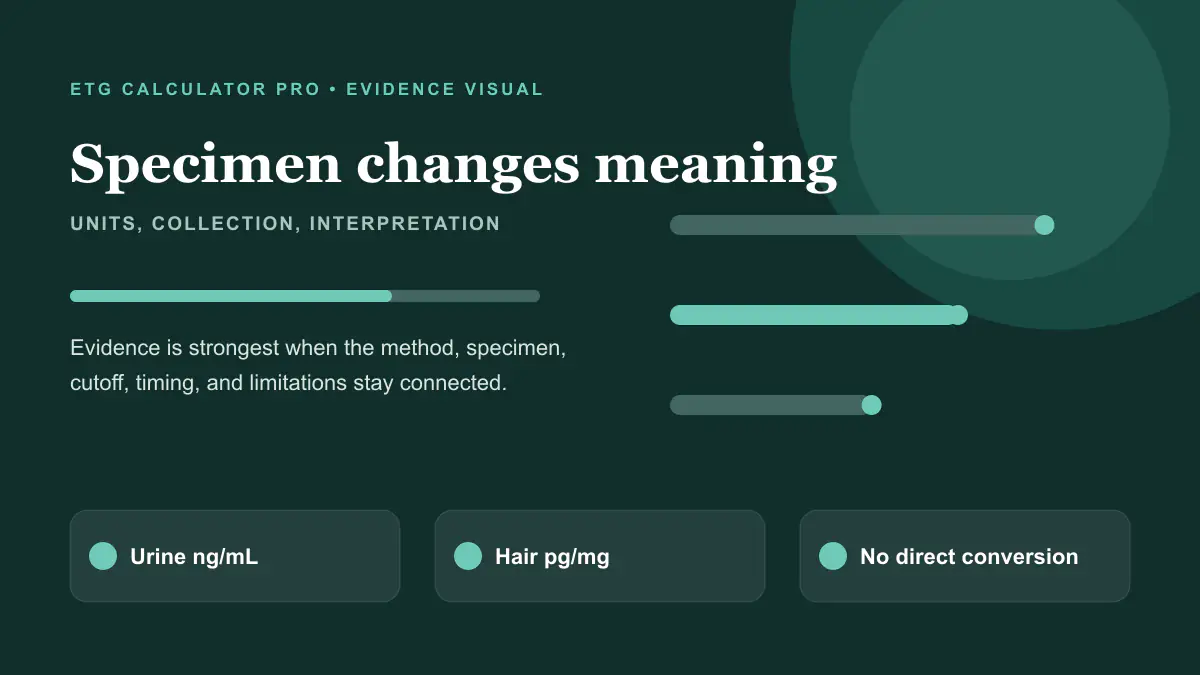
Urine EtG is commonly reported in ng/mL and compared with thresholds such as 100, 200, or 500 ng/mL. Hair EtG is typically reported in pg/mg and evaluated using criteria designed for hair. A urine cutoff must never be applied to hair, and a hair category must never be used to predict whether a urine sample will be positive. The numbers describe different matrices and concentration relationships.
Even within one specimen, criteria can depend on the laboratory, method, population, and purpose. A result should identify the specimen, segment or collection time, units, analytical method, reporting threshold, and interpretive category. If any of these elements is missing, request the complete report before attempting to compare results or timelines.
Related: Urine EtG cutoff guide · Read a urine EtG report
Collection and sample-quality differences
Urine collection captures one specimen at one time. Collection may be observed or unobserved, and laboratories can assess creatinine, specific gravity, temperature, or other validity measures. Dilution is a central urine issue because the result is reported per volume. Time since the previous void can also affect concentration without changing the underlying exposure history.
Hair collection samples a physical record that grows over time. The collector documents scalp location, proximal end, length, mass, and cosmetic treatment. Segment selection determines the intended retrospective window. A short or unavailable scalp sample may change what can be concluded. Neither collection method is inherently superior; each has vulnerabilities that fit a different monitoring question.
Related: Urine creatinine and dilution
When urine EtG may be the better fit
Urine EtG is often selected when the question concerns recent abstinence or exposure across days, when repeated collections are practical, or when a program has a defined urine cutoff and confirmation process. It offers timely feedback and can be paired with EtS and creatinine. The result must still be interpreted within the exact collection schedule and policy.
Urine is not an appropriate stand-in for current impairment because EtG can remain after ethanol has cleared. It is also not ideal for reconstructing a pattern across several months from one specimen. For those questions, direct ethanol testing or a longer-window biomarker may be more suitable. The test should follow the clinical or monitoring objective rather than convenience alone.
Related: Calculate urine collection timing
When hair EtG may be the better fit
Hair EtG may be considered when the question concerns repeated or chronic exposure across a retrospective period and a suitable hair sample is available. It can complement blood PEth or clinical information in longer-term monitoring. Because new hair must grow out before it can be sampled, hair is not a rapid test for an event that occurred yesterday.
A hair result also should not be used to prove a single drinking episode or exact daily consumption. Interpretation can be affected by segment length, growth variation, cosmetic history, and laboratory criteria. In medical or legal contexts, a qualified toxicologist or laboratory professional should explain the report and its limitations rather than reducing it to a positive/negative internet chart.
Related: EtG, EtS, and PEth compared
Choosing the specimen responsibly
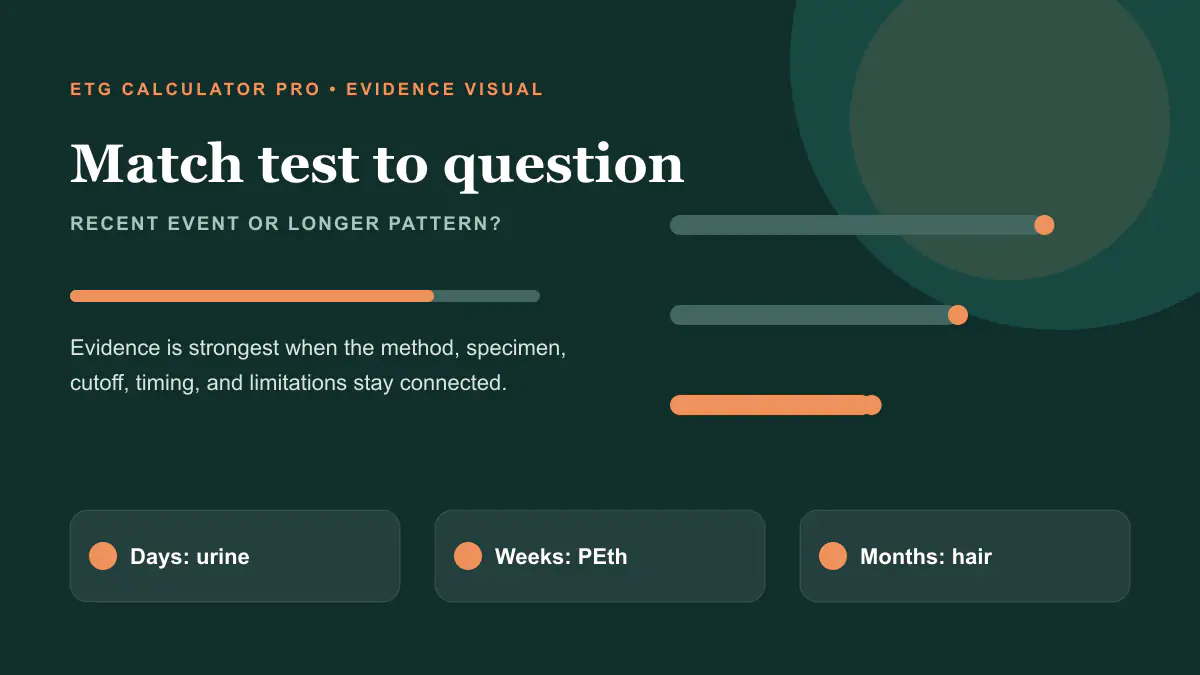
Begin with the time-frame question. For recent exposure over days, urine EtG/EtS may fit. For a recent pattern over weeks, blood PEth may offer a different view. For repeated exposure over months, hair EtG may fit when collection requirements are met. For present ethanol or impairment, breath or blood ethanol serves a different purpose. More testing is not automatically better if the biomarkers answer mismatched questions.
Before acting on a result, confirm specimen, units, collection or segment period, cutoff, method, and sample-quality notes. Use primary research to understand the test's demonstrated capabilities, then follow the program or clinician responsible for interpretation. EtG Calculator Pro models urine detection concepts only; it does not calculate hair EtG.
- Match specimen to time frame
- Use specimen-specific units and criteria
- Document collection quality
- Separate exposure from impairment
- Do not reverse-calculate exact drinking
Frequently asked questions
Does hair EtG last longer than urine EtG?+
Hair EtG can reflect repeated exposure across a much longer retrospective period, while urine EtG generally addresses recent exposure over days. Hair also has a growth-related lag, so longer does not mean faster or more precise.
Can one drink be detected in hair?+
Hair EtG is not designed to prove one isolated drink. It is generally interpreted as a marker of repeated exposure over a segment period, with substantial biological and analytical variation.
Can hair EtG predict a urine EtG result?+
No. The specimens use different units, matrices, windows, and interpretation criteria. A hair concentration cannot be converted into a urine ng/mL result.
Does bleaching affect hair EtG?+
Cosmetic treatment can affect hair integrity and measured EtG. Laboratories should receive accurate treatment history and apply their validated acceptance and interpretation procedures.
Which test is better for recent drinking?+
Urine EtG/EtS is generally better aligned with recent exposure over days. Hair EtG is intended for a longer retrospective pattern and has a lag while hair grows.
Evidence and limitations
This guide summarizes primary research and public-health guidance. Group-level findings cannot predict one person's result.