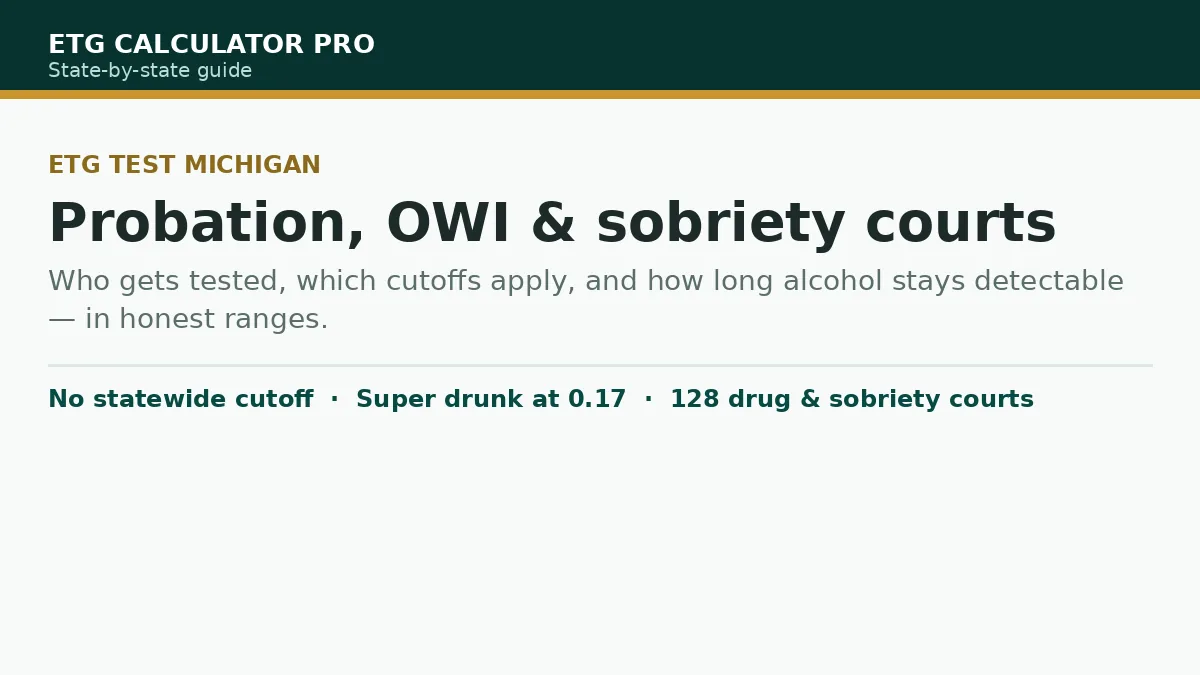
How EtG testing works in Michigan
Ethyl glucuronide (EtG) is a direct metabolite of alcohol found in urine after drinking. Michigan courts and supervision officers use it because it answers one question: has this person consumed alcohol since the last check-in? Breath tests catch only very recent use, and standard drug panels do not detect alcohol, so when abstinence is ordered, EtG fills the gap.
Testing in Michigan is court- and program-driven, not statewide. Probation conditions are set by the sentencing court and supervised locally; people released from state prison are supervised by Michigan Department of Corrections (MDOC) parole agents; and problem-solving courts are certified by the State Court Administrative Office but run locally. Conditions vary by offense, county, court, and program.
One caveat: most Michigan sources describe testing generically, as drug testing or urinalysis, not EtG by name. EtG applies where the program or lab specifies it — most clearly in OWI supervision, sobriety court, and license-restoration evidence.
A second distinction: the ignition interlock (BAIID) is a breath device fitted to a vehicle, not an EtG test; a person can be subject to both.
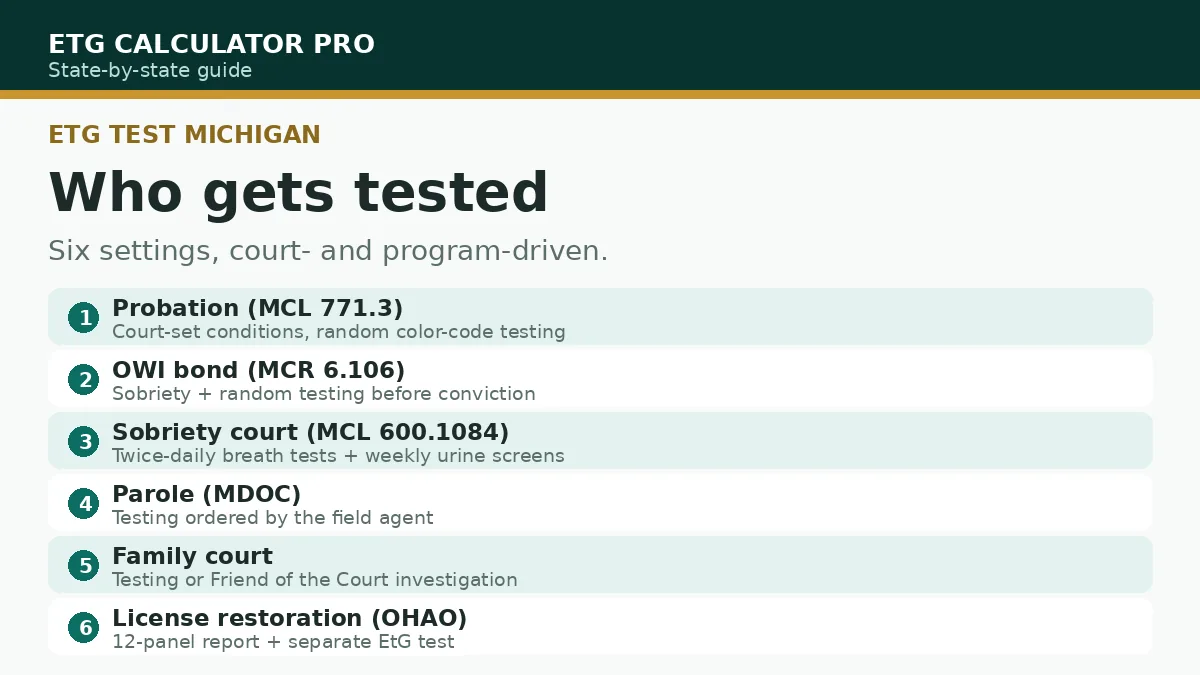
Who gets tested in Michigan and why
Probation
Probation is where most Michigan alcohol and drug testing happens. Under MCL 771.3, the court may impose conditions reasonably necessary for rehabilitation and public safety, and courts routinely order testing under that authority, including EtG urine testing where abstinence is ordered. Urine analysis is the most common method, with a standard panel covering five to ten substance categories, expanded where the court order requires it. Portable breath testing is standard for alcohol monitoring after an OWI conviction, and EtG is added where the program needs a longer look-back than breath can give.
Most Michigan counties test randomly, often on a color-code system: the officer assigns a color at the start of supervision, and each day the person calls in or checks online to learn whether their color was drawn. Frequency runs from about once a month to three or more times a week. Missing or failing a drug test is a technical probation violation under MCL 771.4b, carrying statutory ceilings on jail time — but a single positive does not automatically end probation; the court can modify conditions, increase testing, or impose a lesser sanction.
Pretrial bond in OWI cases
Testing often starts before conviction. Under Michigan Court Rule 6.106, a judge at arraignment on a criminal or OWI charge may impose reasonable bond conditions to protect public safety and ensure appearance, and where alcohol or drugs are involved, routinely orders absolute sobriety with random testing. Methods vary by court and budget: preliminary breath tests at a police station, portable cellular breath testers blown into at set times with a photo, transdermal ankle monitors (SCRAM) sampling perspiration around the clock, and EtG or EtS urine tests, typically once or twice a week, reaching back roughly 72 hours. EtG is the method that catches drinking between breath checks.
OWI, sobriety court, and the interlock program
Michigan calls drunk driving OWI — operating while intoxicated — under MCL 257.625. The standard limit is 0.08% BAC for drivers 21 and older, and operating with a high BAC of 0.17% or more is a separate, enhanced category, commonly called “super drunk.” A first standard OWI carries up to 93 days in jail and fines of $100 to $500; a first high-BAC offense carries up to 180 days and fines of $200 to $700, plus a one-year suspension with no restricted driving during the first 45 days.
Sobriety court is Michigan's intensive alternative for repeat offenders. Under MCL 600.1084, a DWI/sobriety court must be certified by the State Court Administrative Office. Eligibility centers on two or more OWI convictions (or one Michigan OWI plus a prior elsewhere); violent felonies generally exclude. The program is post-adjudication and typically runs about two years in four phases, with treatment, frequent hearings, support meetings, and testing that starts intensive and eases with progress. Published county manuals show the pattern: Lenawee County's sobriety court requires twice-daily breath tests and weekly random urine screens at first, continuing on at least a random basis until graduation.
Admission to the specialty court interlock program can also restore limited driving: under MCL 257.304, a participant may receive a restricted license after at least 45 days without a license, once the judge certifies admission and an approved interlock device is installed on every vehicle the person owns or drives. It covers work, school, court-ordered programs, and medical appointments — not unrestricted driving.
Parole
People released from Michigan prisons are supervised by MDOC parole agents, typically for one to four years. Standard parole conditions require compliance with testing ordered by the field agent. For people with a substance-abuse history, MCL 791.240 goes further: a prisoner placed on parole under intensive, maximum, or medium supervision must submit to substance abuse testing at least twice each month. As with probation, the conditions speak of testing generally; EtG applies where the agent or program specifies it.
Drug and sobriety courts statewide
Michigan's problem-solving court system is among the largest in the country. As of June 30, 2026, the State Court Administrative Office counted 128 drug and sobriety courts: 61 hybrid DWI/drug courts, 45 DWI courts, 13 adult drug courts, 5 juvenile courts, and 4 tribal courts, within a system of nearly 200 problem-solving courts. Examples run from the 3rd Circuit's hybrid court in Detroit to the 16th Circuit's DWI sobriety court in Mt. Clemens. Each sets its own testing schedule, and EtG enters where the court or its lab orders an alcohol panel.
Family court
In custody and parenting-time cases, Michigan courts decide on the child's best interests, and when substance use is raised, a judge can order drug testing or a Friend of the Court investigation — interviews, record review, questionnaires, and home visits. Testing can be one-time or ongoing, and safeguards may include an agreement not to consume certain substances, random testing, or supervised visitation. Testing is not automatic; it follows a request and a reason, and a positive result is one factor among many, not a custody decision on its own.
License restoration
Drivers seeking restoration of a revoked Michigan license face an evidence-heavy process before the Secretary of State's Office of Hearings and Administrative Oversight (OHAO): a laboratory report from a 12-panel urinalysis screen with cutoff levels and at least two integrity variables (such as specific gravity, creatinine, or pH); instant tests are not accepted. A standard 12-panel does not test for alcohol, so it is often supplemented with a separate EtG test to evidence sustained sobriety.
Cutoffs used in Michigan programs
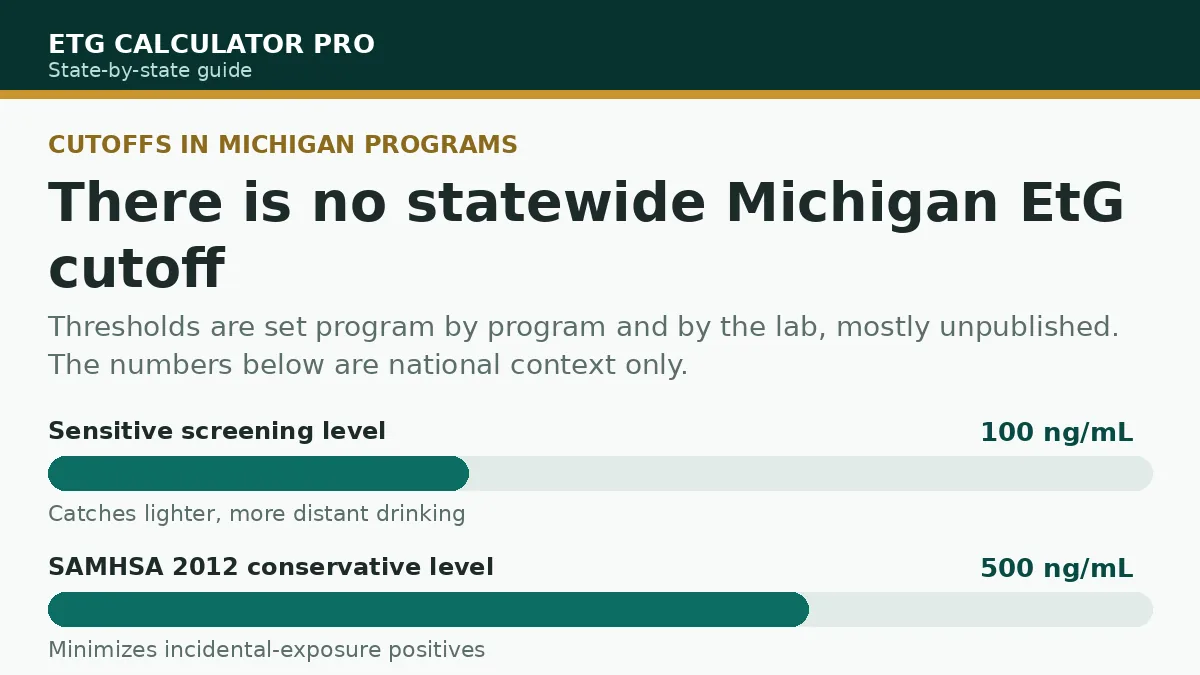
The most important point on this page: there is no statewide Michigan EtG cutoff. We checked Michigan statutes, court rules, MDOC policies, sobriety-court standards and county manuals, family-court law, and license-restoration rules; none names an EtG threshold. Thresholds are set program by program and by the lab, mostly unpublished. Your paperwork names the only cutoff that counts.
National context:
- 100 ng/mL — the sensitive level many labs use; catches lighter, more distant drinking.
- 500 ng/mL — SAMHSA's 2012 conservative recommendation.
- Labs screen anywhere from 100 to 1,000 ng/mL, depending on the program's goals.
Do not assume a Michigan program uses either number unless its paperwork says so. And do not confuse the numbers that do appear in Michigan law — 0.08% and 0.17% BAC — with EtG cutoffs: those are breath-alcohol thresholds for OWI charges, not urine concentrations.
Detection windows in Michigan programs
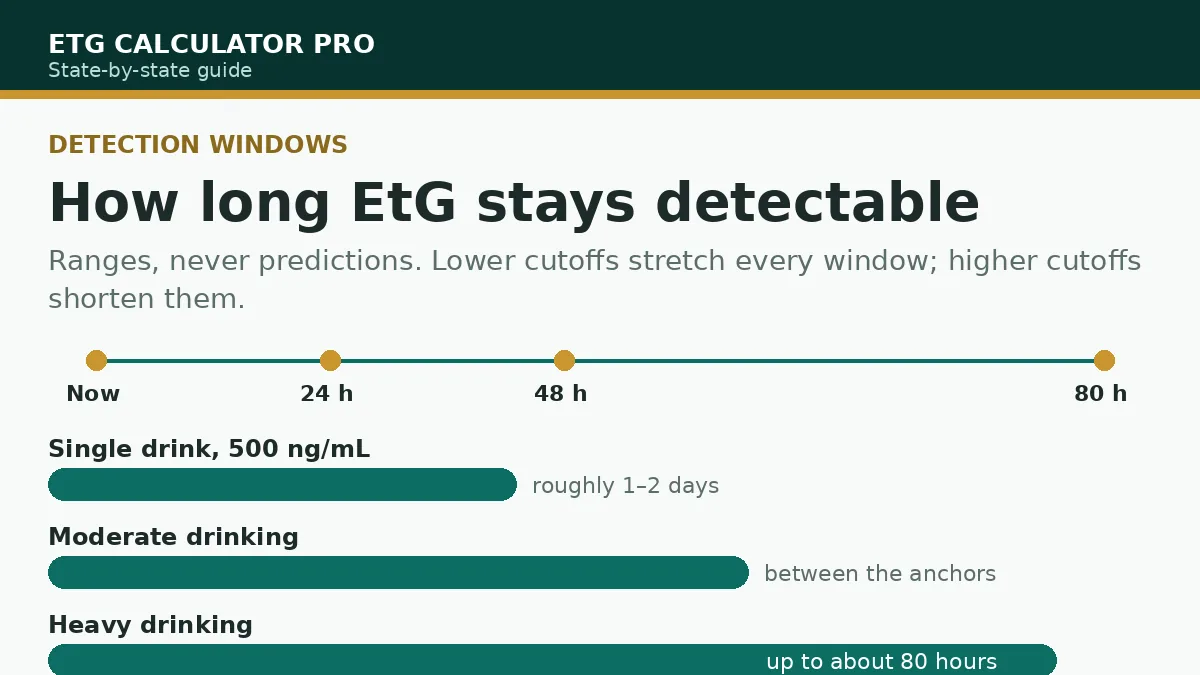
Detection windows are ranges, never predictions:
- Heavy drinking: up to about 80 hours after the last drink.
- A single drink: roughly 1–2 days at a 500 ng/mL cutoff; lower cutoffs extend the window.
- Moderate drinking: between those anchors.
The biggest lever is the cutoff: at 100 ng/mL, the same episode stays detectable longer. One caution: an NIH-funded study found EtG detection sensitivity poor after 48 hours at every dose and cutoff it tested, and called marketing of EtG as an 80-hour test unsubstantiated. Treat any window as a range with wide individual variation, not a countdown.
Apply these ranges with our homepage calculator or our detection timeline tool.
A realistic Michigan scenario
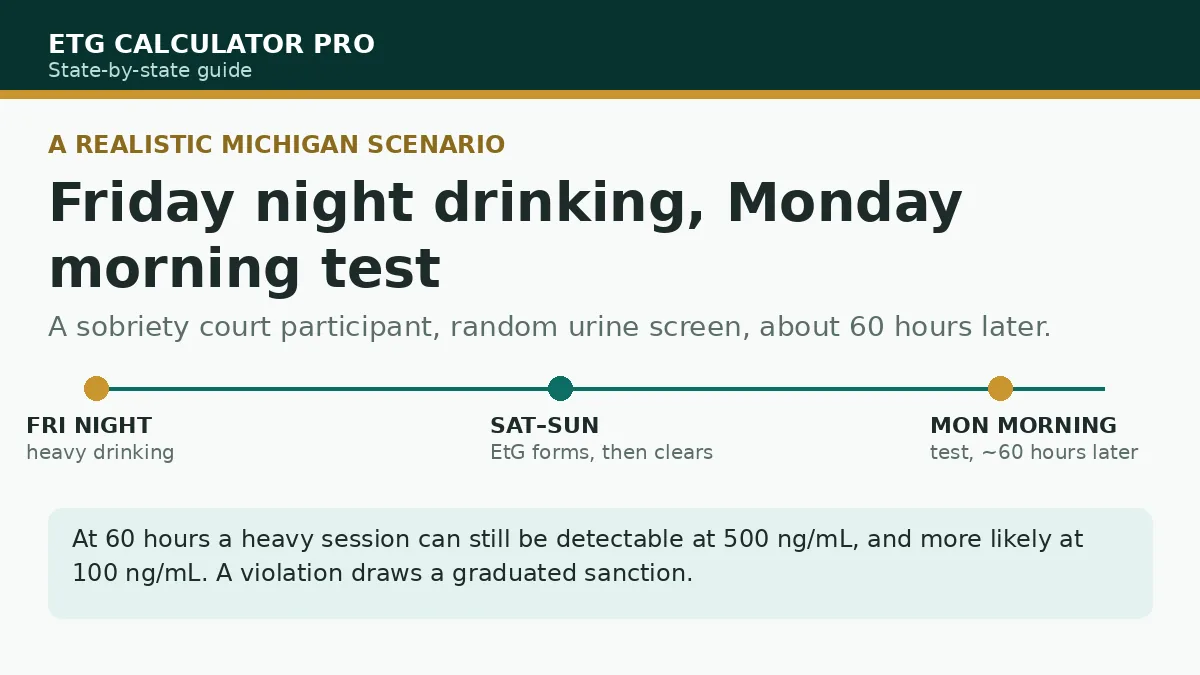
Consider a second-offense OWI defendant in a Michigan sobriety court, in the early intensive phase: twice-daily breath tests, weekly random urine screens, and a no-alcohol condition. He drinks heavily on a Friday night, then faces a random urine screen on Monday morning, about 60 hours later.
Sixty hours sits inside the published range for heavy drinking, so the result could go either way: at 500 ng/mL a heavy session can still be detectable, while a lighter one would likely have cleared; at 100 ng/mL, a positive is more likely. In sobriety court, a violation draws a graduated sanction — increased testing, added treatment, or short jail time — rather than automatic termination, but repeated violations can end the program and restore the original revocation and sentence exposure.
No pass-or-fail claim is possible from a timeline alone.
A note on legal advice
This page is educational, describing how EtG testing works in Michigan probation, OWI programs, sobriety courts, parole, and family court. It is not legal advice, and program rules change. If you are subject to testing, your program's requirements — and an attorney if a violation is alleged — are the authorities that matter.
Frequently asked questions
Is there one Michigan EtG cutoff?
No. No Michigan statute, court rule, MDOC supervision policy, sobriety-court standard, or licensing-board page we checked publishes a statewide EtG cutoff. Each court, program, and lab sets its own, mostly unpublished. Nationally the common levels are 100 and 500 ng/mL (SAMHSA, 2012); neither is a Michigan rule. Your program's paperwork names the only number that counts.
Does Michigan probation use EtG testing?
Michigan probation can include alcohol and drug testing: under MCL 771.3, the court may impose conditions reasonably necessary for rehabilitation and public safety, and courts routinely order testing under that authority, including EtG urine testing for alcohol where abstinence is ordered. Most Michigan counties run random testing, often on a color-code system where you call in daily to learn whether your color was drawn. Missing or failing a drug test is a technical probation violation under MCL 771.4b. Most probation sources describe testing generically, as drug testing or urinalysis, not EtG by name — EtG applies where your program or lab specifies it.
What is Michigan sobriety court, and how does testing work there?
Sobriety court — Michigan's DWI/sobriety court under MCL 600.1084 — is a post-adjudication specialty program for repeat OWI offenders, typically running about two years in four phases. Testing is frequent, especially early: some programs require twice-daily breath tests plus weekly random urine screens, easing as participants progress. Admission can also unlock a restricted license after at least 45 days without a license, once an approved ignition interlock device is installed on every vehicle you own or drive (MCL 257.304). The interlock is a breath device, not an EtG test; participants can be subject to both.
What is Michigan's 'super drunk' law?
Michigan calls drunk driving OWI — operating while intoxicated — under MCL 257.625. The standard limit is 0.08% BAC for drivers 21 and older; operating with a high BAC of 0.17% or more is a separate, enhanced category, commonly called 'super drunk.' A first super drunk offense carries up to 180 days in jail and fines of $200 to $700, versus up to 93 days and $100 to $500 for a standard first OWI, plus a one-year license suspension with no restricted driving during the first 45 days. These are breath-alcohol tiers, not EtG cutoffs.
Can a Michigan family court order EtG testing?
Yes, at the judge's discretion. Custody and parenting time are decided on the child's best interests, and when substance use is raised, the court can order drug testing or a Friend of the Court investigation, which may include interviews, record review, and home visits. Testing can be one-time or ongoing, and a positive result is one factor among many, not a custody decision on its own. Remote breath monitoring is also used in some parenting-time cases. Testing is not automatic; it follows a request and a reason to order it.
How long after drinking can an EtG test detect alcohol in Michigan?
The biology does not change at the state line: up to about 80 hours after heavy drinking, roughly 1–2 days after a single drink at 500 ng/mL; lower cutoffs extend the window. These are research ranges, not predictions. A Michigan study often cited in this debate found EtG detection sensitivity poor after 48 hours at every dose and cutoff it tested — a reminder that the '80-hour test' label is a marketing shorthand, not a guarantee.
Evidence and limitations
This guide summarizes primary research, public-health guidance, and Michigan public records. Group-level findings cannot predict one person's result.
- Michigan probation drug testing rules — MCL 771.3 probation conditions, EtG use in alcohol cases, random color-code testing, technical violations under MCL 771.4b
- Michigan drunk driving alcohol testing — bond conditions under MCR 6.106; PBT, SCRAM, and EtG/EtS methods; EtG typically 1–2 times per week
- MCL 600.1084 — DWI/sobriety court and the specialty court interlock program; SCAO certification; eligibility (two or more OWI convictions); restricted license after interlock installation
- Michigan Courts — Problem-Solving Courts: 128 drug/sobriety courts as of June 30, 2026 (61 hybrid DWI/drug, 45 DWI, 13 adult drug, 5 juvenile, 4 tribal)
- Michigan Judicial Institute — State-certified treatment courts: drug treatment courts (MCL 600.1062), DWI/sobriety courts (MCL 600.1084), specialty court interlock program
- Lenawee County Sobriety Court — twice-daily PBTs and weekly random urine screens at first, testing continuing on at least a random basis until graduation; violations draw graduated sanctions
- Michigan Department of Corrections — Parole & Probation: Field Operations Administration, 10 regions, parole typically one to four years, probation conditions set by the court
- MCL 791.240 — Parolees with a history of substance abuse on intensive, maximum, or medium supervision must submit to substance abuse testing at least twice each month
- Michigan BAC limits and OWI penalties — 0.08% standard limit, 0.17% high-BAC ('super drunk') tier under MCL 257.625; first-offense penalties for both tiers
- 34th District Court Sobriety Court — restricted license after a minimum 45 days without a license; interlock required on every vehicle owned or operated
- 12-panel drug test in Michigan — OHAO license-restoration evidence requires a lab 12-panel report with cutoffs and integrity variables; alcohol (EtG/EtS) requires a separate test
- Court-ordered drug testing in Michigan custody cases — best-interests standard, testing ordered on evidence of substance abuse, safeguards including random testing or supervised visitation
- Determining Ethyl Glucuronide Cutoffs (PMC) — SAMHSA Advisory 2012 conservative 500 ng/mL recommendation; lab cutoffs 100–1,000 ng/mL