Why the United States tests for EtG so widely
Breath and blood tests only catch alcohol for hours — roughly 12 to 24 hours after the last drink. That is fine for roadside stops, but it is useless for the job most American alcohol-monitoring programs actually do: verifying that someone stayed abstinent between appointments that may be days apart. Courts, probation departments, and treatment programs need a retrospective test, one that can look back across a weekend rather than across a shift.
Ethyl glucuronide (EtG) fills that gap. It is a direct, minor metabolite of ethanol: the liver conjugates a tiny fraction of each dose with glucuronic acid, and the kidneys excrete the result in urine. Because EtG forms only from ethanol that was actually metabolized, it is a highly specific marker of alcohol exposure. After heavier drinking, it can be detected in urine for up to about 80 hours — roughly three and a half days — which is why it has become the default test wherever abstinence, not current impairment, is what a program is checking. Many laboratories measure a sibling metabolite, ethyl sulfate (EtS), alongside EtG to strengthen the result.
Who gets EtG-tested in the United States
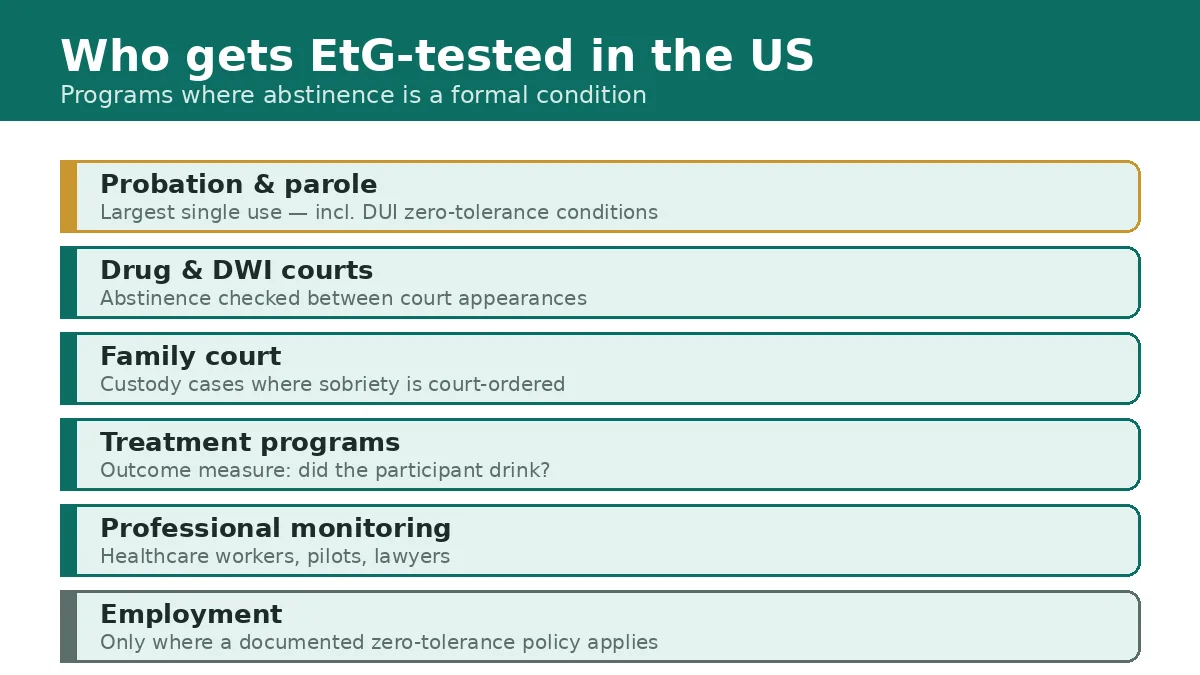
EtG testing is not random workplace screening. It shows up wherever a US program has made abstinence a formal condition. The main settings, documented by legal and testing-industry sources, are:
- Probation and parole. This is the largest single use. Probation programs that need to monitor alcohol abstinence reach for EtG because standard urine panels do not test for alcohol at all — alcohol clears the body within hours, so a standard panel would miss it entirely. The test is especially popular under zero-tolerance probation conditions for DUI offenders.
- Drug courts and DWI courts. Abstinence is typically a condition of participation, and EtG gives the court a multi-day window into compliance between appearances.
- Family court. In child-custody cases where sobriety is a court-ordered condition, EtG is one of the tools judges use to verify it.
- Substance abuse treatment programs. Here EtG serves as an outcome measure — did the participant drink since the last visit — which is the setting SAMHSA’s advisory was written for.
- Professional monitoring programs. Healthcare workers, airline pilots, lawyers, and others in professions with formal monitoring requirements may be tested where abstinence is mandatory.
- Employment. EtG is not a test of current on-the-job impairment — testing-industry sources are explicit that it cannot show whether someone is impaired right now — so it does not belong in routine workplace sobriety testing. It appears in employment only where a documented policy makes abstinence itself the condition, such as return-to-work monitoring.
How EtG cutoffs vary across programs and states
Here is the fact that surprises most people: there is no single national EtG cutoff for these programs. EtG is not part of the federal DOT drug-testing panel, which sets fixed cutoffs for a fixed list of drugs — so no federal rule dictates the number. Each program, court, or laboratory sets its own threshold, and commercial laboratories use cutoffs ranging from 100 ng/mL to 1,000 ng/mL.
In practice, two levels dominate American monitoring programs: 100 ng/mL, the sensitive option, which catches more low-level and older drinking at the cost of a higher false-positive rate from incidental alcohol exposure such as hand sanitizer or mouthwash; and 500 ng/mL, the conservative option — in its 2012 advisory on alcohol biomarkers, the Substance Abuse and Mental Health Services Administration (SAMHSA) recommended this relatively conservative screening cutoff precisely because it reduces positives from incidental exposure.
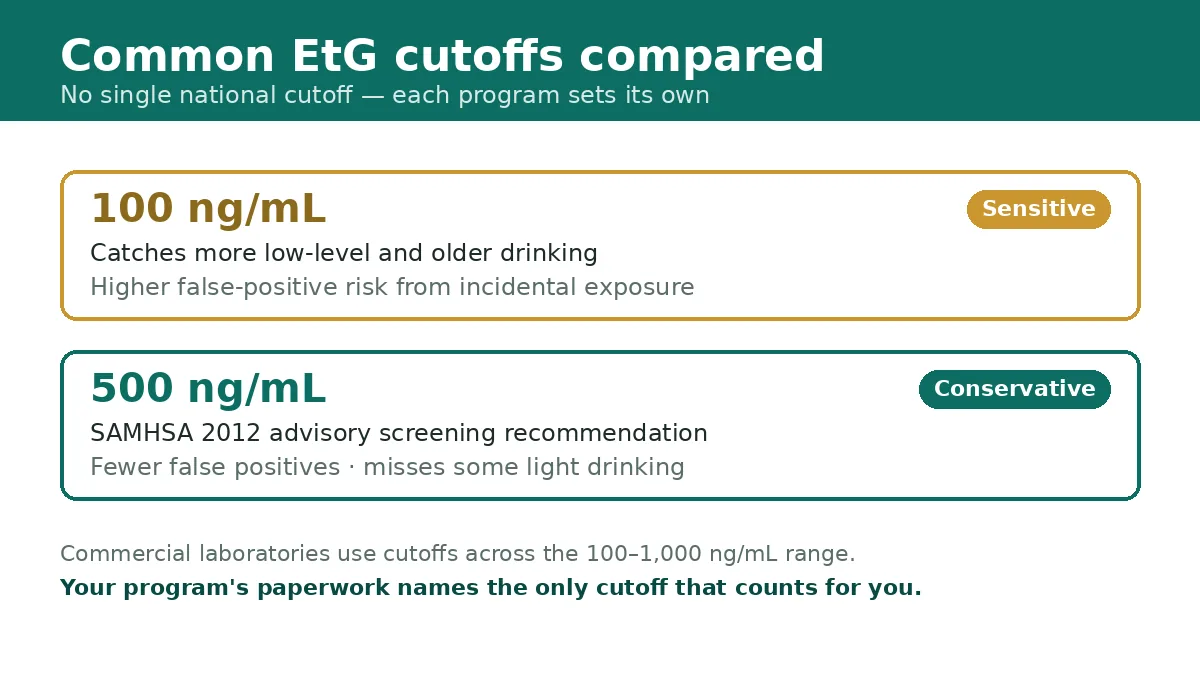
Because these programs are administered locally — by counties, individual courts, and program operators — the cutoff that applies to one person can differ from the cutoff used by a different program in the same state. Two people on probation in the same state can legitimately face different thresholds. That is why our state pages research the programs themselves rather than stating one number per state: the honest answer is that it varies, and the paperwork from your specific program is the only cutoff that counts for you.
What a positive EtG result actually means
A positive EtG result proves one thing: ethanol entered the body within the detection window. It does not measure impairment, it cannot calculate how many drinks were consumed, and a positive result the morning after a weekend does not mean the person was impaired at the time of the test. EtG is a test of exposure, and every honest interpretation starts there.
SAMHSA’s 2012 advisory gives the most widely cited framework for interpreting positive results, dividing them into three bands: a high positive (above 1,000 ng/mL) may indicate heavy drinking the same day or the previous day or two — or light drinking on the same day as the test; a low positive (500–1,000 ng/mL) may indicate previous heavy drinking one to three days earlier, recent light drinking within the past 24 hours, or recent intense extraneous (non-beverage) exposure; a very low positive (100–500 ng/mL) may indicate previous heavy drinking one to three days earlier, previous light drinking 12 to 36 hours earlier, or recent extraneous exposure.
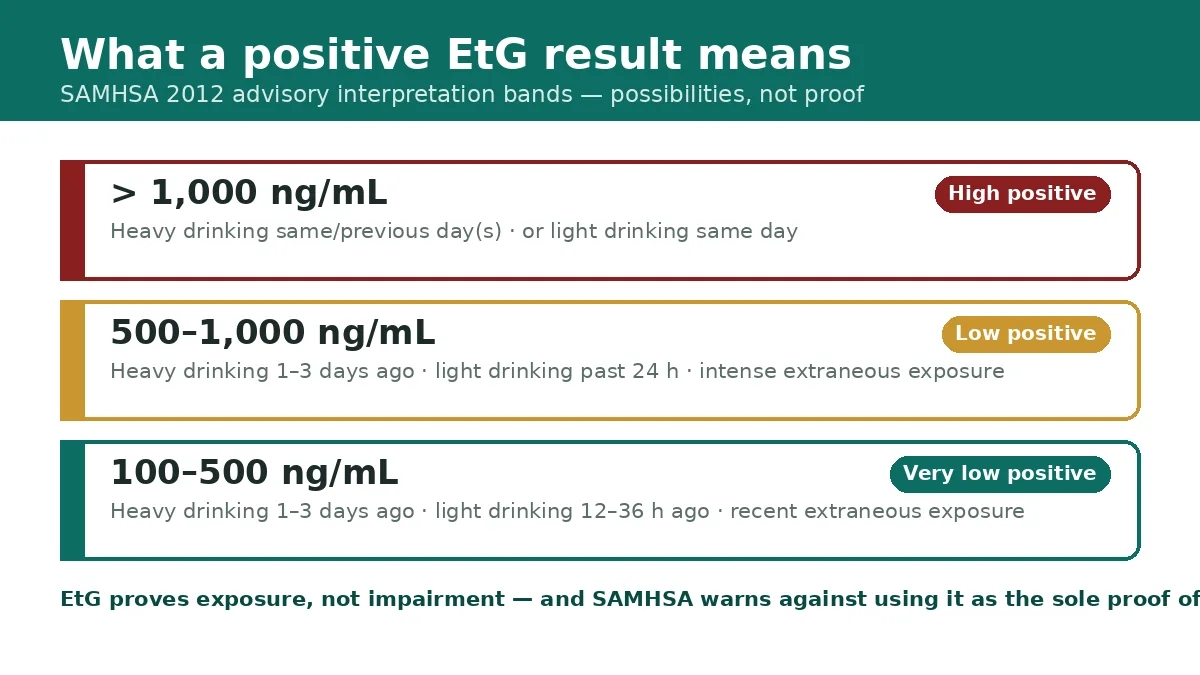
Note how often “extraneous exposure” appears: even SAMHSA’s framework treats incidental contact with alcohol-containing products as a live explanation for low results. The advisory is also explicit on the most important safeguard of all — EtG and EtS should not be used as the sole determinant of whether someone drank. A single number, by itself, is not proof of a violation.
Detection windows: how far back EtG can see
Detection windows are ranges, never guarantees. As a rough map of the territory: after heavier drinking, EtG can remain detectable for up to about 80 hours at commonly used cutoffs. After a single drink, clinical guidance tables put the window at roughly one to two days at the 500 ng/mL cutoff. Dose, timing, hydration, and body size all shift the numbers — which is exactly what our calculator is built to explore.
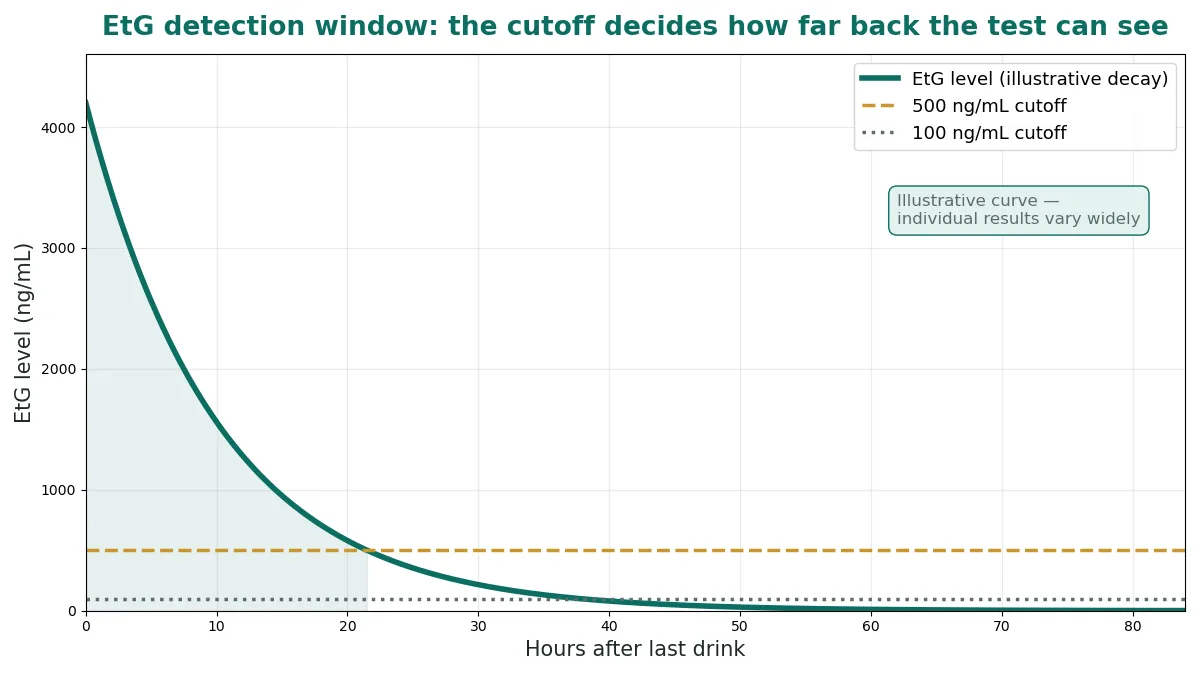
To estimate your own window, run the numbers through the EtG calculator on our homepage, or walk the timeline forward with the detection timeline calculator.
A realistic scenario
Consider someone on probation with a 500 ng/mL cutoff who drinks heavily on a Friday night and takes a random test on Tuesday morning — about 80 hours later. At the outer edge of the window, a heavy-drinking result can still be positive; by Thursday, the same cutoff would most likely be negative. Now change one variable: the same person, the same Friday, but a 100 ng/mL cutoff — and Tuesday’s test looks considerably more dangerous. Or keep the 500 cutoff but make it a single beer on Friday: Tuesday is almost certainly clear. The cutoff matters more than the calendar, and that is the single most useful thing to understand about EtG testing.
Safeguards that protect people who are tested
SAMHSA’s advisory does not just set a cutoff — it lays out how programs should handle questionable positives. Its recommended response includes considering clinical and other information about the person, increasing the frequency of testing to monitor status, following up with additional biomarkers such as CDT or PEth, and even a controlled trial in which the person is exposed to the product they believe caused the result. Transdermal alcohol-monitoring devices are another option the advisory names.
Incidental exposure is not a theoretical concern. Published research has shown that repeated use of ethanol-based hand sanitizer can produce EtG levels above the standard cutoff in people who consumed no alcohol at all, with elevated results persisting for six or more hours after exposure. Mouthwash, medications, cosmetics, and cleaning products containing ethanol sit in the same category. Anyone subject to EtG testing should treat this seriously — and any program that treats a single low positive as automatic proof of a violation is not following the advisory’s guidance.
Browse EtG testing by state
We are publishing one state page per day, each researched from that state’s courts, probation, DUI-program, and testing sources. Texas is first — our own search data already shows people looking for EtG testing information there — followed by Florida, California, and the rest of the priority list. Each page covers how EtG testing is used in that state, which programs order it, the cutoffs those programs commonly use, and the state-specific rules worth knowing.
The state list below becomes clickable as each page goes live:
- TexasPublishing next
- Florida
- California
- Ohio
- Georgia
- North Carolina
- Pennsylvania
- Arizona
- Michigan
- Colorado
- Indiana
- Tennessee
- Missouri
- Washington
- Virginia
- New Jersey
- Illinois
- South Carolina
- Alabama
- Oklahoma
A note on legal advice
This hub is educational. It explains how EtG testing works in the United States in general terms; it is not legal advice, and program rules change. If you are subject to testing, the specific requirements of your program — and, if a violation is alleged, an attorney — are the authorities that matter.
Frequently asked questions
Is there one national EtG cutoff in the United States?
No. EtG is not part of the federal DOT drug-testing panel, so no federal rule sets the number. Each program or laboratory sets its own cutoff; commercial laboratories use levels ranging from 100 ng/mL to 1,000 ng/mL. The two levels you will encounter most often are 100 ng/mL (sensitive) and 500 ng/mL (the conservative screening cutoff SAMHSA’s 2012 advisory recommended).
Why would two programs in the same state use different cutoffs?
Because the programs are administered locally — by counties, individual courts, and program operators — each one chooses its own threshold based on its philosophy and caseload. A 100 ng/mL cutoff catches more low-level and older drinking but produces more false positives from incidental exposure; a 500 ng/mL cutoff is more specific but misses some light drinking. Neither choice is wrong in the abstract; what matters is which one your paperwork names.
Can an EtG test tell how much someone drank?
Not reliably. EtG confirms that ethanol entered the body within the detection window; it does not measure impairment and cannot be converted into a drink count. SAMHSA’s interpretation bands give rough guidance — for example, a result above 1,000 ng/mL suggests heavier or very recent drinking — but they are explicitly framed as possibilities, not proof.
Can mouthwash or hand sanitizer cause a positive EtG result?
Yes — this is documented, not hypothetical. Research has shown that inhalation of ethanol from hand sanitizer can produce EtG levels above the standard cutoff in people who drank nothing, with elevated results lasting six or more hours. Mouthwash, medications, cosmetics, and cleaning products containing ethanol are in the same category. SAMHSA’s advisory specifically lists recent extraneous exposure as a possible explanation for low positive results.
How long after drinking can EtG be detected?
It depends on dose and cutoff. After heavier drinking, EtG can remain detectable for up to about 80 hours at commonly used cutoffs. After a single drink, clinical guidance tables put the window at roughly one to two days at 500 ng/mL. These are ranges, not guarantees — use the EtG calculator to explore estimates for a specific scenario.
Is one positive EtG result enough to violate someone’s probation?
SAMHSA’s advisory says EtG and EtS should not be used as the sole determinant of whether someone drank. Its recommended response to a questionable positive includes considering the person’s clinical picture, testing more frequently, and following up with additional biomarkers. Whether a specific program follows that guidance is a legal question — this page is educational, not legal advice.
Evidence and limitations
This guide summarizes primary research and public-health guidance. Group-level findings cannot predict one person’s result.
- SAMHSA Advisory: The Role of Biomarkers in the Treatment of Alcohol Use Disorders, 2012 revision (archived PDF copy)
- RTI summary of the SAMHSA alcohol-biomarkers advisory
- Determining ethyl glucuronide cutoffs when detecting self-reported alcohol use (PMC)
- ASAM Appropriate Use of Drug Testing in Clinical Addiction Medicine (detection-window table)
- Alcohol testing for court: types, costs, and consequences
- What drug tests do probation officers use?
- What is EtG on a drug test? (US Drug Test Centers)