How EtG testing works in Alabama
Ethyl glucuronide (EtG) is an alcohol metabolite found in urine after drinking.
Alabama's testing system rests on two laws. The Mandatory Treatment Act of 1990 (Ala. Code Title 12, Chapter 23) created the Court Referral Program and made testing mandatory for anyone convicted of an alcohol- or drug-related offense and placed on probation or parole. The drug court chapter (Title 12, Chapter 23A, enacted 2010) added random observed testing as a condition of pretrial release. Testing in Alabama is a standing obligation, with a test possible on any day.
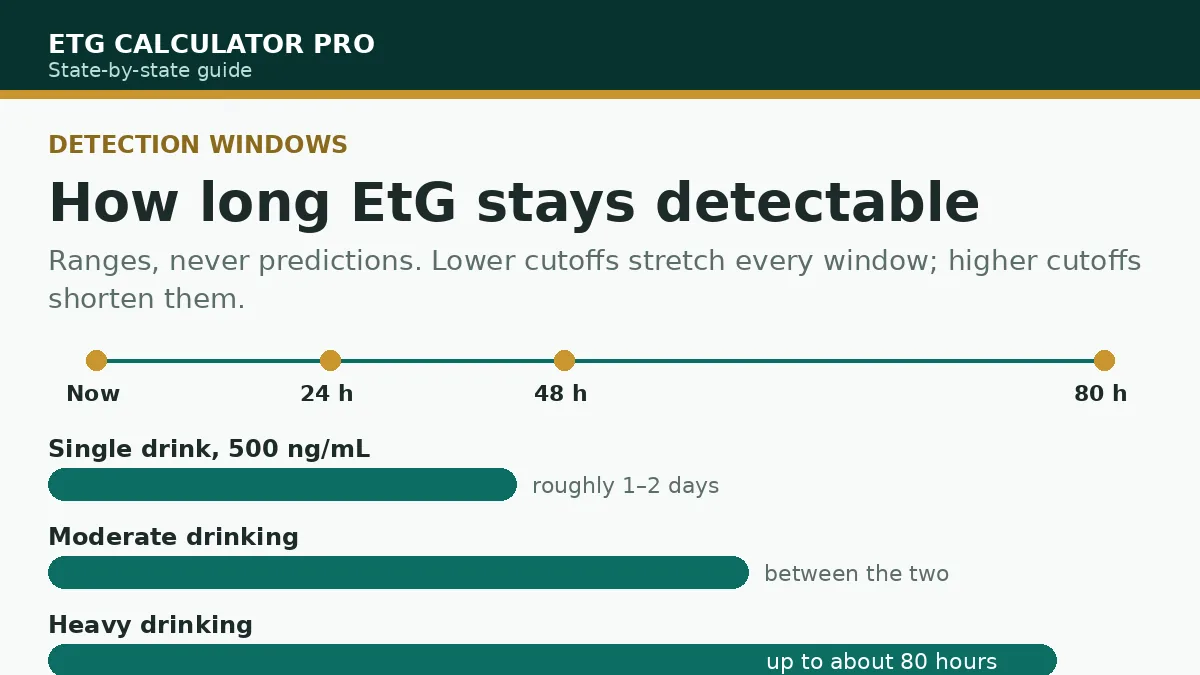
Who gets tested in Alabama and why
Probation and parole: color-code testing
Probation and parole are supervised by the Alabama Bureau of Pardons and Paroles, and the testing most people on supervision experience is color-code testing. Under Ala. Code § 12-23-7, any person convicted of an alcohol- or drug-related offense and placed on probation or parole must participate in an alcohol or drug testing program at their own expense, unless the court finds them indigent.
Each participant is assigned a color and must call a toll-free number every day to hear which colors have been selected. If your color is announced, you must report to your designated testing site that same day. Testing can happen any day of the week, including weekends, when hours are typically 8:00 a.m. to noon. Color-code programs primarily use urine tests, and a missed test counts as a failed test.
A failed test means a mandatory treatment assessment, completion of the recommended treatment, and payment for the assessment, treatment, and testing unless the court finds the person indigent. Failing to complete treatment or pay can be charged as a probation or parole violation, and a failed test can lead to a revocation hearing with jail time on the table.
DUI
Alabama prohibits driving or being in actual physical control of a vehicle with 0.08 percent or more alcohol in the blood, or while under the influence of alcohol or a controlled substance, under Ala. Code § 32-5A-191. Drivers under 21 face a 0.02 percent limit, and commercial drivers 0.04 percent.
A first conviction carries a fine of $600 to $2,100, up to one year in the county or municipal jail, or both, and a 90-day license suspension, stayed if the offender elects an approved ignition interlock device for 90 days. With an aggravating factor — 0.15 percent or higher, a child under 14 in the car, injury, or refusal — the minimum punishment at least doubles and interlock runs one year.
Penalties escalate with each conviction; priors count within 10 years. A second conviction brings a fine of $1,100 to $5,100, a mandatory minimum of five days in jail or 30 days of community service, a one-year license revocation, and two years of interlock. A third brings a fine of $2,100 to $10,100, a mandatory minimum of 60 days in jail, a three-year revocation, and three years of interlock. A fourth conviction within 10 years, or any DUI after a prior felony DUI, is a Class C felony: one year and one day to 10 years in prison, $4,100 to $10,100 in fines, a five-year revocation, and four years of interlock. A 2026 bill prefiled in the Legislature (House Bill 1) would require six months of interlock for a first DUI; it is a proposal, not law.
Court Referral Program
Every DUI conviction also runs through the Court Referral Program, established by the Mandatory Treatment Act of 1990 to identify the causes of court involvement and substance use and address them through education, treatment, and counseling. Court Referral Officers are appointed by the Administrative Director of Courts for each court jurisdiction.
A Court Referral Officer screens and evaluates every defendant ordered into the program, recommends an education or treatment program to the court, keeps a file on each defendant, monitors compliance, and reports violations and test results to the prosecutor or the court. While in the program, a person may not consume any alcohol or drug not prescribed by a licensed physician, random drug testing is instituted, and the person must report to the Court Referral Officer at least once a month. After evaluation, a first DUI offender typically enters a Level I or Level II program; a third-offense offender must complete Level III. Failure to complete the program results in a delinquency report and the likelihood of an active jail sentence.
Drug courts
Alabama drug courts are court-supervised, treatment-focused alternatives to incarceration, established under Ala. Code § 12-23A and guidelines from the Administrative Office of Courts. They are designed for first-time or low-level nonviolent drug offenders; a prior Class A felony or violent history makes a person ineligible. Most programs run 12 to 18 months in four phases, requiring about 90 consecutive clean days before graduation. Testing starts before admission: under Ala. Code § 12-23A-5, any drug offender who posts bail must submit to random observed drug tests as a condition of pretrial release, and the court must consider ordering a drug offender into drug court when a screening shows substance abuse and the district attorney consents.
Jefferson County's Drug Court runs three phases with random screens through a color-coded system — weekly, then bi-weekly, then monthly — completed after a clean drug test for 90 days. Its urine screens cover amphetamine, barbiturates, benzodiazepines, marijuana, cocaine, opiates, methadone, and buprenorphine. Jefferson County's Juvenile Drug Court handbook is blunt: a urine or breath sample on request, observed by a same-sex team member, submitted within 30 minutes or counted as positive, dilution treated as a violation, and over-the-counter products containing alcohol — including mouthwash — prohibited.
Family court and DHR
Alabama's custody statutes contain no provision specifically addressing alcohol use or testing. Courts evaluate alcohol concerns through the best-interest factors in Ala. Code § 30-3-152: the character and fitness of each parent, the ability to provide a stable and nurturing environment, and any history of abuse or neglect. A separate provision, Ala. Code § 30-3-131, creates a rebuttable presumption against awarding custody to a parent who has perpetrated domestic or family violence.
Alabama courts have broad discretion, but no rule allows testing on an accusation alone: a court is more likely to order testing when credible allegations are supported by corroborating evidence, a documented history, or a demonstrated concern for child safety. The Alabama Department of Human Resources (DHR) can also request a drug screening during a child-welfare investigation. A parent need not comply unless a court has ordered it, but refusing can lead DHR to ask the court for an order. Parents in dependency cases have a right to counsel under Ala. Code § 12-15-305.
License reinstatement and interlock
Getting a license back after a DUI runs through the Alabama Law Enforcement Agency (ALEA). After serving at least 45 days of a first-offense suspension (45 days for a second offense, 60 for a third), a driver may apply for an ignition interlock restricted license: 90 days for a first conviction under 0.15 percent, one year at 0.15 percent or higher or with another aggravating factor, two years on a second conviction, three on a third, four on a fourth, plus an extra year for a refusal. Completing the Court Referral Program is a condition of the sentence; failure can mean an active jail sentence rather than a reinstated license.
Cutoffs used in Alabama programs
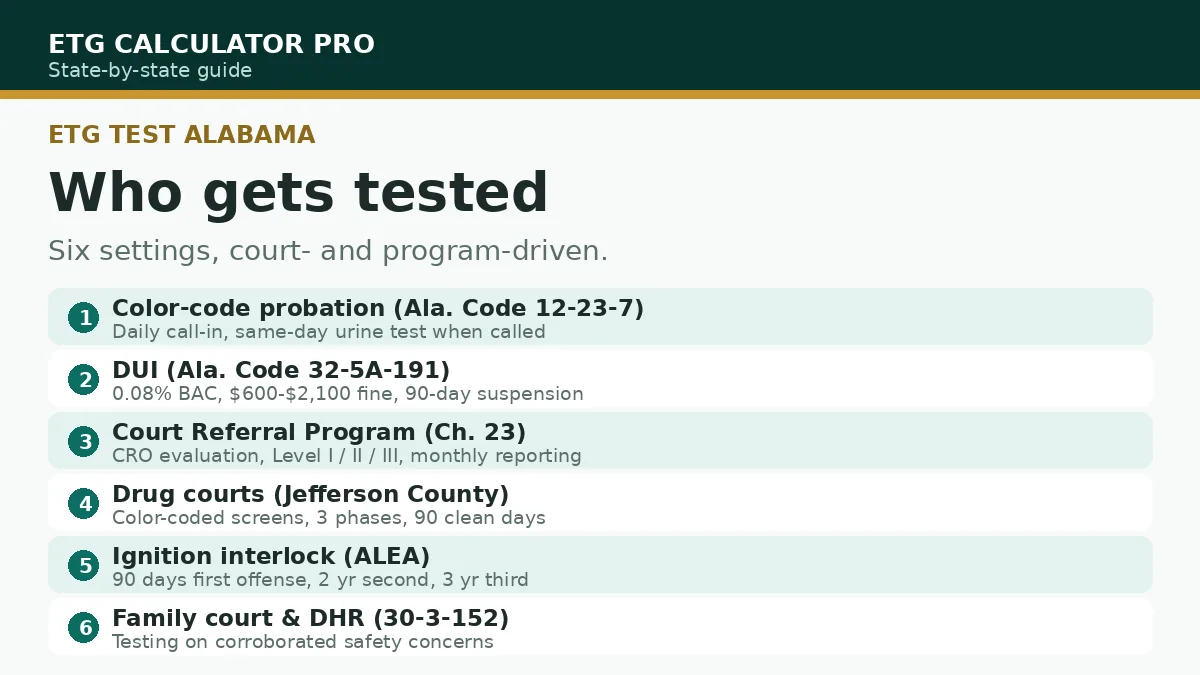
There is no statewide Alabama EtG cutoff: no statute, court rule, or state program document we checked names a threshold. Your paperwork names the only one that counts.
National context:
- 100 ng/mL — the sensitive level many labs use.
- 500 ng/mL — SAMHSA's 2012 conservative recommendation.
- Labs screen anywhere from 100 to 1,000 ng/mL.
Do not assume an Alabama program uses either number, and do not confuse the 0.08%, 0.04%, and 0.02% BAC figures in Alabama law with EtG cutoffs.
Detection windows in Alabama programs
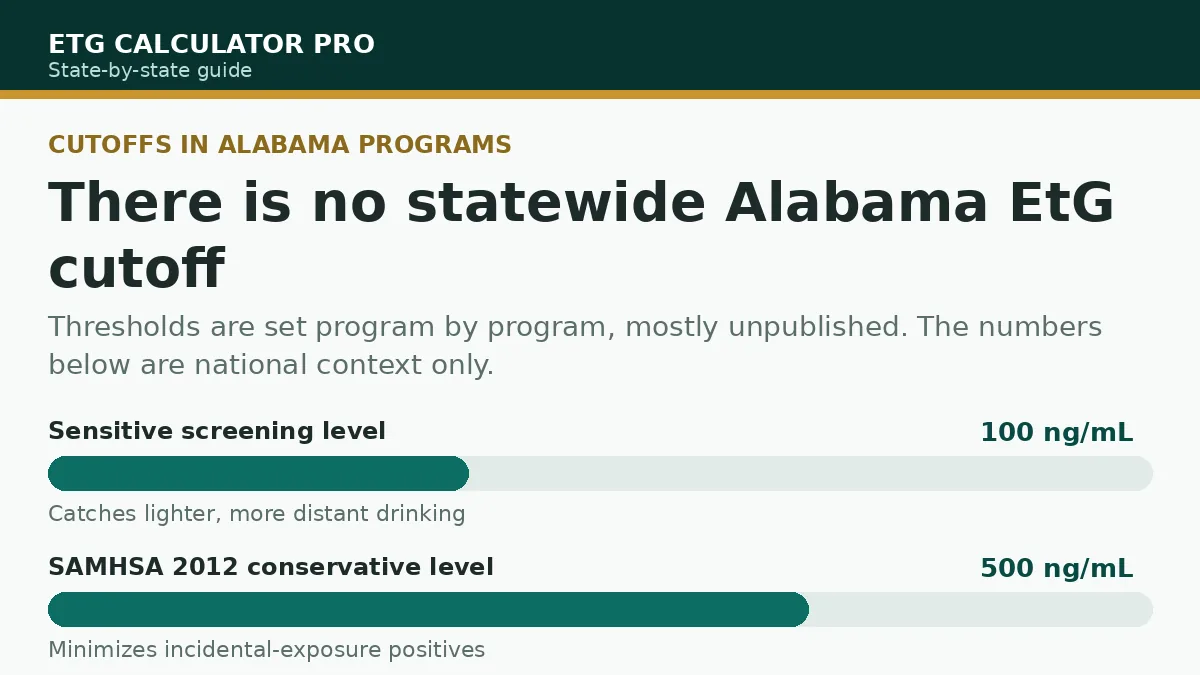
- Heavy drinking: up to about 80 hours after the last drink.
- A single drink: roughly 1–2 days at a 500 ng/mL cutoff.
- Moderate drinking: between those two.
The biggest lever is the cutoff: at 100 ng/mL the same episode stays detectable longer.
Try these ranges in our homepage calculator or our detection timeline calculator.
A realistic Alabama scenario
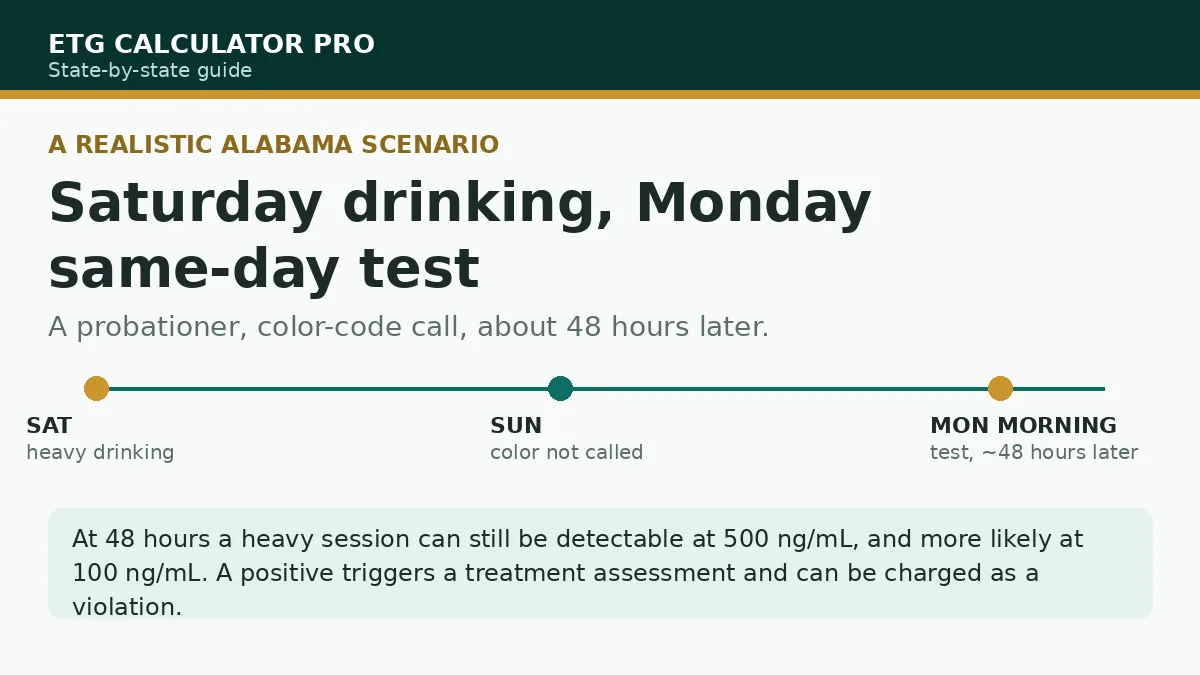
Consider a person on probation in Birmingham after a DUI conviction who drinks heavily at a Saturday cookout. On Sunday their color is not called. On Monday they call again, and this time their color is announced: they must report to the testing site that same day, about 48 hours after the last drink.
Forty-eight hours sits inside the published range for heavy drinking: at 500 ng/mL a heavy session can still be detectable, while a lighter one would likely have cleared. A positive would trigger a mandatory treatment assessment and completion of the recommended treatment, and failing to complete it can be charged as a probation violation. A new positive test in the Court Referral Program can also bring a delinquency report and the likelihood of an active jail sentence.
A note on legal advice
This page is educational, not legal advice, and program rules change. If you are subject to testing, your program's requirements — and an attorney if a violation is alleged — are what matter.
Frequently asked questions
Is there one Alabama EtG cutoff?
No. No Alabama statute, court rule, Bureau of Pardons and Paroles standard, or state program document we checked publishes a statewide EtG cutoff. Each court, Court Referral Officer, probation or parole officer, treatment program, and lab sets its own, mostly unpublished. Nationally the common levels are 100 and 500 ng/mL (SAMHSA, 2012); neither is an Alabama rule. Your program's paperwork names the only number that counts. And do not confuse the numbers that do appear in Alabama law — 0.08%, 0.04%, and 0.02% BAC — with EtG cutoffs: those are blood-alcohol thresholds for DUI charges, not urine concentrations.
What is color-code testing in Alabama?
Color-code testing is Alabama's random drug and alcohol testing system for people convicted of an alcohol- or drug-related offense and placed on probation or parole. Under Ala. Code § 12-23-7, participation is mandatory and at the person's own expense unless the court finds them indigent. Each participant is assigned a color and must call a toll-free number every day to hear which colors have been selected; if your color is called, you must report to your designated testing site that same day, including weekends, when hours are typically 8:00 a.m. to noon. Testing is usually by urine screen, and a missed test counts as a failed test. A failed test triggers a mandatory treatment assessment, completion of the recommended treatment, and payment for the assessment, treatment, and testing unless the court finds you indigent; failing to complete treatment or pay can be charged as a probation or parole violation.
Does Alabama probation use EtG testing?
Yes. Probation and parole in Alabama are supervised by the Alabama Bureau of Pardons and Paroles, and testing is built into supervision in two ways. First, the color-code system above applies to everyone convicted of an alcohol- or drug-related offense on probation or parole. Second, people referred through the Court Referral Program are monitored by a Court Referral Officer, who collects urine screens and other drug test results, reports violations to the prosecutor or the court, and requires the person to report at least once a month. In the federal courts in Alabama, standard conditions of supervision require a drug test within 15 days of release from imprisonment and at least two periodic drug tests after that, with placement in a substance abuse intervention program after a positive test or evidence of excessive alcohol use. Testing can also be a condition of pretrial release: under Ala. Code § 12-23A-5, a drug offender who posts bail must submit to random observed drug tests.
What happens after a DUI conviction in Alabama?
A first DUI under Ala. Code § 32-5A-191 carries a fine of $600 to $2,100, up to one year in the county or municipal jail, or both, and a 90-day license suspension that is stayed if the driver elects to have an approved ignition interlock device installed and operating for 90 days. If the blood alcohol level was 0.15% or higher, a child under 14 was in the car, someone else was injured, or the driver refused the test, the court orders one year of interlock and at least double the minimum punishment. A second conviction brings a fine of $1,100 to $5,100, a mandatory minimum of five days in jail or 30 days of community service, a one-year license revocation, and two years of interlock. A third brings a fine of $2,100 to $10,100, a mandatory minimum of 60 days in jail that cannot be suspended or probated, a three-year revocation, and three years of interlock. A fourth conviction within 10 years is a Class C felony, with one year and one day to 10 years in prison, fines of $4,100 to $10,100, a five-year revocation, and four years of interlock. Every DUI conviction also means an evaluation by a Court Referral Officer and enrollment in a court-approved substance abuse program.
What is Alabama's Court Referral Program?
The Court Referral Program was created by the Mandatory Treatment Act of 1990 (Ala. Code Title 12, Chapter 23) to serve the courts by identifying the causes of court involvement and substance use and addressing them through education, treatment, and counseling. Court Referral Officers are appointed by the Administrative Director of Courts for each court jurisdiction. A Court Referral Officer screens and evaluates every defendant ordered into the program, recommends an education or treatment program to the court, monitors compliance, collects urine screens and drug test results, and reports violations to the prosecutor or the court. While in the program, a person is prohibited from consuming any alcohol or drug not prescribed by a licensed physician, random drug testing is instituted to ensure compliance, and the person must report to the Court Referral Officer at least once a month. After evaluation, a first DUI offender is typically enrolled in a Level I or Level II substance abuse program; a third-offense DUI offender must complete a Level III program. Failure to complete the program as required results in a delinquency report and the likelihood of an active jail sentence.
How do Alabama drug courts test participants?
Alabama drug courts are court-supervised, treatment-focused alternatives to incarceration for people with substance use disorders, established under Ala. Code § 12-23A and guidelines from the Administrative Office of Courts. Testing starts before admission: under § 12-23A-5, a drug offender who posts bail must submit to random observed drug tests as a condition of pretrial release, and a screening is required when a test is positive, the person admits substance use, or the charge involves a controlled substance or impaired driving. The court must consider ordering a drug offender into drug court when a screening shows substance abuse and the district attorney consents. Jefferson County's Drug Court runs in three phases with random drug screens through a color-coded selection system — weekly in the first phase, then bi-weekly, then monthly — and the program is completed once the person has a clean drug test for 90 days; its urine screens cover amphetamine, barbiturates, benzodiazepines, marijuana, cocaine, opiates, methadone, buprenorphine, and heroin. Jefferson County's Juvenile Drug Court handbook is concrete about the rules: a urine or breath sample on request, observed by a same-sex member of the drug team, submitted within 30 minutes or counted as positive, with dilution treated as a violation and over-the-counter products containing alcohol — including mouthwash — prohibited. Most Alabama drug court programs run 12 to 18 months in four phases and require about 90 consecutive days of clean tests in the final phase before graduation.
Can an Alabama family court or DHR order EtG testing?
Yes, at the judge's discretion, but Alabama has no custody statute that specifically addresses alcohol use or alcohol testing. Courts weigh alcohol concerns through the broader best-interest factors in Ala. Code § 30-3-152 — the character and fitness of each parent, the ability to provide a stable and nurturing environment, and any history of abuse or neglect — and a separate provision, § 30-3-131, creates a rebuttable presumption against awarding custody to a parent who has perpetrated domestic or family violence. In practice, a court is more likely to order testing or other safeguards when credible allegations are supported by corroborating evidence, a documented history of alcohol-related incidents, or a demonstrated concern for child safety; testing on the basis of an accusation alone is not the norm. The Alabama Department of Human Resources (DHR) can also request a drug screening during a child-welfare investigation. You are not automatically required to comply with a DHR request unless a court has ordered it, but refusing can raise concerns and lead DHR to ask the court for an order, and if children are removed, the juvenile court must hold a hearing within 72 hours. Parents in dependency cases have a right to counsel under Ala. Code § 12-15-305.
Evidence and limitations
This guide summarizes primary research, public-health guidance, and Alabama public records. Group-level findings cannot predict one person's result.
- Ala. Code § 32-5A-191 — Driving While Under Influence of Alcohol, Controlled Substances, Etc. (2025 statute text): unlawful to drive or be in actual physical control of a vehicle with 0.08 percent or more alcohol in the blood, or while under the influence; under 21, 0.02 percent; on a first conviction, imprisonment for not more than one year or a fine of not less than $600 nor more than $2,100, or both, and a 90-day suspension stayed if the offender elects an approved ignition interlock device for 90 days; a person arrested for DUI shall not be released from jail until blood alcohol is below 0.08 percent (0.02 percent if under 21)
- Ala. Code § 12-23-7 — Mandatory Drug Testing at Own Expense for Person Convicted of Alcohol or Drug-Related Offenses and Placed on Probation or Parole (2025 statute text): any person convicted of an alcohol or drug-related offense and placed on probation or parole shall participate in an alcohol or drug testing program at their own expense unless indigent; a person who fails the test must provide information for a treatment assessment, complete the recommended treatment, and pay unless indigent; failure to complete treatment or pay can be charged as a violation of probation or parole
- Ala. Code § 12-23-4 — Court referral officers or contracting entities (2006 statute text): the Administrative Director of Courts may appoint court referral officers to provide alcohol and drug assessment and conduct the court referral programs in each court jurisdiction; officers screen and evaluate defendants, recommend education or rehabilitation programs, maintain files including drug screen results, continuously monitor defendants, and collect and report urine screen and drug testing results to the courts
- Ala. Code § 12-23A-5 — Drug Tests; Screening; Confidentiality of Information; Criteria for Participation (2020 statute text): any drug offender who posts bail shall submit to random observed drug tests as a condition of pretrial release; a screening is required when a test is positive, the offender requests one, admits substance use within the past year, or refuses a required test; the court shall consider ordering participation in drug court when a screening reveals substance abuse and the district attorney consents
- Conditions of Supervision, U.S. District Court for the Northern District of Alabama — standard conditions require submitting to one drug test within 15 days of release from imprisonment and at least two periodic drug tests thereafter, as determined by the court; on a court order for good cause, or after a positive drug test or evidence of excessive use of alcohol, the person shall be placed in the Substance Abuse Intervention Program
- City of Hoover Municipal Court — Court Referral Program: the State of Alabama Court Referral Program was established by the Mandatory Treatment Act of 1990; the Court Referral Officer evaluates a client to place and refer them and monitors compliance; while in the program the person is prohibited from consuming any alcohol or drug not prescribed by a licensed physician, random drug testing is instituted, and the person must report to the Court Referral Officer at least once a month
- DUI FAQs (Montgomery, Alabama) — on a first DUI with a 0.15% blood alcohol result the court must impose double minimum punishment and order attendance at a court-approved substance abuse program; after evaluation by the Court Referral Officer the motorist is enrolled in a Level I or Level II program; failure to complete the program results in a delinquency report and the likelihood of an active jail sentence; a third-offense DUI offender must complete a Level III program
- Color Code Probation in Alabama: How It Works — Alabama's color code probation requires anyone convicted of an alcohol or drug-related offense and placed on probation or parole to submit to random drug and alcohol testing at their own expense under Ala. Code § 12-23-7; each participant is assigned a color and must call a toll-free number every day; if the color is announced, the person must report to the testing site that same day; weekend hours are typically 8:00 a.m. to noon; a missed test counts as a failed test; most participants are tested three to five times per month
- Baldwin County Color Code: Rules, Violations, and Rights — the Baldwin County color code system is run by the Baldwin County Court Referral Office and applies to people on probation, pretrial release, or in drug court after an alcohol- or drug-related offense; a missed test counts as a failed test and repeated violations can lead to jail time or revocation of probation; the program runs through the statewide Court Referral Officer program under Ala. Code Title 12, Chapter 23
- What Are the Rules in the Alabama Drug Court Manual? — Alabama drug courts are established through Ala. Code § 12-23A and guidelines from the Administrative Office of Courts; programs run 12 to 18 months in four phases (Stabilization, Education/Treatment, Transition, Aftercare); Phase I requires weekly court appearances and frequent drug testing, decreasing as participants advance; successful completion generally requires approximately 90 consecutive days of clean drug tests in the final phase; a prior Class A felony or violent history makes a person ineligible
- Method Development of Drug Court Samples (UAB thesis, 2022) — Jefferson County Drug Court is available to youth and adults to help first-time offenders with felony drug offenses, with cases dismissed on completion; three phases with random drug screens through a color-coded selection system (weekly, bi-weekly, monthly); completed once the person has a clean drug test for 90 days; urine screens cover amphetamine, barbiturates, benzodiazepines, marijuana, cocaine, opiates, methadone, buprenorphine, and heroin
- Jefferson County Juvenile Drug Court — Drug Testing Agreement: a participant must provide a urine or breath sample at any time on request by any member of the drug treatment court team, observed by a same-sex member of the team; a sample not submitted within 30 minutes of request is considered positive; attempts to adulterate a sample, including dilution, are a violation; over-the-counter medications and products containing alcohol, including mouthwash, are prohibited
- Alcohol Testing in Child Custody: Each State's Laws, Explained (2026) — Alabama: the custody statutes include no provision specifically addressing alcohol use or testing; courts evaluate alcohol concerns through the best-interest factors in Ala. Code § 30-3-152 (character and fitness of each parent, ability to provide a stable and nurturing environment, history of abuse or neglect); § 30-3-131 creates a rebuttable presumption against custody for a parent who has perpetrated domestic or family violence; testing is more likely when credible allegations are supported by corroborating evidence, a documented history, or a demonstrated concern for child safety
- Do I have to take a drug screening requested by DHR during an investigation? (Justia Ask A Lawyer) — a parent is not automatically required to comply with a DHR drug screening request unless a court has ordered it, but refusing can raise concerns and lead to further investigation or a court petition; if DHR asks the court for an order, refusal can carry serious consequences including affecting custody or visitation
- What are my rights with DHR? (Justia Ask A Lawyer) — a parent is not required to submit to DHR-requested drug screens, but refusal is often used to justify removing the children; if so, there is a 72-hour hearing at which the parent should request an appointed attorney; in Alabama dependency cases the court must inform a parent of the right to counsel and appoint one if indigent (Ala. Code § 12-15-305)
- Alabama DUI Code: Penalties from First Offense to Felony — second DUI: fines $1,100 to $5,100, mandatory minimum five days in jail or 30 days community service, one-year revocation, two years of interlock, with interlock beginning after at least 45 days of the revocation; third DUI: fines $2,100 to $10,100, mandatory minimum 60 days in jail, three-year revocation, three years of interlock; mandatory interlock periods of one year for a first offense (two years at 0.15% or higher), two years for a second, three for a third
- Alabama DUI Laws: What You Need To Know In 2026 — first DUI: up to one year in jail, a fine starting at $600, a 90-day suspension stayed by a 90-day interlock; second: mandatory minimum five days in jail or 30 days community service, one-year revocation, two years of interlock; third: 60 days in jail, three-year revocation, three years of interlock; fourth: Class C felony with one year and one day to 10 years, $4,100 to $10,100 in fines, five-year revocation, four years of interlock; interlock terms of 90 days for a first conviction under 0.15%, one year at 0.15% or higher, two years on a second, three on a third, four on a fourth, with an extra year for a refusal; House Bill 1 (prefiled for the 2026 session) would require a six-month interlock for first-time DUI convictions
- Alabama House Bill 1 (2026 Regular Session, introduced) — a bill to amend Ala. Code § 32-5A-191 to require an ignition interlock device for the first violation of driving while under the influence; under existing law a first-time offender may have the mandatory 90-day suspension stayed with an approved ignition interlock device for 90 days; the bill would require the device for six months
- Alabama Bureau of Pardons and Paroles — the agency promotes public safety through investigation, supervision, and surveillance services, rehabilitating adult offenders; parole is release back into the general population under careful supervision
- Determining Ethyl Glucuronide Cutoffs (PMC) — SAMHSA Advisory 2012 conservative 500 ng/mL recommendation; lab cutoffs 100–1,000 ng/mL; interpretation bands