How EtG testing works in South Carolina
Ethyl glucuronide (EtG) is an alcohol metabolite found in urine after drinking. Courts and probation officers use it to answer one question: has this person consumed alcohol since the last check-in?
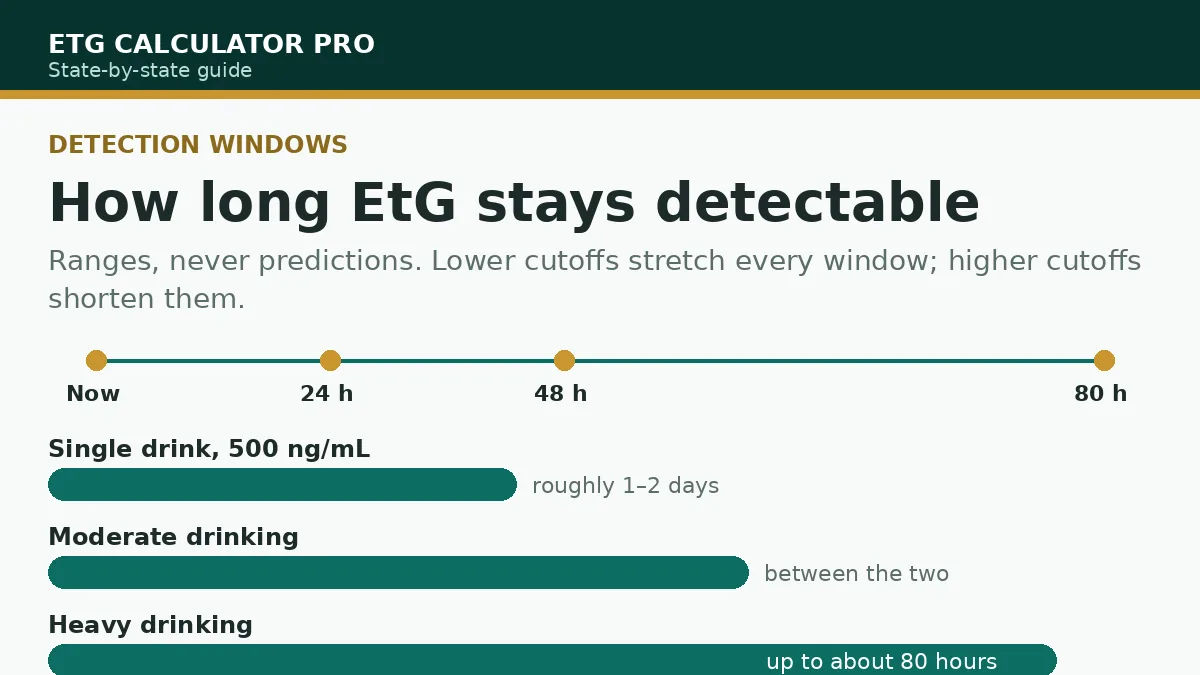
Who gets tested in South Carolina and why
Probation
South Carolina probation is supervised by the Department of Probation, Parole and Pardon Services (DPPPS). Its standard conditions require a probationer to submit to urine, blood, or other forensic testing whenever instructed — random or scheduled, during office visits or unannounced — and those results can be used as evidence in a violation hearing. Probationers also may not use controlled substances unless prescribed, may not drink alcohol excessively, and may not enter bars as their primary business.
For alcohol-related offenses, courts sometimes require continuous alcohol monitoring through SCRAM bracelets, which detect alcohol through the skin around the clock. For repeat DUI offenders, S.C. Code § 56-5-2943 lets a court require abstinence for 30 to 60 days, verified by a continuous remote alcohol monitoring device run by DPPPS. A failed test, a refusal, or any attempt to tamper counts as a violation. No probation term in South Carolina can exceed five years (S.C. Code § 24-21-440).
DUI
South Carolina prohibits driving under the influence under S.C. Code § 56-5-2930: driving while under the influence of alcohol to the extent that the person's faculties are materially and appreciably impaired. A parallel charge — driving with an unlawful alcohol concentration (DUAC, § 56-5-2933) — applies at 0.08% or higher regardless of observed impairment. Drivers under 21 face a much lower threshold under § 56-1-286.
A first DUI carries a $400 fine and either 48 hours in jail or 48 hours of public service, plus a six-month suspension and mandatory ADSAP enrollment. The penalties rise with blood alcohol level: at 0.10% to under 0.16%, the minimum becomes 72 hours; at 0.16% or higher, 30 days. A second DUI brings steeper fines and jail time, a suspension of at least a year, and a two-year interlock requirement; a third brings three years, or four if it occurred within five years of the first; a fourth means an interlock for life.
Refusing a breath test under the implied consent law (§§ 56-5-2950 and 56-5-2951) brings a suspension of at least six months. The most serious cases are charged as felony DUI under § 56-5-2945, where impaired driving causes great bodily injury or death, and child endangerment under § 56-5-2947 applies when a child under 16 is in the vehicle.
ADSAP
The Alcohol and Drug Safety Action Program is South Carolina's statewide assessment, education, and treatment program for DUI offenders, certified by the Office of Substance Use Services and available statewide. Every person convicted of DUI must enroll within 30 days of conviction and successfully complete the program to regain driving privileges.
On enrollment you are assessed, and a plan of education or treatment is developed for you. Services are based on individual need, so completion time varies and can take up to 12 months. Programs meet at least once a month. The cost is the offender's responsibility, capped by statute at $500 for education, $2,000 for treatment, and $2,500 in total (S.C. Code § 56-5-2990); a person unable to pay performs 50 hours of community service instead. First offenders who meet certain requirements may obtain a provisional driver's license from the DMV while participating.
Ignition interlock
Since May 19, 2024, South Carolina's “All Offender Law” (2023 Act No. 55) has required nearly everyone convicted of DUI or DUAC — including a first offense, regardless of blood alcohol concentration — to enroll in the Ignition Interlock Device Program run by DPPPS under S.C. Code § 56-5-2941.
The device must stay on the vehicle for six months after a first offense, two years after a second, three years after a third (four years if the third occurred within five years of the first), and for life after a fourth or subsequent offense. It will not let the vehicle start if the breath sample reads 0.02% or higher, and DPPPS tracks violations on a point system: four or more points triggers a six-month suspension of restricted driving privileges and a mandatory substance abuse assessment. Driving without a required device is a misdemeanor on a first offense, carrying a fine of at least $1,000, up to one year in jail, and a six-month extension.
Drivers suspended under the implied consent law can end the remaining suspension by enrolling and obtaining an ignition interlock restricted license, with a minimum of three months on the device. If you do not install a device when required, your license stays suspended indefinitely.
Drug courts
South Carolina drug courts are judicially supervised programs for nonviolent defendants with substance use problems, run circuit by circuit, and testing is at their core. Charleston County's Adult Drug Court is concrete about it: participants call Monday through Saturday for drug testing and submit to a urine screen when on the list, with hair testing every 120 days at a $50 cost, at least two Alcoholics Anonymous or Narcotics Anonymous meetings a week, and proof of employment each week in court. Missing or failing numerous tests can mean termination — and serving the pre-negotiated prison sentence, with no credit for time in drug court. Successful completion results in the charges being dismissed.
The Twelfth Judicial Circuit (Florence County) drug court runs a minimum of twelve months in four phases, requires at least four consecutive months of sobriety, and orders random urine or hair samples and alcohol breath testing. Participants must be at least 17, charged with a nonviolent felony, willing to plead guilty, and pay a $140 application fee. Graduation requires completing all four phases and program requirements.
Family court
In ordinary custody cases, South Carolina courts decide on the best interests of the child under S.C. Code § 63-15-240 and may impose abstinence conditions before and during visitation where needed to protect the child. A separate provision (§ 63-15-50(B)(4)) lets the court require a parent found to have committed domestic violence to abstain from alcohol or controlled substances during visitation and for the 24 hours before it.
The clearest testing authority is in child-protection cases. Under S.C. Code § 63-7-1690, where a child was removed because of a parent's addiction or substance abuse, the court may require the parent to complete an approved treatment program and submit to random testing, and to be alcohol or drug free for a court-set period before the child is returned — and to keep testing after the child returns until the case is closed. Testing follows a factual basis showing a safety concern, not a bare allegation.
License reinstatement
Getting a license back after a DUI suspension runs through the DMV and DPPPS, and completing ADSAP is a mandatory condition. A first offender who meets the requirements may obtain a provisional driver's license while participating, but the license cannot be reinstated until ADSAP is successfully completed. The driver must also provide proof of financial responsibility to the DMV, usually SR-22 insurance, and pay the license fee. For most offenders the practical route back to driving runs through the ignition interlock program: enroll, install the device, and serve the required period.
Cutoffs used in South Carolina programs
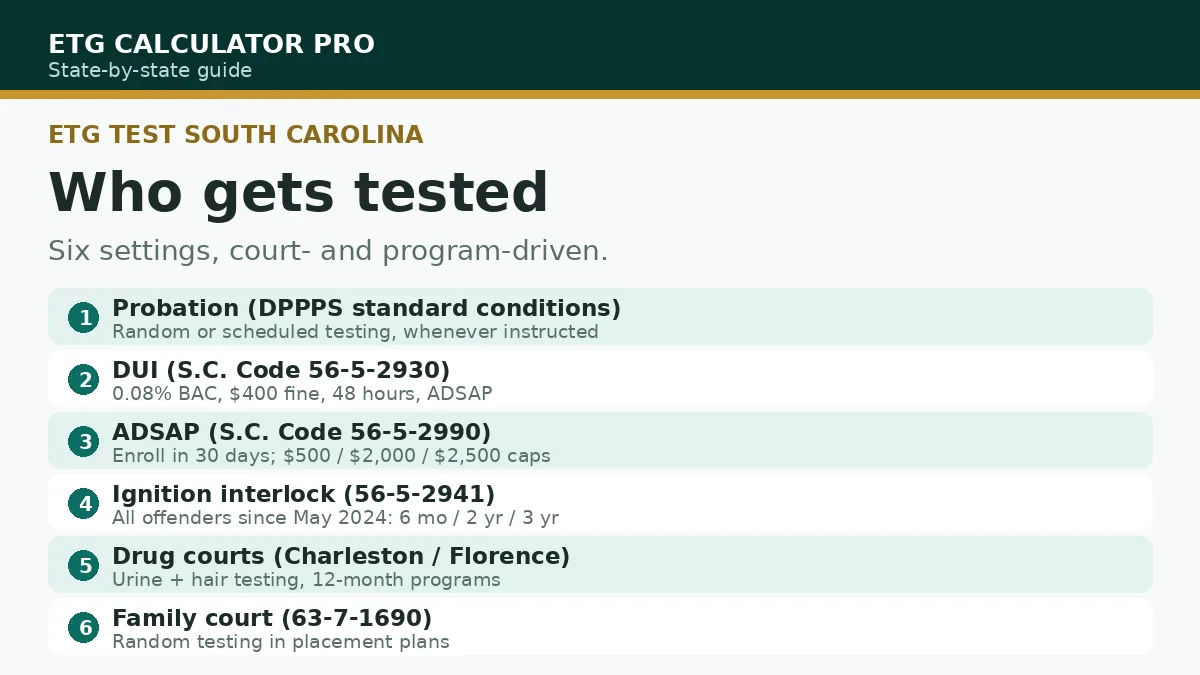
There is no statewide South Carolina EtG cutoff: no statute, court rule, or state program document we checked names a threshold. Your paperwork names the only one that counts.
National context:
- 100 ng/mL — the sensitive level many labs use.
- 500 ng/mL — SAMHSA's 2012 conservative recommendation.
- Labs screen anywhere from 100 to 1,000 ng/mL.
Do not assume a South Carolina program uses either number, and do not confuse the 0.08%, 0.10%, 0.15%, and 0.16% BAC figures in South Carolina law with EtG cutoffs.
Detection windows in South Carolina programs
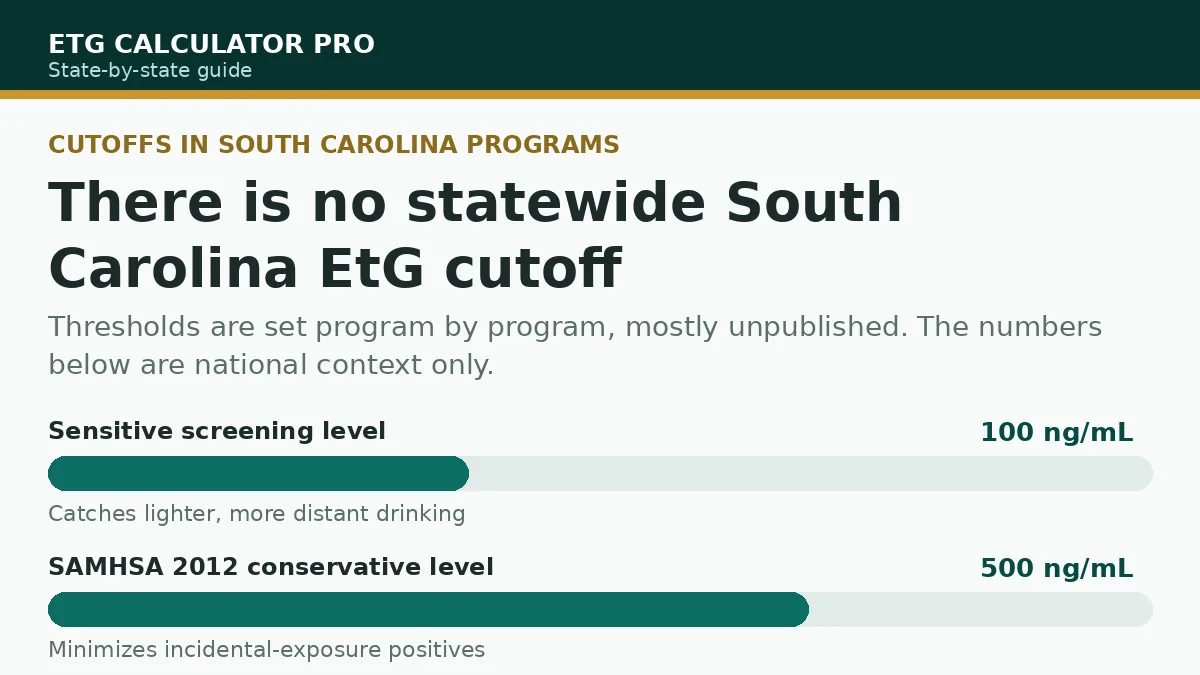
- Heavy drinking: up to about 80 hours after the last drink.
- A single drink: roughly 1–2 days at a 500 ng/mL cutoff.
- Moderate drinking: between those two.
The biggest lever is the cutoff: at 100 ng/mL the same episode stays detectable longer. One caution: an NIH-funded study found EtG detection sensitivity poor after 48 hours at every dose and cutoff tested.
Try these ranges in our homepage calculator or our detection timeline calculator.
A realistic South Carolina scenario
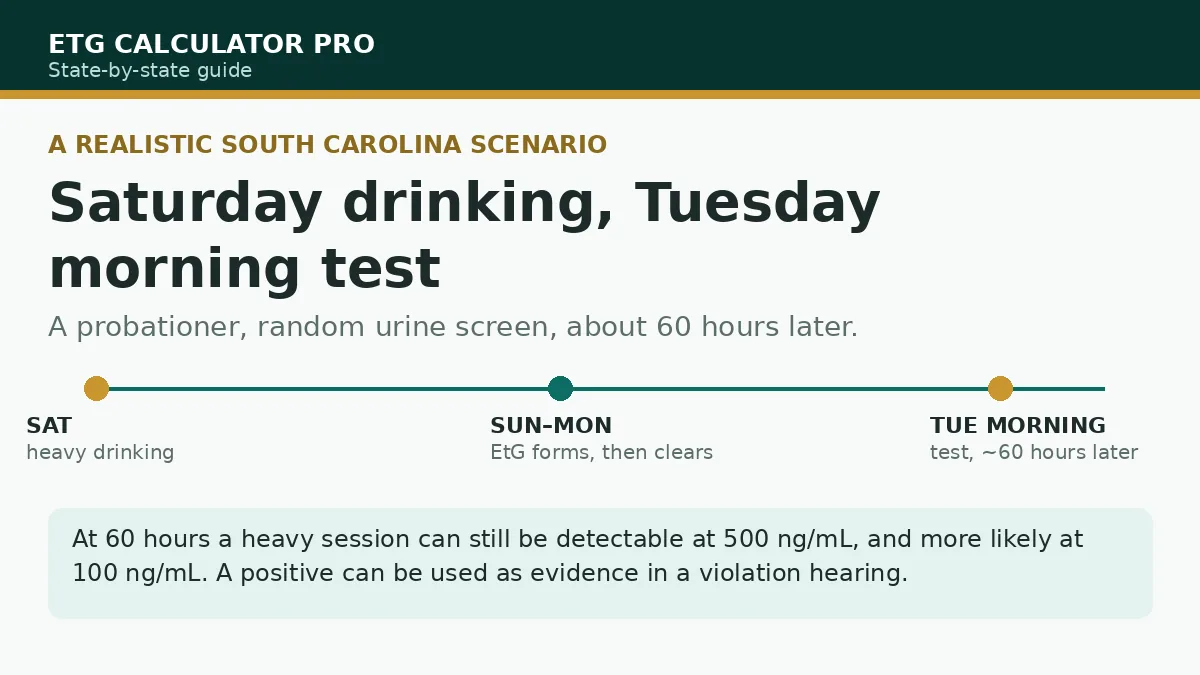
Consider a person on probation in Charleston County after a DUI conviction who drinks heavily at a Saturday cookout and is called in for a random urine screen on Tuesday morning, about 60 hours later.
Sixty hours sits inside the published range for heavy drinking: at 500 ng/mL a heavy session can still be detectable, while a lighter one would likely have cleared; at 100 ng/mL a positive is more likely. A positive would be used as evidence in a violation hearing and could mean sanctions up to revocation of probation. The same weekend could also matter for ADSAP: a new positive test during the program can extend the time to completion — and with it, the wait for license reinstatement.
A note on legal advice
This page is educational, not legal advice, and program rules change. If you are subject to testing, your program's requirements — and an attorney if a violation is alleged — are what matter.
Frequently asked questions
Is there one South Carolina EtG cutoff?
No. No South Carolina statute, court rule, Department of Probation, Parole and Pardon Services standard, or state program document we checked publishes a statewide EtG cutoff. Each court, probation agent, treatment program, and lab sets its own, mostly unpublished. Nationally the common levels are 100 and 500 ng/mL (SAMHSA, 2012); neither is a South Carolina rule. Your program's paperwork names the only number that counts. And do not confuse the numbers that do appear in South Carolina law — 0.08%, 0.10%, 0.15%, and 0.16% BAC — with EtG cutoffs: those are blood-alcohol thresholds for DUI charges and penalties, not urine concentrations.
Does South Carolina probation use EtG testing?
Yes. South Carolina probation is supervised by the Department of Probation, Parole and Pardon Services (DPPPS), and its standard conditions require a probationer to submit to urine, blood, or other forensic testing whenever instructed — random or scheduled, during office visits or unannounced. Probationers also may not use controlled substances unless prescribed, may not drink alcohol excessively, and may not enter establishments whose primary business is selling and serving alcohol. For alcohol-related offenses, courts sometimes require continuous alcohol monitoring through devices such as SCRAM bracelets, which detect alcohol through the skin around the clock. A failed test, a refusal to test, or any attempt to tamper with results counts as a violation, and test results can be used as evidence in a violation hearing. No probation term in South Carolina can exceed five years (S.C. Code § 24-21-440).
What is ADSAP, and is it required?
ADSAP is the Alcohol and Drug Safety Action Program, South Carolina's statewide assessment, education, and treatment program for DUI offenders, certified by the Office of Substance Use Services and available in each of the state's 46 counties. Every person convicted of DUI must enroll within 30 days of conviction and successfully complete it to regain driving privileges. On enrollment you are assessed, and a plan of education or treatment is developed for you; services are based on individual need, so completion time varies and can take up to 12 months. The cost is the offender's responsibility, capped by statute at $500 for education services, $2,000 for treatment services, and $2,500 in total (S.C. Code § 56-5-2990); a person unable to pay performs 50 hours of community service instead. Failing to enroll or complete ADSAP blocks license reinstatement.
When is an ignition interlock device required in South Carolina?
Since May 19, 2024, South Carolina's “All Offender Law” (2023 Act No. 55) requires nearly everyone convicted of DUI or DUAC — including a first offense, regardless of blood alcohol concentration — to enroll in the Ignition Interlock Device Program run by DPPPS (S.C. Code § 56-5-2941). The device must stay on the vehicle for six months after a first offense, two years after a second, three years after a third (four years if the third offense occurred within five years of the first), and for life after a fourth or subsequent offense. Drivers who refuse a breath test or test at 0.15% or higher under the implied consent law can also end the remaining suspension by enrolling and obtaining an ignition interlock restricted license, with a minimum of three months on the device. If you do not install a device when required, your license stays suspended indefinitely. The device will not let the vehicle start if the breath sample reads 0.02% or higher.
What are the penalties for a first DUI in South Carolina?
A first DUI under S.C. Code § 56-5-2930 carries a $400 fine and either 48 hours in jail or 48 hours of public service employment, plus a six-month license suspension and mandatory ADSAP enrollment. The penalties rise with the blood alcohol level: at 0.10% to under 0.16%, the minimum becomes 72 hours; at 0.16% or higher, it becomes 30 days. A parallel charge, driving with an unlawful alcohol concentration (DUAC, § 56-5-2933), applies at 0.08% or higher regardless of observed impairment. Refusing a breath test under the implied consent law (§§ 56-5-2950 and 56-5-2951) brings a suspension of at least six months. A second DUI brings steeper fines and jail time, a suspension of at least a year, and a two-year ignition interlock requirement; a third brings a three-year interlock period. Felony DUI (§ 56-5-2945), where impaired driving causes great bodily injury or death, carries far more severe penalties.
What are South Carolina drug courts, and how does testing work there?
South Carolina drug courts are judicially supervised programs for nonviolent defendants with substance use problems, run circuit by circuit. Charleston County's Adult Drug Court is concrete about testing: participants call Monday through Saturday for drug testing and submit to a urine drug screen when on the list, with hair testing every 120 days at a $50 cost, at least two Alcoholics Anonymous or Narcotics Anonymous meetings a week, and proof of employment each week in court. Missing or failing numerous tests can mean termination — and serving the pre-negotiated prison sentence, with no credit for time spent in drug court. The Twelfth Judicial Circuit (Florence County) drug court runs a minimum of twelve months in four phases, requires at least four consecutive months of sobriety, and orders random urine or hair samples and alcohol breath testing; graduation requires completing all four phases. Successful completion in Charleston County results in the charges being dismissed.
Can a South Carolina family court order EtG testing?
Yes, at the judge's discretion. In ordinary custody cases, South Carolina courts decide on the best interests of the child under S.C. Code § 63-15-240 and may impose abstinence conditions before and during visitation where needed to protect the child; a separate provision (§ 63-15-50(B)(4)) lets the court require abstinence during visitation and for the 24 hours before it in domestic-violence cases. The clearest testing authority is in child-protection cases: under S.C. Code § 63-7-1690, where a child was removed because of a parent's addiction or substance abuse, the court may require the parent to complete an approved treatment program and submit to random testing for substance abuse, and to be alcohol or drug free for a court-set period before the child is returned — and to keep testing after the child returns until the case is closed. The Department of Social Services (DSS) also uses random drug screens in safety plans, which last up to 90 days. Testing follows a factual basis showing a safety concern, not a bare allegation.
Evidence and limitations
This guide summarizes primary research, public-health guidance, and South Carolina public records. Group-level findings cannot predict one person's result.
- S.C. Code § 56-5-2930 — Operating a motor vehicle while under the influence of alcohol or drugs (2025 statute text): unlawful to drive while under the influence to the extent that the person's faculties are materially and appreciably impaired; a first offense carries a fine of $400 or imprisonment for not less than 48 hours nor more than 30 days, with 48 hours of public service employment in lieu of the minimum imprisonment; at 0.10% to under 0.16% the minimum becomes 72 hours; at 0.16% or more, 30 days
- S.C. Code § 56-5-2990 — Suspension of convicted person's driver's license (2025 statute text): a person whose license is suspended must enroll in and successfully complete an Alcohol and Drug Safety Action Program; an assessment must be prepared and a plan of education or treatment developed; ADSAP programs shall meet at least once a month; the cost may not exceed $500 for education services, $2,000 for treatment services, and $2,500 in total; a person unable to pay shall perform 50 hours of community service
- S.C. Code § 63-7-1690 — Placement plans; substance abuse issues (2025 statute text): where a child was removed because of a parent's addiction or substance abuse, the court may require the parent to complete an approved treatment program and to submit to random testing for substance abuse and be alcohol or drug free for a period set by the court before return of the child, and to continue random testing after return until the case is authorized to be closed
- S.C. Code § 56-5-2943 (2008 Act, as amended) — Continuous remote alcohol monitoring: as a condition of probation for a second or subsequent violation of §§ 56-5-2930, 56-5-2933, or 56-5-2945, a person may be required to abstain from alcohol for not less than 30 days and not more than 60 days verified by an alcohol monitoring device; DPPPS must develop and operate an alcohol monitoring device program
- South Carolina Department of Probation, Parole and Pardon Services — Ignition Interlock Device Program Procedures (effective May 19, 2024): the All Offender Law requires all individuals convicted of DUI, regardless of blood alcohol concentration, to participate in the IID program; the device is required for six months for a first offense, two years for a second, three years for a third, four years if the third offense occurred within five years of the first, and for life for a fourth or subsequent offense; a person who chooses not to install the device remains suspended indefinitely until enrollment and successful completion
- South Carolina Department of Behavioral Health and Developmental Disabilities, Office of Substance Use Services — ADSAP brochure (October 2025): ADSAP is a statewide substance abuse program available in each of the state's 46 counties; offenders must enroll within 30 days of conviction; on enrollment you are assessed and education or treatment services are provided; completion time varies by individual need and can take up to 12 months; first offenders meeting certain requirements may obtain a provisional driver's license while participating
- South Carolina Probation Guidelines: Conditions and Violations — courts can sentence a person to probation for any offense not carrying death or life imprisonment, and no probation term can exceed five years (S.C. Code §§ 24-21-410, 24-21-440); standard conditions require submitting to urine, blood, or other forensic testing whenever instructed, random or scheduled, with results usable as evidence in a violation hearing; probationers may not drink alcohol excessively or enter establishments whose primary business is selling and serving alcohol; continuous alcohol monitoring (SCRAM) may be required for alcohol offenses; a failed test, refusal, or tampering counts as a violation
- Charleston County Adult Drug Court (official county overview): participants call for drug testing Monday through Saturday and submit to a urine drug screen if on the list; hair testing every 120 days at a $50 cost; at least two Alcoholics Anonymous or Narcotics Anonymous meetings per week; proof of employment each week in court; failure to comply brings sanctions; consistently missing or failing numerous drug tests or hair tests can mean termination and serving the pre-negotiated prison sentence with no credit for time in drug court; successful completion and graduation results in charges being dismissed
- Twelfth Judicial Circuit Drug Court Program (Florence County information sheet): the program is a minimum of twelve months in four phases; participants must submit to random urine or hair samples for drug testing and alcohol breath testing as ordered; graduation requires completing all four phases and at least twelve months enrollment and four consecutive months of sobriety; the application fee is $140; participants must be at least 17, charged with a nonviolent felony, and willing to plead guilty
- Alcohol Testing in Child Custody: Each State's Laws, Explained (2026) — South Carolina: S.C. Code § 63-15-240 directs courts to evaluate the child's best interests and allows abstinence conditions before and during visitation; § 63-7-1690 allows the court to require treatment and random testing in child-protection placement plans; § 63-15-50(B)(4) permits requiring abstinence during visitation and for the 24 hours preceding it; testing follows a factual basis showing a safety concern, not a bare allegation
- What Happens If You Fail a Drug Test for DSS in South Carolina? — DSS must begin investigating within 24 hours where a child faces imminent and substantial risk, and within two business days otherwise; safety plans last up to 90 days and include random drug screens; the family court must hold a probable cause hearing within 72 hours of a child being taken into emergency protective custody
- DUI & Traffic Laws in South Carolina (2026) — first-offense DUI (§ 56-5-2930): $400 fine, 48 hours jail or community service, six-month suspension, mandatory ADSAP; higher BAC tiers raise the minimum to 72 hours (0.10%–0.15%) and 30 days (0.15%+); DUAC (§ 56-5-2933) applies at 0.08%+ regardless of observed impairment; Emma's Law IID for BAC 0.15%+ first offense or any second offense; felony DUI (§ 56-5-2945) is among the most severe in the southeastern United States
- Ignition Interlock in SC: Who Needs It, How Long & Cost — since May 19, 2024, anyone convicted of DUI or DUAC, including a first offense, generally must enroll in the Ignition Interlock Device Program regardless of blood alcohol concentration (2023 Act No. 55, amending § 56-5-2941); the required period runs from six months for a first offense to life for a fourth; a second or subsequent offense is subject to the interlock only after the license has been suspended for at least one year in the employer-vehicle exception; implied consent suspensions (refusal or 0.15%+) can be ended by enrolling, with a minimum of three months on the device
- Emma's Law: South Carolina Ignition Interlock Requirements — S.C. Code § 56-5-2941: a second offense triggers a mandatory IID period of two years, a third three years (four if within five years of the first), and a fourth or subsequent offense a lifetime requirement; installation is also required for implied consent violations such as refusing a breath test or registering 0.15% or greater; a first offense for driving without the device is a misdemeanor punishable by a fine of at least $1,000, up to one year in jail, and a six-month extension; DPPPS uses a point system, and four or more points triggers a six-month suspension of restricted driving privileges and a mandatory substance abuse assessment
- Interlock Ignition Program Explained in SC — the BAIID will not allow the vehicle to start if the driver's blood alcohol content is 0.02% or higher; a driver who refuses blood alcohol testing faces license suspension or a BAIID requirement; a person convicted of DUI faces a BAIID requirement of six months for a first offense, two years for a second, three years for a third, and the license can be suspended indefinitely if the offender elects not to enroll
- SC's 2024 Ignition Interlock Device (IID) Rules for DUI Offenders — arrests on or after May 19, 2024 are subject to the new rules; refusing the breathalyzer or blood test means a license suspension of at least six months, depending on prior DUI convictions within the past 10 years; a BAC of 0.15% or higher brings a suspension of at least one month; the 2024 rules extend the IID requirement to repeat offenders regardless of BAC and to offenders who refuse breathalyzer tests
- South Carolina DUI Laws — DUI is operating a motor vehicle while under the influence; standard BAC limit 0.08%; first offense requires mandatory ADSAP enrollment and possible ignition interlock; refusing a chemical test under the implied consent law results in a six-month license suspension (first refusal) and mandatory ADSAP enrollment; all individuals convicted of DUI must complete ADSAP to regain driving privileges
- Why You Must Never Violate Probation After A DUI Conviction — the probation period following a DUI conviction typically lasts for one year in Clemson; during probation you must abstain from alcohol and drug use, submit to regular testing, and attend counseling sessions; a failed test or violation can mean jail time
- Determining Ethyl Glucuronide Cutoffs (PMC) — SAMHSA Advisory 2012 conservative 500 ng/mL recommendation; lab cutoffs 100–1,000 ng/mL; interpretation bands