The short comparison
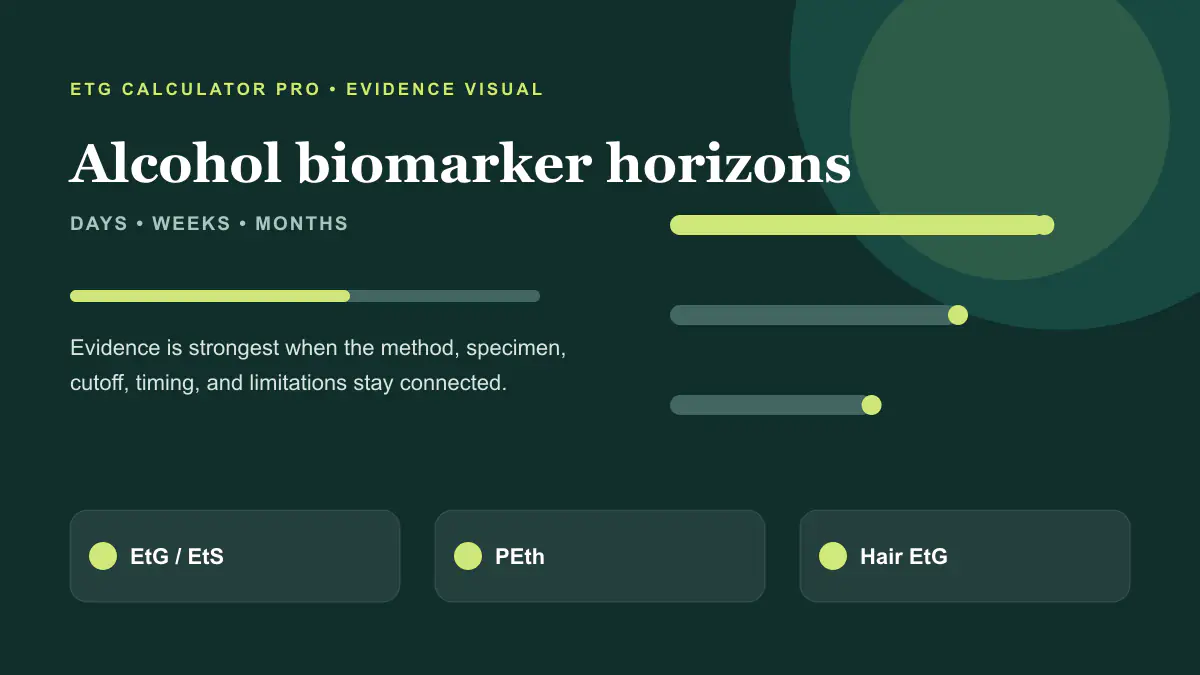
Ethyl glucuronide and ethyl sulfate are minor direct metabolites of ethanol. They are commonly measured in urine to evaluate recent exposure after ethanol itself has cleared. Phosphatidylethanol is an abnormal phospholipid formed in cell membranes only in the presence of ethanol and is generally measured in whole blood. PEth usually represents a longer recent period than urinary EtG or EtS.
No biomarker is universally best. The appropriate choice depends on whether the question concerns a recent event, repeated exposure, a longer pattern, or current impairment. Urine EtG/EtS, blood PEth, hair EtG, and breath or blood ethanol cannot be substituted simply because they all relate to alcohol. Their formation, specimen, units, kinetics, and interpretive criteria differ.
Related: EtG test basics · Urine vs hair EtG
EtG: ethyl glucuronide
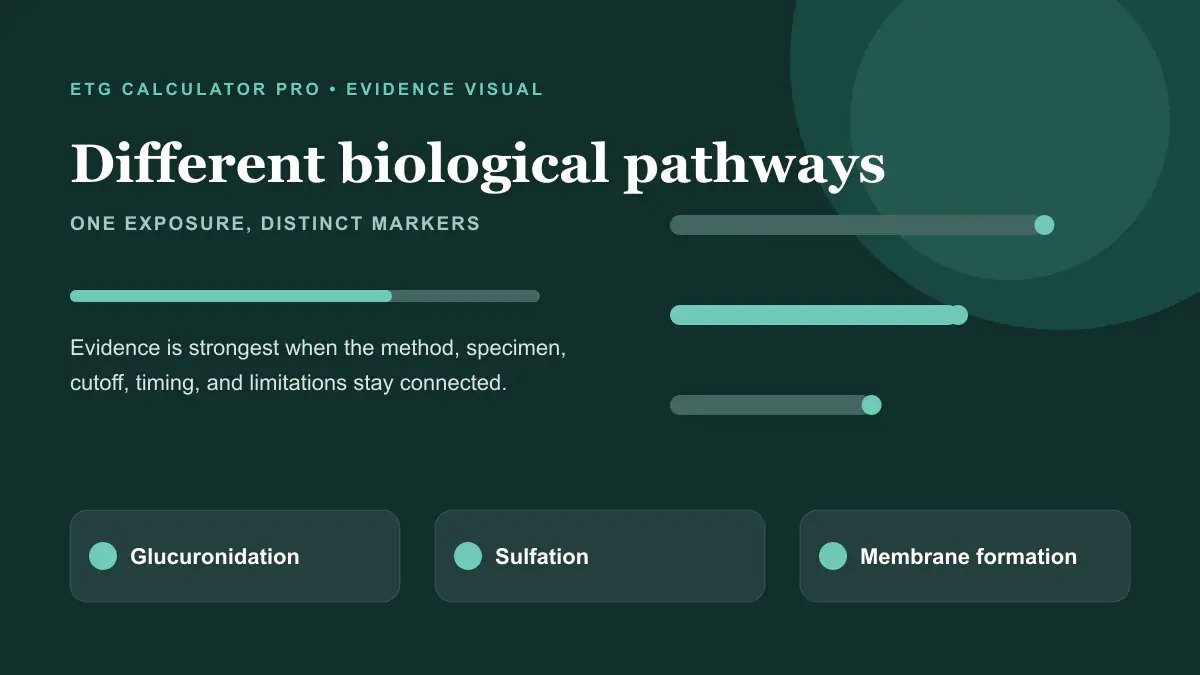
EtG forms when ethanol is conjugated with glucuronic acid. Only a small fraction of ethanol follows this pathway, but modern assays can detect the metabolite after breath or blood ethanol is gone. Urine EtG is usually reported in ng/mL and compared with a cutoff such as 100, 200, or 500 ng/mL. Lower cutoffs are more sensitive; higher cutoffs are more specific.
EtG can also be measured in hair, where the units and retrospective window are completely different. In urine, creatinine, hydration, collection timing, dose, repeated use, and renal handling influence concentration. EtG supports ethanol exposure but does not establish present intoxication, exact dose, or a universal time since drinking.
Related: Urine EtG detection window · EtG cutoff levels
EtS: ethyl sulfate
EtS forms when ethanol is conjugated through sulfation. Like EtG, it is a direct metabolite and can remain measurable after ethanol has cleared. Laboratories may analyze EtS alongside EtG by LC-MS/MS. Because the compounds follow different metabolic and stability pathways, agreement can provide corroborating evidence of exposure.
EtS concentrations and cutoffs are not interchangeable with EtG. A report should list each analyte, unit, method, and threshold separately. Discordant findings do not have one automatic explanation; they can prompt review of collection, storage, microbial effects, cutoff differences, analytical performance, or the exposure history. Qualified interpretation matters more than matching a result to a simplified online table.
Related: Detailed EtG vs EtS guide
PEth: phosphatidylethanol
PEth is a group of phospholipids formed in blood-cell membranes when ethanol is present. The commonly reported homolog PEth 16:0/18:1 is measured in whole blood, often by LC-MS/MS. Its formation pathway and persistence give it a longer recent window than urinary EtG/EtS, making it useful when the question concerns a drinking pattern over weeks rather than a single recent day.
PEth is not a perfect drink counter. Formation and elimination vary across people, repeated exposure can accumulate, and laboratory cutoffs and interpretive categories depend on the method and purpose. A detectable PEth result supports ethanol exposure within its relevant window but does not establish a precise daily schedule or current impairment.
Detection windows overlap but are not identical
Urine EtG and EtS are most useful for recent exposure over days. Detection probability decreases with time and changes with dose, cutoff, and urine concentration. PEth can remain measurable across a longer recent period, often described in weeks, particularly after repeated use. Hair EtG may address a retrospective period of months but includes a growth-related lag.
These time descriptions are not hard expiration dates. A biomarker can be detectable in some people at the late edge and absent in others earlier. The question should be framed as demonstrated sensitivity under relevant study conditions, not 'how long does it stay in everyone?' Combining biomarkers can widen the information available, but it also requires reconciling different biological clocks.
Related: EtG timing evidence · 80-hour EtG claim
Specimen, units, and analytical method
Urine EtG and EtS are commonly reported in ng/mL, with creatinine supplying concentration context. Blood PEth may be reported in ng/mL or µmol/L depending on the laboratory and region. Hair EtG is commonly reported in pg/mg. These numbers cannot be converted across specimens by a simple multiplier because the biological matrices and accumulation processes differ.
LC-MS/MS is widely used for specific identification and quantification of direct biomarkers. Immunoassay is also used for urine EtG screening. A report should state specimen, analyte, homolog where relevant, units, cutoff, method, and sample-quality notes. Without that information, comparisons across tests or laboratories can create false equivalence.
Related: EtG screening and confirmation
Using biomarkers together
Longitudinal monitoring research has used urine EtG/EtS, blood PEth, and other markers as complementary evidence. A recent exposure may appear in urine before a longer-window pattern is clear in PEth. Repeated exposure can keep PEth elevated after a particular urine window closes. Agreement across appropriate specimens can strengthen a pattern interpretation.
Discordance is not automatically deception or laboratory failure. It may be expected when tests emphasize different periods. Collection time, exposure pattern, cutoff, specimen quality, and biological variation should be reviewed. The additional test should be ordered because it answers a useful question, not simply to collect more numbers.
Related: Compare biomarker studies
Which biomarker fits which question?
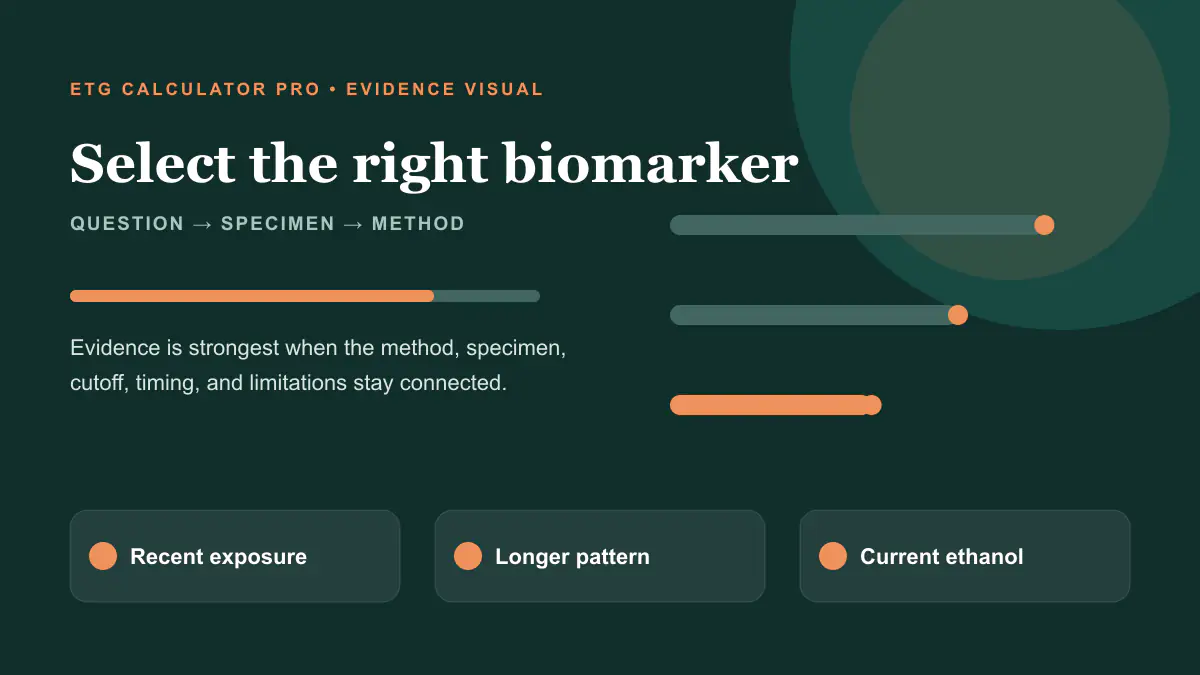
For a recent abstinence-monitoring question over days, urine EtG with EtS and creatinine may fit. For a pattern across recent weeks, whole-blood PEth may fit. For a retrospective pattern across months, hair EtG may fit when a suitable sample exists. For present ethanol or impairment, breath or blood ethanol is the relevant class of test. Clinical assessment and self-report can add information no analyte supplies.
The choice also depends on turnaround, collection practicality, invasiveness, cost, laboratory access, and the consequences of an error. A fair policy defines the purpose, method, cutoff, confirmation process, and response to discordant findings before specimens are collected. Interpretation after the fact should not silently change the question the test was selected to answer.
- Days: urine EtG and EtS
- Weeks: blood PEth
- Months: hair EtG
- Current ethanol: breath or blood alcohol
- Context: clinical assessment and documented history
What no alcohol biomarker can prove alone
EtG, EtS, and PEth do not independently prove current intoxication, impairment, an exact beverage count, a precise drinking time, or the source of every ethanol exposure. Concentrations overlap and are influenced by biological and analytical factors. A result is strongest when the specimen, method, time frame, and policy match the question.
EtG Calculator Pro is intentionally limited to educational urine EtG ranges. It does not calculate PEth or hair EtG and does not combine biomarkers into a diagnostic score. Use the comparison to understand terminology and prepare questions for the responsible laboratory or clinician, not to self-adjudicate a consequential result.
Related: Calculator scope and limitations · EtG test FAQ
Frequently asked questions
Which lasts longer, EtG or PEth?+
Blood PEth generally reflects a longer recent pattern over weeks, while urine EtG primarily reflects recent exposure over days. Hair EtG can address a still longer retrospective period.
Can PEth confirm an EtG result?+
PEth can add complementary information, but it answers a different time-frame question. Agreement or disagreement must be interpreted using both collection dates, exposure pattern, methods, and cutoffs.
Are EtG and EtS always tested together?+
No. Some programs use EtG screening alone, while others confirm EtG and measure EtS with mass spectrometry. The laboratory report should state exactly which analytes were tested.
Can PEth show current impairment?+
No. PEth reflects ethanol exposure over a longer period and is not a measure of current blood alcohol concentration or impairment.
Can I convert a PEth level to an EtG level?+
No. PEth and EtG use different specimens, formation pathways, kinetics, units, and interpretation criteria. There is no reliable direct conversion.
Evidence and limitations
This guide summarizes primary research and public-health guidance. Group-level findings cannot predict one person's result.