How EtG testing works in Illinois
Ethyl glucuronide (EtG) is an alcohol metabolite found in urine after drinking. Courts and probation officers use it to answer one question: has this person consumed alcohol since the last check-in? Breath tests catch only very recent use, and standard drug panels do not detect alcohol, so EtG fills the gap.
Who gets tested in Illinois and why
Probation
When an Illinois court sentences a person to probation, it may impose conditions reasonably related to rehabilitation, and the Unified Code of Corrections expressly contemplates mandatory drug or alcohol testing during the term: under 730 ILCS 5/5-6-3(g), a person who undergoes mandatory testing is ordered to pay its costs. Cook County's standard traffic sentencing order lists random drug testing and zero tolerance for drugs and alcohol among its DUI conditions.
One limit is worth knowing. Under 730 ILCS 5/5-6-3(n), a person on probation, conditional discharge, or supervision may not be ordered to refrain from alcohol in their body unless they are under 21, the offense itself involved an intoxicating compound, they are in a problem-solving court, or a validated clinical assessment and treatment plan includes alcohol testing. Testing usually arrives with a reason tied to the case, the assessment, or the program — not as a blanket condition.
A failed test, or refusing one, can be treated as a probation violation, and the court can revoke probation.
DUI
Illinois prohibits driving under the influence under 625 ILCS 5/11-501: driving with a blood alcohol concentration of 0.08% or more, or while impaired by alcohol, drugs, or intoxicating compounds — a driver can be charged even below 0.08% if impairment is shown. The limit is effectively 0.00% for drivers under 21 (625 ILCS 5/11-501.8) and 0.04% for a commercial driver (625 ILCS 5/6-514).
A first offense is a Class A misdemeanor: up to 364 days in jail and a fine of up to $2,500, though jail is uncommon for a genuine first offense with no aggravating factors. A BAC of 0.16% or higher carries enhanced penalties, including mandatory minimum community service and fines. Court supervision — available only once in a lifetime for DUI — is the outcome most first offenders hope for: complete the conditions and no conviction is entered, which also avoids the revocation that follows a conviction. A conviction instead brings a minimum one-year revocation, and it cannot be expunged or sealed.
The license side runs on its own clock. The moment a driver fails or refuses chemical testing, the statutory summary suspension starts its countdown under 625 ILCS 5/11-501.1: it takes effect automatically on the 46th day after notice — six months for a first offender who failed the test, twelve months for one who refused — whether or not the criminal case is ever proven. A petition to rescind can be filed within 90 days of the notice (625 ILCS 5/2-118.1), with a hearing within 30 days of filing.
Before sentencing or supervision, every DUI defendant must complete an alcohol and drug evaluation (625 ILCS 5/11-501.01) — the Alcohol and Drug Uniform Report — which classifies the person as Minimal, Moderate, Significant, or High Risk and sets the treatment: 10 hours of DUI Risk Education for Minimal Risk; 10 plus 12 hours of early intervention for Moderate; 10 plus 20 hours of treatment for Significant; and 75 hours of treatment for High Risk, with continuing care where required.
BAIID and driving permits
The breath alcohol ignition interlock device is the tool Illinois uses to let people keep driving while their license is suspended or revoked. A first offender can usually drive through the entire summary suspension with a Monitoring Device Driving Permit (MDDP), available after 30 days, which requires a BAIID at the driver's expense and allows broader driving privileges than the older restricted permit.
A Restricted Driving Permit (RDP) allows limited driving for work, school, or medical appointments, issued through the Secretary of State as part of reinstatement. For multiple offenders the BAIID is effectively the price of any driving relief: an RDP is conditioned on BAIID installation, and a person with two or more DUI convictions must install and maintain a BAIID on every motor vehicle registered in their name for 1,826 consecutive days — five years — under 92 Ill. Admin. Code 1001.443. BAIID violations are reported to the Secretary of State and can cancel an RDP.
Drug courts
Illinois drug courts operate under the Drug Court Treatment Act (730 ILCS 166) for non-violent defendants with a substance use disorder. Admission needs the defendant's consent, the prosecutor's agreement, and the court's approval, and the statute excludes crimes of violence, defendants who deny drug use, those unwilling to enter treatment, and anyone who has previously completed a drug court program.
Before admission, the court orders a screening and clinical needs assessment; the program includes substance analysis testing, individual and group therapy, and close monitoring by the court. Cook County's Drug Treatment Court handbook is concrete about what that means: participants must agree to drug and alcohol tests, complete random testing through four phases, attend treatment, meet probation officers regularly, and appear frequently before the judge, and are sentenced to two years of Drug Treatment Court Probation. DUI offenses are not eligible for drug court, but may be considered for a separate DUI Court program where one exists.
Family court
In parenting-time and decision-making cases, Illinois courts decide on the best interests of the child under 750 ILCS 5/602.7, weighing the child's needs, each parent's mental and physical health, any history of domestic violence, and each home's stability. The court may also order substance abuse evaluations (750 ILCS 5/602.10).
Where a parent's drinking bears directly on the child's safety, the court may order testing — including EtG testing — as a condition of parenting time, require testing before or after visits, order supervised visitation, or pause parenting time until the parent completes treatment. A history of substance use is one factor among many, not an automatic loss of parenting time, and courts look at current circumstances and treatment efforts.
License reinstatement
Getting a license back after a revocation runs through the Secretary of State, and nothing is automatic: a revocation has no end date, and the driver stays revoked until reinstatement is granted. A first-time offender can usually handle reinstatement through an informal hearing; a second or subsequent offender must request a formal hearing in writing and show that restoring driving privileges will not endanger public safety.
Reinstatement also requires an alcohol and drug evaluation and any recommended treatment, proof of financial responsibility (SR-22 insurance, high-risk for three years after a DUI reinstatement), and a reinstatement fee — $250 for a first offense, $500 for a repeat. A second DUI within 20 years of the first means the driver may not apply for a license for five years after the revocation; a full license also requires a Restricted Driving Permit and five continuous years of BAIID compliance.
Cutoffs used in Illinois programs
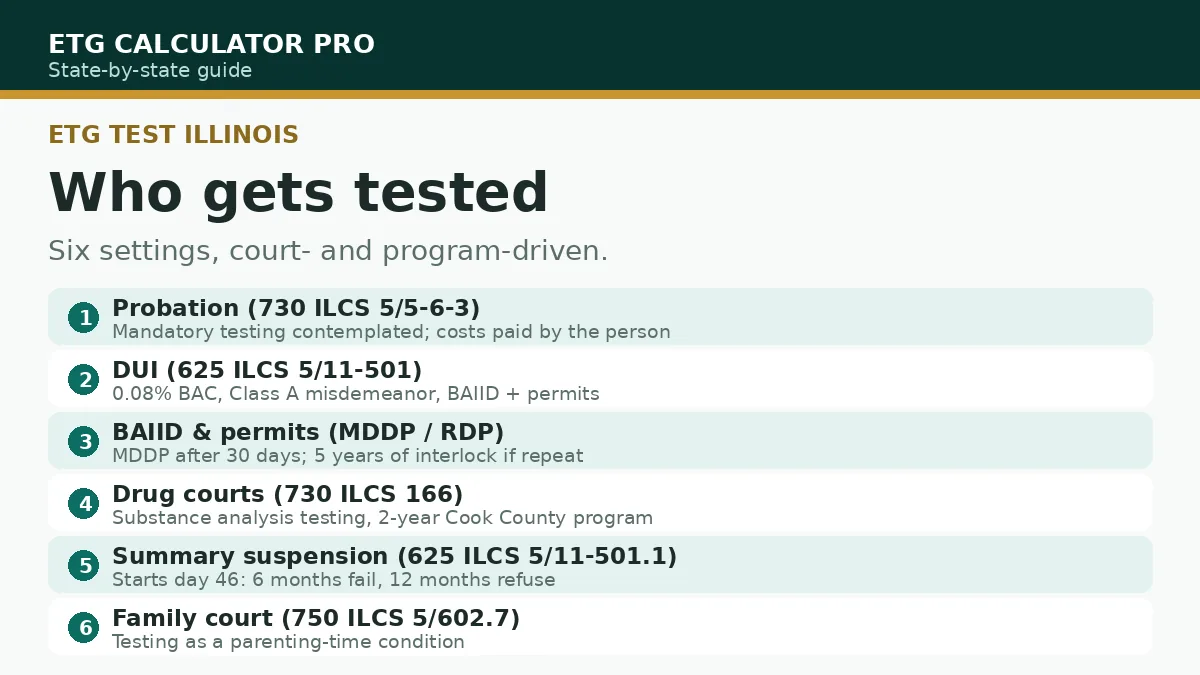
There is no statewide Illinois EtG cutoff: no statute, court rule, or state program document we checked names a threshold. Your paperwork names the only one that counts.
National context:
- 100 ng/mL — the sensitive level many labs use.
- 500 ng/mL — SAMHSA's 2012 conservative recommendation.
- Labs screen anywhere from 100 to 1,000 ng/mL.
Do not assume an Illinois program uses either number unless its paperwork says so, and do not confuse the 0.08%, 0.16%, and 0.04% BAC figures in Illinois law with EtG cutoffs. SAMHSA's bands add context: above 1,000 ng/mL may indicate heavy or very recent drinking; 100 to 500 ng/mL may indicate older drinking or incidental exposure — possibilities, not proof.
Detection windows in Illinois programs
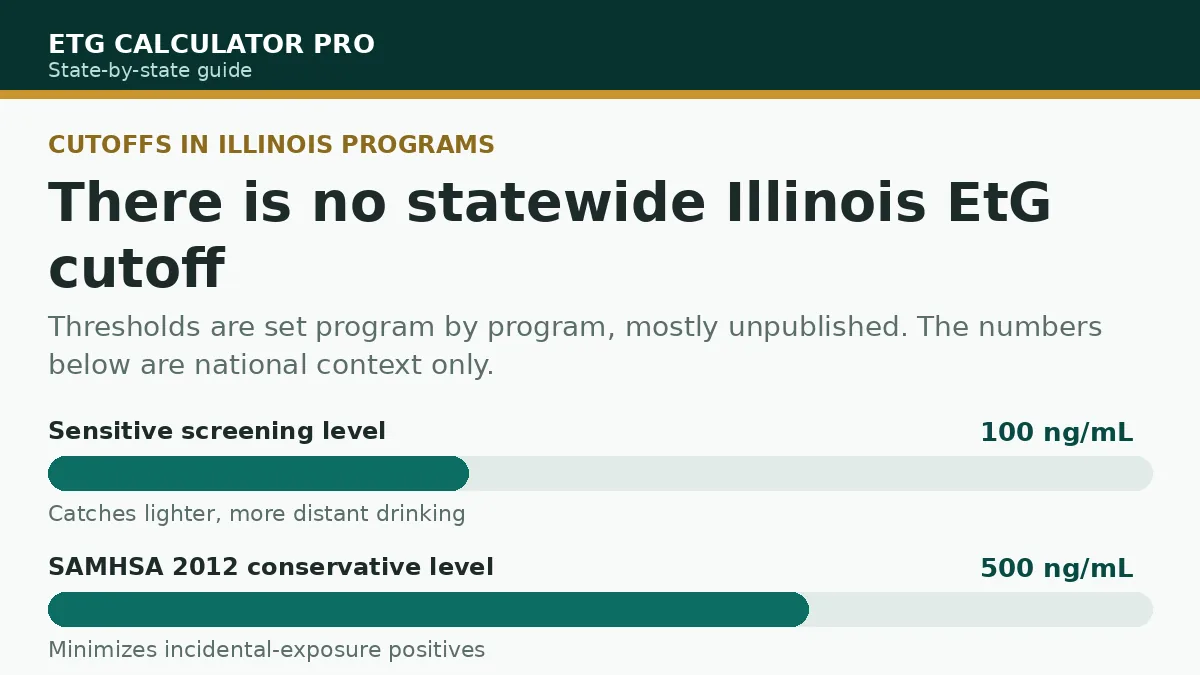
- Heavy drinking: up to about 80 hours after the last drink.
- A single drink: roughly 1–2 days at a 500 ng/mL cutoff.
- Moderate drinking: between those two.
The biggest lever is the cutoff: at 100 ng/mL the same episode stays detectable longer. One caution: an NIH-funded study found EtG detection sensitivity poor after 48 hours at every dose and cutoff tested.
Try these ranges in our homepage calculator or our detection timeline calculator.
A realistic Illinois scenario
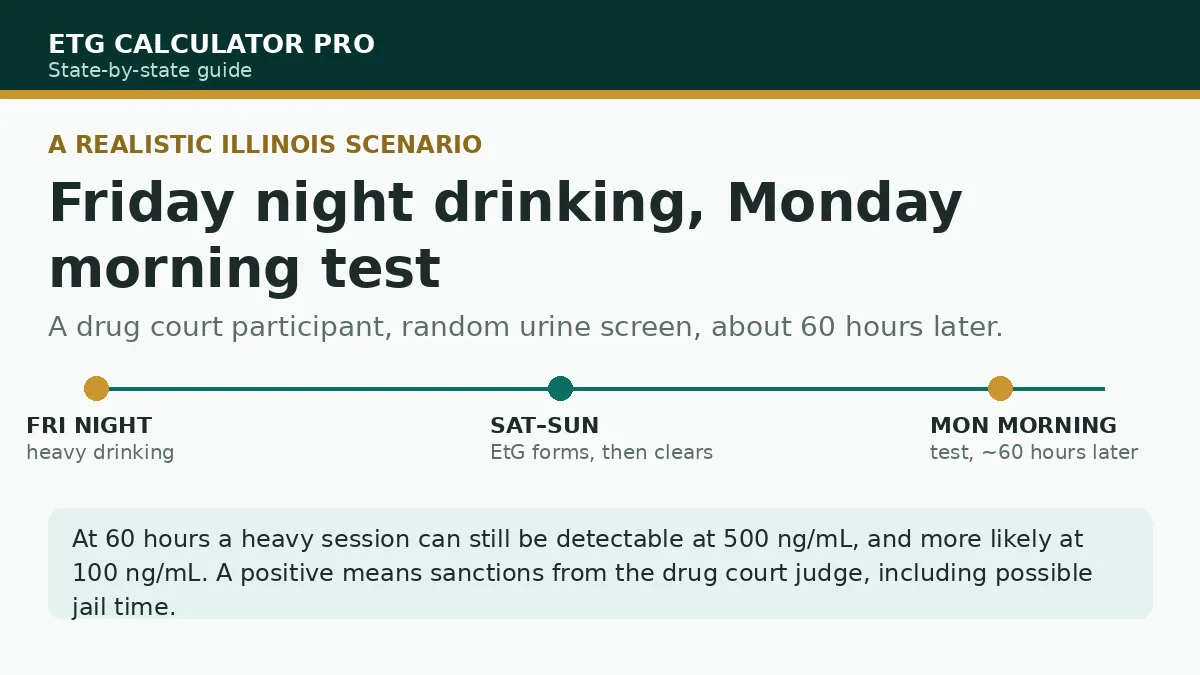
Consider a drug court participant in Cook County on two years of Drug Treatment Court Probation who drinks heavily on a Friday night and faces a random urine screen on Monday morning, about 60 hours later.
Sixty hours sits inside the published range for heavy drinking: at 500 ng/mL a heavy session can still be detectable, while a lighter one would likely have cleared; at 100 ng/mL a positive is more likely. A positive would mean sanctions from the drug court judge, including possible jail time, and could put the participant's place in the program at risk.
A note on legal advice
This page is educational, not legal advice, and program rules change. If you are subject to testing, your program's requirements — and an attorney if a violation is alleged — are what matter.
Frequently asked questions
Is there one Illinois EtG cutoff?
No. No Illinois statute, court rule, Administrative Office standard, or state program document we checked publishes a statewide EtG cutoff. Each court, probation department, treatment program, and lab sets its own, mostly unpublished. Nationally the common levels are 100 and 500 ng/mL (SAMHSA, 2012); neither is an Illinois rule. Your program's paperwork names the only number that counts. And do not confuse the numbers that do appear in Illinois law — 0.08%, 0.16%, and 0.04% BAC — with EtG cutoffs: those are blood-alcohol thresholds for DUI charges and penalties, not urine concentrations.
Does Illinois probation use EtG testing?
Yes. When an Illinois court sentences a person to probation, it may impose any conditions reasonably related to rehabilitation, and the Unified Code of Corrections expressly contemplates mandatory drug or alcohol testing during probation (730 ILCS 5/5-6-3(g)), with the person ordered to pay the testing costs. There is one limit worth knowing: under 730 ILCS 5/5-6-3(n), a person on probation, conditional discharge, or supervision may not be ordered to refrain from having alcohol in their body unless they are under 21, the offense itself involved an intoxicating compound, they are in a problem-solving court, or a validated clinical assessment and treatment plan includes alcohol testing. Cook County's standard traffic sentencing order lists random drug testing and zero tolerance for drugs and alcohol among its DUI conditions. A positive test — or refusing one — can be treated as a probation violation.
What is a BAIID, and when is one required?
A BAIID is a breath alcohol ignition interlock device: it requires a breath sample before the vehicle will start and prevents starting if alcohol is detected. First offenders on a statutory summary suspension can usually keep driving through the whole suspension with a Monitoring Device Driving Permit (MDDP), available after 30 days, which requires a BAIID installed at the driver's expense. For multiple offenders the BAIID is effectively the price of any driving relief: a Restricted Driving Permit (RDP) is conditioned on BAIID installation, and a person with two or more DUI convictions must install and maintain a BAIID on every motor vehicle registered in their name for 1,826 consecutive days — five years — under 92 Ill. Admin. Code 1001.443. BAIID violations are reported to the Secretary of State and can cancel an RDP.
What are the penalties for a first DUI in Illinois?
A first DUI under 625 ILCS 5/11-501 is a Class A misdemeanor: up to 364 days in jail and a fine of up to $2,500, though jail is uncommon for a genuine first offense with no aggravating factors. A BAC of 0.16% or higher carries enhanced penalties, including mandatory minimum community service and fines. Separately, the license faces a statutory summary suspension that starts on the 46th day after the arrest notice: six months if the driver failed chemical testing, twelve months if the driver refused. Court supervision — available only once in a lifetime for DUI — avoids a conviction and the revocation that follows one; a conviction instead brings a minimum one-year revocation of driving privileges, plus high-risk SR-22 insurance for three years and a Secretary of State hearing before reinstatement.
What happens on a second or third DUI in Illinois?
A second DUI is still a Class A misdemeanor, but court supervision is no longer available and the court must order either five days in jail or 240 hours of community service. A conviction revokes the license, and if the first offense was within 20 years, the driver may not apply for a license for five years after the revocation; a full license also requires a Restricted Driving Permit and five continuous years of BAIID compliance. A third DUI is a Class 2 felony with a minimum ten-year revocation. A fourth or later DUI can bring lifetime revocation. For drivers under 21, a DUI conviction carries a minimum two-year revocation. A commercial driver convicted of DUI faces a one-year CDL disqualification on a first offense — three years if transporting hazardous materials — and a lifetime disqualification on a second.
What are Illinois drug courts, and how does testing work there?
Illinois drug courts operate under the Drug Court Treatment Act (730 ILCS 166) as problem-solving courts for non-violent defendants with a substance use disorder. Admission needs the defendant's consent, the prosecutor's agreement, and the court's approval; crimes of violence, denying drug use, unwillingness to enter treatment, and prior completion of a drug court program are all exclusions. The statute requires a screening and clinical needs assessment before admission, and the program itself includes substance analysis testing, individual and group therapy, and close monitoring by the court. Cook County's Drug Treatment Court handbook is concrete about it: participants must agree to drug and alcohol tests, complete random drug and alcohol testing through four phases, and are sentenced to two years of Drug Treatment Court Probation. DUI offenses are not eligible for drug court, but may be considered for a separate DUI Court program where one exists.
Can an Illinois family court order EtG testing?
Yes, at the judge's discretion. Illinois allocates parenting time and decision-making under the best-interests-of-the-child standard in 750 ILCS 5/602.7, weighing factors including the child's needs, each parent's mental and physical health, any history of domestic violence, and the stability of each home. The statute also lets the court order substance abuse evaluations (750 ILCS 5/602.10). Where a parent's drinking bears directly on the child's safety, the court may order testing — including EtG testing — as a condition of parenting time, require drug testing before or after visits, order supervised visitation, or pause parenting time until the parent completes treatment. Testing follows a request and a reason, and a positive result is one factor among many.
Evidence and limitations
This guide summarizes primary research, public-health guidance, and Illinois public records. Group-level findings cannot predict one person's result.
- 625 ILCS 5/11-501 — Driving under the influence (statute text): unlawful to operate a motor vehicle while under the influence of alcohol or drugs, or with a blood alcohol concentration of 0.08% or more; a first offense is a Class A misdemeanor; a BAC of 0.16% or higher carries enhanced penalties
- 625 ILCS 5/11-501.01 — Additional administrative sanctions (statute text): after a finding of guilt and before any final sentencing or an order for supervision, individuals shall undergo a professional evaluation to determine if an alcohol, drug, or intoxicating compound abuse problem exists, and undergo treatment as appropriate; programs conducting evaluations shall be licensed by the Department of Human Services
- 625 ILCS 5/11-501.8 — Suspension of driver's license; persons under age 21 (statute text): a person under 21 who drives is deemed to have consented to chemical testing if an officer has probable cause to believe the driver consumed any amount of alcohol; a test disclosing an alcohol concentration of more than 0.00 may result in loss of driving privileges under Section 6-208.2
- 625 ILCS 5/11-501.8 — Zero tolerance (FindLaw): for driving with a BAC of more than 0.00, a first offense carries a three-month driver's license suspension and a second offense a one-year suspension; for refusing testing, a first violation brings a six-month suspension and a second a one-year suspension
- 730 ILCS 5/5-6-3 — Conditions of probation and of conditional discharge (statute text): the court may impose conditions reasonably related to rehabilitation; subsection (g) provides that an offender who undergoes mandatory drug or alcohol testing shall pay all costs incidental to the testing; subsection (n) provides that a person on probation, conditional discharge, or supervision shall not be ordered to refrain from having cannabis or alcohol in his or her body unless under 21, the offense involved an intoxicating compound, the person is in a problem-solving court, or a validated clinical assessment and treatment plan includes testing
- 730 ILCS 166/25 — Drug Court Treatment Act, procedure (statute text): a screening and clinical needs assessment and risk assessment shall be performed before admission; the drug court program shall include a regimen of graduated requirements, including fines, fees, costs, restitution, individual and group therapy, substance analysis testing, close monitoring by the court, and educational or vocational counseling
- 730 ILCS 166 — Drug Court Treatment Act (statute text): the Act creates specialized drug courts for individuals with substance use disorders charged with felony or misdemeanor offenses; admission requires the defendant's consent and the court's approval; a defendant shall be excluded if the crime is a crime of violence, the defendant denies drug use or addiction, or the defendant has previously completed or been discharged from a drug court program
- Explaining the Illinois DUI evaluation process — DUI is the only offense in Illinois that requires an evaluation before sentencing; the evaluator classifies the defendant as Minimal Risk (10 hours of DUI Risk Education), Moderate Risk (10 hours of Risk Education plus 12 hours of early intervention), Significant Risk (10 hours of Risk Education plus 20 hours of treatment), or High Risk (75 hours of treatment), each with a continuing care plan where required
- First DUI in Illinois: Penalties, Suspension & Supervision (updated November 2026) — a first DUI is a Class A misdemeanor (625 ILCS 5/11-501); statutory summary suspension of six months if the driver tested at or over the limit, or twelve months if the driver refused (625 ILCS 5/6-208.1); court supervision is available only if the driver has never had a DUI conviction or supervision before (730 ILCS 5/5-6-1(d)); the suspension takes effect on the 46th day after notice
- Second DUI in Illinois (updated October 2026) — a second DUI is still a Class A misdemeanor, with a mandatory minimum of 5 days in jail or 240 hours of community service, no court supervision, and a license revocation; if the first offense was within 20 years, the driver cannot apply for a license for 5 years; a full license also requires a Restricted Driving Permit and 5 continuous years of ignition-interlock compliance
- DUI & Traffic Violations in Waukegan, Illinois — a first DUI is a Class A misdemeanor, up to 364 days in jail and a fine of up to $2,500; a BAC of 0.16 or higher carries mandatory minimum community service and fines; court supervision is available once per lifetime for DUI and means no conviction is entered; a DUI conviction triggers a minimum one-year revocation, high-risk SR-22 insurance for three years, and a Secretary of State hearing before reinstatement
- First DUI in Illinois (Ktenas Law) — a first DUI is a Class A misdemeanor carrying up to 364 days in jail and fines up to $2,500; the license suspension begins on the 46th day after the arrest notice under 625 ILCS 5/11-501.1; first-time offenders may qualify for a Monitoring Device Driving Permit after 30 days with an interlock device installed; a DUI conviction cannot be expunged or sealed in Illinois
- Second DUI in Illinois — a second offense DUI under 625 ILCS 5/11-501 is still a Class A misdemeanor, but the court must order a minimum of five days in jail or 240 hours of community service; if the offense occurred within 20 years of the first DUI conviction, the license will be revoked for at least five years; reinstatement requires a Secretary of State hearing, and the driver is likely to be granted only a Restricted Driving Permit requiring a BAIID
- Driver's License and Illinois DUI (updated October 30, 2026) — a DUI conviction results in revocation, not suspension; a first conviction means a minimum one-year revocation, a second offense a five-year revocation; first-time offenders may attend an informal hearing for reinstatement, while second or subsequent offenders go through a formal hearing, which requires a written request and is recorded, with an attorney for the Secretary of State present
- How Multiple DUI Convictions Affect License Reinstatement — a first DUI conviction means at least a one-year revocation, a second within 20 years at least five years, a third at least ten years, and a fourth or later can result in lifetime revocation; multiple offenders must request a formal hearing in writing, pay a non-refundable filing fee, complete an evaluation and treatment, file SR-22 insurance, pay a $500 reinstatement fee, and pass a driver's license exam
- Illinois License Reinstatement: Fees, Hearings & Steps — a revocation has no built-in end date and nothing happens automatically; the reinstatement fee is $250 for a first offense and $500 for a repeat offense; a second DUI counts as a 5-year revocation only if it falls within 20 years of the first
- Statutes and Administrative Rules Governing BAIID Installation and Use — the Secretary of State's BAIID rules are at 92 Ill. Admin. Code 1001.441–1001.443, with the MDDP rules at 1001.444; failure to comply can result in cancellation of the Restricted Driving Permit; a cancelled RDP may not be granted a hearing for further driving relief for one year from cancellation except to contest the cancellation
- 92 Ill. Admin. Code 1001.443 — BAIID Multiple Offender (Justia): anyone required to install a BAIID on all owned vehicles who is granted driving relief shall have a BAIID installed within 14 days and maintain it for 1,826 consecutive days; non-compliance can result in immediate cancellation of the driving relief
- Illinois Secretary of State — Supplemental Hearing Instructions, Alcohol/DUI Related Hearings, BAIID Program (September 2025): multiple DUI offenders must have a BAIID installed in any motor vehicle they operate and, in certain cases, in every motor vehicle registered in their name; a BAIID prevents starting a vehicle if alcohol has been consumed
- How To Get Your License Back After A DUI (Ktenas Law) — a Restricted Driving Permit allows limited driving for work, school, or medical appointments; a Monitoring Device Driving Permit allows broader driving privileges but requires an ignition interlock device; reinstatement fees are typically $250 for a first DUI-related suspension and $500 for multiple offenses; a formal hearing may be needed for revocation cases
- Circuit Court of Cook County — Drug Treatment Court Participant Handbook: participants must agree to drug and alcohol tests; the program has four phases with random drug and alcohol testing, treatment sessions, regular meetings with probation officers, and frequent court appearances; participants enter a plea of guilty and are sentenced to two years of Drug Treatment Court Probation; DUI offenses are not eligible for Drug Court but may be considered for the DUI Court Program
- Problem-solving courts for defendants (Illinois Legal Aid) — problem-solving courts focus on substance use disorders, veterans, DUI, and mental health; drug treatment courts are the most common type; a typical program includes substance use treatment, frequent check-ins, regular court appearances and drug screens, and recovery support meetings
- Cook County Traffic Sentencing and Conditions Order (CCTR 0090, December 2024) — standard conditions for DUI orders include completing a drug and alcohol evaluation and treatment recommendations, submitting to random drug testing as determined by the monitoring agency or treatment provider, and zero tolerance for drugs and alcohol; DUI offenders sentenced to supervision or conditional discharge must commence the intervention program within 60 days
- Substance Abuse and Child Custody (Illinois) — under 750 ILCS 5/602.7, Illinois courts evaluate the best interests of the child when making parenting decisions, and substance abuse by either parent is one of the factors explicitly considered; restrictions can include supervised visitation, drug testing before or after visits, a prohibition on consuming alcohol or drugs before picking up the child, or stopping parenting time until the parent completes rehabilitation
- Dealing With Substance Abuse Issues In Custody Arrangements (Illinois) — under 750 ILCS 5/602.7, courts evaluate the mental and physical health of both parents, including substance abuse; 750 ILCS 5/602.10 allows courts to order substance abuse evaluations and determine whether a treatment program is appropriate; where there is suspicion of substance abuse, the court may issue an order for random drug testing
- Underage DUI in Illinois — the zero-tolerance law at 625 ILCS 5/11-501.8 prohibits anyone under 21 from having any detectable amount of alcohol while driving, effectively a 0.00% limit; a first-time DUI can result in an automatic one-year CDL disqualification, while a second offense leads to a lifetime ban; CDL drivers face a 0.04% BAC limit under 625 ILCS 5/6-514
- Underage DUI (Freidberg) — for driving with a BAC of more than 0.00, a first offense carries a three-month driver's license suspension and a second a one-year suspension; for refusing testing, a first violation brings a six-month suspension and a second a one-year suspension; individuals under 21 convicted of a DUI are subject to a minimum 2-year revocation of their driver's license
- DUI FAQs (Fotopoulos Law) — the legal BAC limit is 0.08% for drivers 21 and older and 0.04% for commercial drivers; drivers under 21 are bound by zero-tolerance laws under 625 ILCS 5/11-501.8; first and second DUIs are generally Class A misdemeanors, but a third offense escalates to a Class 2 felony under 625 ILCS 5/11-501(d)(2)(B)
- Determining Ethyl Glucuronide Cutoffs (PMC) — SAMHSA Advisory 2012 conservative 500 ng/mL recommendation; lab cutoffs 100–1,000 ng/mL; interpretation bands