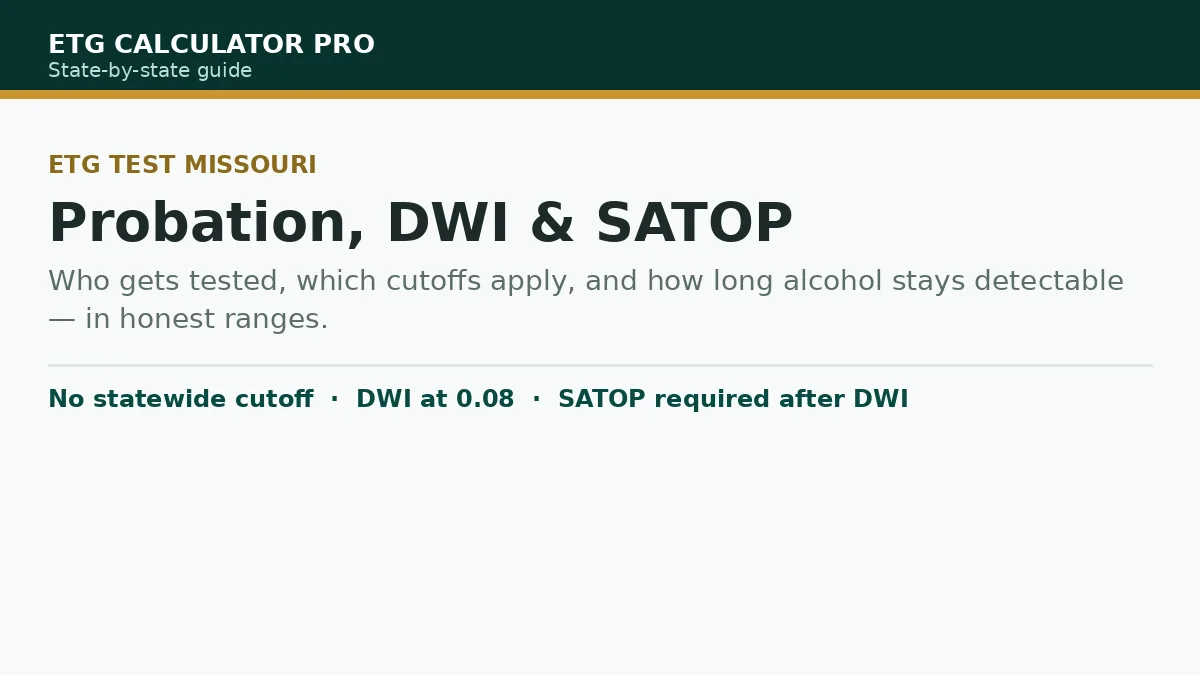
How EtG testing works in Missouri
Ethyl glucuronide (EtG) is a direct metabolite of alcohol found in urine after drinking. Courts and supervision officers use it to answer one question: has this person consumed alcohol since the last check-in? Breath tests catch only very recent use and standard drug panels do not detect alcohol, so when abstinence is ordered, EtG fills the gap.
Testing in Missouri is court- and program-driven, not statewide: probation and parole are supervised by the Missouri Department of Corrections' Division of Probation and Parole; DWI courts run locally under RSMo 478.001 to 478.009; and SATOP is run by the Department of Mental Health's Division of Behavioral Health.
Screening is usually a rapid urine immunoassay, with laboratory confirmation available when a result is contested. Labs run a creatinine check, so an abnormally low level — for example from drinking excessive water — can mean a failed or rejected test.
A transdermal ankle monitor and an ignition interlock are different tools, not EtG tests — though a person can be subject to both at once. Missouri DWI courts may require continuous alcohol monitoring or breath testing at least four times a day alongside urine testing.
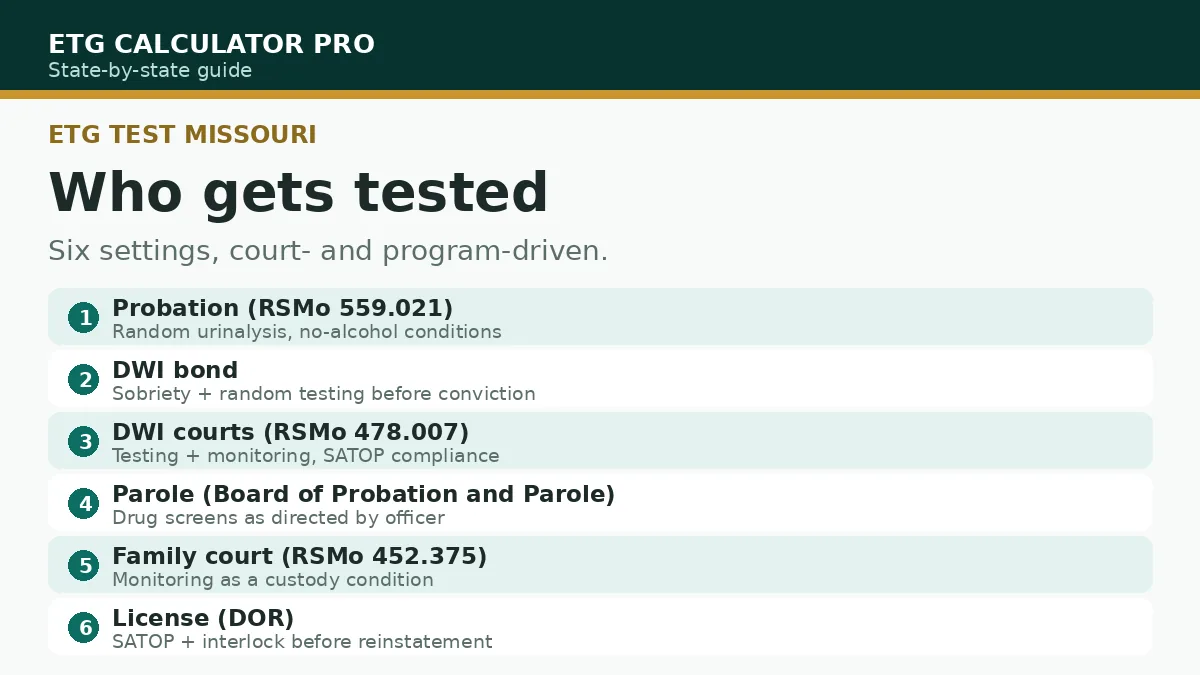
Who gets tested in Missouri and why
Probation
Probation is where most Missouri alcohol and drug testing happens. When a court grants probation it sets the conditions it deems reasonably necessary to keep the person from reoffending (RSMo 559.021), and the person receives a certificate stating the conditions. Supervision is handled by the Department of Corrections' Division of Probation and Parole. The department's supervision rules state that a person on supervision “will be expected to undergo urinalysis or other types of drug testing on a random basis” — a positive result is a violation, and failing to produce a specimen in the required time is a violation too. Special conditions can include no alcohol and substance use disorder treatment. A positive test, or refusing one, can lead to a revocation hearing, though courts often respond first with treatment or increased supervision.
Pretrial bond in DWI cases
Testing often starts before conviction: a judge setting bond in a DWI case may require abstinence and random testing while the case is pending. Methods vary by county — breath tests, transdermal monitors, and EtG urine tests reaching back roughly 72 hours — and EtG catches drinking between breath checks.
DWI
Missouri prohibits driving while intoxicated under RSMo 577.010, and driving with excessive blood alcohol content under RSMo 577.012. The per se limit is 0.08% BAC; 0.04% for commercial drivers; 0.02% for drivers under 21. A first offense is a Class B misdemeanor: up to six months in jail and a fine of up to $1,000. A BAC of 0.15% or higher carries a minimum of 48 hours in jail; a BAC over 0.20% carries at least five days. A court may give a first offender a suspended imposition of sentence (SIS): complete probation and the DWI is dismissed. Repeat offenses escalate through Missouri's four-tier system — prior, persistent, aggravated, and chronic offenders (RSMo 577.023) — with longer jail terms and license consequences: a second offense within five years brings 10 days to one year in jail and a fine up to $2,000, and a third brings 30 days to four years and a fine up to $10,000. Every DWI case also requires SATOP completion, covered below.
Treatment courts and DWI courts
Missouri's alternative to incarceration for high-risk repeat offenders is its treatment courts — adult treatment court, DWI court, family treatment court, juvenile treatment court, veterans treatment court, and mental health treatment court — established under RSMo 478.001 and consolidated by 2025 legislation. A DWI court combines judicial supervision, drug testing, continuous alcohol monitoring or verifiable breath testing at least four times a day, SATOP compliance, and treatment (RSMo 478.007). The 13th Circuit (Boone and Callaway counties) runs drug and DWI courts with random testing for drugs and alcohol plus group and individual counseling. The 4th Circuit DWI Court, serving five northwest Missouri counties, runs an 18-month program: weekly individual and group counseling, probation officer visits, random drug and alcohol testing, random home visits, AA meetings, community service, and court twice a month — with a reported 1.5% graduate recidivism rate.
Parole
Release from a Missouri Department of Corrections facility means supervision by the Board of Probation and Parole, with day-to-day supervision by the Division of Probation and Parole. Standard conditions include obeying the law, not possessing or using drugs except as prescribed, and random urinalysis; special conditions can include no alcohol and substance use disorder treatment. A failed test is a violation that can lead to increased supervision, a treatment referral, or revocation proceedings.
Family court
In custody and parenting-time cases, Missouri courts decide on the child's best interests under RSMo 452.375, and the mental and physical health of all individuals involved is one of the factors the court must consider — so a parent's alcohol use that bears on parenting or the child's safety can be weighed. Since a 2023 revision, the law starts from a presumption that equal or roughly equal parenting time is in the child's best interests, but the presumption can be rebutted. Missouri courts commonly order alcohol or drug monitoring as a condition of visitation or custody — remote breath systems such as Soberlink, or random urinalysis at court-approved facilities — and a DWI conviction is the kind of evidence a co-parent raises. Testing follows a request and a reason, and a positive result is one factor among many.
License reinstatement
Getting a license back after a Missouri DWI runs through the Department of Revenue. A first conviction brings a 30-day suspension followed by a 60-day Restricted Driving Privilege (RDP); alternatively, an immediate 90-day RDP is available if an approved ignition interlock device is installed. A BAC of 0.150 or higher, or personal injury or property damage, makes an interlock mandatory for any RDP. A prior alcohol conviction means a one-year revocation with no RDP, though a Limited Driving Privilege may be available. Refusing a chemical test brings a one-year revocation. Reinstatement requires a $45 fee, an SR-22 insurance filing maintained for two years, proof of SATOP completion, and an interlock where required.
Cutoffs used in Missouri programs
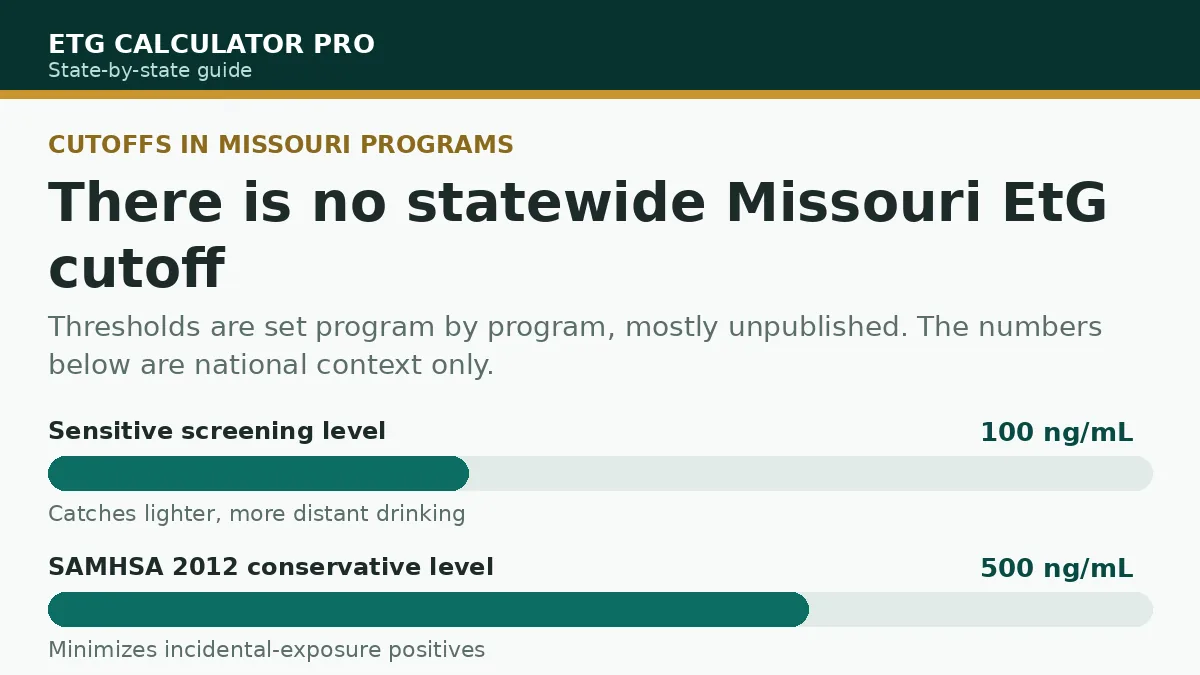
The most important point on this page: there is no statewide Missouri EtG cutoff. We checked Missouri statutes, court rules, Department of Corrections policies, and Department of Mental Health standards; none names an EtG threshold. Thresholds are set program by program, mostly unpublished — your paperwork names the only cutoff that counts.
National context:
- 100 ng/mL — the sensitive level many labs use; catches lighter, more distant drinking.
- 500 ng/mL — SAMHSA's 2012 conservative recommendation.
- Labs screen anywhere from 100 to 1,000 ng/mL.
Do not assume a Missouri program uses either number unless its paperwork says so, and do not confuse the 0.08%, 0.15%, and 0.20% BAC figures in Missouri law with EtG cutoffs. SAMHSA's interpretation bands add context — a high positive above 1,000 ng/mL may indicate heavy or very recent drinking, while a very low positive of 100 to 500 ng/mL may indicate older drinking or recent incidental exposure — but these are possibilities, not proof.
Detection windows in Missouri programs
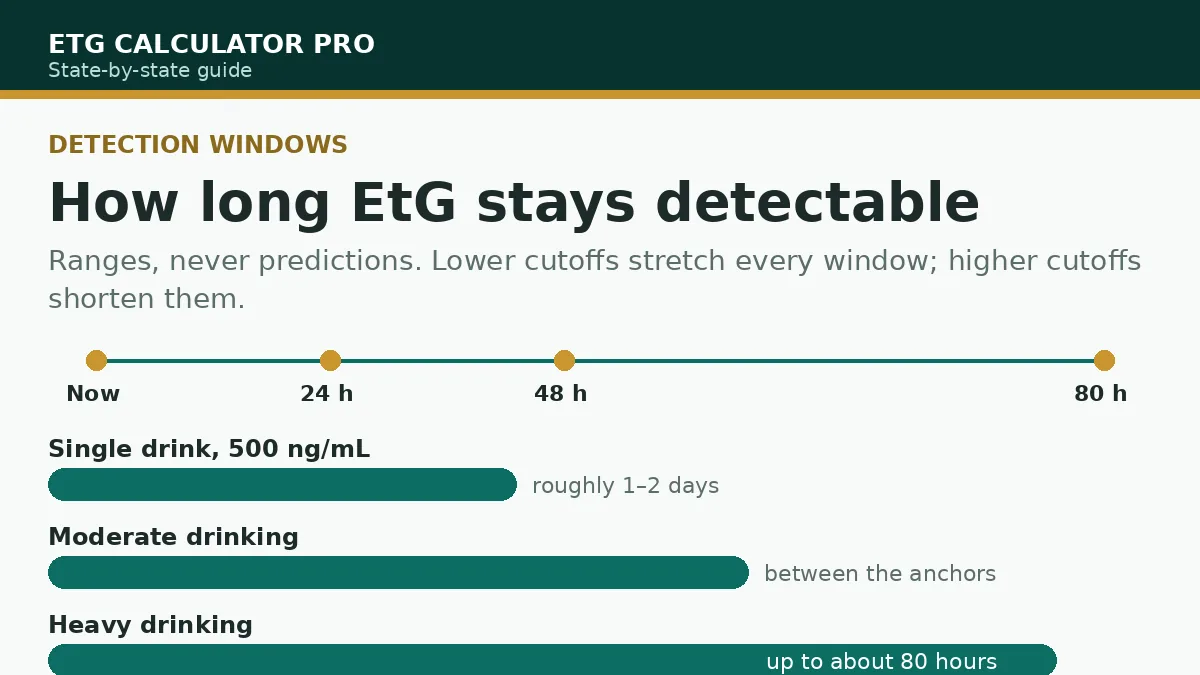
Detection windows are ranges, never predictions:
- Heavy drinking: up to about 80 hours after the last drink.
- A single drink: roughly 1–2 days at a 500 ng/mL cutoff; lower cutoffs extend the window.
- Moderate drinking: between those anchors.
The biggest lever is the cutoff: at 100 ng/mL, the same episode stays detectable longer. One caution: an NIH-funded study found EtG detection sensitivity poor after 48 hours at every dose and cutoff tested.
Apply these ranges with our homepage calculator or our detection timeline calculator.
A realistic Missouri scenario
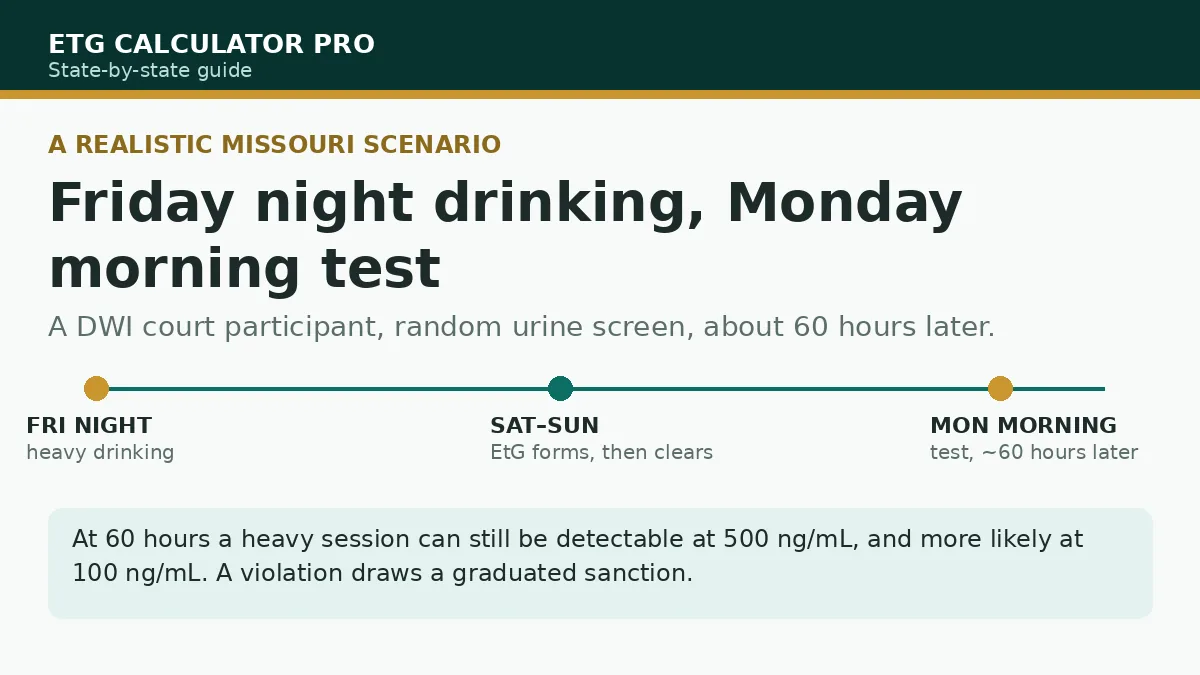
Consider a participant in the 4th Circuit DWI Court, in the intensive phase: weekly random drug and alcohol testing, probation officer visits, and a no-alcohol condition. He drinks heavily on a Friday night, then faces a random urine screen on Monday morning, about 60 hours later.
Sixty hours sits inside the published range for heavy drinking: at 500 ng/mL a heavy session can still be detectable, while a lighter one would likely have cleared; at 100 ng/mL, a positive is more likely. In a DWI court, a violation draws a graduated sanction — increased testing, added treatment, or short jail time — rather than automatic termination.
No pass-or-fail claim is possible from a timeline alone.
A note on legal advice
This page is educational, not legal advice, and program rules change. If you are subject to testing, your program's requirements — and an attorney if a violation is alleged — are the authorities that matter.
Frequently asked questions
Is there one Missouri EtG cutoff?
No. No Missouri statute, court rule, Department of Corrections policy, or Department of Mental Health standard we checked publishes a statewide EtG cutoff. Each court, program, and lab sets its own, mostly unpublished. Nationally the common levels are 100 and 500 ng/mL (SAMHSA, 2012); neither is a Missouri rule. Your program's paperwork names the only number that counts. And do not confuse the numbers that do appear in Missouri law — 0.08%, 0.15%, and 0.20% BAC — with EtG cutoffs: those are breath-alcohol thresholds for DWI charges and sentencing, not urine concentrations.
Does Missouri probation use EtG testing?
Yes. When a court grants probation it sets the conditions it deems reasonably necessary to keep the person from reoffending (RSMo 559.021), and supervision is handled by the Department of Corrections' Division of Probation and Parole. The department's supervision rules state that a person on supervision “will be expected to undergo urinalysis or other types of drug testing on a random basis,” and that failing to produce a specimen in the required time is itself a violation. Special conditions can include no alcohol and substance use disorder treatment. A positive test — or refusing one — can lead to a revocation hearing, though courts often respond first with treatment or increased supervision.
What is SATOP, and who has to complete it?
SATOP is the Substance Awareness Traffic Offender Program, run by the Missouri Department of Mental Health's Division of Behavioral Health. It serves more than 16,000 people a year and is required after an administrative license suspension or revocation from a DWI, a court order, a condition of probation, or a plea bargain — and for minor-in-possession and zero-tolerance offenses. It starts with a screening at a state-certified Offender Management Unit ($126, plus a $249 supplemental fee), where a qualified professional assigns one of four levels: the 10-hour Offender Education Program, the Weekend Intervention Program, the Clinical Intervention Program, or the Serious and Repeat Offender Program (75 hours of treatment, for drivers with a BAC of 0.15 or higher, repeat offenses, and a substance use disorder diagnosis). The assigned program must be completed within six months, online classes do not count, and the Department of Revenue requires proof of completion before reinstating a license.
What are the penalties for a first DWI in Missouri?
A first DWI under RSMo 577.010 is a Class B misdemeanor: up to six months in jail and a fine of up to $1,000. A BAC of 0.15% or higher carries a minimum of 48 hours in jail; a BAC over 0.20% carries at least five days. A court may give a first offender a suspended imposition of sentence (SIS): complete probation and the DWI is dismissed. On the license side, a first conviction brings a 30-day suspension followed by a 60-day Restricted Driving Privilege, or an immediate 90-day restricted privilege if an approved ignition interlock device is installed. Refusing a chemical test brings a one-year revocation. SATOP completion is mandatory in every DWI case.
What are Missouri DWI courts, and how does testing work there?
Missouri's alternative to incarceration is its treatment courts — adult treatment court, DWI court, family treatment court, juvenile treatment court, veterans treatment court, and mental health treatment court — established under RSMo 478.001 and consolidated by 2025 legislation. A DWI court combines judicial supervision, drug testing, continuous alcohol monitoring or verifiable breath testing at least four times a day, SATOP compliance, and treatment (RSMo 478.007). The 13th Circuit (Boone and Callaway counties) runs drug and DWI courts with random testing for drugs and alcohol plus group and individual counseling. The 4th Circuit DWI Court, serving five northwest Missouri counties, runs an 18-month program with weekly random drug and alcohol testing, probation visits, random home visits, AA meetings, and court twice a month — and reported a 1.5% graduate recidivism rate at launch.
Can a Missouri family court order EtG testing?
Yes, at the judge's discretion. Custody is decided on the child's best interests under RSMo 452.375, and the mental and physical health of all individuals involved is one of the factors the court must consider — so a parent's alcohol use that bears on parenting or the child's safety can be weighed. Since a 2023 revision, the law starts from a presumption that equal or roughly equal parenting time is in the child's best interests, but the presumption can be rebutted. Missouri courts commonly order alcohol or drug monitoring as a condition of visitation or custody — remote breath systems such as Soberlink, or random urinalysis at court-approved facilities — and a DWI conviction is the kind of evidence a co-parent raises. Testing follows a request and a reason, and a positive result is one factor among many.
How long after drinking can an EtG test detect alcohol in Missouri?
The biology does not change at the state line: up to about 80 hours after heavy drinking, roughly 1–2 days after a single drink at 500 ng/mL; lower cutoffs extend the window. These are research ranges, not predictions. One caution: an NIH-funded study found EtG detection sensitivity poor after 48 hours at every dose and cutoff it tested, and called marketing of EtG as an 80-hour test unsubstantiated — a reminder that the '80-hour test' label is a marketing shorthand, not a guarantee.
Evidence and limitations
This guide summarizes primary research, public-health guidance, and Missouri public records. Group-level findings cannot predict one person's result.
- Missouri Department of Mental Health — Substance Awareness Traffic Offender Program (SATOP): serves more than 16,000 people annually; required after a DWI suspension or revocation, court order, probation condition, or plea bargain; screening $126 plus $249 supplemental fee; 10-hour Offender Education Program; six-month completion window; internet classes do not count
- 9 CSR 30-3.206 — SATOP Structure: Offender Management Units as entry point; screening by a SATOP Qualified Professional; referral guidelines, including the Serious and Repeat Offender Program for BAC 0.15 or higher with repeat offenses and a substance use disorder diagnosis
- Missouri Department of Revenue — Restricted Driving Privilege (Points, Alcohol): first conviction 30-day suspension followed by a 60-day RDP; immediate 90-day RDP with an ignition interlock device; BAC 0.150 or above, or injury or property damage, makes an interlock mandatory; prior conviction means one-year revocation with no RDP
- Missouri Department of Revenue — Reinstatement Requirements: $45 fee; SR-22 insurance for two years; proof of SATOP completion; ignition interlock where required
- RSMo 478.001 (2025) — Treatment court divisions: adult, DWI, family, juvenile, mental health, and veterans treatment courts; a treatment court combines judicial supervision, drug or alcohol testing, and treatment
- RSMo 478.007 — DWI docket or court: combines judicial supervision, drug testing, continuous alcohol monitoring or breath testing at least four times a day, SATOP compliance, and treatment
- 13th Judicial Circuit — Treatment Court (Boone and Callaway counties): drug and DWI courts; random testing for drugs and alcohol; group and individual counseling
- 4th Circuit DWI Court — 18-month program for five northwest Missouri counties; weekly random drug and alcohol testing, probation visits, random home visits, AA meetings, court twice a month; 1.5% graduate recidivism rate as reported at launch
- Missouri Department of Corrections — Understanding Probation & Parole for Family & Friends: DOC supervises adult offenders in communities; standard conditions; special conditions include no alcohol and substance use disorder treatment
- Missouri Department of Corrections — Rules and Regulations Governing the Conditions of Probation, Parole, and Conditional Release (MBPP-258): random urinalysis expected; a positive result, or failure to produce a specimen in time, is a violation; authority under RSMo 559.021
- RSMo 452.375 — Custody: best interests of the child; the mental and physical health of all individuals involved is a factor the court must consider
- Nolo — Missouri DWI Penalties: 0.08% BAC limit (0.04% commercial); first offense Class B misdemeanor, up to six months and up to $1,000; BAC 0.15% or higher minimum 48 hours, over 0.20% at least five days; suspended imposition of sentence; second and third offense penalties; suspension and RDP periods
- Missouri Probation Rules, Violations, and Early Discharge — DOC Division of Probation and Parole supervises probationers; the court can order drug and alcohol testing at any time; a positive test or refusal is a violation
- What Is SATOP in Missouri? — RSMo 302.580 requires SATOP after a DWI conviction; four program levels; screening $126 plus $249; six months to begin the assigned program
- Alcohol Testing in Child Custody: Each State's Laws (2026) — Missouri: custody statute does not name alcohol abuse; judges weigh a parent's substance use under the mental and physical health factor of RSMo 452.375
- Can a DWI Affect Child Custody in Missouri? — 2023 revision: presumption of equal or roughly equal parenting time (rebuttable); a DWI conviction is evidence a co-parent raises; sobriety conditions can be written into a parenting plan
- Determining Ethyl Glucuronide Cutoffs (PMC) — SAMHSA Advisory 2012 conservative 500 ng/mL recommendation; lab cutoffs 100–1,000 ng/mL; interpretation bands