Why programs reach for EtG in the first place
Court-ordered monitoring, workplace return-to-duty agreements, and clinical recovery programs share a common need: an objective, hard-to-fake signal of recent drinking that does not depend on self-report. Breath and blood alcohol testing only answer that question for a few hours after drinking, which makes them impractical for programs that test on a schedule rather than in the moment. EtG's longer detection window—paired with urine's ease of collection—is what made it attractive for exactly this use case.
That practical advantage is real. It is also where the science and the policy start to pull in different directions, because a laboratory result is a continuous, probabilistic measurement and a program typically needs a binary pass-or-fail decision.
The gap between a lab number and a program decision
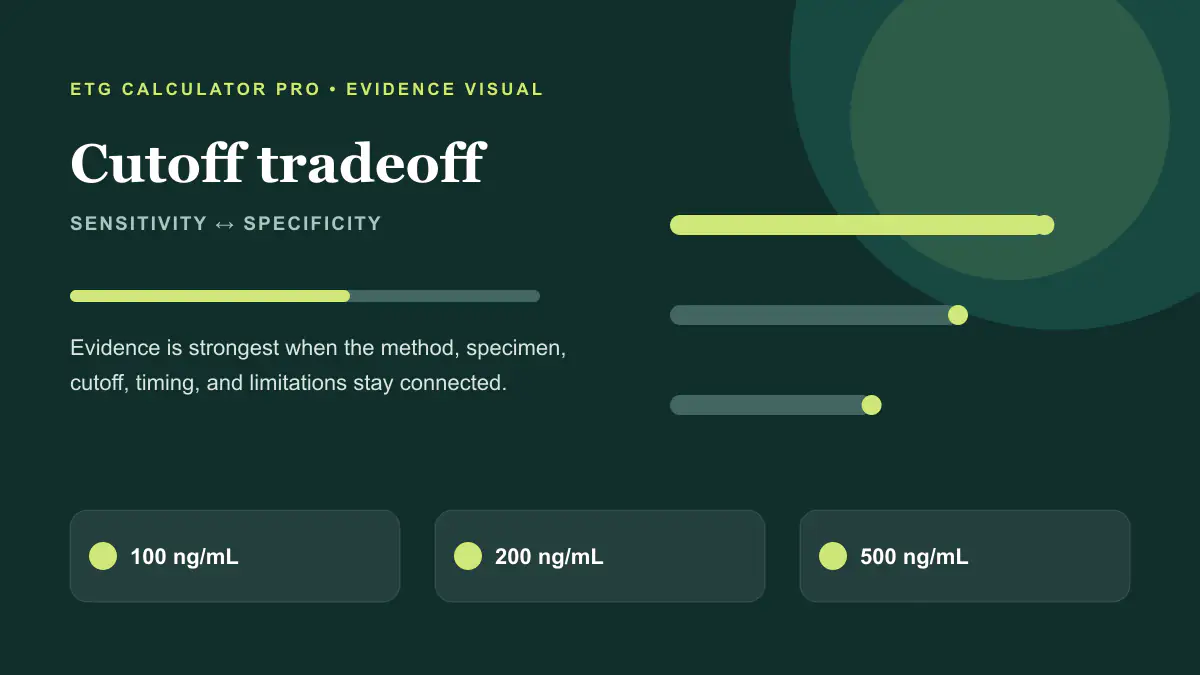
Sensitivity and specificity are the two properties that describe how well a cutoff performs: sensitivity is how reliably a real drinking event gets detected, and specificity is how reliably a negative stays negative. Every published cutoff study shows the same underlying tradeoff—lower cutoffs catch lighter or older drinking more consistently but are more susceptible to incidental exposure, while higher cutoffs reduce that risk at the cost of missing some genuine recent use. Our sensitivity and specificity explainer and 100 vs 500 ng/mL comparison cover the research behind this tradeoff in detail.
The uncomfortable truth for program design is that there is no cutoff that simultaneously maximizes both properties. A well-run program has to decide, explicitly, which error it is more willing to tolerate for its specific purpose—and should be able to explain that choice.
Where false positives really come from
'False positive' gets used loosely, but the research points to a narrower set of genuine mechanisms: incidental ethanol exposure from products like hand sanitizer, mouthwash, or certain foods and medicines, particularly at very sensitive cutoffs and with frequent hand or oral contact. Our false-positives guide walks through which sources have credible supporting evidence and which are overstated. The honest takeaway for programs is that incidental exposure is a real but generally low-probability event at moderate cutoffs, not a routine occurrence—so it should be handled through a defined confirmation and appeal process rather than dismissed or treated as common.
Dilution, creatinine, and sample validity
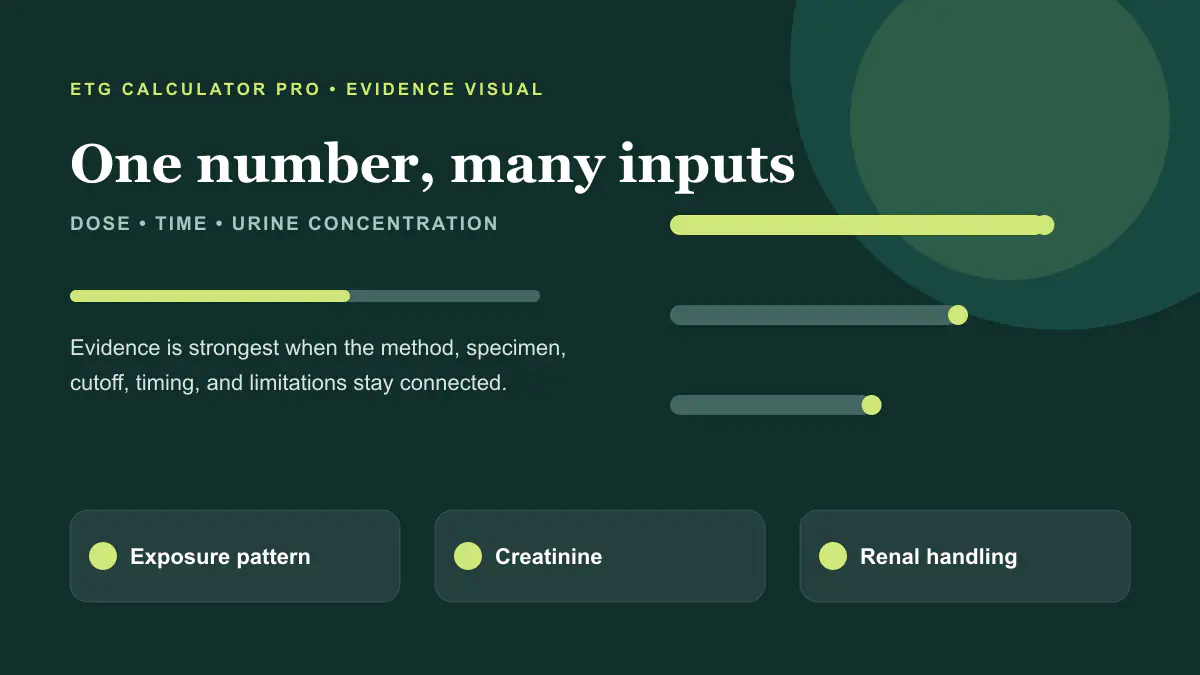
Urine concentration can move a result in both directions. A dilute sample—whether from high fluid intake or an intentional attempt to lower a concentration—can push a genuine exposure below a cutoff, while a highly concentrated sample can produce a higher number for the same underlying dose. This is why many laboratories report creatinine alongside EtG: an unusually low creatinine value flags a sample as dilute and appropriately qualifies how the EtG number should be read. Our creatinine and dilution guide explains what sample-validity testing can and cannot rule out.
What an evidence-informed program looks like
None of this argues against using EtG testing—it argues for using it carefully. A handful of practices consistently show up in well-designed programs and align with what the underlying research supports:
- Confirm consequential positive screens with a more specific method such as LC-MS/MS rather than acting on an immunoassay screen alone.
- Document the cutoff and analytical method being used, and apply it consistently rather than case by case.
- Check creatinine or another sample-validity indicator so a dilute or unusually concentrated sample is flagged before interpretation.
- Consider EtS alongside EtG when a result is disputed, since it can corroborate or complicate a single-marker finding.
- Provide a clear, timely retest or appeal path rather than treating a single screen as a final determination.
- Avoid converting a concentration into an exact drink count or an exact number of hours—the evidence does not support that level of precision.
Where a calculator fits into this picture
Tools like the one on this site are built for education, not for adjudicating a specific case. They can help someone understand why a range exists, what cutoff and timing variables are doing to that range, and which questions are worth asking a laboratory or a program administrator. They cannot replace a program's documented policy, a laboratory's confirmed result, or legal and clinical advice specific to someone's situation. Our methodology page and EtG test FAQ both state this boundary directly, and we think that transparency matters as much as the underlying science.
Frequently asked questions
Can everyday products cause a positive EtG result in a monitoring program?+
It is possible at sensitive cutoffs with frequent exposure to products containing ethanol, though the research suggests this is uncommon rather than routine at moderate cutoffs. Programs should have a defined process for evaluating a disputed result rather than assuming either extreme.
Should a program act on a single positive screen for a serious consequence?+
Most evidence-informed programs confirm a consequential positive screen with a more specific method before acting on it, precisely because screening immunoassays are optimized for throughput rather than maximum specificity.
Does raising the cutoff make a monitoring program fairer?+
It changes which error is more likely, not whether errors happen. A higher cutoff reduces sensitivity to lighter or older drinking while modestly reducing incidental-exposure risk—it is a tradeoff decision, not a straightforward fairness upgrade.
Evidence and limitations
This article summarizes primary research and public-health guidance. Group-level findings cannot predict one person's result.