How EtG testing works in Washington
Ethyl glucuronide (EtG) is a metabolite of alcohol found in urine after drinking. Courts and supervision officers use it to answer one question: has this person consumed alcohol since the last check-in? Breath tests catch only very recent use, and standard drug panels do not detect alcohol, so EtG fills the gap.
Testing in Washington is court- and program-driven: felony supervision is community custody run by the Department of Corrections, misdemeanor DUI probation by county probation departments, drug courts locally, and the 24/7 Sobriety Program by participating counties and cities.
A transdermal ankle monitor and an ignition interlock are different tools, not EtG tests, though a person can face both at once. When a Washington court orders abstinence it may also order alcohol monitoring through a breathalyzer, a transdermal sensor, or other technology. Screening is usually a rapid urine immunoassay, with lab confirmation when a result is contested; labs run a creatinine check, so an abnormally low level can mean a failed or rejected test.
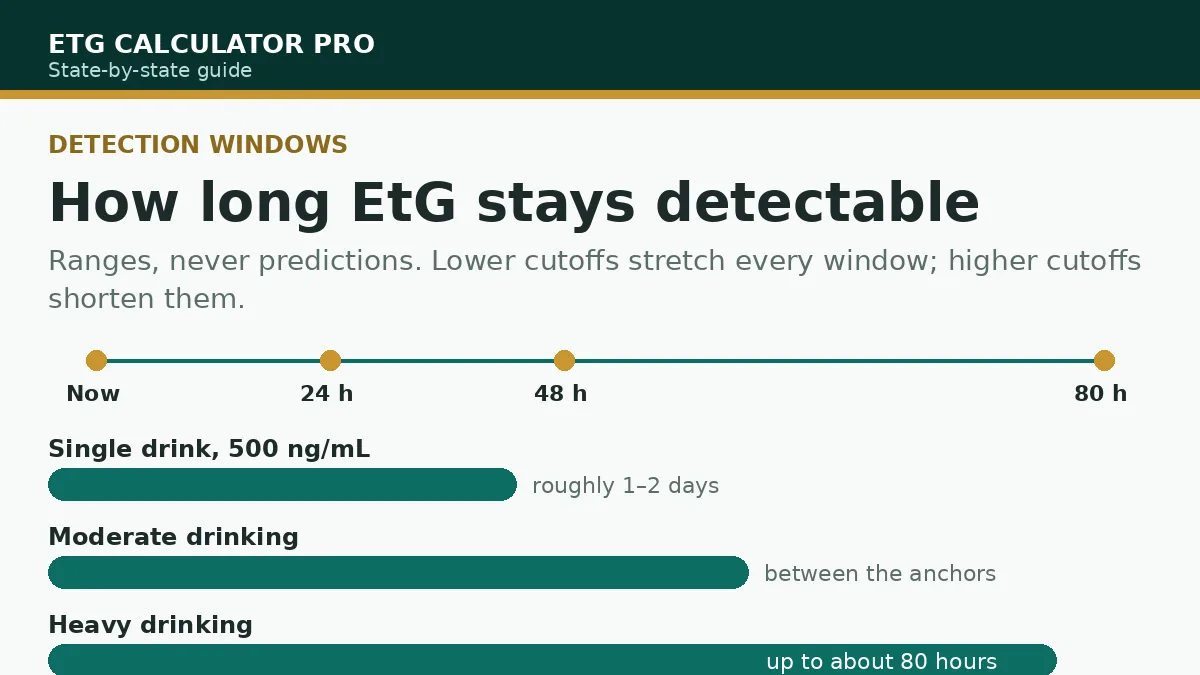
Who gets tested in Washington and why
Community custody
Washington largely replaced parole with community custody under its Sentencing Reform Act. When a court sentences a person to community custody it may order the person to refrain from possessing or consuming alcohol and to participate in crime-related treatment (RCW 9.94A.703). The Department of Corrections uses drug and alcohol testing as a supervision tool, testing people according to the judgment and sentence, imposed conditions, and case plan (DOC 420.380); officers may test for cause, and people on a Drug Offender Sentencing Alternative are tested weekly for the first 90 days after release. A failed test is a violation, drawing sanctions from increased reporting and additional testing up to confinement.
Pretrial release in DUI cases
Testing often starts before conviction: a person charged with DUI who has a prior DUI-related offense and is released before trial must be ordered to install a functioning ignition interlock device, comply with 24/7 Sobriety Program monitoring, or both (RCW 10.21.055).
DUI
Washington prohibits driving under the influence under RCW 46.61.502: an alcohol concentration of 0.08% within two hours of driving, a THC concentration of 5.00 ng/mL, or driving while under the influence of or affected by alcohol, cannabis, or any drug. Lower limits apply to commercial drivers and drivers under 21 (0.02%). A first offense is a gross misdemeanor. With a BAC under 0.15%, the mandatory minimum is 24 consecutive hours in jail and a fine of $350 to $5,000; at 0.15% or higher, or on refusal, the minimums rise to 48 hours and $500. The court may substitute electronic home monitoring or 24/7 sobriety program monitoring for the jail minimum. A fourth offense within 15 years is a class B felony. Every DUI conviction also requires an alcohol and drug evaluation by a state-certified agency and completion of recommended treatment.
DUI probation
A DUI conviction in Washington comes with up to five years of probation (RCW 46.61.5055). Mandatory conditions include a valid license and proof of insurance, not driving at 0.08 or higher, not refusing a breath or blood test, and a functioning ignition interlock device. Violating a mandatory condition means 30 days of confinement that cannot be suspended or deferred, plus a 30-day license suspension. The court may add treatment or supervised probation.
Deferred prosecution
Washington's deferred prosecution (RCW 10.05) pauses a DUI prosecution while the person completes a two-year treatment program: total abstinence from alcohol and non-prescribed drugs for five years, at least two support-group meetings a week during treatment, weekly counseling for six months after the intensive phase and monthly contact after that, an ignition interlock device, and random urinalysis through both the treatment agency and probation. Complete the program and stay law-abiding, and the court can dismiss the charge — no sooner than five years after the deferred prosecution was granted. Historically a person could receive deferred prosecution only once in a lifetime; a 2026 change allows a second deferred prosecution in some DUI cases.
The 24/7 Sobriety Program
Washington's signature monitoring program was created by RCW 36.28A.300 through 36.28A.390. A participant submits to testing of blood, breath, urine, or other bodily substances at locations designated by the participating agency — any county or city may participate through its sheriff or police chief. Courts use it as a pretrial-release condition, and in place of mandatory minimum jail time after conviction (90 days for a first offense at the lower tier, 120 days at the higher tier). Pretrial monitoring can count toward the posttrial sentence, and monitoring may include mandatory urine analysis tests. Violating the program's terms carries penalties.
Drug courts
King County's Drug Diversion Court is the oldest in the state — started in August 1994, the 12th drug court in the country and the first in Washington. It is a voluntary program for adults charged with eligible felony property and drug-related crimes: frequent, random urinalysis, treatment, community service, and at least 20 hours a week of productive activity to graduate. The standard adult track is a minimum of 10 months; the average participant takes about 16 months. More than 3,000 people have graduated since 1994, the graduation rate runs 70–80%, and a state analysis found 90% had no new felony convictions in the three years after starting. Completion typically results in dismissal. King County also runs a Family Treatment Court for parents whose children have been removed, lasting 12 months to two years.
Family court
In custody cases, Washington courts decide on the child's best interests, and a long-term impairment from drug, alcohol, or other substance abuse that interferes with parenting is one factor that may limit a parent's residential time (RCW 26.09.191). The court may order a substance use disorder evaluation and treatment, and may condition residential time on treatment and ongoing testing. Testing follows a request and a reason, and a positive result is one factor among many.
License reinstatement
Getting a license back after a DUI runs through the Department of Licensing. The arrest itself triggers an administrative case separate from the criminal one: under the implied consent law (RCW 46.20.308), refusing a chemical test brings a one-year administrative revocation, while failing the test brings a 90-day suspension for a first offense. The driver must request a hearing promptly — the notice received at arrest states the deadline. In the criminal case, a first offense at a BAC under 0.15% brings a 90-day suspension, and at 0.15% or higher the license is revoked for one year; a refusal is sentenced in the higher tier, which carries a two-year revocation. Reinstatement requires completing the evaluation and any recommended treatment, and an ignition interlock is required on every vehicle the person drives — at least one year after a first DUI, five years after a second, ten years after a third.
Cutoffs used in Washington programs
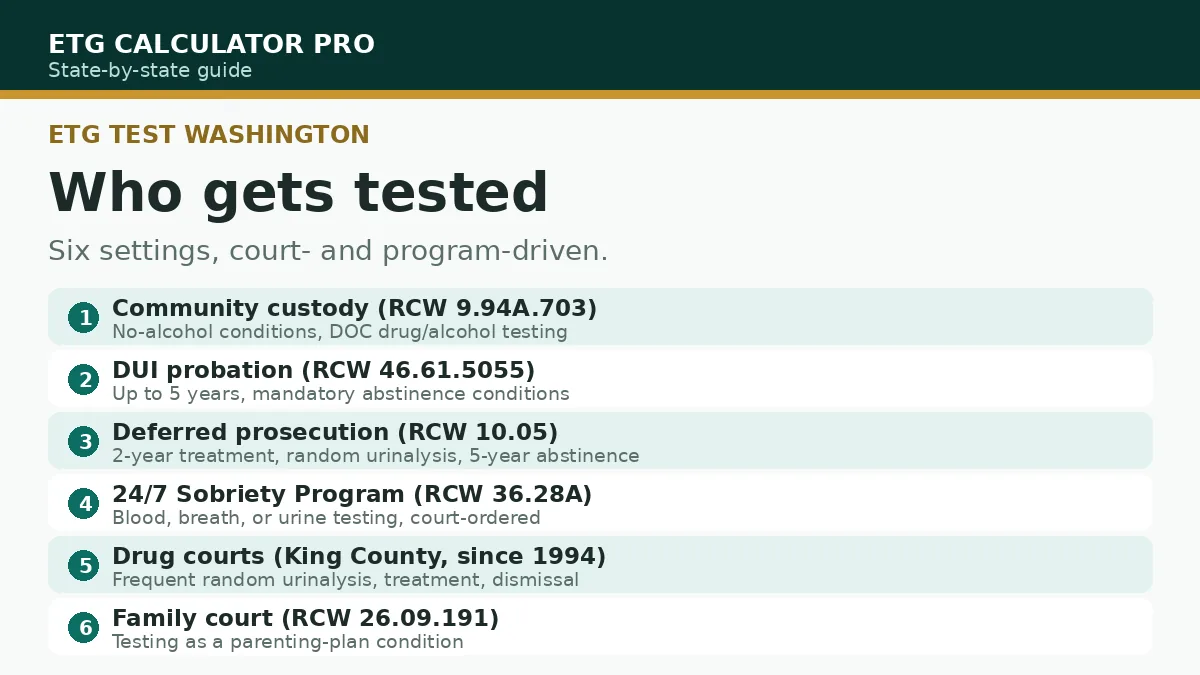
There is no statewide Washington EtG cutoff: we checked Washington statutes, court rules, Department of Corrections policies, and state program standards, and none names a threshold. Thresholds are set program by program, mostly unpublished — your paperwork names the only cutoff that counts.
National context:
- 100 ng/mL — the sensitive level many labs use; catches lighter, more distant drinking.
- 500 ng/mL — SAMHSA's 2012 conservative recommendation.
- Labs screen anywhere from 100 to 1,000 ng/mL.
Do not assume a Washington program uses either number unless its paperwork says so, and do not confuse the 0.08% and 0.15% BAC figures in Washington law with EtG cutoffs. SAMHSA's interpretation bands add context — a high positive above 1,000 ng/mL may indicate heavy or very recent drinking, while a very low positive of 100 to 500 ng/mL may indicate older drinking or incidental exposure — but these are possibilities, not proof.
Detection windows in Washington programs
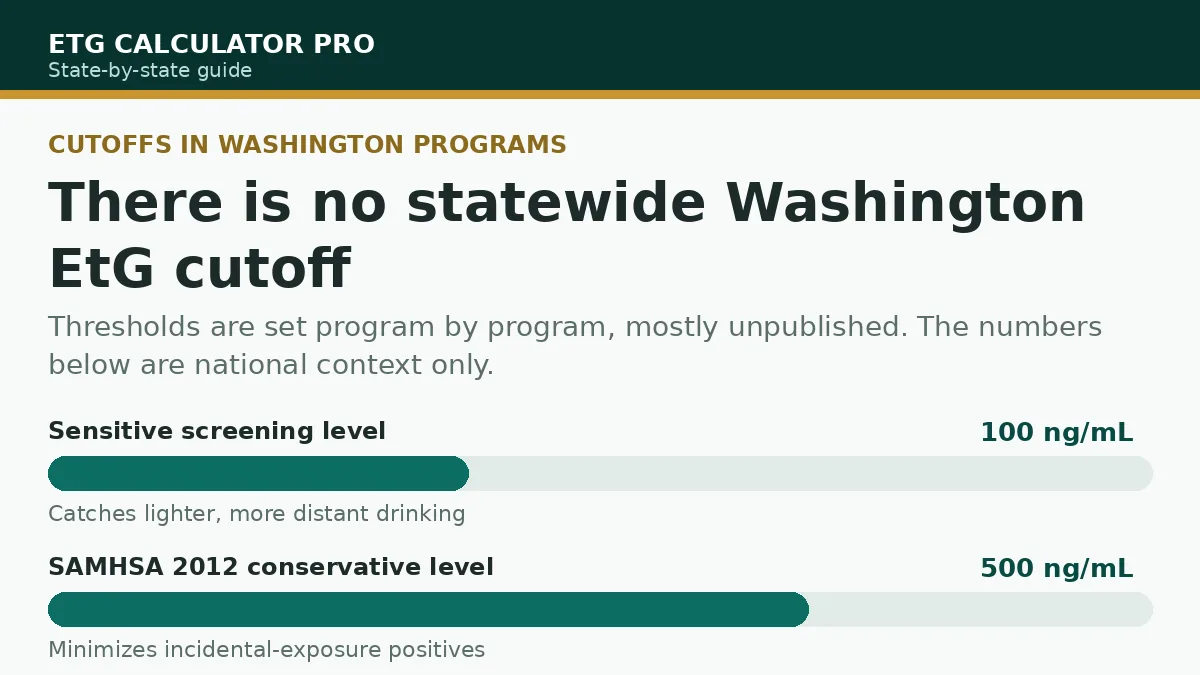
Detection windows are ranges, never predictions:
- Heavy drinking: up to about 80 hours after the last drink.
- A single drink: roughly 1–2 days at a 500 ng/mL cutoff; lower cutoffs extend the window.
- Moderate drinking: between those anchors.
The biggest lever is the cutoff: at 100 ng/mL, the same episode stays detectable longer. One caution: an NIH-funded study found EtG detection sensitivity poor after 48 hours at every dose and cutoff it tested.
Apply these ranges with our homepage calculator or our detection timeline calculator.
A realistic Washington scenario
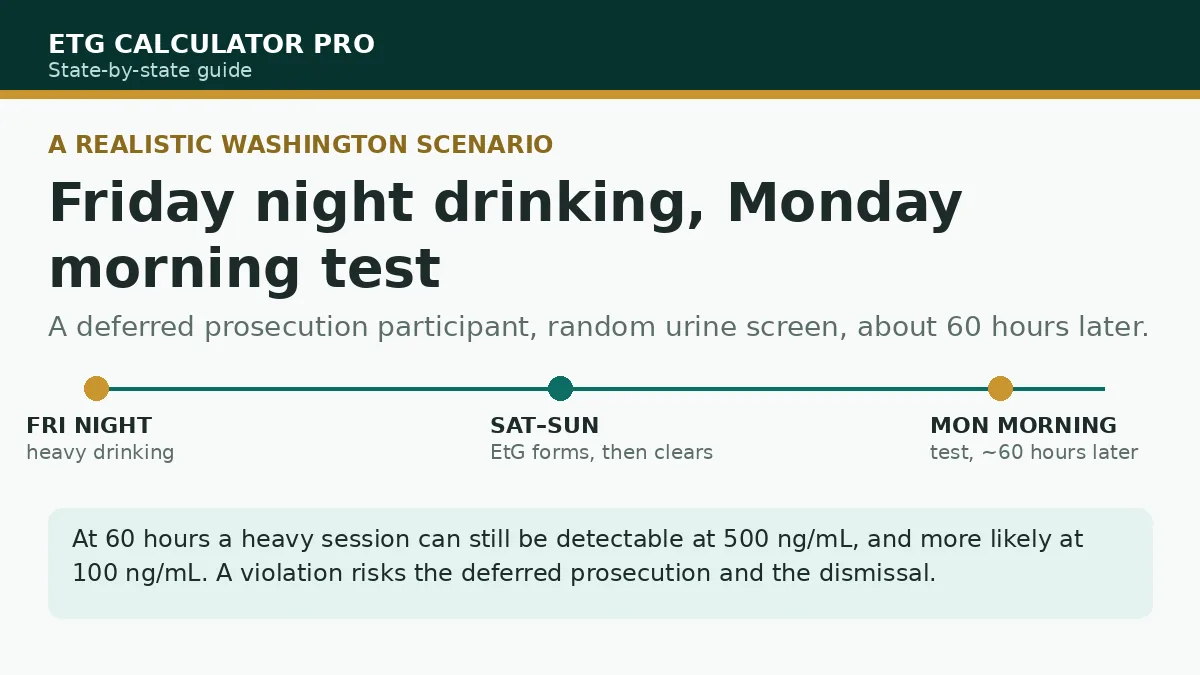
Consider a deferred prosecution participant in King County — two years of treatment, five years of total abstinence, random urinalysis through the treatment agency and probation. He drinks heavily on a Friday night, then faces a random urine screen on Monday morning, about 60 hours later.
Sixty hours sits inside the published range for heavy drinking: at 500 ng/mL a heavy session can still be detectable, while a lighter one would likely have cleared; at 100 ng/mL, a positive is more likely. A violation risks the program — and the dismissal it was working toward.
No pass-or-fail claim is possible from a timeline alone.
A note on legal advice
This page is educational, not legal advice, and program rules change. If you are subject to testing, your program's requirements — and an attorney if a violation is alleged — are what matter.
Frequently asked questions
Is there one Washington EtG cutoff?
No. No Washington statute, court rule, Department of Corrections policy, or state standard we checked publishes a statewide EtG cutoff. Each court, program, and lab sets its own, mostly unpublished. Nationally the common levels are 100 and 500 ng/mL (SAMHSA, 2012); neither is a Washington rule. Your program's paperwork names the only number that counts. And do not confuse the numbers that do appear in Washington law — 0.08% and 0.15% BAC — with EtG cutoffs: those are breath-alcohol thresholds for DUI charges and sentencing, not urine concentrations.
Does Washington probation use EtG testing?
Yes. Washington largely replaced traditional parole with community custody, and a court sentencing a person to community custody may order the person to refrain from possessing or consuming alcohol and to take part in crime-related treatment (RCW 9.94A.703). The Department of Corrections uses drug and alcohol testing as a supervision tool and tests people according to the judgment and sentence, imposed conditions, and case plan; officers may test for cause, and people on a Drug Offender Sentencing Alternative are tested weekly for the first 90 days after release. Misdemeanor DUI probation is handled by county and district court probation departments, with mandatory conditions that include abstinence-related rules and an ignition interlock. A positive test — or refusing one — can lead to sanctions, from increased reporting and additional testing up to confinement.
What is the 24/7 Sobriety Program, and who has to join it?
The 24/7 Sobriety Program was created by RCW 36.28A.300 through 36.28A.390. A participant submits to testing of blood, breath, urine, or other bodily substances to determine the presence of alcohol or drugs, at locations designated by the participating agency; any county or city may participate through its sheriff or police chief. Courts order it as a condition of pretrial release for repeat DUI defendants, and as a substitute for mandatory minimum jail time after conviction — a 90-day period for a first offense at the lower BAC tier, 120 days at the higher tier. Pretrial monitoring can count toward the posttrial sentence, and monitoring may also include mandatory urine analysis tests ordered by the court. Violating the program's terms carries penalties.
What is deferred prosecution, and how does testing work in it?
Deferred prosecution under RCW 10.05 pauses a DUI prosecution while the person completes a two-year treatment program. The conditions are strict: total abstinence from alcohol and non-prescribed drugs for five years, at least two support-group meetings a week during treatment, weekly counseling for six months after the intensive phase and monthly contact after that, an ignition interlock, and random urinalysis through the treatment agency and probation. Complete it and stay law-abiding, and the court can dismiss the charge — no sooner than five years after the deferred prosecution was granted. Historically once in a lifetime; a 2026 change allows a second deferred prosecution in some DUI cases.
What are the penalties for a first DUI in Washington?
A first DUI under RCW 46.61.502 is a gross misdemeanor. With a BAC under 0.15%, the mandatory minimum is 24 consecutive hours in jail and a fine of $350 to $5,000; the court may substitute 15 days of electronic home monitoring or a 90-day period of 24/7 sobriety program monitoring. With a BAC of 0.15% or higher, or on refusal of a chemical test, the minimums rise to 48 hours in jail and a $500 fine, with 30 days of electronic home monitoring or a 120-day period of 24/7 monitoring as the substitute. A first conviction also brings a 90-day license suspension, an ignition interlock for at least one year, a mandatory alcohol and drug evaluation and any recommended treatment, and up to five years of probation with mandatory conditions. A fourth offense within 15 years is a class B felony.
What are Washington drug courts, and how does testing work there?
King County's Drug Diversion Court, started in August 1994 — the 12th drug court in the country and the first in Washington — is a voluntary program for adults charged with eligible felony property and drug-related crimes, with frequent, random urinalysis drug testing, treatment, community service, and at least 20 hours a week of productive activity to graduate. The standard adult track is a minimum of 10 months; the average participant takes about 16 months. More than 3,000 people have graduated since 1994, the graduation rate runs 70–80%, and a state analysis found 90% of participants had no new felony convictions in the three years after starting. Successful completion typically results in dismissal of the charges. King County also runs a Family Treatment Court for parents, expected to last 12 months to two years.
Can a Washington family court order EtG testing?
Yes, at the judge's discretion. A long-term impairment resulting from drug, alcohol, or other substance abuse that interferes with parenting functions is one of the factors that may limit a parent's residential time under RCW 26.09.191. The court may order a parent to undergo a substance use disorder evaluation and complete treatment, and may condition residential time on completing treatment and on ongoing testing to ensure compliance. Testing follows a request and a reason, and a positive result is one factor among many.
Evidence and limitations
This guide summarizes primary research, public-health guidance, and Washington public records. Group-level findings cannot predict one person's result.
- RCW 46.61.502 — Driving under the influence: 0.08 alcohol concentration within two hours of driving, THC 5.00 ng/mL, or driving while under the influence of or affected by alcohol, cannabis, or any drug; ordinarily a gross misdemeanor; a class B felony with three or more prior offenses within 15 years
- RCW 46.61.5055 — Alcohol and drug violators, penalty schedule: first offense 24 hours to 364 days and $350–$5,000 (BAC under 0.15%), 48 hours and $500–$5,000 (BAC 0.15% or higher or refusal); 15 days electronic home monitoring or 90-day 24/7 sobriety program monitoring in lieu of the jail minimum (30 days or 120 days in the higher tier); ignition interlock required; license suspension 90 days or revocation one year; probation up to five years with mandatory conditions; 30 days confinement for violating a mandatory condition
- RCW 36.28A.300–390 — 24/7 sobriety program: a participant submits to testing of blood, breath, urine, or other bodily substances to determine the presence of alcohol or drugs; each county or city, through its sheriff or chief, may participate; violations of program terms carry penalties
- RCW 9.94A.703 — Community custody, conditions: court may order a person to refrain from possessing or consuming alcohol and to participate in crime-related treatment; special condition for alcohol/drug traffic offenses requires a diagnostic evaluation and treatment where a problem is found, with the report forwarded to the Department of Licensing
- RCW 26.09.191 — Parenting plan limitations: a long-term impairment resulting from drug, alcohol, or other substance abuse that interferes with parenting functions may limit a parent's residential time; the court may order evaluations and treatment
- Washington Department of Corrections — DOC 420.380 Drug/Alcohol Testing: the department uses drug/alcohol testing as a management/treatment tool; individuals are tested according to the judgment and sentence, imposed conditions, and case plan; community corrections officers may test for cause; Drug Offender Sentencing Alternative individuals are tested weekly for the first 90 days after release
- King County Drug Diversion Court — Program information: frequent, random urinalysis drug testing, treatment attendance, community service, and at least 20 hours per week of productive activity to graduate; standard adult track a minimum of 10 months, average 16 months
- King County drug court marks major milestone (Seattle Times) — started August 1994, the 12th drug court in the country and the first in Washington; over 3,000 graduates since inception; graduation rate 70–80%; DSHS analysis found 90% of participants had no new felony convictions in the three years after starting
- Clark County — Deferred Prosecution: RCW 10.05 program; assessment with a state-certified treatment provider and completion of treatment; total abstinence from alcohol and non-prescribed mind-altering drugs; Probation Services monitors DUI cases for three years after treatment
- DUI Deferred Prosecution in Washington — two-year treatment program (RCW 10.05.150); charge may be dismissed three years after treatment and compliance, no sooner than five years after the deferred prosecution is granted; at least two support-group meetings a week, random urinalysis through the treatment agency and probation; a second deferred prosecution allowed in some DUI cases from January 1, 2026
- Minimum DUI Sentence in Washington State — first offense minimums (24 hours/$350 under 0.15%; 48 hours/$500 at 0.15% or on refusal); license suspension 90 days or revocation one year; refusal triggers a two-year revocation in the criminal tier; ignition interlock at least one year (first), five years (second), ten years (third); fourth offense within 15 years a class B felony
- What Happens With a DOC Violation in Washington State? — community custody replaced traditional parole; low-level violations up to three days of confinement, high-level violations up to 30 days per hearing; a failed drug test can draw increased reporting, additional urinalysis, curfews, or treatment
- Washington State Parenting Plans, Restrictions — under RCW 26.09.191 the court may condition a parent's residential time on successful completion of a drug and alcohol treatment program and order ongoing testing to ensure compliance
- FindLaw — Washington DUI Laws: implied consent (RCW 46.20.308); first refusal brings a one-year administrative license suspension; failing the test brings a 90-day suspension; substance abuse assessment and treatment required
- Washington DUI Laws — two parallel processes (criminal case under RCW 46.61.502 and administrative DOL action); 30-day temporary license after arrest; ignition interlock 1 year (first), 5 years (second), 10 years (third); Ignition Interlock License available
- Washington DUI Laws, Penalties, and Legal Resources — DOL handles administrative suspensions, IID oversight, and SR-22 monitoring; refusal brings a 1-year revocation (first offense), 2 years (subsequent); evaluation and treatment from a state-certified agency required for reinstatement
- RCW 36.28A.330 — 24/7 sobriety program definitions: a program in which a participant submits to testing of blood, breath, urine, or other bodily substances to determine the presence of alcohol or drugs
- Determining Ethyl Glucuronide Cutoffs (PMC) — SAMHSA Advisory 2012 conservative 500 ng/mL recommendation; lab cutoffs 100–1,000 ng/mL; interpretation bands