How EtG testing works in North Carolina
Ethyl glucuronide (EtG) is a direct metabolite of alcohol found in urine after drinking. North Carolina courts, supervision officers, and monitoring programs use it because it answers one question: has this person consumed alcohol since the last check-in? Breath tests catch only very recent use, and standard urine drug panels do not detect alcohol, so when abstinence is ordered, EtG fills the gap.
Testing in North Carolina is court- and program-driven, not statewide. The Department of Adult Correction (DAC), through its Division of Community Supervision and Reentry, supervises more than 75,000 adults in the community on probation, parole, or post-release supervision, with more than 2,000 probation and parole officers. Conditions therefore vary by offense, county, court, and program.
One caveat: most North Carolina sources describe testing generically, as drug and alcohol screening, urinalysis, or substance abuse monitoring, not EtG by name. The statute authorizes screening; it does not name the metabolite. EtG applies where the program or lab specifies it, and where abstinence is the condition being verified, it is the test that fits.
A second distinction matters in North Carolina more than in most states: continuous alcohol monitoring. CAM is a transdermal ankle device that samples perspiration around the clock, and North Carolina law names it expressly in both DWI sentencing and family court. An EtG test is a single urine sample at a single moment; a person can be subject to either tool, or both.
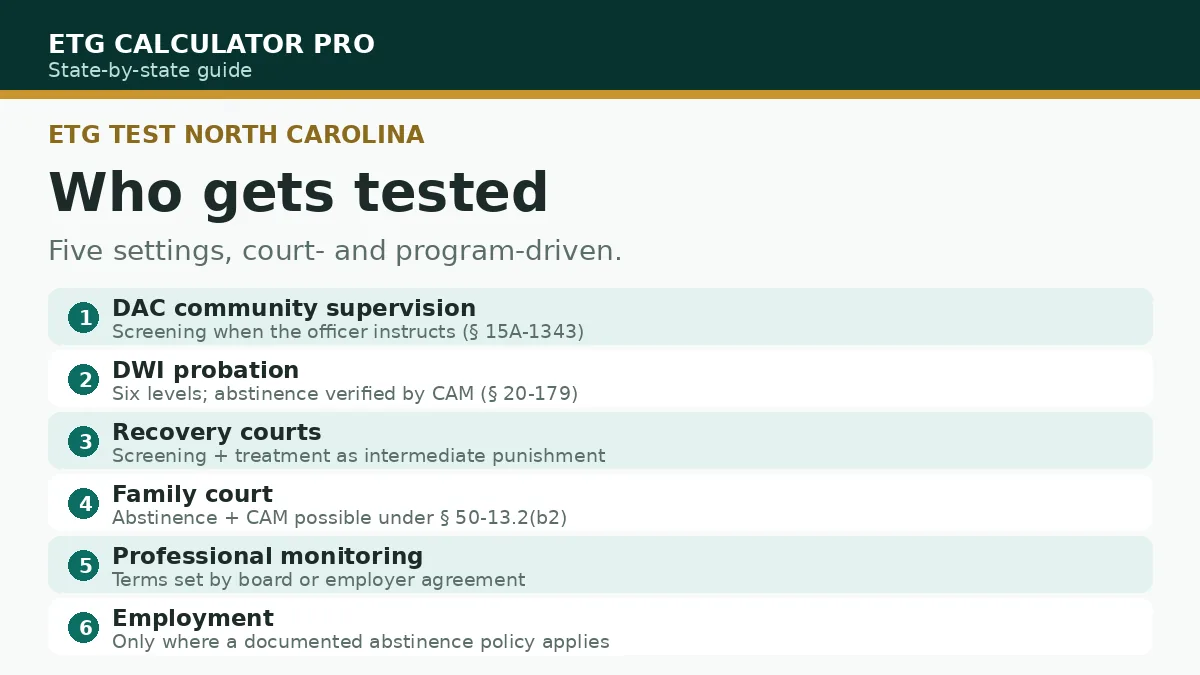
Who gets tested in North Carolina and why
DAC community supervision (North Carolina probation)
Community supervision is where most North Carolina alcohol and drug testing happens. Under N.C.G.S. § 15A-1343(a1)(16), a court may require a probationer to submit to drug and alcohol screening for analysis of the possible presence of prohibited drugs or alcohol when instructed by the probation officer, for purposes directly related to supervision — and if the result is positive, the probationer may be required to reimburse the Division of Community Supervision and Reentry for the actual costs of the screening and testing. Intermediate-punishment conditions add alcohol abstinence and directed evaluation, counseling, treatment, or education. Under N.C.G.S. § 15A-1343.2(f), the Division may require an offender sentenced to an intermediate punishment to submit to substance abuse assessment, monitoring, or treatment, including continuous alcohol monitoring when abstinence from alcohol is required. DAC substance use disorder programs use Treatment Accountability for Safer Communities (TASC) screening and assessment for community-based placement. A failed test does not automatically mean revocation: a probation officer reports the alleged violation and a judge decides it at a violation hearing.
DWI probation and the six sentencing levels
North Carolina calls it DWI, not DUI, and sentences it under its own scheme. Under N.C.G.S. § 20-179, DWI punishment runs on six levels, from Aggravated Level One (the most serious) to Level Five (the least serious), set by grossly aggravating, aggravating, and mitigating factors. A suspended sentence can carry probation with abstinence and monitoring conditions. Two CAM provisions are written into the statute: under § 20-179(k2), the judge may order that as a condition of special probation for any level of offense, the defendant abstain from alcohol consumption as verified by a continuous alcohol monitoring system of a type approved by the Division of Community Supervision and Reentry; and under § 20-179(k3), the court may authorize probation officers to require continuous alcohol monitoring for assessment purposes where abstinence has been ordered and the officer believes the defendant is consuming alcohol. For the most serious level, abstinence verified by CAM runs for a minimum of 120 days up to the term of probation, alongside a substance abuse assessment and the education or treatment required for license restoration. Separately, license restoration under N.C.G.S. § 20-17.6 requires a certificate of completion: a substance abuse assessment plus an alcohol and drug education traffic school or a substance abuse treatment program, depending on the assessment. And where N.C.G.S. § 20-17.8 applies — an alcohol concentration of 0.15 or more, a repeat offense within seven years, or a § 20-179(f3) sentence — restoration also requires an ignition interlock device. An ignition interlock is a breath device fitted to a vehicle, not a urine EtG test.
Recovery courts (judicially managed accountability and recovery courts)
North Carolina's treatment courts sit under the Judicially Managed Accountability and Recovery Court Act of 2021, N.C.G.S. § 7A-790 (originally the Drug Treatment Court Act of 1995). The Act's goals include reducing alcoholism and other drug dependencies among offenders, reducing recidivism, and reducing the alcohol- and drug-related court workload. Drug treatment courts were defined as an intermediate punishment: participants are required, as a condition of probation, to comply with program rules, report as required, and participate in court supervision, drug screening or testing, and drug or alcohol treatment programs. Frequency, panel, and consequences are set by each local court's own program, not by a statewide rule.
Family court
In custody and visitation cases, testing follows the child's best interests. Under N.C.G.S. § 50-13.2, a custody order must promote the interest and welfare of the child, considering all relevant factors, and the court has wide discretion over the order's terms. Under § 50-13.2(b2), an order may, as a condition of custody or visitation, require either or both parents, or any other person seeking custody or visitation, to abstain from consuming alcohol and to submit to a continuous alcohol monitoring system approved by the Division of Community Supervision and Reentry, with the monitoring provider ordered to report any violation to the court and each party; failure to comply is grounds for civil or criminal contempt. Testing is not automatic: it follows a request and a good reason, such as a history relating to drug or alcohol use. A positive result alone does not decide custody; it is one factor the judge weighs, and North Carolina courts must make findings linking substance use to the child's welfare — substance use alone does not establish that a parent is unfit.
Professional monitoring and employment
North Carolina licensing boards and employers run their own monitoring tracks, with terms set by the board or the employer agreement rather than by a statewide EtG rule. In employment, EtG testing appears only where a documented abstinence policy applies: safety-sensitive roles, return-to-work or last-chance agreements, or employer-specific programs. No general North Carolina employment EtG requirement was found.
Cutoffs used in North Carolina programs
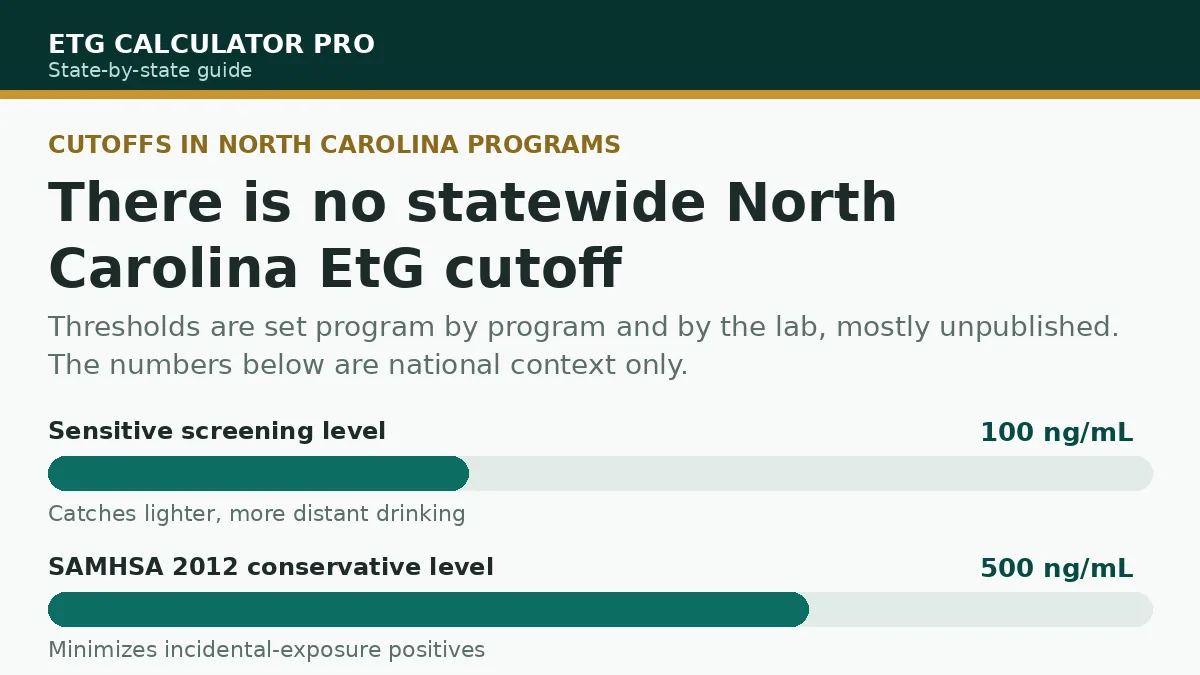
Here is the most important point on this page: there is no statewide North Carolina EtG cutoff. We checked North Carolina statutes, DAC supervision policy and program materials, recovery-court law, DWI program rules, and family-court law; none names an EtG threshold. Thresholds are set program by program and by the lab, mostly unpublished. Your paperwork names the only cutoff that counts.
For national context:
- 100 ng/mL — the sensitive level many labs use; catches lighter, more distant drinking, but risks incidental-exposure flags.
- 500 ng/mL — SAMHSA's 2012 conservative recommendation, minimizing incidental-exposure positives.
- Labs screen anywhere from 100 to 1,000 ng/mL, depending on the program's goals.
Do not assume a North Carolina program uses either number unless its paperwork says so; if it names none, ask in writing and keep the answer.
Detection windows in North Carolina programs
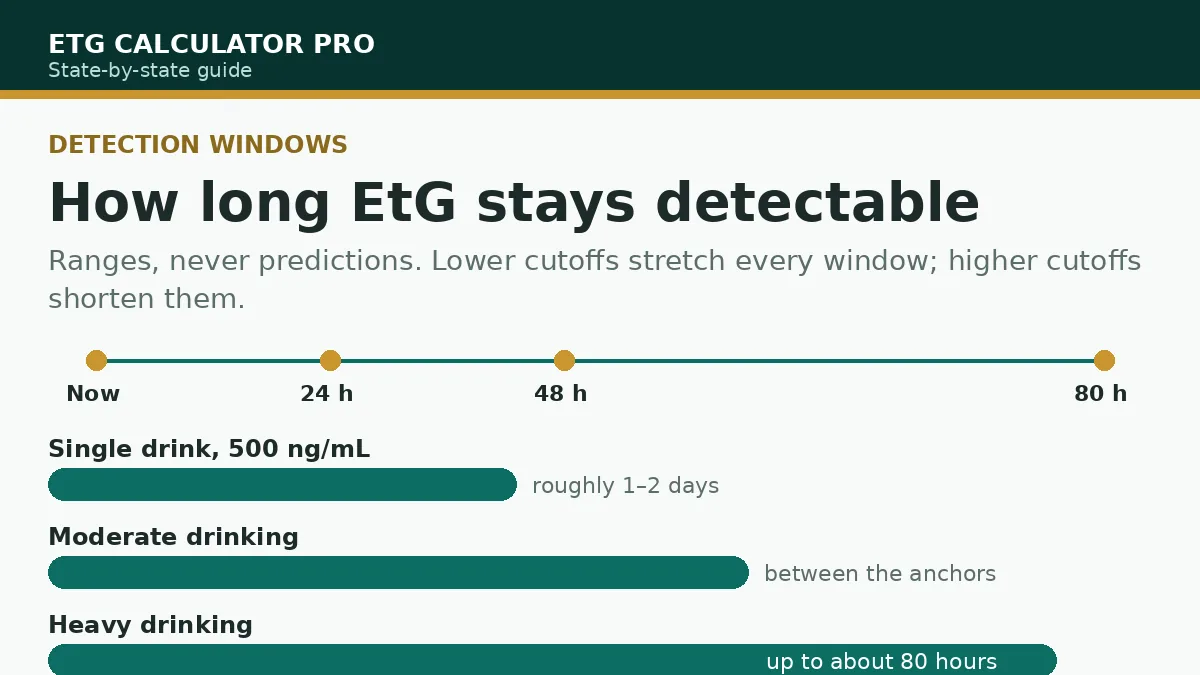
Detection windows are ranges, never predictions, depending on amount, timing, cutoff, hydration, and metabolism:
- Heavy drinking: up to about 80 hours after the last drink.
- A single drink: roughly 1–2 days at a 500 ng/mL cutoff; lower cutoffs extend the window.
- Moderate drinking: between those anchors.
The biggest lever is the cutoff: at 100 ng/mL, the same episode stays detectable longer than at 500 ng/mL. Where CAM also applies, there is no urine detection window at all, because the device samples continuously.
Apply these ranges with our homepage calculator, the 100 ng/mL calculator, or our detection timeline tool.
A realistic North Carolina scenario
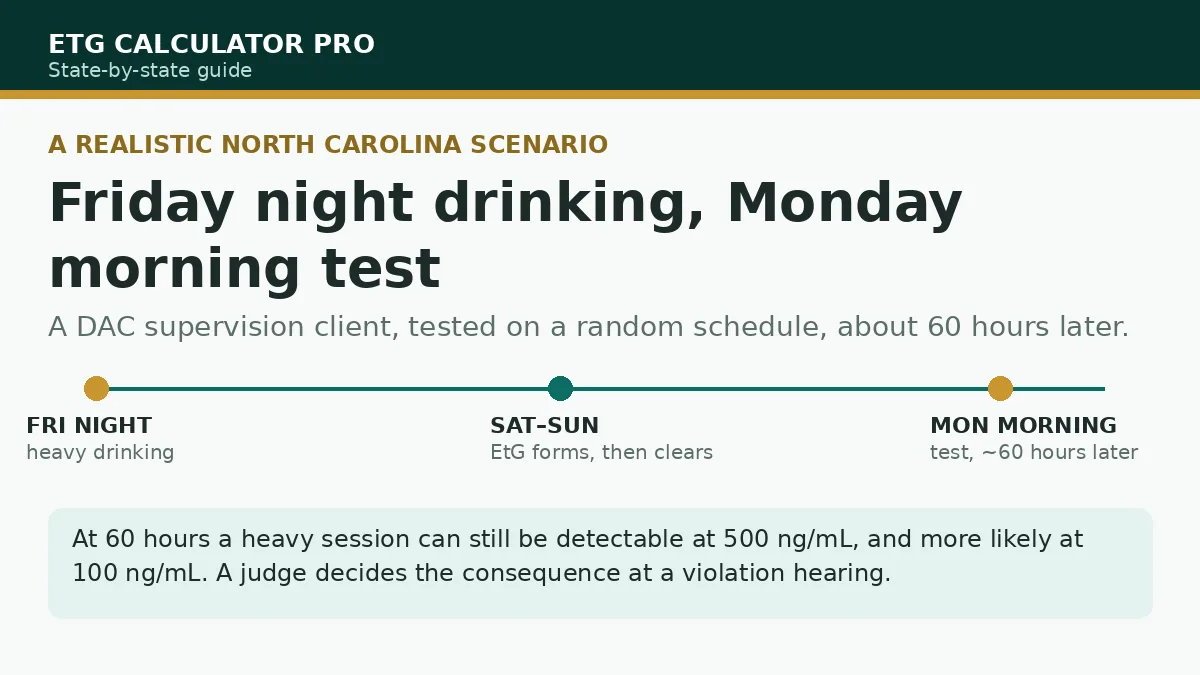
Consider a person on DAC community supervision with an abstinence condition, tested on a random schedule: heavy drinking Friday night, a screening Monday morning, about 60 hours later.
Sixty hours sits inside the published range for heavy drinking, so the result could go either way. At 500 ng/mL, a heavy session can still be detectable at 60 hours, while a lighter one would likely have cleared; at 100 ng/mL, a positive would be more likely. A positive does not automatically end supervision: the officer reports the alleged violation, the person may be required to reimburse the screening costs, and a judge decides the consequence at a violation hearing — continued supervision with added conditions, treatment, or, for serious or repeated violations, revocation.
No pass-or-fail claim is possible from a timeline alone — cutoff, amount, and elapsed time shape the result.
A note on legal advice
This page is educational, describing how EtG testing works in North Carolina DAC supervision, DWI programs, recovery courts, and family court, from published research, public-health guidance, and North Carolina public records. It is not legal advice, and program rules change. If you are subject to testing, your program's requirements, and an attorney if a violation is alleged, are the authorities that matter.
Frequently asked questions
Is there one North Carolina EtG cutoff?
No. No North Carolina statute, Department of Adult Correction policy, recovery-court standard, DWI program rule, or licensing-board page we checked publishes a statewide EtG cutoff. Each court, program, and lab sets its own, mostly unpublished. Nationally the common levels are 100 and 500 ng/mL (SAMHSA, 2012); neither is a North Carolina rule. Your program's paperwork names the only number that counts.
Does North Carolina probation use EtG testing?
North Carolina probation uses drug and alcohol screening under N.C.G.S. § 15A-1343(a1)(16): a probationer must submit to drug and alcohol screening when instructed by the probation officer for purposes directly related to supervision. Most North Carolina sources describe testing generically, as screening or urinalysis, not EtG by name. EtG applies where your program or lab specifies it, and it is the test that answers the abstinence question breath tests cannot.
What is continuous alcohol monitoring in North Carolina, and is it the same as an EtG test?
No. Continuous alcohol monitoring (CAM) is a transdermal ankle device that samples perspiration around the clock; an EtG test is a point-in-time urine test for an alcohol metabolite. North Carolina law treats them as separate tools: under N.C.G.S. § 20-179(k2) a DWI judge may order abstinence verified by CAM as a condition of special probation at any offense level, and under § 50-13.2(b2) a family court may require abstinence verified by CAM as a custody or visitation condition. A person can be subject to either, or both.
What happens after a DWI conviction in North Carolina?
DWI sentencing runs under N.C.G.S. § 20-179, which uses six punishment levels from Aggravated Level One (most serious) to Level Five (least serious), set by grossly aggravating, aggravating, and mitigating factors. A suspended sentence can carry probation with abstinence and monitoring conditions, and license restoration requires a certificate of completion under N.C.G.S. § 20-17.6: a substance abuse assessment plus an alcohol and drug education traffic school or a treatment program, depending on the assessment. Where § 20-17.8 applies (alcohol concentration of 0.15 or more, a repeat offense within seven years, or a § 20-179(f3) sentence), restoration also requires an ignition interlock device — a breath device, not an EtG test.
Can a North Carolina family court order EtG testing?
Yes, at the judge's discretion. Custody orders must promote the child's best interests under N.C.G.S. § 50-13.2, considering all relevant factors, and under § 50-13.2(b2) an order may require a parent to abstain from alcohol and submit to a continuous alcohol monitoring system approved by the Division of Community Supervision and Reentry, with the provider reporting violations to the court and each party. Testing is not automatic; it follows a request and a reason to order it, and substance use alone does not establish that a parent is unfit — findings must link the use to the child's welfare.
How long after drinking can an EtG test detect alcohol in North Carolina?
The biology does not change at the state line: up to about 80 hours after heavy drinking, roughly 1–2 days after a single drink at 500 ng/mL; lower cutoffs extend the window. These are research ranges, not predictions.
Evidence and limitations
This guide summarizes primary research, public-health guidance, and North Carolina public records. Group-level findings cannot predict one person's result.
- N.C.G.S. § 15A-1343 — conditions of probation: drug and alcohol screening when instructed by the probation officer; intermediate-punishment alcohol abstinence
- N.C.G.S. § 15A-1343.2 — special probation rules: delegation to the Division, including substance abuse assessment, monitoring, or treatment with continuous alcohol monitoring
- North Carolina Department of Adult Correction — Probation, Parole and Post-Release Supervision: more than 75,000 adults supervised, more than 2,000 officers
- North Carolina Department of Adult Correction, Community Supervision Policy — Terms and Conditions of Probation (September 26, 2025)
- N.C.G.S. § 20-179 — DWI sentencing: six punishment levels; (k2) abstinence verified by continuous alcohol monitoring; (k3) CAM for assessment purposes
- N.C.G.S. § 20-17.6 — license restoration after DWI: certificate of completion via substance abuse assessment plus ADET school or treatment program
- N.C.G.S. § 20-17.8 — license restoration after certain DWI convictions: ignition interlock requirement
- N.C.G.S. § 7A-790 — Judicially Managed Accountability and Recovery Court Act of 2021 (formerly Drug Treatment Court Act of 1995)
- N.C.G.S. § 50-13.2 — child custody: best interests, and (b2) abstinence plus continuous alcohol monitoring as a custody or visitation condition
- DWI sentencing levels in North Carolina — six levels from Aggravated Level One to Level Five (secondary explainer of § 20-179)
- Determining Ethyl Glucuronide Cutoffs (PMC) — SAMHSA Advisory 2012 conservative 500 ng/mL recommendation; lab cutoffs 100–1,000 ng/mL