How EtG testing works in Texas
Ethyl glucuronide (EtG) is a direct metabolite of alcohol that shows up in urine after drinking. Texas courts, probation departments, and monitoring programs use it because it answers one question reliably: has this person consumed alcohol since the last check-in? Standard urine panels do not detect alcohol at all, and breathalyzers only catch very recent use — so when a judge orders abstinence as a condition, EtG urine testing fills the gap between check-ins.
Testing in Texas is local by design. A judge sets the conditions of community supervision (probation), and the local community supervision and corrections department (CSCD) administers the testing — drug screens, breathalyzers, and monitoring devices among them. According to a TDCJ CJAD fact sheet, Texas has 122 CSCDs serving 254 counties, organized by judicial district under Texas Government Code §76.002. With that many departments, what is tested, how often, and at what cutoff vary county by county.
One honest caveat: most Texas program pages describe testing generically — "urinalysis," "breath," "SCRAM," "alcohol monitoring devices" — rather than naming EtG. Where a source names EtG outright, we say so; otherwise we keep it general. We do not fill gaps with guesses.
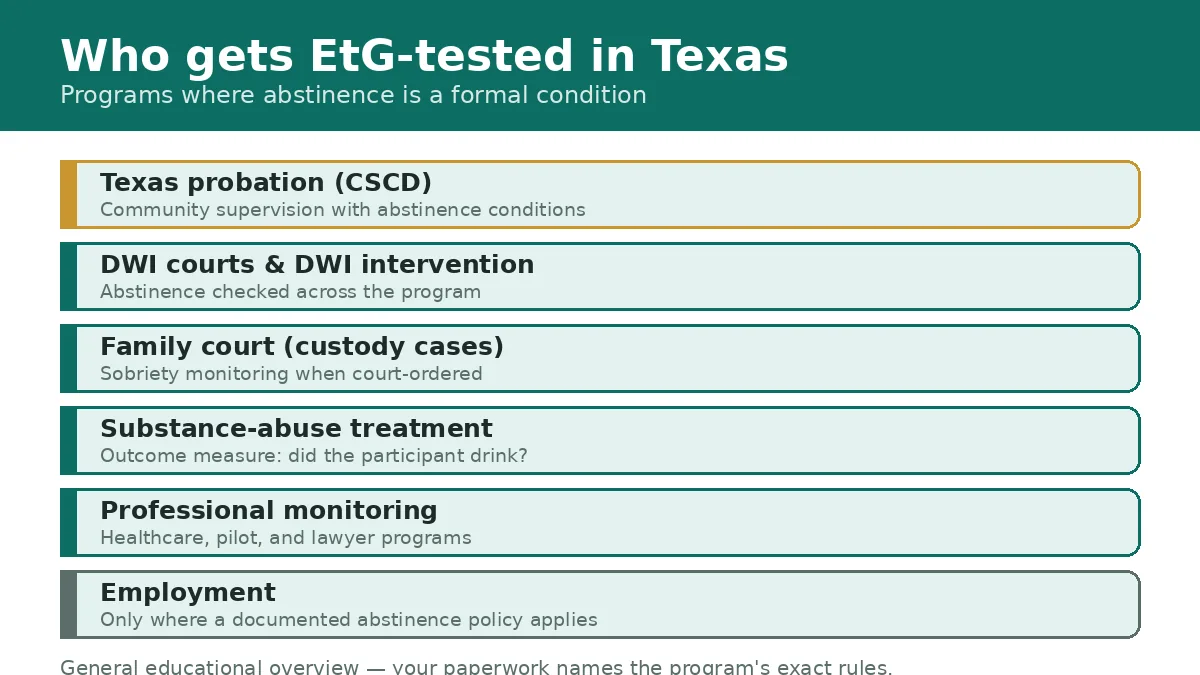
Who gets tested in Texas and why
Texas probation (community supervision)
Probation — "community supervision" in Texas — is where most alcohol testing happens. The judge orders abstinence as a supervision condition, and the local CSCD enforces it with testing. The Harris County CSCD handbook lists drug testing as a standard court-ordered condition (testing, breathalyzers, monitoring devices), and the department runs a High Risk DWI Specialized Caseload. Dallas County's brochure tells probationers to abstain from abusing alcohol and complete court-ordered treatment; Travis County's TCCES office provides the alcohol and drug assessments courts order.
Most county documents describe testing generically — urinalysis, breath, monitoring devices — rather than naming the EtG assay. If abstinence is your condition, confirm exactly what it covers with your supervision officer in writing.
Texas DWI courts
DWI courts and intensive supervision layer alcohol monitoring on top of standard probation. Harris County's SOBER Court, run by Justice Forward, requires abstinence monitored through alcohol monitoring devices, and Texas pretrial intervention programs commonly include random drug and alcohol tests. Under Texas Code of Criminal Procedure Art. 42A.402, a judge may also order evaluation and treatment as a condition of DWI community supervision — a pathway that routinely leads to ongoing alcohol monitoring.
Family court
When substance use is relevant to parenting, Texas courts can order testing in custody cases. Lone Star Law Firm specifically names EtG in the custody context (an attorney's explanation, not a court rule), and Bryan Fagan's office covers drug testing in Texas child-custody cases generally. One consistent attorney warning: refusing a court-ordered test can itself be treated as evidence against you.
Treatment programs
SAMHSA's 2012 advisory on biomarkers in alcohol-use-disorder treatment frames how EtG is used clinically: as a tool to verify self-reported abstinence and anchor clinical conversations, not as a standalone diagnostic. Texas treatment programs that monitor abstinence operate in the same framework.
Professional monitoring
The Texas Physician Health Program (TXPHP), created by the Texas Legislature in 2009, monitors drug screening and reports non-compliance to the Texas Medical Board. The Texas Peer Assistance Program for Nurses (TPAPN) requires complete abstinence with random screening — 12 to 54 selections per year. Both describe screening in general terms; for participants, screening is random, the abstinence condition is total, and the program's written requirements govern.
Employment
EtG testing in Texas appears only where a documented abstinence policy applies — safety-sensitive roles, last-chance agreements, or employer-specific programs. There is no Texas general-employment EtG requirement.
Cutoffs used in Texas programs
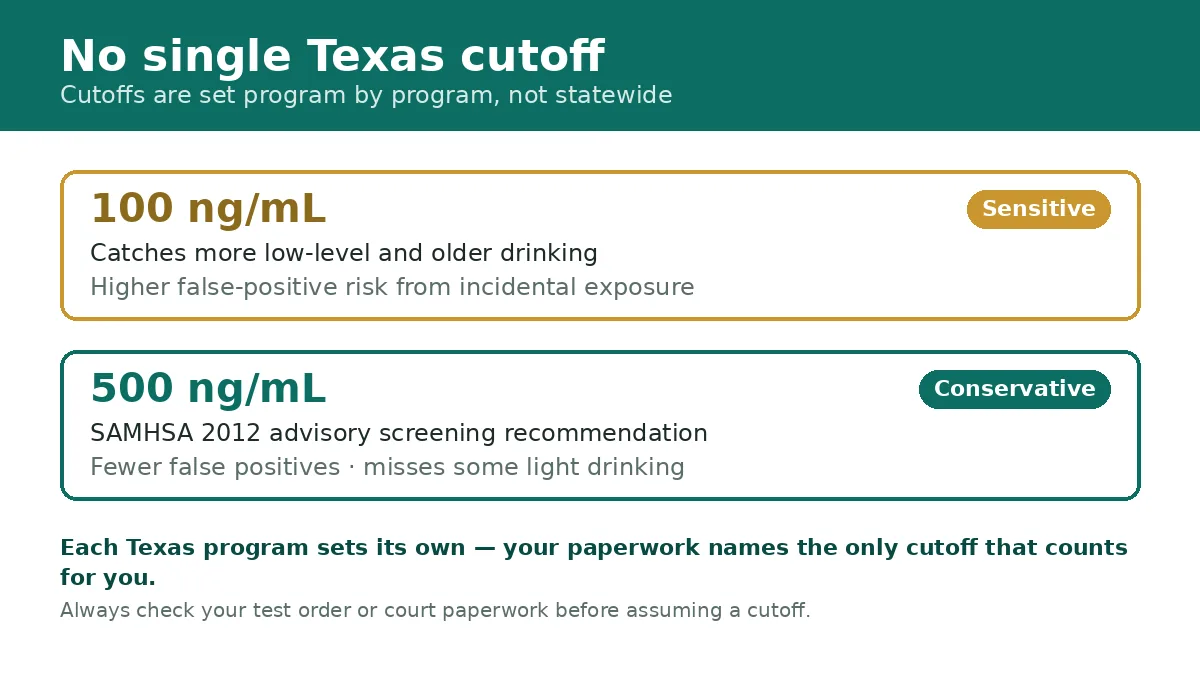
Here is the most important point on this page, and the one we will not soften: there is no single statewide Texas EtG cutoff. Texas Government Code §76.002 organizes community supervision by judicial district, and each court sets the conditions it enforces — thresholds are decided program by program, and most programs never publish theirs. If you are in a probation EtG testing Texas program, the only cutoff that counts for you is the one your program's paperwork names.
The only Texas-sourced cutoff number in public records is the Texas Department of Criminal Justice's "CONFIRMATION TESTING LEVEL ETG/ETS 500NG" — a 500 ng/mL confirmation level for offender specimens analyzed by LC-MS/MS, named in a TDCJ procurement document. Read that carefully: it is a confirmation level in a state purchasing record, not a statewide screening cutoff, and it does not mean every Texas probation department screens at 500 ng/mL.
For national context, where most public guidance comes from:
- 100 ng/mL — the sensitive screening level many labs use. Catches lighter and more distant drinking, but with a higher risk of incidental-exposure flags (hand sanitizer, mouthwash).
- 500 ng/mL — the conservative screening cutoff recommended by SAMHSA's 2012 advisory, chosen to minimize positives from incidental exposure while still detecting meaningful drinking.
- Commercial and program labs across the country screen anywhere from 100 to 1,000 ng/mL, depending on the program's goals.
Educational, not advisory: the paperwork from your program names the only threshold that counts in your case. If it does not name one, ask the program in writing and keep the answer.
Detection windows in Texas programs
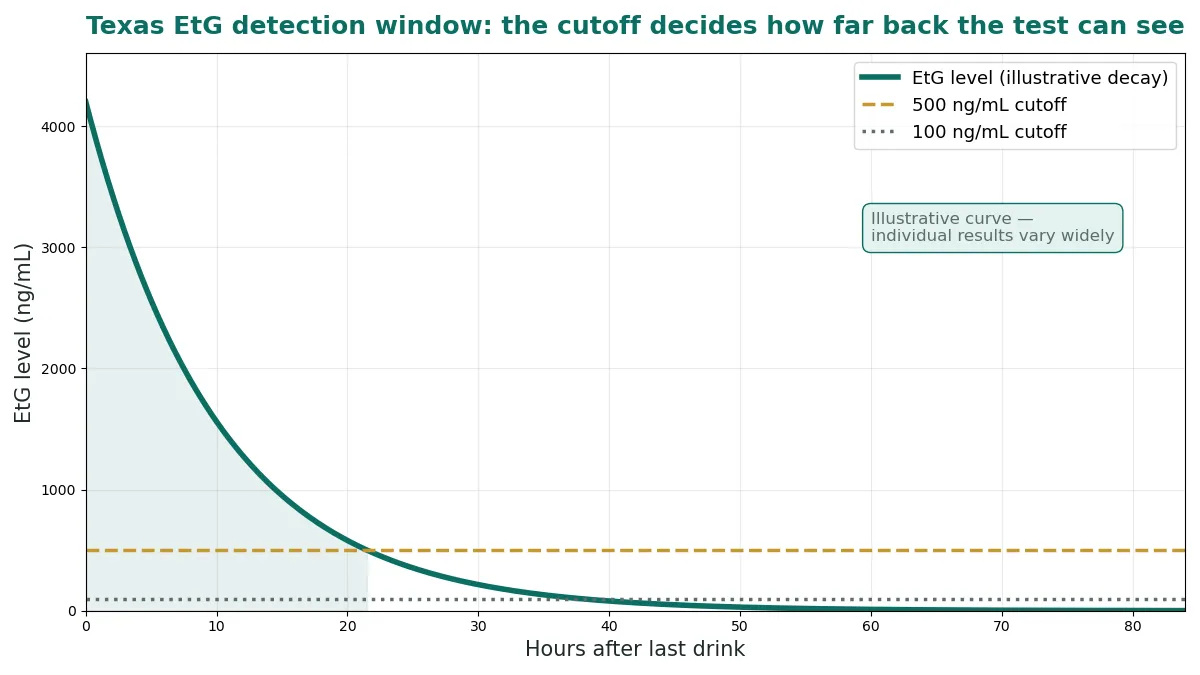
Detection windows are ranges, never guarantees. How long EtG stays detectable depends on how much was consumed, when, the cutoff the lab uses, and individual factors such as hydration and metabolism:
- Heavy drinking: up to about 80 hours after the last drink — the widely cited outer edge of EtG detection in urine.
- A single drink: roughly 1–2 days at a 500 ng/mL cutoff, per clinical guidance; lower cutoffs (100 ng/mL) extend the window, higher ones shorten it.
- Moderate drinking: falls between those two anchors, closer to the heavy end as quantity rises.
The biggest lever on the window is the cutoff: at 100 ng/mL, the same drinking episode stays detectable longer than at 500 ng/mL. EtG also needs time to form after drinking and clears gradually — a test 12 hours after drinking and one 70 hours after tell very different stories.
Want to see how these ranges apply to a specific timeline? Run your numbers through our homepage calculator, or explore the full picture in our detection timeline tool.
A realistic Texas scenario
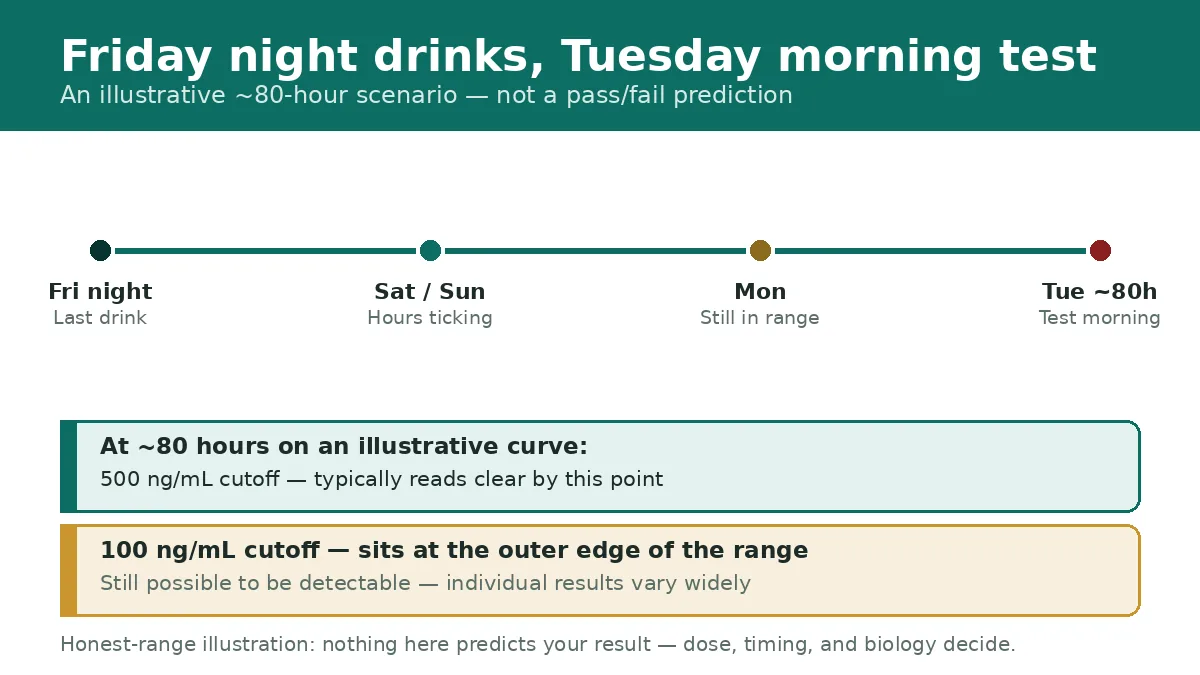
Consider a Texas probationer whose program uses a 500 ng/mL confirmation level — the only Texas-sourced number we have. Friday night, they drink heavily. Tuesday morning, about 80 hours later, they are called in for a random test.
Eighty hours is the outer edge of the published detection range for heavy drinking — the result could genuinely go either way: a heavy session can still be detectable at 500 ng/mL near the 80-hour mark, while a lighter one would likely have cleared. At 100 ng/mL instead, the odds of a positive at 80 hours would be materially higher — same drinking, same person, different threshold, different outcome.
The honest picture: no pass-or-fail claim is possible from a timeline alone. Cutoff, amount consumed, and elapsed time shape the result — ranges are all the science can responsibly offer.
A note on legal advice
This page is educational. It describes how EtG alcohol testing generally works in Texas probation, courts, and monitoring programs, based on published research, public-health guidance, and Texas public records. It is not legal advice, and program rules change. If you are subject to testing, the specific requirements of your program — and, if a violation is alleged, an attorney — are the authorities that matter.
Frequently asked questions
Is there one Texas EtG cutoff?
No. Each Texas court, CSCD, and program sets its own threshold, and most never publish it. Nationally the common screening levels are 100 ng/mL and 500 ng/mL (the latter SAMHSA's 2012 conservative recommendation). The only Texas-sourced number in public records is TDCJ's 500 ng/mL confirmation level for offender specimens — not a statewide screening cutoff. Your program's paperwork names the only number that counts in your case.
Does Texas probation use EtG testing?
Texas probation departments use alcohol testing as a court-ordered condition — the Harris County CSCD handbook names drug testing among standard conditions, and Dallas and Travis County materials describe abstinence and alcohol-assessment requirements. Most county sources describe testing generically (urinalysis, breath, monitoring devices) rather than naming the EtG assay.
Can a Texas family court order an EtG test?
Yes, in custody cases where substance use affects parenting. Lone Star Law Firm specifically names EtG in the custody context (an attorney's explanation, not a court rule), and attorneys note that refusing a court-ordered test can count as evidence.
How long after drinking can an EtG test detect alcohol in Texas?
The biology does not change at the state line: up to about 80 hours after heavy drinking, and roughly 1–2 days after a single drink at a 500 ng/mL cutoff; lower cutoffs extend the window. These are research ranges, not guarantees. Explore them with our detection timeline tool.
What does a positive EtG test prove in a Texas case?
Recent alcohol exposure — not impairment, not intoxication, and not how much was consumed. It cannot say whether someone was drunk, only that alcohol was metabolized within the detection window. At sensitive cutoffs (100 ng/mL), even incidental exposure can contribute — which is why SAMHSA's 2012 advisory recommended the more conservative 500 ng/mL screening level.
Is one positive result enough to violate probation?
That is a legal question for your program and your attorney. SAMHSA's 2012 advisory cautions that a test result should not be the sole determinant of a clinical or administrative decision — results should be interpreted in context. Whether a positive leads to a violation filing depends on your court's conditions and procedures.
Evidence and limitations
This guide summarizes primary research, public-health guidance, and Texas public records. Group-level findings cannot predict one person's result.
- SAMHSA Advisory: The Role of Biomarkers in the Treatment of Alcohol Use Disorders, 2012 revision (archived PDF copy)
- Harris County CSCD Client Handbook (PDF)
- Harris County CSCD programs page (High Risk DWI Specialized Caseload)
- Dallas County CSCD probationer brochure
- Travis County TCCES alcohol assessment
- Justice Forward SOBER Court
- Texas Code of Criminal Procedure Art. 42A.402
- Texas Government Code §76.002
- TDCJ CJAD Community Supervision fact sheet (122 CSCDs / 254 counties)
- TDCJ purchase order naming ETG/ETS 500 ng/mL confirmation (procurement document)
- Texas Physician Health Program FAQ
- TPAPN intemperate-use explainer (Texas nursing)
- Fastest Labs EtG/EtS Texas locations (Grapevine)
- Lone Star Law Firm — EtG in custody (attorney source)
- Bryan Fagan — Texas custody testing (attorney source)
- LegalClarity — Texas court-ordered drug test guide (secondary)