How EtG testing works in Virginia
Ethyl glucuronide (EtG) is a metabolite of alcohol found in urine after drinking. Courts and supervision officers use it to answer one question: has this person consumed alcohol since the last check-in? Breath tests catch only very recent use, and standard drug panels do not detect alcohol, so EtG fills the gap.
Testing in Virginia is court- and program-driven. Felony probation is supervised by Department of Corrections officers, misdemeanor cases by local community-based probation officers, DUI cases by the local Alcohol Safety Action Program (ASAP), and recovery-court and pretrial cases by the court team and local pretrial services agencies.
An ignition interlock device and a portable breathalyzer are different tools, not EtG tests, though a person can face both. Screening is usually a rapid urine immunoassay, with lab confirmation when a result is contested; labs run a creatinine check, so an abnormally low level can mean a failed test.
Who gets tested in Virginia and why
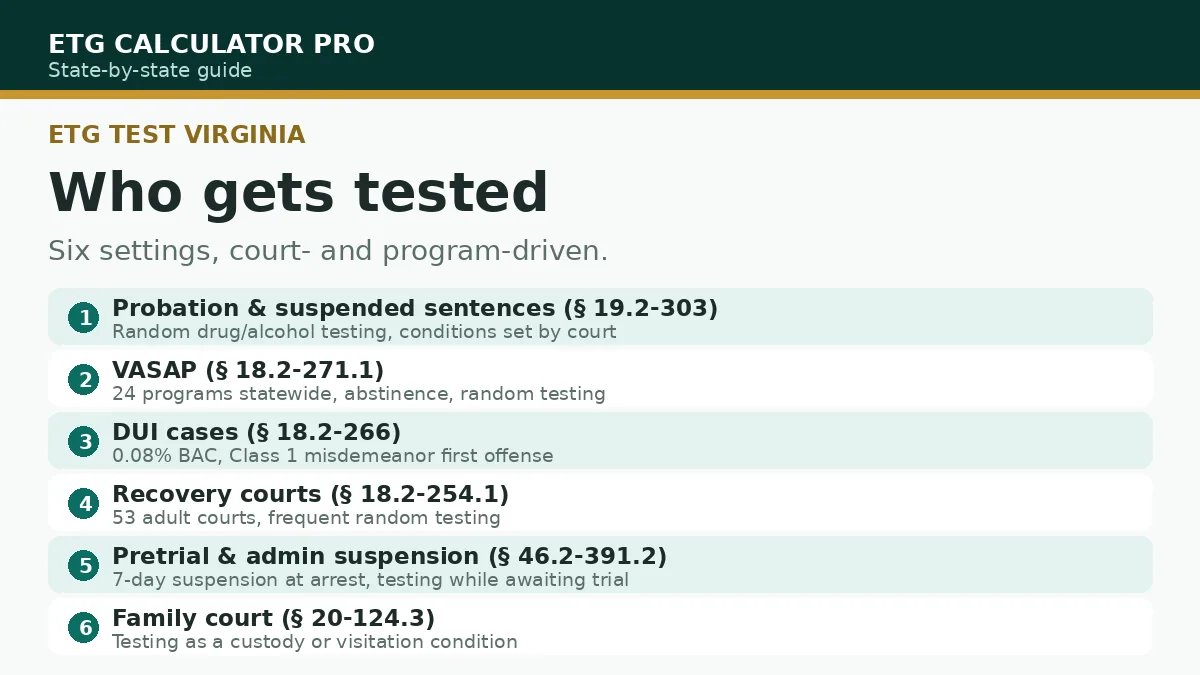
Probation and suspended sentences
After a conviction, a Virginia court may suspend the sentence in whole or in part and place the person on probation under whatever conditions it determines (Va. Code § 19.2-303), and supervised probation may run up to five years from release from any active period of incarceration. The testing power is written into the statutes: Department of Corrections probation and parole officers may order drug and alcohol screening tests of any probationer or parolee they have reason to believe is using alcohol or illegal drugs (§ 53.1-145), and local community-based probation officers may conduct random drug and alcohol tests on any offender they have reason to believe is abusing alcohol or illegal substances (§ 9.1-176.1). A positive test, or refusing one, can lead to a show-cause hearing and revocation of the suspended sentence.
Pretrial release and the administrative suspension
Testing can start before any conviction. A driver's license is suspended immediately at arrest: a breath test of 0.08% BAC or higher — 0.02% for a driver under 21 — or a refusal triggers the suspension on the spot under § 46.2-391.2. For a first offense the suspension lasts seven days, for a second offense 60 days, and for a third or subsequent offense until trial; no restricted license is available during the first seven days. Refusing the chemical test is a separate problem: a first refusal is a civil offense with a one-year suspension, while a second refusal within ten years is a Class 1 misdemeanor with a three-year suspension (§ 18.2-268.3).
DUI
Virginia prohibits driving while intoxicated under § 18.2-266: a blood alcohol concentration of 0.08% or more, or driving while under the influence of alcohol, drugs, or both. The limit is 0.02% for drivers under 21 (§ 18.2-266.1) and 0.04% for commercial drivers (§ 46.2-341.24). A first offense is a Class 1 misdemeanor with a mandatory minimum fine of $250 and up to 12 months in jail and a $2,500 fine. There is no mandatory jail time for a standard first offense with a BAC under 0.15%, but a BAC of 0.15% to 0.20% adds five mandatory days in jail, and a BAC above 0.20% adds ten. A second offense is still a Class 1 misdemeanor, but the minimums jump: within five years of the first, a $500 mandatory fine and 20 days of mandatory jail; five to ten years after the first, the same $500 fine and 10 days of mandatory jail. A third offense within ten years is a Class 6 felony, with a mandatory minimum of 90 days in jail and a $1,000 fine — six months if all three fell within five years. Driving with a passenger 17 or younger adds a $500–$1,000 fine and five mandatory days in jail.
VASAP
VASAP is the program almost every DUI defendant will meet. Every person convicted of a first or second DUI must enter into and successfully complete an alcohol safety action program in the judicial district where the charge was brought (§ 18.2-271.1), unless the court waives it for good cause after an assessment. There are 24 ASAPs across the Commonwealth, and enrollment is required within 15 days of conviction. The program fee is $250 to $300 by statute, plus a $100 intervention fee per the Commission. After intake and classification, most first offenders take 20 hours of education classes; others are referred to a treatment provider for assessment and any recommended treatment. Participants are placed in an abstinence — “dry” — program with random alcohol and drug testing. A positive test means reclassification for treatment and a violation report to the sentencing court, and missing classes or failing treatment also triggers a non-compliance report. Non-compliance can bring a show-cause hearing, and the court can revoke the suspension of sentence and activate the suspended jail time.
Recovery courts
Virginia's recovery courts — formerly called drug treatment courts — operate under § 18.2-254.1 for adults charged with non-violent felonies where dependence is assessed, and the Supreme Court of Virginia publishes standards for them. The state directory lists 53 adult recovery courts, updated January 14, 2026. Fairfax County's Recovery Court is a minimum 14-month, five-phase program averaging about 18 months; Loudoun County's Adult Recovery Court pairs intensive probation supervision with frequent drug testing. Participation is voluntary and usually requires a written agreement with the court, and testing is frequent and random throughout.
Family court
In custody and visitation cases, Virginia courts decide on the best interests of the child, weighing the ten factors in § 20-124.3, including each parent's physical and mental condition and any history of family abuse. The court may order a mental health or psychological evaluation, and where a parent's substance use bears directly on the child's safety, it may order testing — including EtG testing — as a condition of custody or visitation, or condition a parent's time with the child on completing treatment and staying alcohol-free. Testing follows a request and a reason; a positive result is one factor among many.
License reinstatement
Getting a license back runs through the Department of Motor Vehicles, and the administrative and court-ordered tracks run consecutively. The arrest itself brings the seven-day administrative suspension; a conviction then deprives the driver of the privilege to drive for one year on a first offense (§ 18.2-271), three years on a second within ten years, and indefinitely on a felony DUI or a third within ten years (§ 46.2-391). Reinstatement requires completing VASAP if the court ordered it — the DMV will not reinstate the license until it receives notice of successful completion — plus an ignition interlock on any vehicle driven under a restricted license (§ 18.2-270.1), proof of financial responsibility, and the fee. A restricted license covers only court-approved purposes such as work, school, and medical needs.
Cutoffs used in Virginia programs
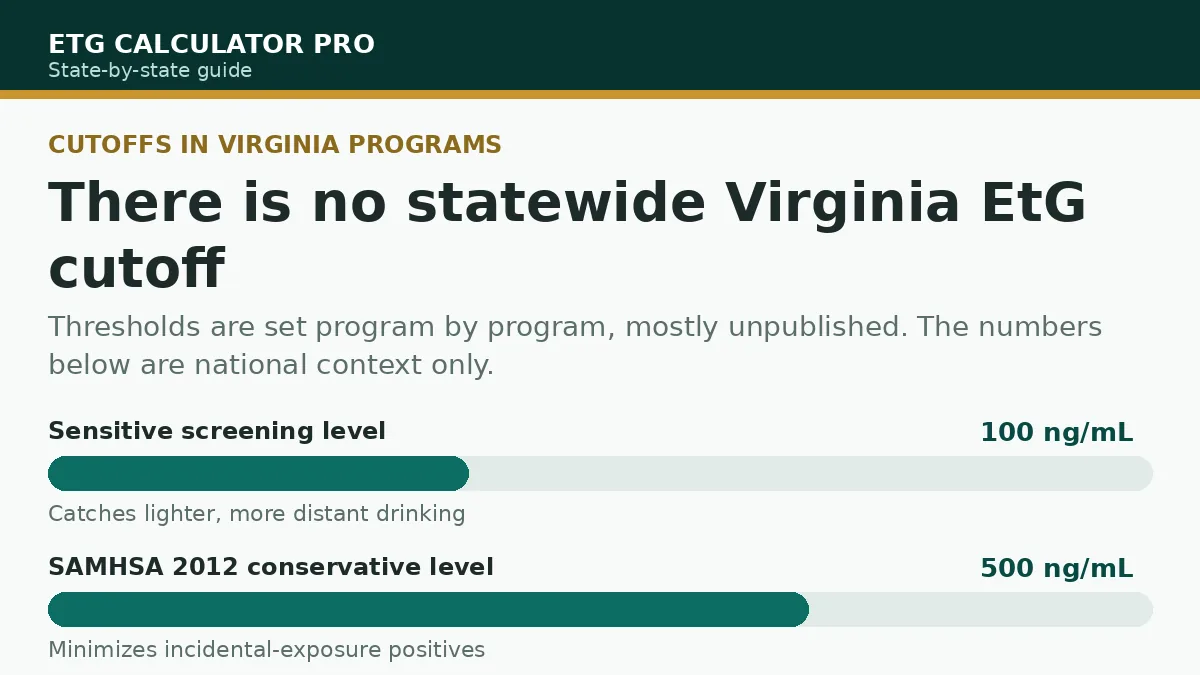
There is no statewide Virginia EtG cutoff: we checked Virginia statutes, court rules, and state program standards, and none names a threshold. Thresholds are set program by program, mostly unpublished — your paperwork names the only cutoff that counts.
National context:
- 100 ng/mL — the sensitive level many labs use; catches lighter, more distant drinking.
- 500 ng/mL — SAMHSA's 2012 conservative recommendation.
- Labs screen anywhere from 100 to 1,000 ng/mL.
Do not assume a Virginia program uses either number unless its paperwork says so, and do not confuse the 0.08%, 0.15%, and 0.20% BAC figures in Virginia law with EtG cutoffs. SAMHSA's interpretation bands add context: a high positive above 1,000 ng/mL may indicate heavy or very recent drinking, while a very low positive of 100 to 500 ng/mL may indicate older drinking or incidental exposure — possibilities, not proof.
Detection windows in Virginia programs
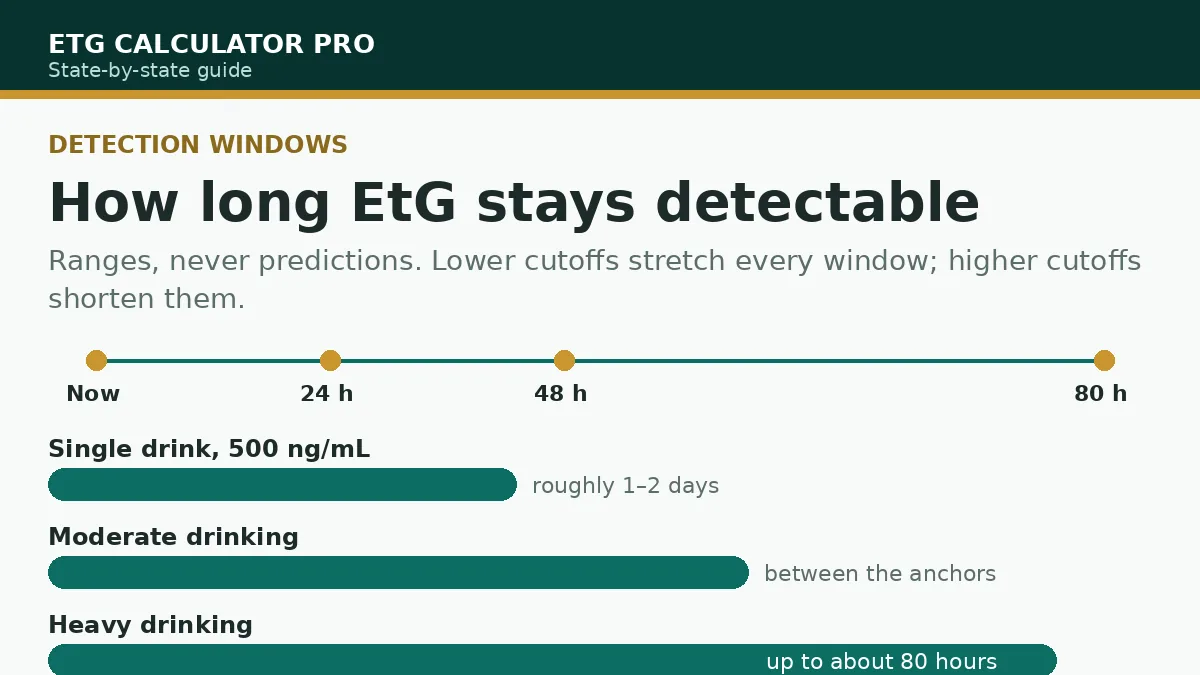
Detection windows are ranges, never predictions:
- Heavy drinking: up to about 80 hours after the last drink.
- A single drink: roughly 1–2 days at a 500 ng/mL cutoff; lower cutoffs extend the window.
- Moderate drinking: between those anchors.
The biggest lever is the cutoff: at 100 ng/mL the same episode stays detectable longer. One caution: an NIH-funded study found EtG detection sensitivity poor after 48 hours at every dose and cutoff it tested.
Apply these ranges with our homepage calculator or our detection timeline calculator.
A realistic Virginia scenario
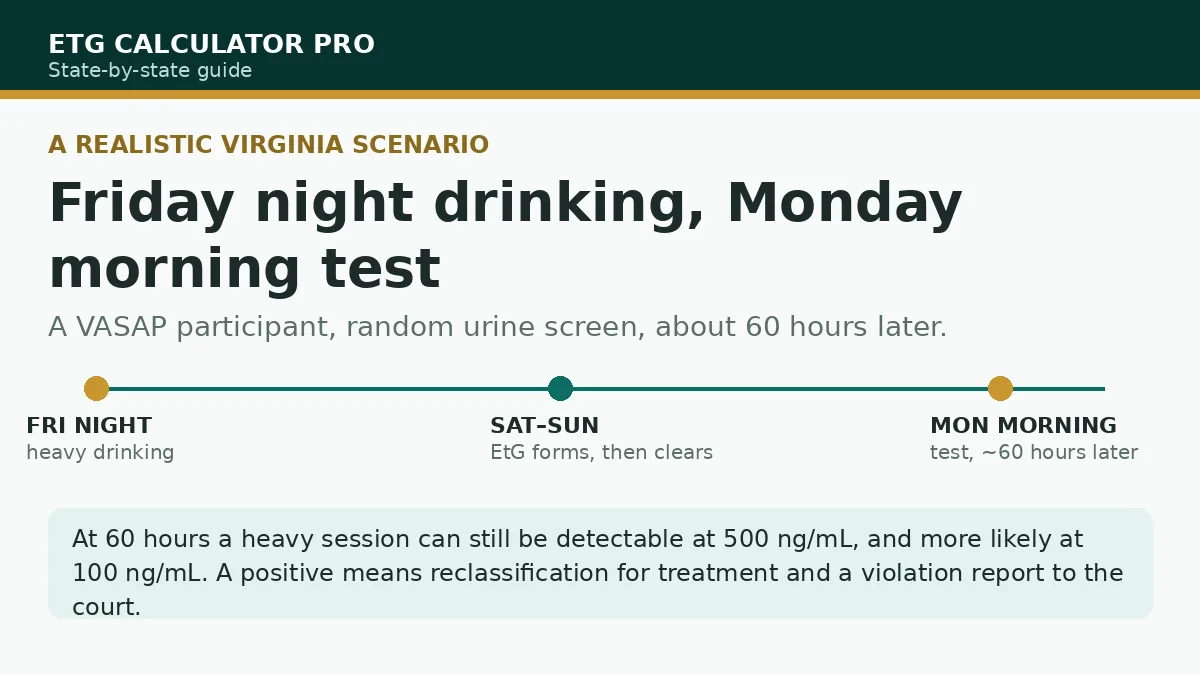
Consider a first-offense DUI defendant in Fairfax County ordered into VASAP — 20 hours of classes, an abstinence program, and random testing, with suspended jail time hanging over the order. He drinks heavily on a Friday night, then faces a random urine screen on Monday morning, about 60 hours later.
Sixty hours sits inside the published range for heavy drinking: at 500 ng/mL a heavy session can still be detectable, while a lighter one would likely have cleared; at 100 ng/mL a positive is more likely. A positive would mean reclassification for treatment and a violation report to the court — and a show-cause hearing that could activate the suspended jail time.
No pass-or-fail claim is possible from a timeline alone.
A note on legal advice
This page is educational, not legal advice, and program rules change. If you are subject to testing, your program's requirements — and an attorney if a violation is alleged — are what matter.
Frequently asked questions
Is there one Virginia EtG cutoff?
No. No Virginia statute, court rule, Department of Corrections policy, or state standard we checked publishes a statewide EtG cutoff. Each court, program, and lab sets its own, mostly unpublished. Nationally the common levels are 100 and 500 ng/mL (SAMHSA, 2012); neither is a Virginia rule. Your program's paperwork names the only number that counts. And do not confuse the numbers that do appear in Virginia law — 0.08%, 0.15%, and 0.20% BAC — with EtG cutoffs: those are blood-alcohol thresholds for DUI charges and sentencing, not urine concentrations.
Does Virginia probation use EtG testing?
Yes. After a conviction, a Virginia court may suspend the sentence in whole or in part and place the person on probation under conditions it determines (Va. Code § 19.2-303), and supervised probation may run up to five years from release from any active period of incarceration. Department of Corrections probation and parole officers may order drug and alcohol screening tests of a probationer they have reason to believe is using alcohol or drugs (§ 53.1-145), and local community-based probation officers may conduct random drug and alcohol tests on an offender they have reason to believe is abusing alcohol or illegal substances (§ 9.1-176.1). Local programs list random drug and alcohol testing as a standard probation condition. A positive test — or refusing one — can lead to a show-cause hearing and revocation of the suspended sentence. Local programs make it explicit: Prince William County's probation program lists random drug and alcohol testing among its conditions.
What is VASAP, and what does it require?
VASAP is the Virginia Alcohol Safety Action Program. Every person convicted of a first or second DUI must enter into and successfully complete an alcohol safety action program in the judicial district where the charge was brought (§ 18.2-271.1). There are 24 ASAPs across the Commonwealth, and the law requires enrollment within 15 days of conviction. The program fee is $250 to $300 by statute (the Commission lists a $300 program fee plus a $100 intervention fee). After intake and classification, most first offenders take 20 hours of education classes; others are referred for treatment. Participants are placed in an abstinence — “dry” — program with random alcohol and drug testing. A positive test means reclassification for treatment and a violation report to the sentencing court, and non-compliance can bring a show-cause hearing that activates suspended jail time. Completing VASAP is also required before a license can be reinstated. The probationary period typically corresponds to the license suspension — usually one year for first offenders and three years for second and subsequent offenders.
What are the penalties for a first DUI in Virginia?
A first DUI under § 18.2-266 is a Class 1 misdemeanor, with a mandatory minimum fine of $250 and up to 12 months in jail and a $2,500 fine. A BAC of 0.15% to 0.20% adds five mandatory days in jail, and a BAC above 0.20% adds ten; below 0.15%, no jail time is mandatory for a first offense. A first conviction also brings a one-year loss of driving privileges, mandatory completion of VASAP, and an ignition interlock on any vehicle driven under a restricted license. The arrest itself triggers an immediate administrative license suspension of seven days, with no restricted license available during that week.
What happens on a second or third DUI in Virginia?
A second offense is still a Class 1 misdemeanor, but the mandatory minimums jump: a second offense committed within five years of the first carries a mandatory minimum fine of $500 and 20 days of mandatory jail time; a second offense five to ten years after the first carries the same $500 fine and 10 days of mandatory jail. A BAC of 0.15% to 0.20% on a second offense within ten years adds ten more mandatory days (twenty above 0.20%), plus another $500 mandatory fine. A third offense within ten years is a Class 6 felony, with a mandatory minimum of 90 days in jail and a $1,000 fine — six months if all three offenses fell within five years. On the license side, a second conviction within ten years means a three-year revocation; a felony DUI or a third offense within ten years means an indefinite revocation. After a second offense within five years of the first, license restoration is also conditioned on six months of ignition interlock following the three-year revocation.
What are Virginia recovery courts, and how does testing work there?
Virginia's recovery courts — formerly called drug treatment courts — operate under § 18.2-254.1, and the Supreme Court of Virginia publishes standards for them. The state directory lists 53 adult recovery courts, updated January 14, 2026. They combine treatment with court supervision: Fairfax County's Recovery Court, for example, is a minimum 14-month, five-phase program with an average length of about 18 months, and Loudoun County's Adult Recovery Court pairs intensive probation supervision with frequent drug testing. Participation is voluntary and usually requires a written agreement; successful completion typically results in dismissal of the charges. Testing is frequent and random throughout, because abstinence is a core program goal.
Can a Virginia family court order EtG testing?
Yes, at the judge's discretion. Virginia courts decide custody and visitation on the best interests of the child, weighing the ten factors in § 20-124.3, including each parent's physical and mental condition and any history of family abuse. The court may order a mental health or psychological evaluation, and where a parent's substance use bears directly on the child's safety, the court may order testing — including EtG testing — as a condition of custody or visitation, or condition the parent's time with the child on treatment and staying alcohol-free. Testing follows a request and a reason, and a positive result is one factor among many.
Evidence and limitations
This guide summarizes primary research, public-health guidance, and Virginia public records. Group-level findings cannot predict one person's result.
- Va. Code § 18.2-266 — Driving while intoxicated: unlawful to drive with a blood alcohol concentration of 0.08 percent or more, or while under the influence of alcohol, drugs, or a combination; § 18.2-266.1 sets 0.02 percent for drivers younger than 21
- Va. Code § 18.2-270 — Penalty for driving while intoxicated: first offense a Class 1 misdemeanor with a mandatory minimum fine of $250; BAC of 0.15 to 0.20 adds five mandatory days, above 0.20 adds ten; second offense within five years carries a $500 mandatory fine and 20 days of mandatory jail, five to ten years carries $500 and 10 days; third offense within ten years is a Class 6 felony with a 90-day mandatory minimum (six months if all within five years) and a $1,000 fine; fourth offense within ten years carries a one-year mandatory minimum; passenger 17 or younger adds a $500–$1,000 fine and five mandatory days
- Va. Code § 18.2-271 — Forfeiture of driver's license for driving while intoxicated: loss of driving privileges for one year on a first conviction, three years on a second conviction within ten years, and indefinite revocation for a felony DUI or a third or later qualifying offense within ten years
- Va. Code § 18.2-271.1 — Probation, education, and rehabilitation: any person convicted of a first or second DUI must enter into and successfully complete an alcohol safety action program; program fee of $250 to $300; after a second offense within five years, license restoration is conditioned on six months of ignition interlock following the three-year revocation
- Va. Code § 46.2-391.2 — Administrative suspension of license: on a breath test of 0.08 percent or more (0.02 percent under 21) or on refusal, the license is suspended immediately — seven days for a first offense, 60 days for a second offense, until trial for a third or subsequent offense
- Va. Code § 46.2-391 — Revocation of license for multiple convictions: three-year revocation for a second DUI within ten years; indefinite revocation for a felony DUI or three offenses within ten years; the DMV will not reinstate a license until it receives notice of successful completion of an alcohol safety action program where the court ordered one
- Va. Code § 19.2-303 — Suspension or modification of sentence; probation: after conviction the court may suspend the sentence in whole or in part and place the defendant on probation under conditions it determines; any period of supervised probation shall not exceed five years from release from any active period of incarceration
- Va. Code § 53.1-145 — Powers and duties of probation and parole officers: officers may order and conduct drug and alcohol screening tests of any probationer or parolee they have reason to believe is engaged in the illegal use of controlled substances or the abuse of alcohol
- Va. Code § 9.1-176.1 — Duties of local community-based probation officers: officers shall conduct, at their discretion, random drug and alcohol tests on any offender they have reason to believe is engaged in the illegal use of controlled substances or the abuse of alcohol or prescribed medication
- The Commission on VASAP — FAQs: 24 ASAPs throughout the Commonwealth; the Code of Virginia requires persons convicted of DUI to enroll in and successfully complete an ASAP, within 15 days of conviction; the probationary period typically corresponds to the license suspension, usually one year for first offenders and three years for second and subsequent offenders; standard ASAP fee $300 plus a $100 intervention fee
- Supreme Court of Virginia — Adult Recovery Court Standards: aspirational best practices for adult recovery courts; abstinence and law-abiding behavior are goals, with specific and measurable criteria; localities must meet the requirements of Va. Code § 18.2-254.1
- Directory of Recovery Courts in Virginia (updated January 14, 2026) — 53 adult recovery courts listed across the Commonwealth
- Fairfax County Community Services Board — Specialty Courts for Behavioral Health: the Recovery Court launched in Circuit Court in 2018, with a minimum requirement of 14 months to complete five phases and an average length of about 18 months
- Office of the Fairfax Commonwealth's Attorney — Specialty Treatment Dockets: Recovery Court is a 14–24-month program of treatment and intense court supervision; if successfully completed, non-violent felonies are dismissed
- Loudoun County Department of Community Corrections — Programs & Services: the Adult Recovery Court pairs judicial monitoring of intensive probation supervision, substance abuse treatment, and frequent drug testing; the Enhanced Docket provides intensive supervision of higher-risk offenders with a BAC of 0.15 or higher
- Va. Code § 20-124.3 — Best interests of the child; visitation: in determining custody or visitation, the court shall consider ten factors, including the age and physical and mental condition of each parent and any history of family abuse
- Prince William County Criminal Justice Services — Local Offender Probation Supervision: offenders under supervision must abide by conditions including random drug and alcohol testing
- Rappahannock Regional Jail — Community Corrections: pretrial services supervise defendants through community supervision, drug and alcohol testing, and treatment; the Adult Drug Treatment Court requires intensive probation and, on graduation, charges are typically dismissed
- Virginia ASAP Violation / Non-Compliance — VASAP is a court-ordered supervisory probation program; participants are placed in an abstinence program and subject to random testing for alcohol and drugs; a positive test results in immediate reclassification for treatment and a violation report to the sentencing court; non-compliance can lead to revocation of the suspended sentence
- VASAP Requirements and Noncompliance — the entry level is 20 hours of classes, usually a two-hour session once a week for 10 weeks; participants may be required to undergo drug and alcohol testing and must remain drug and alcohol free for the duration of probation; a positive urine screen can be reported to the court as a violation
- What Happens When You Get a DUI in Virginia? — a first-offense DUI is a Class 1 misdemeanor carrying a mandatory minimum fine of $250, a one-year license revocation, and mandatory enrollment in VASAP; a BAC of 0.15% to 0.20% adds five mandatory days in jail, above 0.20% adds ten
- Is Your License Suspended Immediately After a DUI in VA? — the license is suspended the moment of arrest for DUI if the breath test shows 0.08% or higher, or on refusal; first offense seven days, second offense 60 days or until trial, third or subsequent offense until trial; no restricted license during the administrative suspension
- Virginia DUI Refusal & Restricted License — a first refusal is a civil offense with a one-year suspension; a second refusal within ten years is a Class 1 misdemeanor with a three-year suspension; a person found guilty of a first refusal may petition the court for a restricted license
- Determining Ethyl Glucuronide Cutoffs (PMC) — SAMHSA Advisory 2012 conservative 500 ng/mL recommendation; lab cutoffs 100–1,000 ng/mL; interpretation bands