How EtG testing works in Colorado
Ethyl glucuronide (EtG) is a direct metabolite of alcohol found in urine after drinking. Courts and supervision officers use it because it answers one question: has this person consumed alcohol since the last check-in? Breath tests catch only very recent use and standard drug panels do not detect alcohol, so when abstinence is ordered, EtG fills the gap.
Testing in Colorado is court- and program-driven, not statewide. Probation conditions are set by the sentencing court and supervised locally; people released from prison are supervised by Colorado Department of Corrections (CDOC) parole officers; and problem-solving courts run locally under the Colorado Judicial Branch. Conditions vary by offense, county, court, and program.
Unlike some states, Colorado probation sources name EtG directly: the typical probation urine screen is described as an 8-panel test that includes EtG. Even so, the exact panel, frequency, and cutoff are set by the county and the program, not by a statewide rule.
The ignition interlock is a breath device fitted to a vehicle, not an EtG test; a person can be subject to both.
Who gets tested in Colorado and why
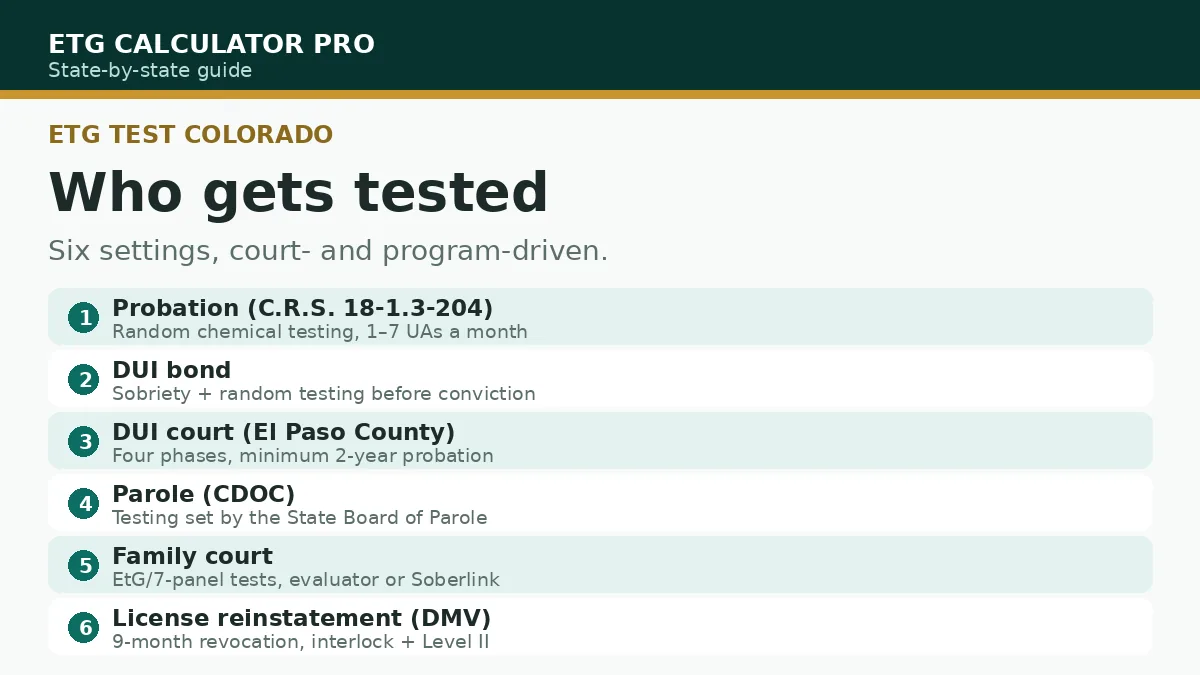
Probation
Probation is where most Colorado alcohol and drug testing happens. Under C.R.S. 18-1.3-204, the court sets probation conditions as it deems reasonably necessary, and every probationer must comply with court orders on substance abuse testing and treatment. The standard conditions include paying for and submitting to random chemical testing for drugs or alcohol at the probation officer's request, and courts commonly add a monthly urine test. For drug- and alcohol-related cases, the court may also order drug court probation under C.R.S. 18-1.3-104.5, with treatment and random testing built in.
In practice, testing is random and frequent: typically one to seven urine screens a month, usually an 8-panel test that includes EtG, run through labs recognized by probation departments. A diluted sample is generally treated as failed, and a missed test counts as failed too. A failed test can support revocation proceedings, though a single positive does not automatically end probation.
Pretrial bond in DUI cases
Testing often starts before conviction. A judge setting bond in a DUI case may require abstinence and random testing while the case is pending, so that sobriety is monitored from the arrest forward rather than only after sentencing. Methods vary by court and county: breath tests, portable breath devices, transdermal ankle monitors (SCRAM), and EtG urine tests reaching back roughly 72 hours. EtG is the method that catches drinking between breath checks.
DUI, DWAI, and DUI courts
Colorado's impaired-driving statute, C.R.S. 42-4-1301, is unusual nationally: it creates two offenses. DUI applies at a BAC of 0.08% or higher; DWAI — driving while ability impaired — applies at a BAC of 0.05% to 0.08%, where the law draws a permissible inference that the driver's ability was impaired. Drivers under 21 face underage drinking and driving (UDD) at a BAC of 0.02%. Colorado's express consent law means every driver has already agreed to a breath or blood test when an officer has probable cause; refusing a test brings a one-year license revocation on a first offense and an automatic persistent drunk driver designation.
A first DUI carries five days to one year in jail, a $600 to $1,000 fine, and 48 to 96 hours of community service; a first DWAI is lighter: two to 180 days, a $200 to $500 fine, and 24 to 48 hours of service. A BAC of 0.20% or higher doubles the minimum jail term on either charge. Every DUI or DWAI conviction also requires an alcohol and drug evaluation and, depending on the result, Level I or Level II education and treatment before privileges can be fully restored.
For repeat offenders, DUI courts offer an intensive alternative. As of May 2026, the state had 64 active problem-solving courts across 20 judicial districts, including DUI courts, adult drug courts, wellness courts, veterans treatment courts, family treatment courts, and juvenile courts. El Paso County's DUI Court, running since June 2008, illustrates the model: it is designed for high-risk, high-need repeat DUI offenders, requires a minimum two-year probation sentence, and runs in four phases that take no less than 18 months. Participants face regular random testing, treatment, and frequent court reviews; progress eases the requirements, and violations tighten them.
Parole and community corrections
Most Colorado felony convictions include a mandatory period of parole after release from prison. The State Board of Parole sets the conditions of supervision under C.R.S. 17-2-201, and the standard conditions include complying with drug and alcohol testing. C.R.S. 18-1.3-211 requires every person sentenced for a felony, and every parolee, to undergo periodic substance abuse testing and treatment, and C.R.S. 17-2-201(5.5) authorizes random chemical testing of a parolee's biological sample at the parolee's own expense. A positive test can lead to increased supervision, referral to treatment, or revocation proceedings. Community corrections programs — a sentencing alternative to prison — likewise require employment, counseling, and drug and alcohol testing.
Family court
In custody and parenting-time cases, Colorado courts decide on the child's best interests under C.R.S. 14-10-124, and a parent's substance use is one of the factors the court weighs. When use is raised, the court can order testing — EtG/7-panel urine tests are the standard tool in Colorado parenting cases — or appoint a parental responsibilities evaluator under C.R.S. 14-10-127 to investigate and recommend safeguards. If parenting time would endanger the child's physical health or significantly impair emotional development, the court can restrict it under C.R.S. 14-10-129 — for example to supervised parenting time, with negative test results or completed treatment as the condition for returning to unsupervised time. Remote breath monitoring (Soberlink) is also used in some cases. Testing is not automatic; it follows a request and a reason, and a positive result is one factor among many.
License reinstatement
Getting a license back after a Colorado DUI runs on two independent tracks: the DMV's administrative process and the court process. A first-offense DUI brings a nine-month revocation, but early reinstatement is available from the first day the revocation is active if an ignition interlock device is installed. Drivers with a BAC of 0.15% or higher face stricter terms: at least two years with an interlock-restricted license, mandatory Level II alcohol education and treatment, and SR-22 insurance. First-time offenders typically complete Level II education (12 sessions); repeat offenders or high-BAC cases may require Level II therapy (up to 86 sessions). Reinstatement also requires a $95 reinstatement fee plus a $25 DUI restoration fee, and because a revocation cancels the license, the driver must re-apply and retake the written and driving tests.
Cutoffs used in Colorado programs
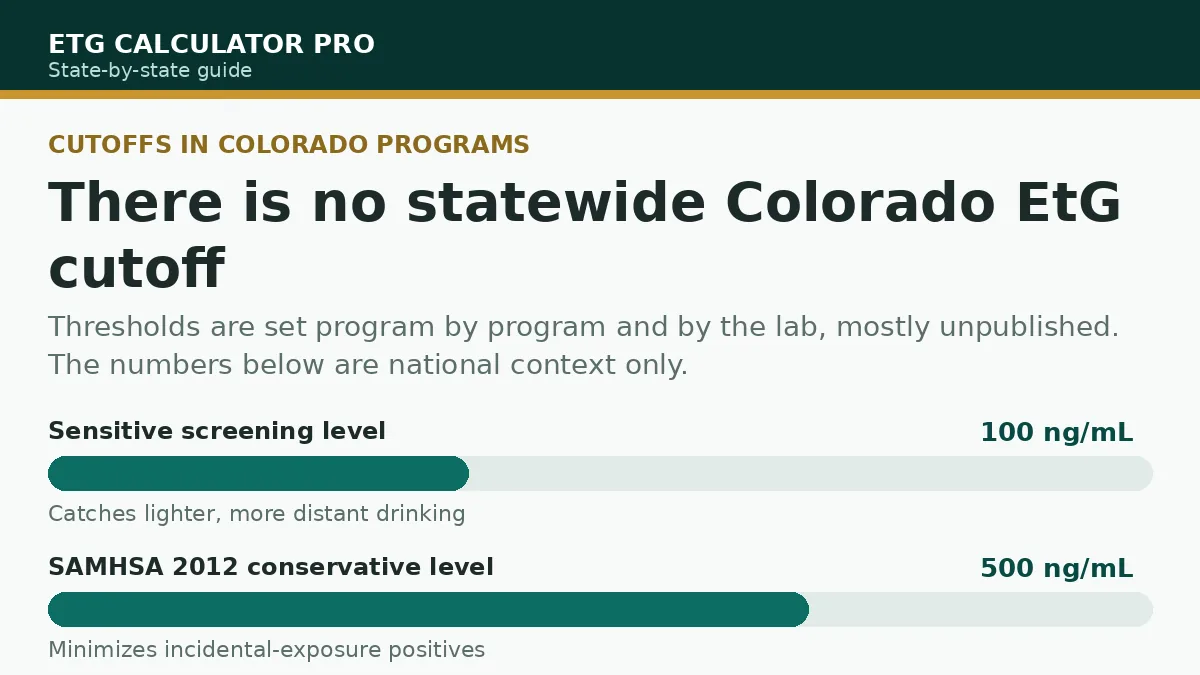
The most important point on this page: there is no statewide Colorado EtG cutoff. We checked Colorado statutes, court rules, Department of Corrections policies, DUI-court standards, and DMV reinstatement rules; none names an EtG threshold. Thresholds are set program by program and by the lab, mostly unpublished — your paperwork names the only cutoff that counts.
National context:
- 100 ng/mL — the sensitive level many labs use; catches lighter, more distant drinking.
- 500 ng/mL — SAMHSA's 2012 conservative recommendation.
- Labs screen anywhere from 100 to 1,000 ng/mL, depending on the program's goals.
Do not assume a Colorado program uses either number unless its paperwork says so. And do not confuse the numbers that do appear in Colorado law — 0.08% and 0.05% BAC — with EtG cutoffs: those are breath-alcohol thresholds, not urine concentrations.
Detection windows in Colorado programs
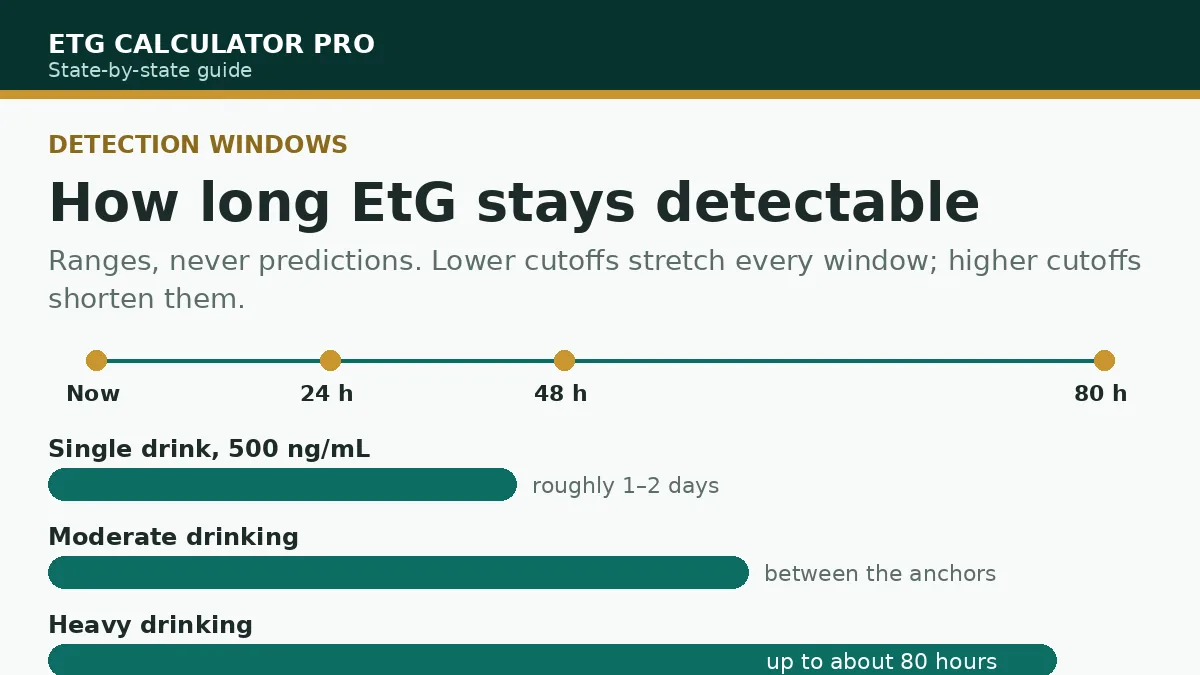
Detection windows are ranges, never predictions:
- Heavy drinking: up to about 80 hours after the last drink.
- A single drink: roughly 1–2 days at a 500 ng/mL cutoff; lower cutoffs extend the window.
- Moderate drinking: between those anchors.
The biggest lever is the cutoff: at 100 ng/mL, the same episode stays detectable longer. One caution: an NIH-funded study found EtG detection sensitivity poor after 48 hours at every dose and cutoff it tested. Treat any window as a range with wide individual variation, not a countdown.
Apply these ranges with our homepage calculator or our detection timeline tool.
A realistic Colorado scenario
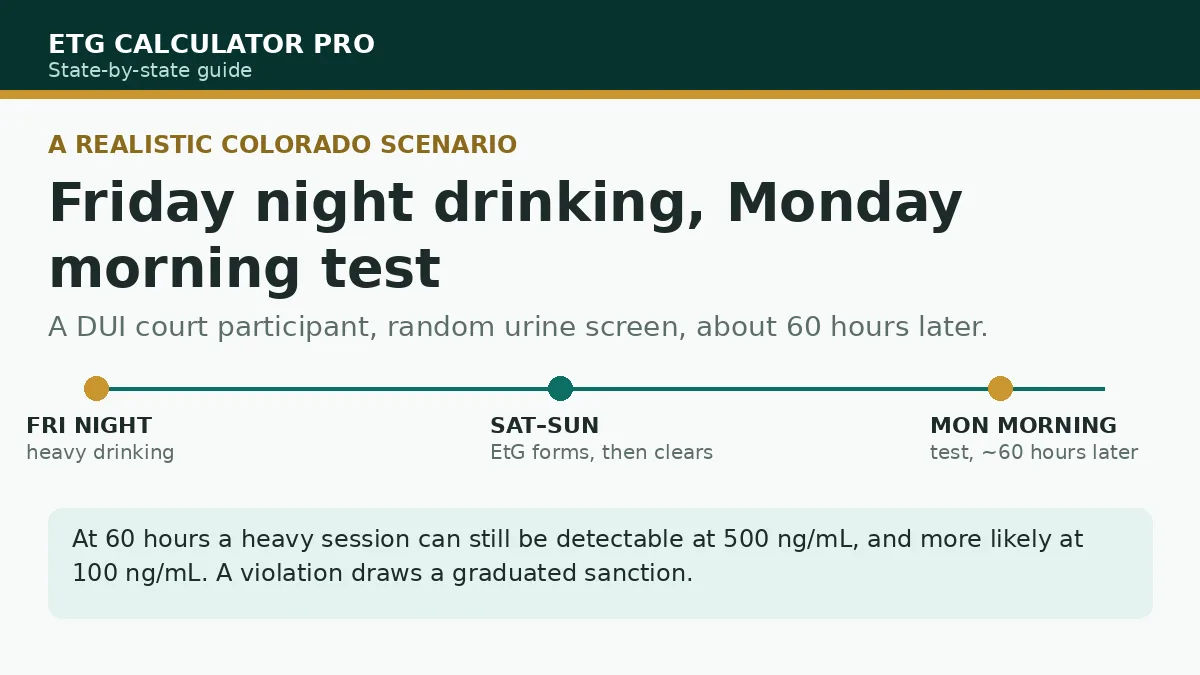
Consider a repeat DUI offender in El Paso County's DUI Court, in the early intensive phase: frequent random urine screens and a no-alcohol condition. He drinks heavily on a Friday night, then faces a random urine screen on Monday morning, about 60 hours later.
Sixty hours sits inside the published range for heavy drinking, so the result could go either way: at 500 ng/mL a heavy session can still be detectable, while a lighter one would likely have cleared; at 100 ng/mL, a positive is more likely. In DUI court, a violation draws a graduated sanction — increased testing, added treatment, or short jail time — rather than automatic termination, but repeated violations can end the program.
No pass-or-fail claim is possible from a timeline alone.
A note on legal advice
This page is educational, describing how EtG testing works in Colorado probation, DUI and DWAI cases, DUI courts, parole, and family court. It is not legal advice, and program rules change. If you are subject to testing, your program's requirements — and an attorney if a violation is alleged — are the authorities that matter.
Frequently asked questions
Is there one Colorado EtG cutoff?
No. No Colorado statute, court rule, Department of Corrections policy, DUI-court standard, or DMV reinstatement rule we checked publishes a statewide EtG cutoff. Each court, program, and lab sets its own, mostly unpublished. Nationally the common levels are 100 and 500 ng/mL (SAMHSA, 2012); neither is a Colorado rule. Your program's paperwork names the only number that counts. And do not confuse the numbers that do appear in Colorado law — 0.08% and 0.05% BAC — with EtG cutoffs: those are breath-alcohol thresholds for DUI and DWAI charges, not urine concentrations.
Does Colorado probation use EtG testing?
Yes. Under C.R.S. 18-1.3-204, probation conditions are set by the court, and every probationer must comply with court orders on substance abuse testing and treatment. The standard conditions include paying for and submitting to random chemical testing for drugs or alcohol at the probation officer's request, and courts commonly add a monthly urine test as a special condition. In practice, Colorado probation urine screens are typically an 8-panel test that includes EtG, run randomly about one to seven times a month through labs recognized by probation departments, such as Norchem. A diluted sample or a missed test is generally treated as a failed test, and a failed test can support revocation proceedings.
What is DWAI, and how is it different from DUI in Colorado?
Colorado is unusual in prosecuting impaired driving at two levels under C.R.S. 42-4-1301. DUI applies at a BAC of 0.08% or higher; DWAI — driving while ability impaired — applies at a BAC of 0.05% to 0.08%, where the law draws a permissible inference that ability to drive was impaired. Drivers under 21 face underage drinking and driving (UDD) at 0.02%. A first DUI carries five days to one year in jail, a $600 to $1,000 fine, and 48 to 96 hours of community service; a first DWAI carries two to 180 days, a $200 to $500 fine, and 24 to 48 hours of service. A BAC of 0.20% or higher doubles the minimum jail term. A driver with a BAC of 0.15% or higher on a first offense, who refuses a chemical test, or who has two or more alcohol-related convictions or revocations is designated a persistent drunk driver (PDD): at least two years with an ignition interlock, mandatory Level II education and treatment, and SR-22 insurance.
What is Colorado DUI court, and how does testing work there?
DUI courts are problem-solving courts for high-risk repeat DUI offenders, built around treatment, frequent testing, and close judicial supervision instead of jail alone. As of May 2026, Colorado had 64 active problem-solving courts across 20 judicial districts, including adult drug courts, DUI courts, wellness courts, veterans treatment courts, family treatment courts, and juvenile courts. El Paso County's DUI Court, running since June 2008, illustrates the model: it is designed for high-risk, high-need repeat offenders, requires a minimum two-year probation sentence, and runs in four phases that take no less than 18 months. Testing is regular and random throughout, alongside treatment, support meetings, and frequent court reviews; progress eases the requirements, violations tighten them.
Can a Colorado family court order EtG testing?
Yes, at the judge's discretion. Parenting time and decision-making are decided on the child's best interests under C.R.S. 14-10-124, and a parent's substance use is one of the factors the court weighs. When use is raised, the court can order testing — EtG/7-panel urine tests are the standard tool in Colorado parenting cases — or appoint a parental responsibilities evaluator under C.R.S. 14-10-127 to investigate. If parenting time would endanger the child's physical health or significantly impair emotional development, the court can restrict it under C.R.S. 14-10-129, for example to supervised parenting time, with negative test results or completed treatment as the condition for returning to unsupervised time. Remote breath monitoring (Soberlink) is also used in some cases. Testing is not automatic; it follows a request and a reason to order it.
How long after drinking can an EtG test detect alcohol in Colorado?
The biology does not change at the state line: up to about 80 hours after heavy drinking, roughly 1–2 days after a single drink at 500 ng/mL; lower cutoffs extend the window. These are research ranges, not predictions. One caution: an NIH-funded study found EtG detection sensitivity poor after 48 hours at every dose and cutoff it tested, and called marketing of EtG as an 80-hour test unsubstantiated — a reminder that the '80-hour test' label is a marketing shorthand, not a guarantee.
Evidence and limitations
This guide summarizes primary research, public-health guidance, and Colorado public records. Group-level findings cannot predict one person's result.
- C.R.S. 18-1.3-204 — Conditions of probation: court-set conditions; compliance with substance abuse testing and treatment orders under C.R.S. 18-1.3-209 and 18-1.3-211
- Colorado probation conditions — random chemical testing for drugs or alcohol as a standard condition; monthly urine test as a special condition; drug court probation
- Random urine screening in Colorado probation — typically 1–7 tests a month, usually an 8-panel test including EtG; Norchem Laboratory recognized by Colorado probation departments; diluted or missed UA treated as failed
- Colorado DUI and DWAI laws — DUI at 0.08% BAC, DWAI at 0.05%–0.08%; first-offense penalties for both; BAC 0.20% doubles minimum jail; express consent and refusal consequences
- Colorado DMV — Reinstating after a DUI or alcohol offense: persistent drunk driver designation at BAC 0.15% or higher; two-year interlock minimum; Level II education and treatment; early reinstatement; $95 reinstatement and $25 DUI restoration fees
- CDOT — How to get your license back after a DUI: nine-month revocation for a first offense; early reinstatement with an ignition interlock; Level II education and treatment up to 13 months; SR-22 insurance
- Colorado Judicial Branch — Treatment Court Month (May 2026): 64 active problem-solving courts across 20 judicial districts, including adult drug courts, DUI courts, wellness courts, veterans treatment courts, family treatment courts, and juvenile courts
- El Paso County DUI Court (Colorado Judicial Branch) — running since June 2008; high-risk, high-need repeat DUI offenders; minimum two-year probation; four phases taking no less than 18 months
- Colorado Department of Corrections — Parole: standard conditions include complying with drug and alcohol testing requirements; State Board of Parole sets conditions under C.R.S. 17-2-201
- C.R.S. 18-1.3-211 — Periodic substance abuse testing and treatment required for felons sentenced to probation, community corrections, or incarceration, and for parolees
- Community corrections programs in Colorado — placement requires employment, counseling, and drug and alcohol testing; nonresidential participants report to drug testing centers
- Colorado DUI license reinstatement — Level II education (12 sessions) for first-time offenders; Level II therapy (up to 86 sessions) for repeat or high-BAC cases; interlock 8 months first offense, up to 2 years for multiple offenses
- C.R.S. 17-2-201(5.5) — Parole board may require random chemical testing of a parolee's biological sample; positive test may lead to treatment or revocation proceedings
- Drugs, alcohol and parenting time in Colorado — EtG/7-panel urine tests standard in parenting cases; parental responsibilities evaluator under C.R.S. 14-10-127; best interests under C.R.S. 14-10-124
- Restriction of parenting time in Colorado — C.R.S. 14-10-129: supervised parenting time, negative drug test results or completed treatment as conditions for unsupervised time; Soberlink remote breath monitoring
- Determining Ethyl Glucuronide Cutoffs (PMC) — SAMHSA Advisory 2012 conservative 500 ng/mL recommendation; lab cutoffs 100–1,000 ng/mL