How EtG testing works in Florida
Ethyl glucuronide (EtG) is a direct metabolite of alcohol found in urine after drinking. Florida courts, probation officers, and monitoring programs use it because it answers one question: has this person consumed alcohol since the last check-in? Breath tests only catch very recent use, and standard urine panels do not detect alcohol at all, so when a judge orders abstinence, EtG testing fills the gap.
Testing in Florida is court- and program-driven, not statewide. Section 948.03 makes random testing a standard probation condition: probationers must submit to random testing as directed by the probation officer or treatment-center staff, to determine the presence or use of alcohol or controlled substances. Section 945.36 also authorizes certified officers and Department of Corrections employees to administer urine screens to people on probation, community control, and pretrial release.
One honest caveat: most Florida sources describe testing generically — "random testing," "urine screen" — rather than naming EtG.
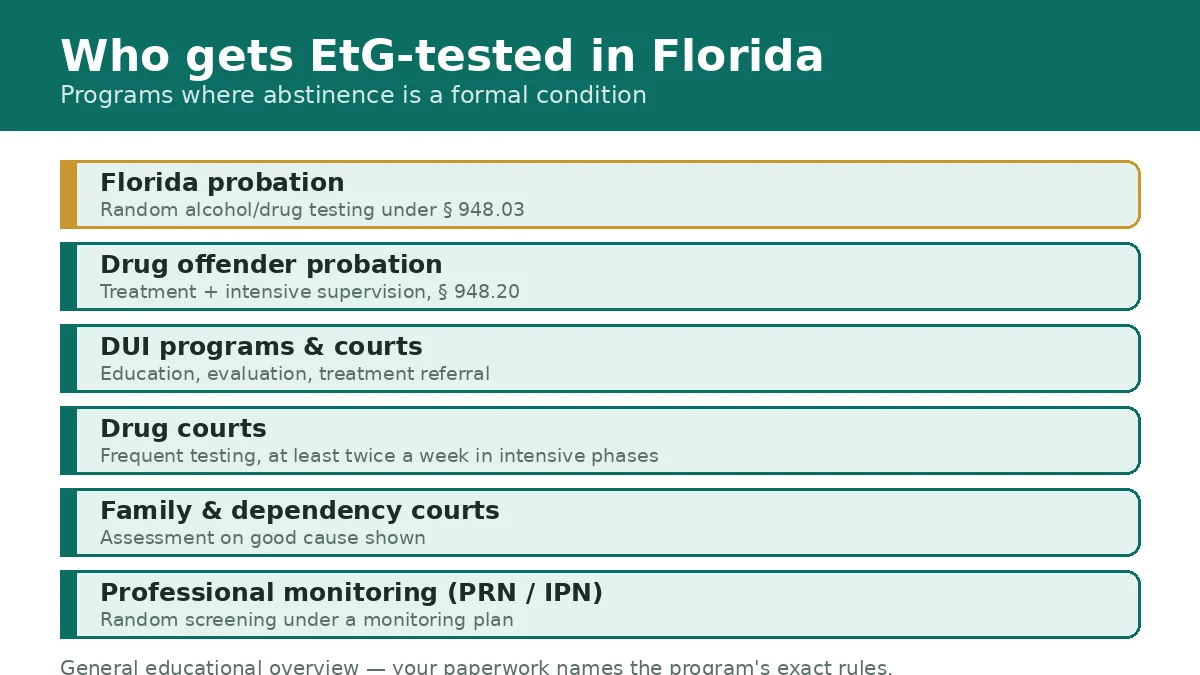
Who gets tested in Florida and why
Florida probation
Probation is where most Florida alcohol testing happens: under section 948.03, random testing is a standard condition and using intoxicants to excess is prohibited. If a controlled-substance offense is followed immediately by probation after incarceration, intermittent random testing throughout supervision is mandatory.
Drug offender probation goes further: under section 948.20, treatment plus intensive supervision, including surveillance and random testing.
DUI programs and DUI courts
Florida's DUI programs, overseen under Administrative Rule Chapter 15A-10, provide education and evaluation, not laboratory testing: Level I is a 12-hour class, Level II a 21-hour small-group program for repeat offenses. Every enrollee gets a psychosocial evaluation under Rule 15A-10.027 — Driver Risk Inventory plus a face-to-face interview — with treatment referral where indicated.
Those programs also gate driving privileges: under section 322.291, reinstatement requires proof of enrollment, including evaluation and treatment if referred; failure to complete them within 90 days leads the program to notify the department and the privilege is cancelled. EtG testing enters separately, when a court or probation officer orders abstinence monitoring. The ignition interlock device is a different, breath-based monitor: under section 316.193, a second DUI conviction carries mandatory interlock placement for at least one year, longer for later offenses under section 322.2715.
Drug courts
Florida's treatment-based drug court programs, under section 397.334, integrate treatment with case processing and monitor abstinence by frequent testing. The Florida Courts' Best Practice Standards set the tempo: testing at least twice weekly during intensive phases, on a random schedule, with urine specimens delivered within eight hours of notice. Ankle monitors run at least ninety days, then intermittent urine testing; breath or oral-fluid tests are used spontaneously when recent use is suspected.
For example, the Eleventh Judicial Circuit's Domestic Violence Drug Court in Miami monitors people court-ordered to complete treatment under probation, pretrial diversion, or a civil injunction.
Family and dependency courts
When substance use is relevant to parenting, Florida courts can order assessment in dependency proceedings: under section 39.407, a person who has custody of a child, or is requesting custody, may be ordered to submit to a substance-abuse assessment or evaluation — but only upon good cause shown, by a qualified professional. The court may also require treatment, including a drug court program.
Florida also has a civil route: the Marchman Act, under Chapter 397, lets a spouse, relative, guardian, friend, sheriff, or treatment-center representative petition the court for assessment and treatment for a person suspected of having a substance-use problem. Marchman cases are civil proceedings, not criminal cases.
Treatment programs
Treatment programs use EtG the way SAMHSA's 2012 advisory describes: to verify self-reported abstinence and anchor clinical conversations, not as a standalone diagnostic.
Professional monitoring
Florida monitors impaired health professionals through two programs. The Professionals Resource Network (PRN) may require urine, nail, hair, breath, oral-fluid, and blood specimens when requested, plus check-in with a toxicology screening selection system. The Intervention Project for Nurses (IPN) provides education, monitoring, and support to Florida nurses, accepts referrals from employers, providers, attorneys, the Department of Health, and the Board of Nursing — nurses may also self-refer — and runs weekly support groups with testing through a third-party partner. Educational sources describe IPN monitoring lasting two to five years with random screens.
Employment
In employment, EtG testing appears only where a documented abstinence policy applies — safety-sensitive roles, last-chance agreements, or employer-specific programs. No Florida general-employment EtG requirement was found.
Cutoffs used in Florida programs
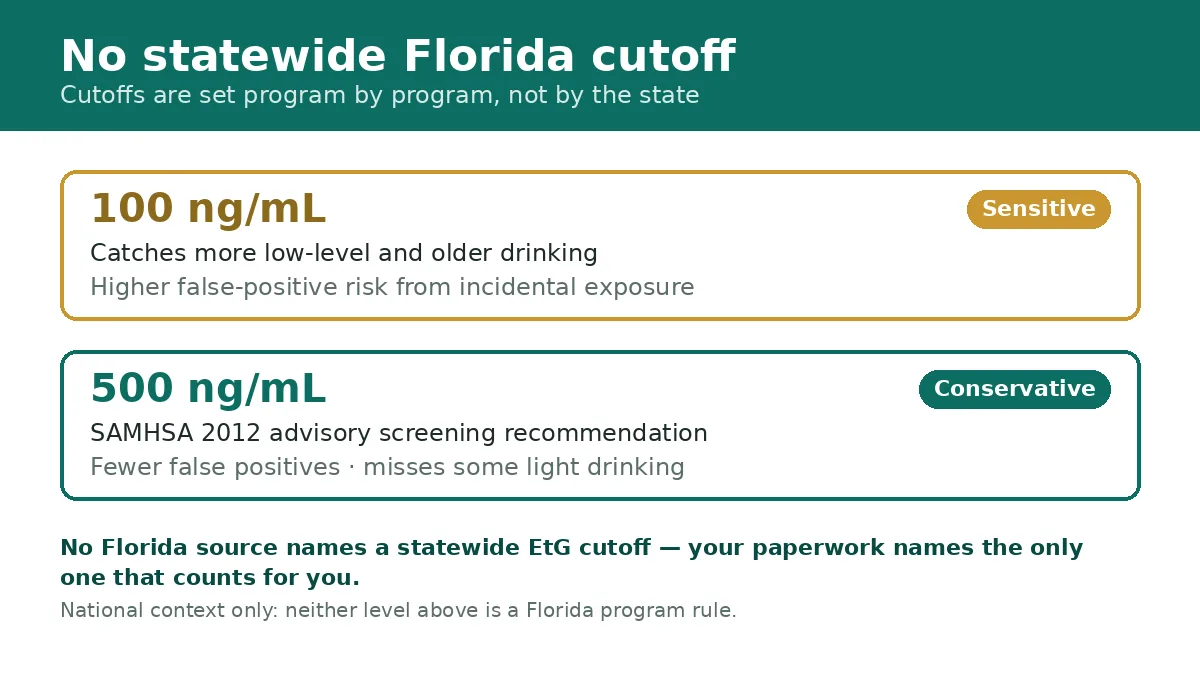
Here is the most important point on this page: there is no statewide Florida EtG cutoff. We checked Florida statutes, court standards, DUI rules, drug court standards, and PRN and IPN materials — none names an EtG threshold. Thresholds are set program by program and by the testing lab, mostly unpublished. In a probation EtG testing Florida program, your paperwork names the only cutoff that counts.
For national context, where most public guidance comes from:
- 100 ng/mL — the sensitive level many labs use. Catches lighter and more distant drinking, but risks incidental-exposure flags (hand sanitizer, mouthwash).
- 500 ng/mL — SAMHSA's 2012 conservative recommendation, chosen to minimize incidental-exposure positives while still detecting meaningful drinking.
- Labs across the country screen anywhere from 100 to 1,000 ng/mL, depending on the program's goals.
Do not assume a Florida program uses 100 ng/mL, 500 ng/mL, or any other number unless its paperwork says so; if it names none, ask in writing and keep the answer.
Detection windows in Florida programs
Detection windows are ranges, never predictions. How long EtG stays detectable depends on amount consumed, timing, the lab's cutoff, hydration, and metabolism:
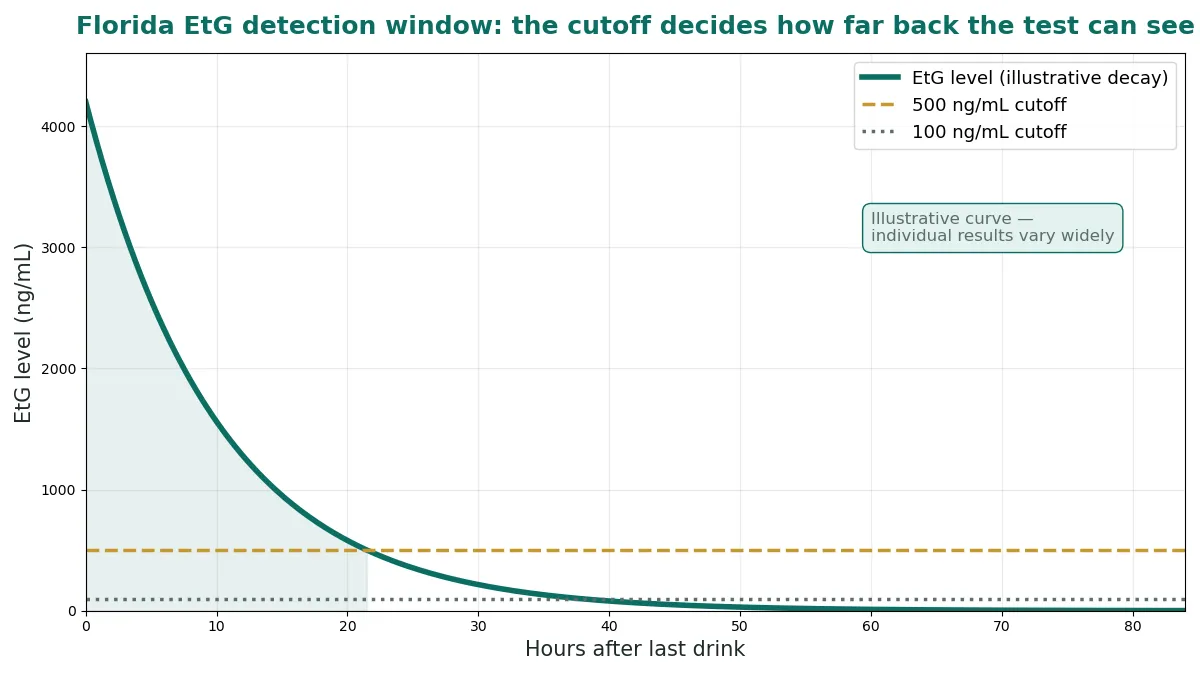
- Heavy drinking: up to about 80 hours after the last drink, the widely cited outer edge.
- A single drink: roughly 1–2 days at a 500 ng/mL cutoff; lower cutoffs extend the window, higher ones shorten it.
- Moderate drinking: between those anchors.
The biggest lever is the cutoff: at 100 ng/mL, the same drinking episode stays detectable longer than at 500 ng/mL, and EtG needs time to form after drinking before it clears gradually.
Apply these ranges to a timeline with our homepage calculator, the 100 ng/mL calculator, or our detection timeline tool.
A realistic Florida scenario
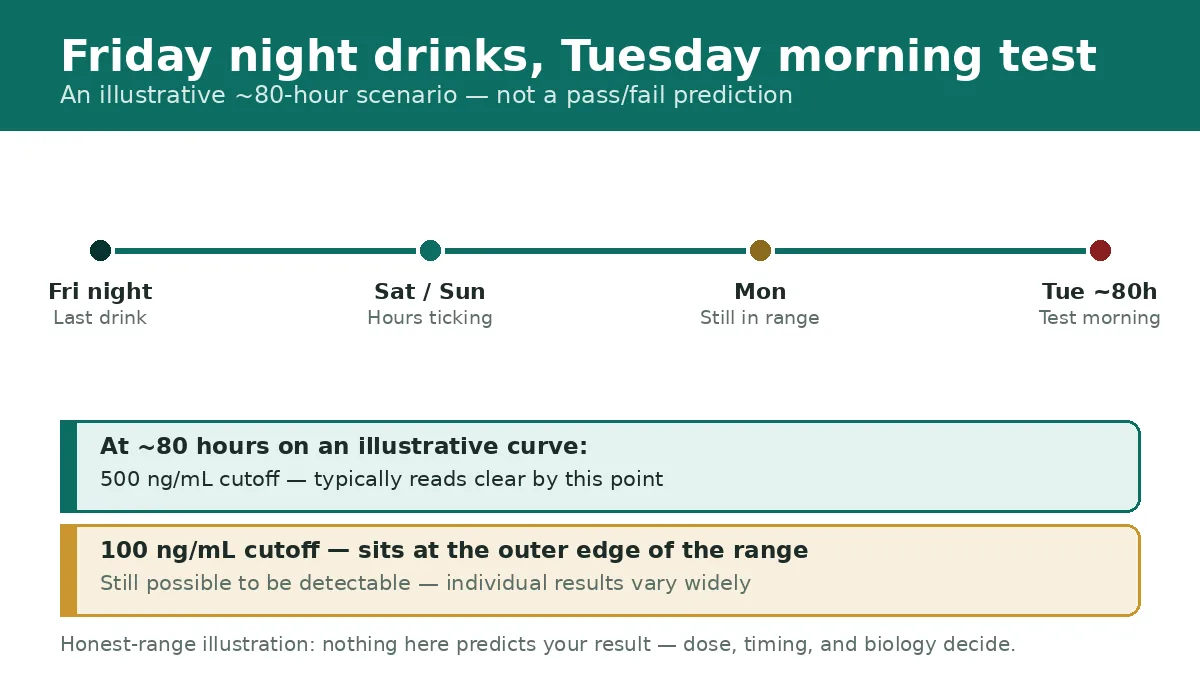
Consider a Florida probationer on drug offender probation, where random testing is built into supervision: heavy drinking Friday night, a random test call Tuesday morning, about 80 hours later.
Eighty hours is the outer edge of the published range for heavy drinking — the result could genuinely go either way. If the lab screened at 500 ng/mL, a heavy session can still be detectable near the 80-hour mark, while a lighter one would likely have cleared; at 100 ng/mL, a positive would be materially more likely. This illustrates how cutoffs change outcomes; it does not claim this program used either number.
No pass-or-fail claim is possible from a timeline alone — cutoff, amount, and elapsed time shape the result.
A note on legal advice
This page is educational, describing how EtG testing generally works in Florida probation, DUI programs, drug courts, and monitoring programs, from published research, public-health guidance, and Florida public records. It is not legal advice, and program rules change. If you are subject to testing, your program's requirements — and, if a violation is alleged, an attorney — are the authorities that matter.
Frequently asked questions
Is there one Florida EtG cutoff?
No. No Florida statute, court, probation department, DUI program, drug court, or monitoring program publishes a statewide EtG cutoff. Each court, program, and lab sets its own threshold, mostly unpublished. Nationally the common levels are 100 ng/mL and 500 ng/mL (SAMHSA's 2012 conservative recommendation); neither is a Florida rule. Your program's paperwork names the only number that counts in your case.
Does Florida probation use EtG testing?
Florida probation uses random alcohol and drug testing: section 948.03 requires submission to random testing as directed by the probation officer or treatment-center staff, with intermittent random testing mandatory throughout supervision when a controlled-substance offense follows incarceration. Most Florida sources describe that testing generically, as urine screens. EtG testing applies where your program or lab specifies it.
Do Florida DUI programs run EtG tests?
Not as their core function. Florida's licensed DUI programs provide education and evaluation: Level I is a 12-hour class, Level II a 21-hour small-group program, each with a psychosocial evaluation that can lead to treatment referral. EtG testing enters when a court or probation officer separately orders abstinence monitoring. Ignition interlock devices are breath devices, not urine EtG testing.
Can a Florida family or dependency court order alcohol testing?
In dependency proceedings, yes, under conditions. Section 39.407 lets the court order a person with custody of a child, or requesting custody, to submit to a substance-abuse assessment or evaluation — but only upon good cause shown, by a qualified professional. The court may also require treatment, including a drug court program. Separately, Florida's Marchman Act lets family members petition a civil court for assessment and treatment for a person with a substance-use problem.
How long after drinking can an EtG test detect alcohol in Florida?
The biology does not change at the state line: up to about 80 hours after heavy drinking, roughly 1 to 2 days after a single drink at a 500 ng/mL cutoff; lower cutoffs extend the window. These are research ranges, not predictions. Explore dose, timing, and cutoff with our calculators and detection timeline tool.
What does a positive EtG test prove in a Florida case?
Recent alcohol exposure, nothing more. It cannot prove impairment, intoxication, how much was consumed, or exactly when the drinking happened. At sensitive cutoffs such as 100 ng/mL, even incidental exposure can contribute — which is why SAMHSA's 2012 advisory recommended the more conservative 500 ng/mL level.
Is one positive result enough to violate probation?
That is a legal question for your program and your attorney. A positive result is evidence of alcohol exposure, not a verdict on its own: SAMHSA's 2012 advisory cautions against treating any single result as the sole determinant of a decision. If a violation is alleged, get legal advice promptly and keep all program paperwork.
Evidence and limitations
This guide summarizes primary research, public-health guidance, and Florida public records. Group-level findings cannot predict one person's result.
- Florida Statutes § 948.03 — Terms and conditions of probation
- Florida Statutes § 948.20 — Drug offender probation
- Florida Statutes § 945.36 — Urine screen drug tests
- Florida Statutes § 397.334 — Treatment-based drug court programs
- Florida Adult Drug Court Best Practice Standards (PDF)
- Eleventh Judicial Circuit — Domestic Violence Drug Court
- Florida Administrative Code Rule 15A-10.027 — DUI program client evaluation
- Florida Association of DUI Programs — DUI program services (Level I / Level II)
- Florida Statutes § 322.291 — DUI programs required for reinstatement
- Florida Statutes § 316.193 — DUI penalties (including ignition interlock)
- Florida Statutes § 322.2715 — Ignition interlock device
- Florida Statutes § 39.407 — Substance-abuse examination in custody cases
- Eleventh Judicial Circuit — Marchman Act
- Professionals Resource Network (PRN) — Participant Manual (PDF)
- Intervention Project for Nurses (IPN) — official site
- StatPearls — Impairment in the workplace in Florida (IPN duration and screening)
- SAMHSA Advisory: The Role of Biomarkers in the Treatment of Alcohol Use Disorders, 2012 revision (archived PDF copy)