The 80-hour number, explained
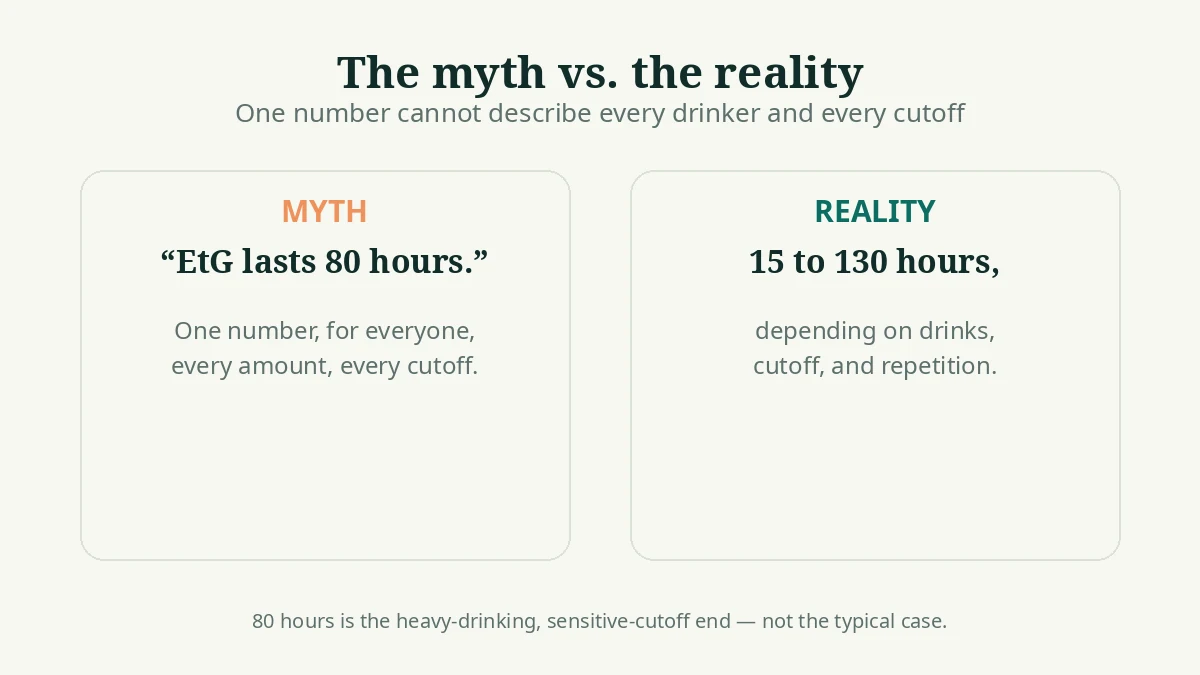
Search for EtG detection times and one number follows you everywhere: 80 hours. It sounds authoritative, and it has a real origin — studies of heavy drinking have reported EtG detection up to about 80 hours after drinking stopped, particularly at sensitive cutoffs. The problem is not that the number is invented. The problem is that it gets repeated without its conditions attached, until it reads as if every drinker, at every cutoff, stays detectable for more than three days.
That is not what the research shows. EtG is eliminated with a half-life reported across studies at roughly 2 to 3 hours, so the amount roughly halves every few hours. A small starting amount falls below a cutoff quickly, while a large one needs many more half-lives — and a test at 500 ng/mL goes negative much earlier than the same sample at 100 ng/mL, because the lower bar takes longer to fall below.
So the honest question is never “how long does EtG last?” It is “how long does EtG last after this much drinking, at this cutoff?” Answer that question and the 80-hour figure falls back into its proper place: the far end of the range, for heavy drinking at a strict cutoff, not the number to plan around for a normal weekend.
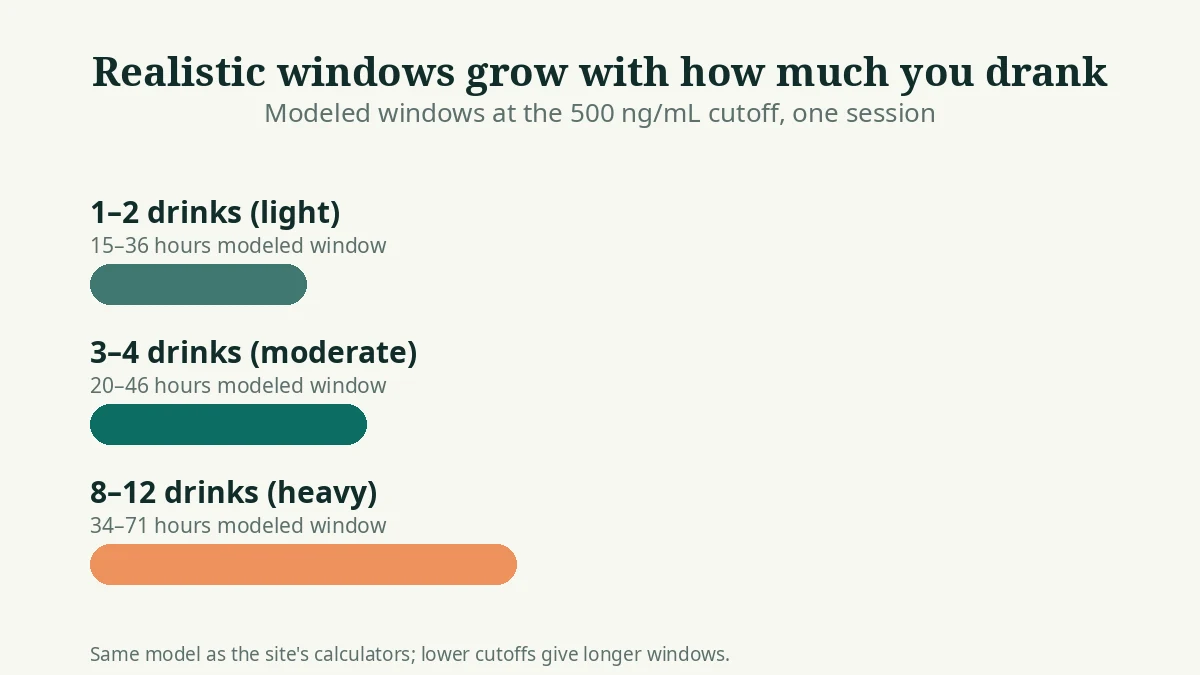
Realistic detection times by how much you drank
The table below uses the site's published model — the same model behind our cutoff calculators, verified against the live homepage calculator — for one drinking session. Read across a row to see how the cutoff changes the answer for the same drinking, and down a column to see how heavier drinking stretches every window. These are modeled windows, not measured levels: the range is the point, because individual metabolism, urine dilution, and test method all shift real results.
| Drinking (one session) | 100 ng/mL | 200 ng/mL | 500 ng/mL |
|---|---|---|---|
| 1–2 drinks | 23–53 hours | 20–46 hours | 15–36 hours |
| 3–4 drinks | 30–68 hours | 26–59 hours | 20–46 hours |
| 5–7 drinks | 38–85 hours | 33–75 hours | 26–58 hours |
| 8–12 drinks | 50–105 hours | 44–92 hours | 34–71 hours |
| More than 12 drinks | 65–130 hours | 57–114 hours | 44–88 hours |
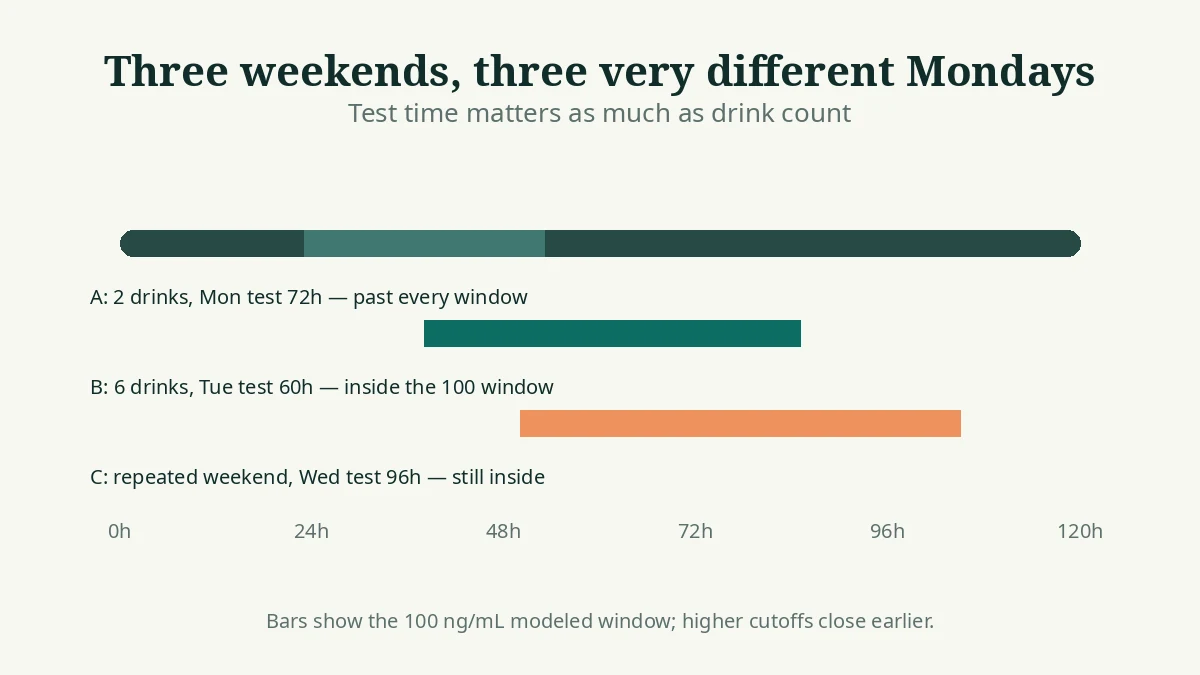
Three weekend scenarios
Two drinks on Friday, a work test on Monday (72 hours later). At every cutoff, Monday falls past the modeled window for two drinks — the longest, at 100 ng/mL, closes around 53 hours. This is the case the 80-hour myth misleads most: a light Friday evening does not produce a three-day window, and treating it as if it did only creates needless worry.
Six drinks on Saturday night, a probation test on Tuesday morning (about 60 hours later). Here the cutoff decides everything. At 500 ng/mL the window for five to seven drinks runs 26–58 hours, so Tuesday sits just past the edge; at 100 ng/mL the same drinking runs 38–85 hours, so Tuesday sits squarely inside it. Same person, same weekend, two different plausible outcomes — which is why asking “what cutoff?” comes before any other question.
A repeated weekend — drinking Friday and again Saturday — with a test on Wednesday (about 96 hours after the last drink). Repeated drinking stacks EtG: each session adds to what is still clearing from the last, so the windows extend, roughly 16 extra hours at the top end in this model. A heavy repeated weekend can still be inside a strict window on Wednesday. Choose “Repeated” in the calculator above to see this effect on your own numbers.
Why one number can never be realistic
Five variables sit between any estimate and a real result, and no single number can carry all of them: how much was drunk, which cutoff the program uses, whether drinking repeated over days, how dilute the urine sample is, and the test method itself (immunoassay screening vs. LC-MS/MS confirmation), on top of individual metabolism and kidney function. A calculator that hides those choices behind one tidy hour is not being precise — it is hiding its assumptions.
Some detection-time pages publish a single clearance time built on a fixed peak level per drink — one competitor, for example, models every drink as adding the same fixed ng/mL figure. That arithmetic is tidy, and it is not how bodies work: drink strength, food, body composition, timing, and metabolism all change the real peak, so a fixed per-drink constant manufactures precision the research does not support. The published literature supports ranges — a 2–3 hour half-life, windows that widen with heavier drinking, and cutoff-dependent closing times — and our methodology page shows exactly how this calculator builds them.
How to use the calculator above
Enter your drinks, how long the session ran, whether drinking repeated over days, and the hours since your last drink. The result shows the modeled window for each cutoff, your status right now at each cutoff — “Likely above” before the window opens, “Transition zone” inside it, “Likely below” after it closes — and a full timeline table in 12-hour steps, so you can see when each cutoff flips from one status to the next.
Pay most attention to the transition zone. Inside it, the model genuinely cannot tell you the outcome, and a test scheduled there is the least predictable test you can take — and knowing that before the test is the most useful thing any calculator can give you.
Frequently asked questions
How long does EtG stay detectable after one drink?
After one or two drinks, the modeled window at the 500 ng/mL cutoff closes within roughly 15–36 hours, and at the strict 100 ng/mL cutoff within roughly 23–53 hours. Even light drinking can still be inside a 100 ng/mL window a day or two later.
How long after a heavy weekend will EtG show up?
It depends on the cutoff and whether drinking repeated. Eight to twelve drinks model to roughly 34–71 hours at 500 ng/mL and 50–105 hours at 100 ng/mL; consecutive days extend the top end further. A heavy weekend can still be inside a strict window on Wednesday, while a 500 ng/mL workplace test may already be past it.
Why does everyone say EtG lasts 80 hours?
Eighty hours comes from the heavy end of the research: heavy or repeated drinking tested at a sensitive cutoff, where detection has been reported up to about 80 hours. It was never a typical figure. Quoted without the drink count and cutoff attached, it overstates the window for light and moderate drinking by days — which is exactly how the myth survives.
Does the cutoff really change the detection time that much?
Yes — it is the single biggest lever after drink count. For four drinks, the modeled window runs 30–68 hours at 100 ng/mL but only 20–46 hours at 500 ng/mL: the same urine, tested two ways, can plausibly read positive at one cutoff and negative at the other. Any detection time quoted without a cutoff is incomplete.
Can drinking water shorten my EtG detection time?
No. Water dilutes a urine sample, lowering the measured concentration, but it does not remove EtG faster, and labs check creatinine and specific gravity to flag diluted samples. Time is the only thing that clears EtG.
Is this calculator a pass or fail prediction?
No. Urine concentration, kidney function, test method (immunoassay screening vs. LC-MS/MS confirmation), incidental exposure, and individual metabolism can all move a real result away from the model. Use the calculator to understand where the uncertainty sits — before, inside, or after each cutoff's window — never to make medical, legal, employment, or supervision decisions.
Evidence and limitations
This page summarizes primary research and public-health guidance. Group-level findings cannot predict one person's result.
Sources: