How EtG testing works in Arizona
Ethyl glucuronide (EtG) is a direct metabolite of alcohol found in urine after drinking. Arizona courts and supervision officers use it because it answers one question: has this person consumed alcohol since the last check-in? Breath tests catch only very recent use, and standard drug panels do not detect alcohol, so when abstinence is ordered, EtG fills the gap.
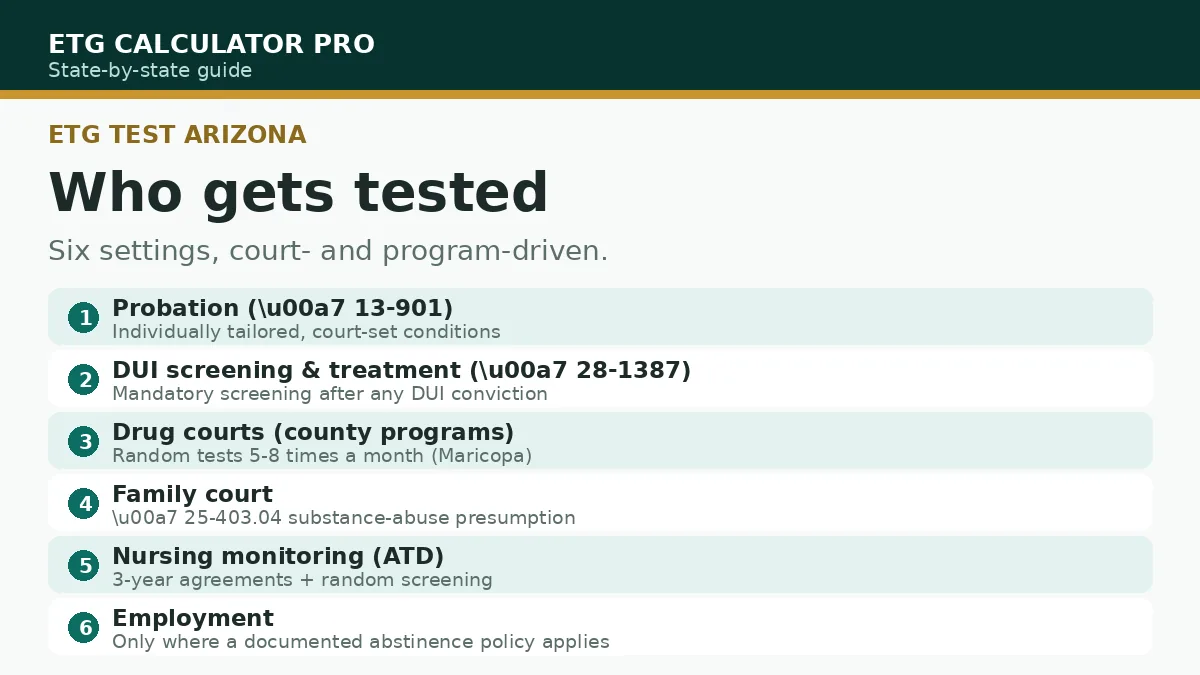
Testing in Arizona is court- and program-driven, not statewide. Most supervision runs through county adult probation departments under court-set conditions; people released from state prison serve community supervision administered by the Department of Corrections, Rehabilitation and Reentry. Conditions vary by offense, county, court, and program — and Arizona law requires them to be individually determined and narrowly tailored, not copied from a standard list.
One caveat: most Arizona sources describe testing generically, as drug testing or urinalysis, not EtG by name. EtG applies where the program or lab specifies it.
A second distinction: the ignition interlock is a breath device fitted to a vehicle, required after DUI convictions. It measures breath alcohol before the car starts and says nothing about drinking days earlier; a person can be subject to both.
Who gets tested in Arizona and why
Probation and community supervision
Probation is where most Arizona alcohol and drug testing happens. Under A.R.S. § 13-901, if a person convicted of an offense is eligible for probation, the court may suspend the sentence and place the person on intensive probation supervision, supervised probation, or unsupervised probation, on such terms and conditions as the law requires and the court deems appropriate. Conditions must be reasonably necessary, individually determined, and narrowly tailored to help the defendant lead a law-abiding life, protect public safety, and promote rehabilitation, and must be informed by a validated risk assessment. Testing frequency, panel, and consequences are set by the court and the county probation department, not by a statewide schedule.
Arizona also has a treatment-first track for drug possession: under A.R.S. § 13-901.01 (Proposition 200), a person convicted of personal possession or use of a controlled substance or paraphernalia is eligible for probation, and the court must require a drug treatment or education program from a qualified agency. On violation, the court sets new conditions, which may include intensified treatment, community restitution, intensive probation, or home arrest.
For people leaving state prison, Arizona largely replaced traditional parole with community supervision under truth-in-sentencing: most serve at least 85 percent of the sentence, then a court-imposed supervision term. Under A.R.S. § 31-411, the Board of Executive Clemency may impose any parole conditions it deems appropriate and may require payment of drug testing program costs; § 31-467.06 allows the same for parole or community supervision. Again, the statutes speak of drug testing generally, not EtG by name.
DUI probation, screening, and treatment
Arizona calls it DUI, and grades it under three statutes by blood alcohol concentration within two hours of driving. Standard DUI under § 28-1381 covers driving while impaired to the slightest degree, or with an alcohol concentration of 0.08 or more. Extreme DUI under § 28-1382 covers 0.15 or more but less than 0.20, and super extreme DUI covers 0.20 or more. Aggravated DUI under § 28-1383 is a felony, turning on circumstances such as driving on a suspended license, a third DUI within 84 months, or a passenger under 15 — not on the concentration alone.
Every DUI conviction triggers mandatory screening. Under A.R.S. § 28-1387, the judge must order a person convicted under §§ 28-1381, 28-1382, or 28-1383 to complete alcohol or other drug screening through an approved facility, and may order education or treatment under court supervision if needed. Screening is regulated by Arizona Administrative Code R9-20-108: it must occur within 30 days after the court order unless the court requires otherwise, as a face-to-face interview of at least 30 minutes. Under § 28-3319, the department will not terminate a suspension or issue a special ignition interlock restricted license until the person proves completion of, or satisfactory participation in, the ordered program.
Penalties escalate with the tier: a first extreme DUI carries at least 30 consecutive days in jail and a 12-month interlock period after reinstatement; a first super extreme DUI carries at least 45 days and 18 months. None of these are EtG rules — they are breath-alcohol tiers — but the screening and treatment track they trigger is where ongoing alcohol monitoring, including EtG testing, can be ordered.
Drug courts
Arizona's drug courts are county programs, not a single statewide court. Maricopa County's drug court, started in 1992, combines outpatient counseling with monitoring by a team of judge, probation officer, public defender, county attorney, and counselor; participants receive random drug tests five to eight times a month, plus group counseling and support groups, over about a year. Yuma County's published regulations show the strictness: missed urinalyses count as positive tests, sanctions can include jail time, alcohol-containing products are no excuse for positive breath tests, and bars and casinos are off limits. Each county sets its own panel and frequency, and the published rules speak of drug testing generally, with EtG applying where the program or lab specifies it.
Family court
In legal decision-making and parenting-time cases, testing follows the child's best interests under A.R.S. § 25-403. Arizona goes further than most states with a substance-abuse presumption: under § 25-403.04, if the court finds a parent abused drugs or alcohol or was convicted of a drug offense or DUI within twelve months before the petition was filed, there is a rebuttable presumption that sole or joint legal decision-making by that parent is not in the child's best interests, and the court must state findings supporting both the determination and the arrangement ordered. To rebut it, the court considers, at a minimum, no other drug conviction in five years, negative results from six months of random drug testing, and a clean screening from an approved facility. Testing is not automatic; it follows a request and a reason, and a positive result is one factor among many, not a custody decision on its own.
Professional monitoring (nursing ATD) and employment
Licensed nurses are monitored through the Arizona State Board of Nursing's Alternative to Discipline (ATD) program, a non-disciplinary program for nurses with substance use disorders, mental health or medical conditions, or at risk for them. ATD agreements are most commonly three years long and may include treatment, AA/NA and nurse recovery group attendance, random drug screening, abstention from all potentially addicting substances including alcohol, and work restrictions. In ordinary employment, EtG testing appears only where a documented abstinence policy applies, such as safety-sensitive roles or return-to-work agreements. No general Arizona employment EtG requirement was found.
Cutoffs used in Arizona programs
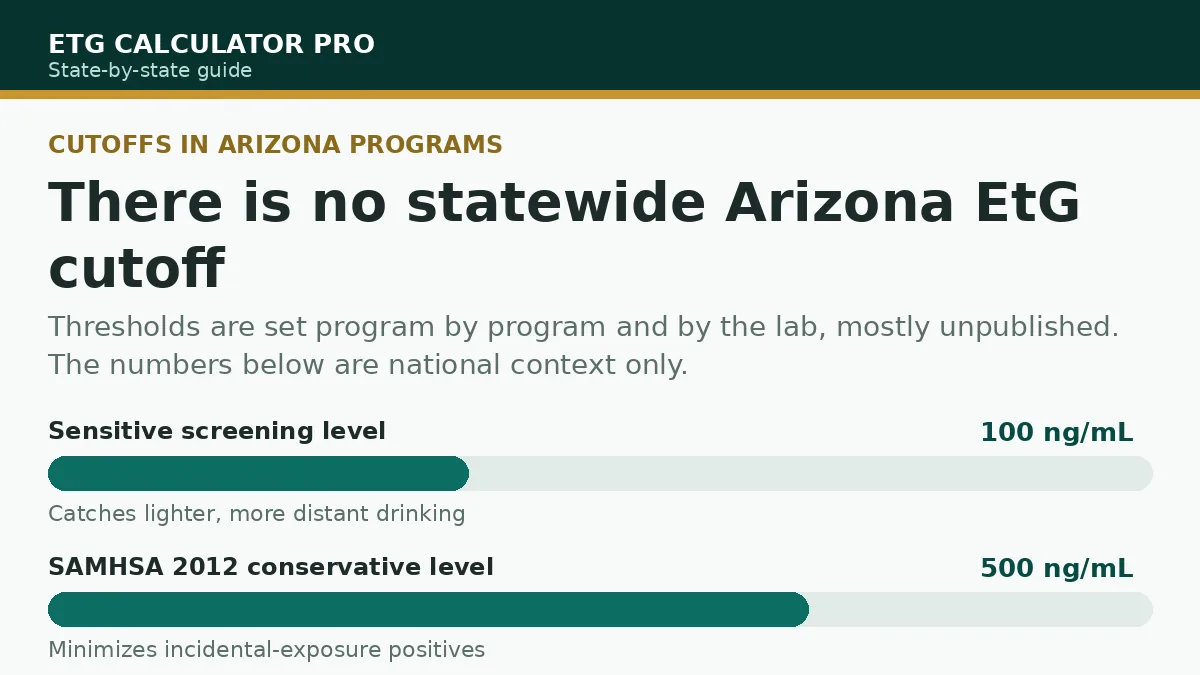
Here is the most important point on this page: there is no statewide Arizona EtG cutoff. We checked Arizona statutes, county probation and drug-court materials, DUI program rules, family-court law, and licensing-board program terms; none names an EtG threshold. Thresholds are set program by program, mostly unpublished. Your paperwork names the only cutoff that counts.
For national context:
- 100 ng/mL — the sensitive level many labs use; catches lighter, more distant drinking, but risks incidental-exposure flags.
- 500 ng/mL — SAMHSA's 2012 conservative recommendation, minimizing incidental-exposure positives.
- Labs screen anywhere from 100 to 1,000 ng/mL, depending on the program's goals.
Do not assume an Arizona program uses either number unless its paperwork says so.
Detection windows in Arizona programs
Detection windows are ranges, never predictions, depending on amount, timing, cutoff, and metabolism:
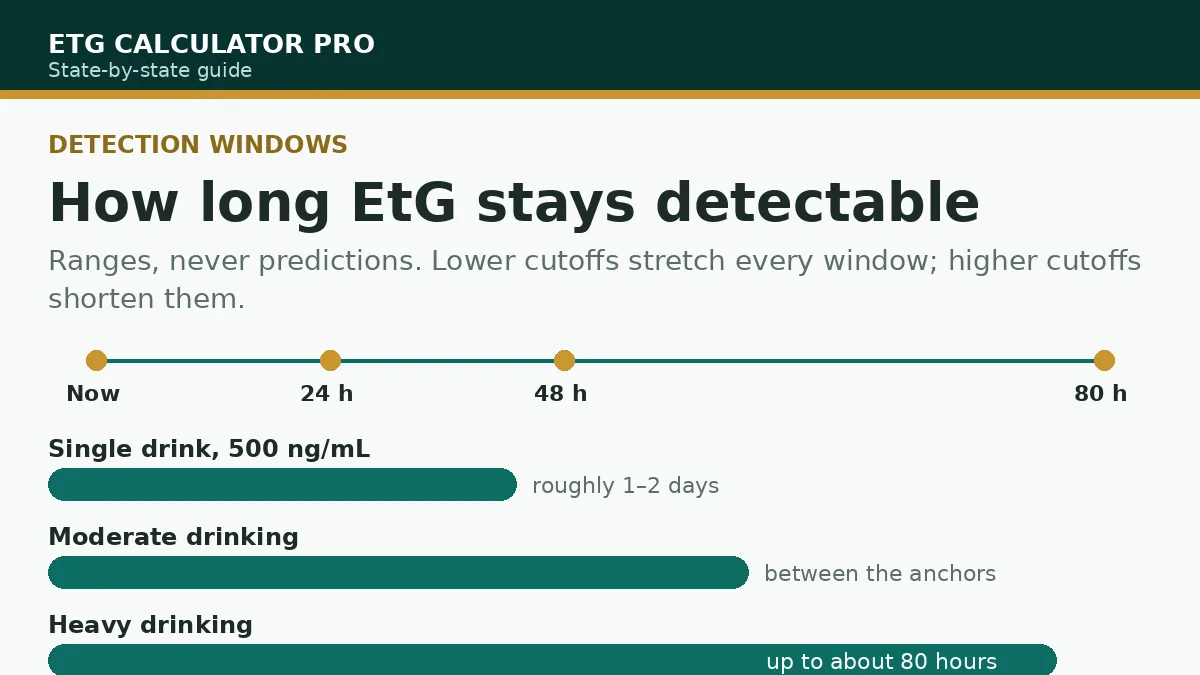
- Heavy drinking: up to about 80 hours after the last drink.
- A single drink: roughly 1–2 days at a 500 ng/mL cutoff; lower cutoffs extend the window.
- Moderate drinking: between those anchors.
The biggest lever is the cutoff: at 100 ng/mL, the same episode stays detectable longer than at 500 ng/mL.
Apply these ranges with our homepage calculator, the 100 ng/mL calculator, or our detection timeline tool.
A realistic Arizona scenario
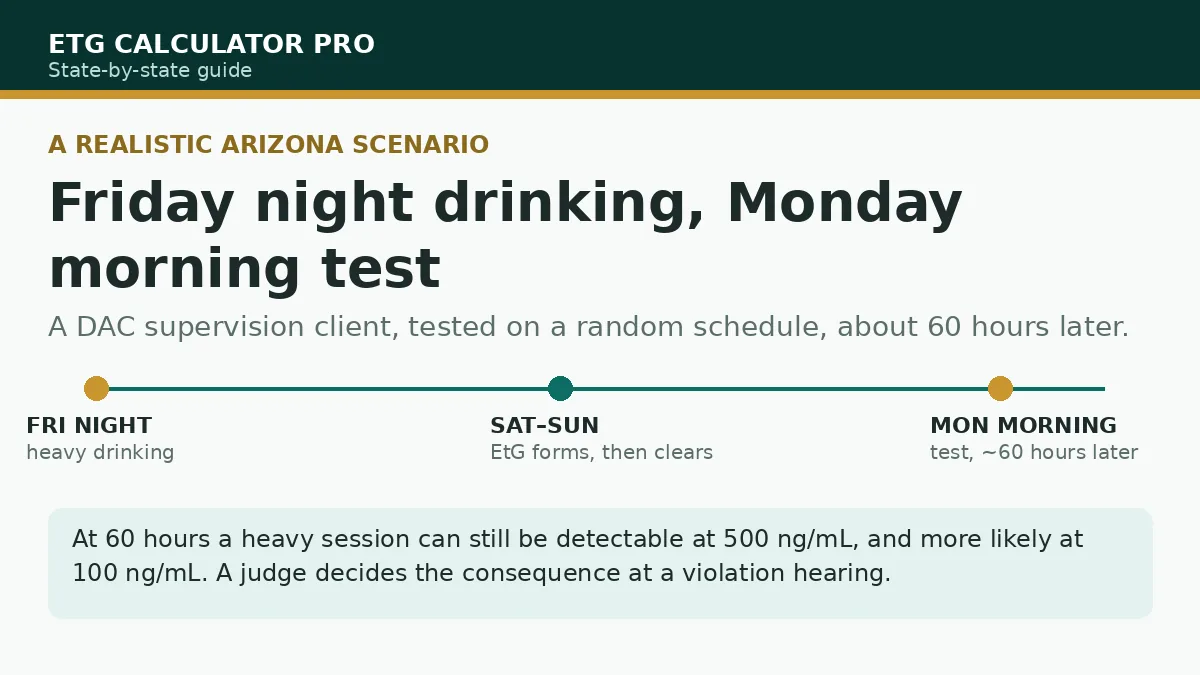
Consider a first-time DUI offender convicted at 0.17 — extreme DUI — ordered to complete alcohol screening and education under court supervision, with abstinence and random testing as probation conditions: heavy drinking Friday night, a test Monday morning, about 60 hours later.
Sixty hours sits inside the published range for heavy drinking, so the result could go either way. At 500 ng/mL, a heavy session can still be detectable at 60 hours, while a lighter one would likely have cleared; at 100 ng/mL, a positive is more likely. A positive does not automatically revoke probation, but the court may modify or add conditions, or revoke probation and impose sentence.
No pass-or-fail claim is possible from a timeline alone — cutoff, amount, and elapsed time shape the result.
A note on legal advice
This page is educational, describing how EtG testing works in Arizona probation, DUI programs, drug courts, and family court, from research, public-health guidance, and Arizona public records. It is not legal advice, and program rules change. If you are subject to testing, your program's requirements — and an attorney if a violation is alleged — are the authorities that matter.
Frequently asked questions
Is there one Arizona EtG cutoff?
No. No Arizona statute, county probation rule, drug-court standard, DUI program rule, or licensing-board page we checked publishes a statewide EtG cutoff. Each court, program, and lab sets its own, mostly unpublished. Nationally the common levels are 100 and 500 ng/mL (SAMHSA, 2012); neither is an Arizona rule. Your program's paperwork names the only number that counts.
Does Arizona probation use EtG testing?
Arizona probation can include drug and alcohol testing: under A.R.S. § 13-901, the court places an eligible person on intensive, supervised, or unsupervised probation on terms and conditions the law requires and the court deems appropriate, and conditions must be individually determined and narrowly tailored to help the person lead a law-abiding life, protect public safety, and promote rehabilitation. Most Arizona sources describe testing generically, as drug testing or urinalysis, not EtG by name. EtG applies where your program or lab specifies it, and it is the test that answers the abstinence question breath tests cannot.
What happens after a DUI conviction in Arizona — is there screening or treatment?
Yes, screening is mandatory. Under A.R.S. § 28-1387, a judge must order a person convicted of DUI under §§ 28-1381, 28-1382, or 28-1383 to complete alcohol or other drug screening through an approved facility, and may order education or treatment under court supervision if the judge determines it is needed. DUI screening itself is governed by Arizona Administrative Code R9-20-108: it must occur within 30 days after the court order unless the court requires otherwise, and consists of a face-to-face interview of at least 30 minutes. License reinstatement is held until screening, education, or treatment is completed or being satisfactorily pursued (§ 28-3319).
What is the difference between extreme DUI and super extreme DUI in Arizona?
Both are tiers of the same offense, A.R.S. § 28-1382, measured within two hours of driving: extreme DUI is an alcohol concentration of 0.15 or more but less than 0.20, and super extreme DUI is 0.20 or more. A first extreme DUI carries at least 30 consecutive days in jail and a 12-month ignition interlock period after reinstatement; a first super extreme DUI carries at least 45 consecutive days and an 18-month interlock period. A third DUI within 84 months, a DUI on a suspended license, or a DUI with a passenger under 15 becomes aggravated DUI, a felony under § 28-1383. These are breath-alcohol tiers, not EtG cutoffs.
Can an Arizona family court order EtG testing?
Yes, at the judge's discretion. Legal decision-making and parenting time are decided on the child's best interests under A.R.S. § 25-403. Separately, § 25-403.04 creates a rebuttable presumption that sole or joint legal decision-making by a parent is not in the child's best interests if the court finds the parent abused drugs or alcohol or was convicted of a drug offense or DUI within twelve months before the petition was filed. To rebut the presumption, the court considers evidence including negative results from six months of random drug testing and a clean screening from an approved treatment facility — which is where EtG testing can enter a custody case. Testing is not automatic; it follows a request and a reason to order it.
How long after drinking can an EtG test detect alcohol in Arizona?
The biology does not change at the state line: up to about 80 hours after heavy drinking, roughly 1–2 days after a single drink at 500 ng/mL; lower cutoffs extend the window. These are research ranges, not predictions.
Evidence and limitations
This guide summarizes primary research, public-health guidance, and Arizona public records. Group-level findings cannot predict one person's result.
- A.R.S. § 13-901 — Probation: intensive, supervised, or unsupervised probation on court-set terms; conditions individually determined and narrowly tailored
- A.R.S. § 13-901.01 — Probation for personal possession or use of controlled substances: probation plus drug treatment or education program; new conditions on violation
- A.R.S. § 28-1387 — DUI screening, education and treatment: judge must order screening after a §§ 28-1381/28-1382/28-1383 conviction; education or treatment if determined needed
- A.R.S. § 28-3319 — License suspension/revocation and ignition interlock: no termination or interlock license until screening, education, or treatment completed or satisfactorily pursued; monthly screening instead of interlock where a medical condition prevents interlock use
- Arizona Administrative Code R9-20-108 — DUI screening requirements: screening within 30 days after the court order; face-to-face interview of at least 30 minutes
- Yuma County Drug Court Regulations — missed urinalyses treated as positive tests; alcohol-containing products not accepted as excuses for positive breath tests; bars and casinos off limits
- A.R.S. § 25-403.04 — Substance abuse: rebuttable presumption against sole or joint legal decision-making where a parent abused drugs or alcohol or was convicted of a drug offense or DUI within twelve months before the petition; rebuttal evidence includes six months of negative random drug testing
- Arizona State Board of Nursing — Alternative to Discipline (ATD): non-disciplinary monitoring; stipulated agreements most commonly three years; random drug screening; abstention from all potentially addicting substances including alcohol
- A.R.S. § 31-467.06 — Supervision fee and drug testing costs: drug testing program costs may be a condition of parole or community supervision
- Determining Ethyl Glucuronide Cutoffs (PMC) — SAMHSA Advisory 2012 conservative 500 ng/mL recommendation; lab cutoffs 100–1,000 ng/mL