Who uses the 100 ng/mL cutoff?
The 100 ng/mL cutoff is the workhorse of abstinence monitoring. Probation and parole departments, DUI and drug courts, child-custody monitoring arrangements, and zero-tolerance workplace programs — including DOT-regulated roles — commonly test at 100 ng/mL because their question is not “was this person heavily drinking recently” but “has this person had anything to drink at all.” Research in outpatient monitoring populations found that lower cutoffs were more useful for detecting drinking across multiple days, while 500 ng/mL primarily identified more recent or heavier exposure.
Treatment programs with abstinence contracts often use 100 ng/mL for the same reason: the lower threshold extends the detection window, so drinking between scheduled tests is harder to hide. The tradeoff is sensitivity to incidental exposure — alcohol-containing mouthwash, hand sanitizers, and even some foods can produce low EtG levels that a 100 ng/mL screen may catch. Programs that test at this level generally know this, which is why confirmation testing and EtS (ethyl sulfate) measurement exist.
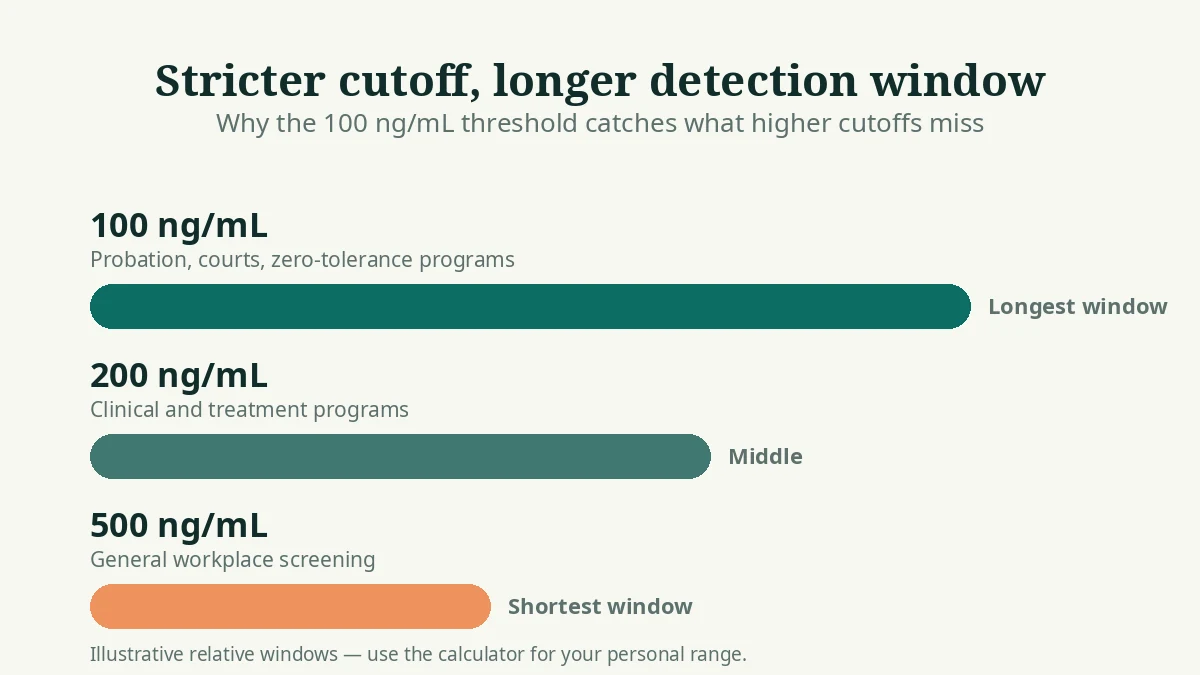
Policies differ between organizations, and a test’s brand name tells you nothing about its cutoff. If you are being tested, ask the laboratory or the ordering program which threshold they use rather than guessing. Our complete cutoff-levels guide explains how the three common thresholds compare.
How to read your result
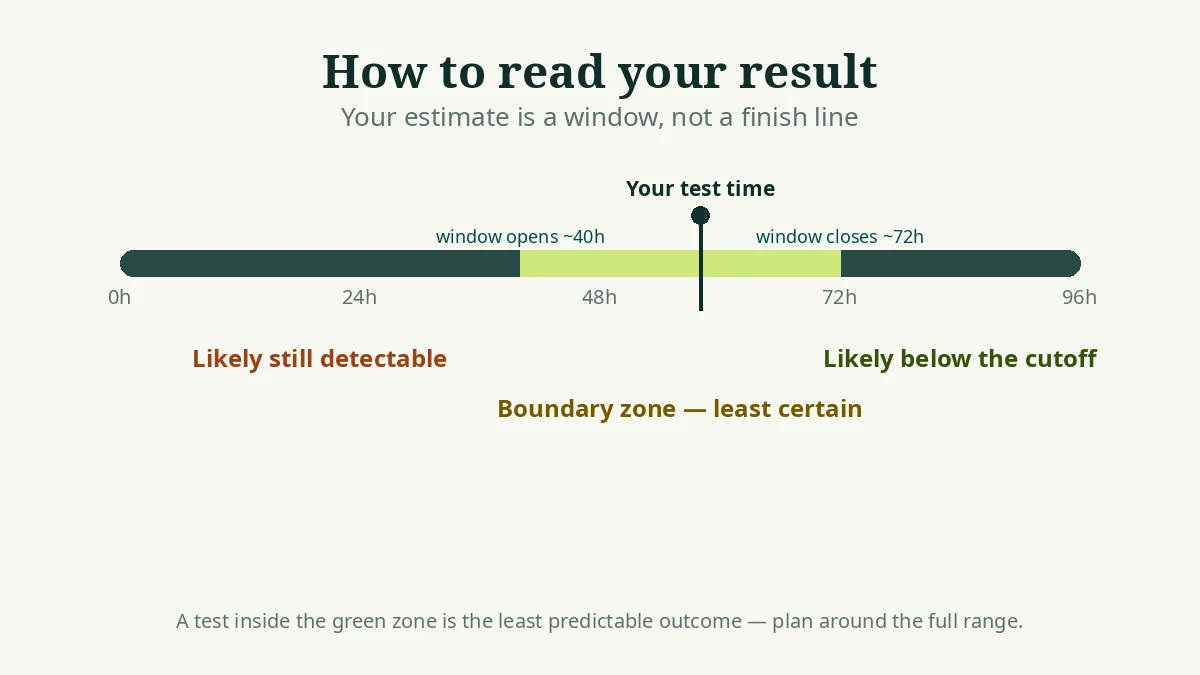
The calculator shows a modeled window — for example, 40–72 hours. Read the early number as the point before which detection is most likely, and the late number as the point after which most people in the research data fall below the cutoff. The space between them is the boundary zone: the least predictable outcome, where small differences in metabolism, hydration, and dose decide the result.
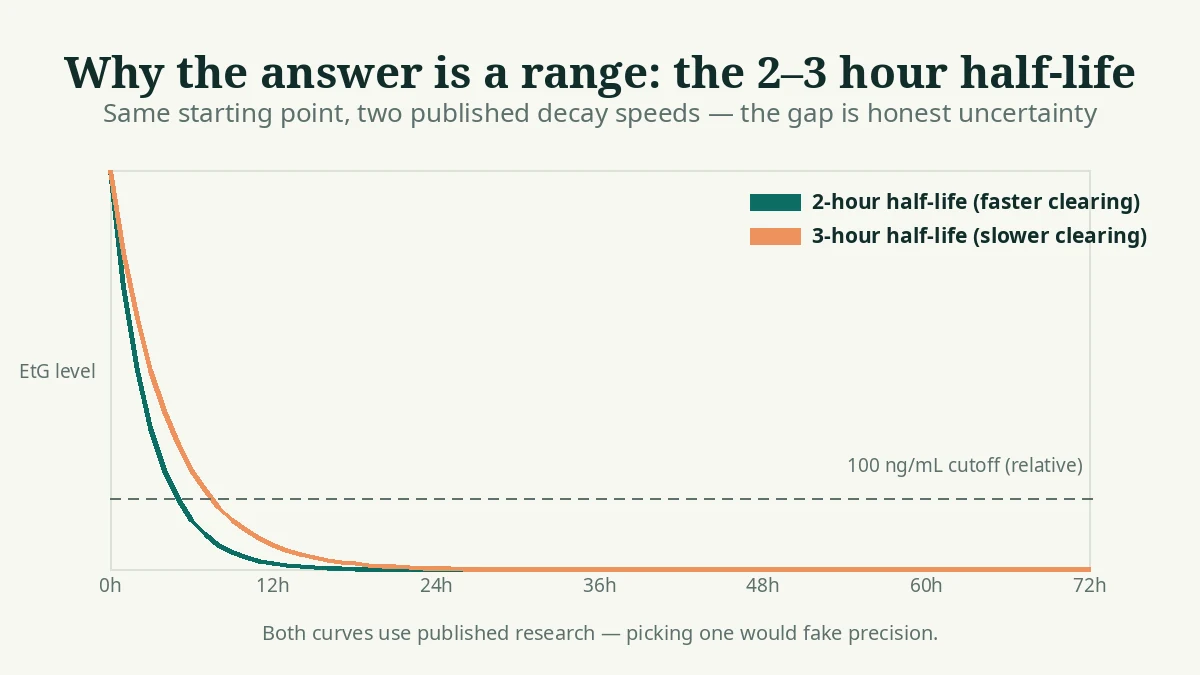
That zone exists because the inputs to the model are ranges, not constants. Published research puts urinary EtG’s elimination half-life at roughly 2–3 hours, so every projection on this site is computed at both bounds. Peak concentration after drinking varies even more — dose, drinking speed, food, body composition, sex, and hydration can shift a real peak several-fold between two people who drank the same amount. A range is the only honest way to present that.
A 100 ng/mL scenario: Friday night, test Monday morning
Take a common situation: four standard drinks, finished at 11 PM on Friday, with a test at 9 AM on Monday — about 58 hours later. Run those numbers through the main EtG urine calculator at 500 ng/mL and the window usually closes before Monday morning. On this page, with the cutoff fixed at 100 ng/mL, the window stretches: Monday morning can land inside the boundary zone — exactly the gap the stricter cutoff is designed to close.
Now change one detail: two drinks instead of four, plus alcohol-based mouthwash used Sunday night. At 500 ng/mL that incidental exposure rarely matters. At 100 ng/mL it is worth mentioning to the program before the test, not explaining after it. The stricter the cutoff, the more the small sources count — which is the entire point of testing at 100.
Why no calculator can promise you will pass
Three things decide a real result, and no calculator knows any of them. First, your true peak EtG concentration: there is no honest formula that converts a drink count into nanograms per milliliter, because the same drinks produce very different peaks in different bodies. Any calculator that multiplies your drinks by a fixed ng/mL-per-drink number and presents the answer as exact is dressing up a guess — published research supports a range, not a constant. Read our calculation formula guide for the full explanation.
Second, your personal elimination rate, which the published 2–3 hour range only brackets. Third, the laboratory itself: its method, its confirmation policy, and the cutoff it actually reports at. An estimate built from population ranges cannot predict an individual lab result, and it should never be used to make medical, legal, employment, or supervision decisions.
100 vs 200 vs 500 ng/mL at a glance
| Cutoff | Typically used by | Detection window | Incidental-exposure sensitivity |
|---|---|---|---|
| 100 ng/mL | Probation, courts, zero-tolerance and DOT-regulated programs | Longest | Highest — mouthwash and sanitizer can register |
| 200 ng/mL | Clinical and treatment programs | Middle | Moderate |
| 500 ng/mL | General workplace screening | Shortest | Lower — filters out most incidental exposure |
For the full comparison, see our 100 vs 500 ng/mL cutoff guide and the complete cutoff-levels guide.
Frequently asked questions
How long does alcohol stay detectable on a 100 ng/mL EtG test?
It depends on how much was consumed. Published research reports detection up to about 80 hours after heavy use at sensitive cutoffs, while one or two drinks may fall below 100 ng/mL within a day. Enter your own numbers in the calculator above for an honest range.
Will one drink show up on a 100 ng/mL EtG test?
Possibly, especially within the first 12–24 hours. Detecting low-level drinking is precisely what the 100 ng/mL cutoff is chosen for — programs that want to catch any drinking, not just heavy drinking, test at this level.
Can mouthwash cause a positive EtG result at 100 ng/mL?
Alcohol-containing mouthwash, hand sanitizer, and some foods and medicines can produce low EtG levels that a 100 ng/mL screen may detect. Higher cutoffs exist partly to filter out this incidental exposure. If you are in a monitoring program, disclose these products before testing.
Is 100 ng/mL the standard EtG cutoff?
It is the common standard for probation, courts, and abstinence-monitoring programs. General workplace screening more often uses 500 ng/mL. Always confirm which cutoff your program uses — never guess from a test brand name.
Why does this calculator show a range instead of one number?
Because the underlying biology is a range. EtG’s published half-life spans 2–3 hours and peak levels vary several-fold between people, so a single number would imply precision the research does not support.
Can I use this result to prove I will pass my test?
No. This is an educational estimate built from published population ranges, not a prediction of your laboratory result. Only a collected urine test can determine whether EtG is above a cutoff.
Evidence and limitations
This page summarizes primary research and public-health guidance. Group-level findings cannot predict one person’s result.