Why family courts order EtG testing
When alcohol use becomes an issue in a child custody case, a judge needs something more reliable than one parent's word against the other's. EtG — ethyl glucuronide — is a direct metabolite of alcohol that urine tests can detect for days after drinking, long after alcohol itself has left the bloodstream, which makes it the most useful alcohol test for a court deciding whether a parent can safely care for a child.
Courts order testing under the "best interests of the child" standard, which guides every custody decision in the United States. The question is never whether a parent drinks in the abstract — it is whether the drinking creates risk for the child. Testing is not automatic: the parent asking for it usually has to show the court something concrete, such as a DUI arrest, treatment history, or witness accounts. Some states have statutes that specifically authorize it — California Family Code section 3041.5, for example.
How EtG testing works in a custody case
The test itself is a urine test. A sample is collected — usually observed, to prevent substitution or tampering — and sent to a laboratory. Most programs screen with an immunoassay and confirm a positive with LC-MS/MS, often testing for both EtG and its companion metabolite EtS. When both are present, the result is stronger evidence of real drinking, because EtS is more specific.
The cutoff matters as much as the test. Custody programs commonly test at 100 ng/mL, the stricter level used by many probation and court-ordered programs, because the goal is usually to verify abstinence. Some programs use 500 ng/mL, the level SAMHSA's 2012 advisory discusses for workplace screening — and the same drinking history produces a very different window at each cutoff, roughly a day longer at 100 ng/mL after a few drinks. Our 100 vs 500 ng/mL cutoff guide explains the difference. Chain of custody is part of the test, and a result can be challenged on collection, handling, or confirmation, like any other evidence. The order should spell out the laboratory, the cutoff, the confirmation method, and who receives the results before testing starts.
Custody alcohol tests compared
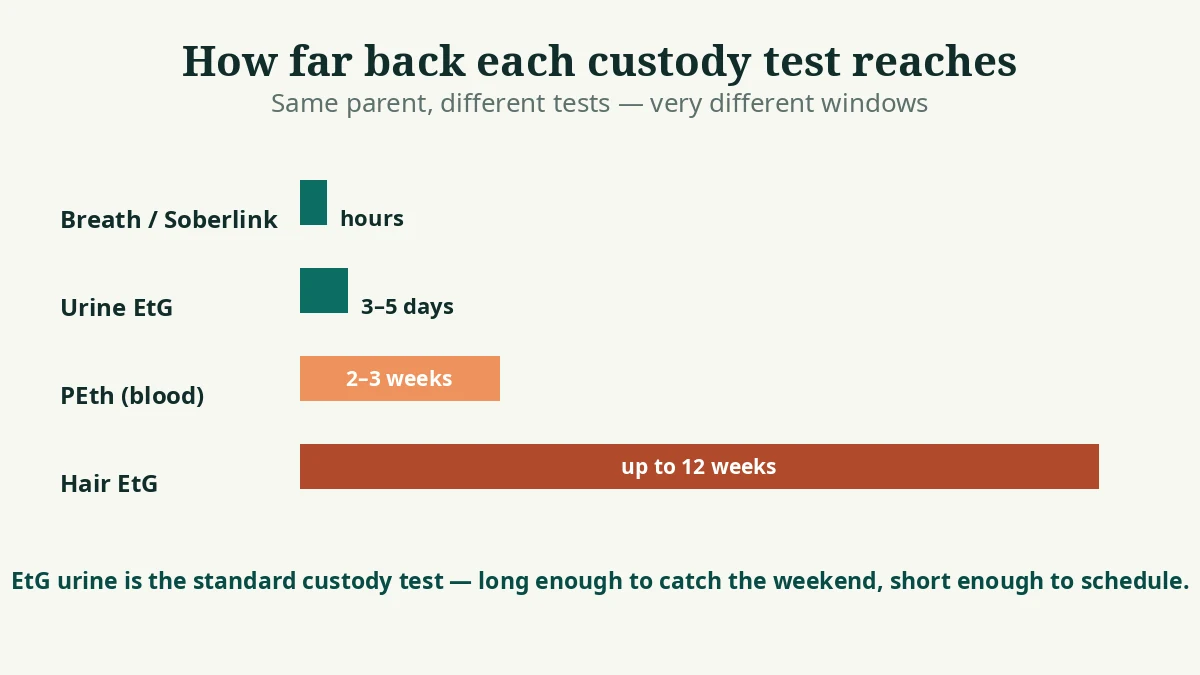
EtG is not the only test a family court can order — each tool answers a different question.
| Test | Detection window | What it shows | Typical custody use |
|---|---|---|---|
| Urine EtG | Roughly 3–5 days (up to about 80 hours) | Recent drinking; best for verifying abstinence | The standard court-ordered test; twice-weekly schedules |
| Hair EtG | Up to about 12 weeks | Pattern of heavy drinking over months | Showing a longer history when recent use is disputed |
| PEth (blood) | About 2–3 weeks | Drinking pattern; distinguishes heavy from light use | Backing up or challenging a urine EtG result |
| Breath test / Soberlink | Hours only, at the moment of the test | Sobriety right now, during parenting time | Real-time checks before and during visits |
| SCRAM ankle monitor | Continuous, every 30 minutes | Any drinking, day or night | High-risk cases where gaps in testing are unacceptable |
Courts often combine them: twice-weekly urine EtG tests catch drinking from the past few days, while a Soberlink breath test before and after parenting time catches intoxication in the moment. In higher-risk cases a judge may order a SCRAM bracelet, which monitors continuously.
What a typical testing schedule looks like
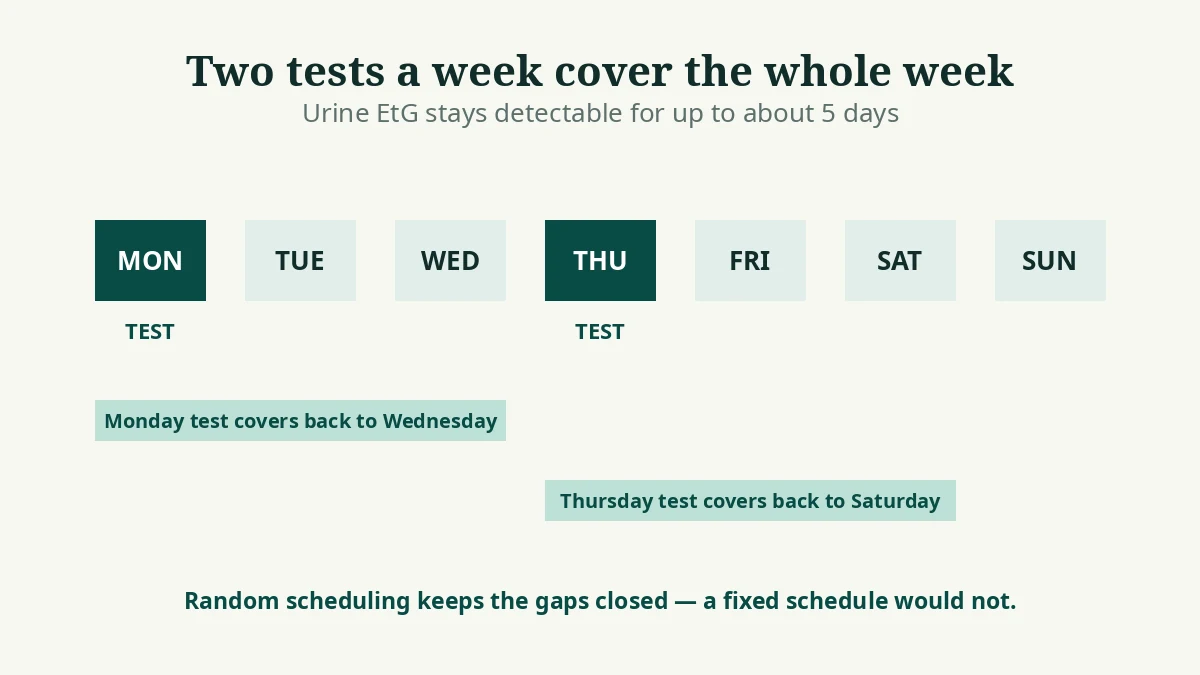
The most common pattern is two random tests a week, often on Mondays and Thursdays. The spacing is deliberate: because urine EtG can detect drinking from up to about five days earlier, two evenly spaced tests leave almost no day unaccounted for — a Saturday drink is still inside the window on Monday, a Tuesday drink on Thursday. Random scheduling is preferred, because a fixed schedule lets someone time their drinking to the gaps.
Tests are typically done at a laboratory or a designated collection site, and the sample is usually observed. The parent pays for the testing in most orders; a urine EtG test runs roughly $50, while a hair EtG or PEth test runs closer to $200. Many orders prohibit drinking entirely during the case, because EtG testing only works as an abstinence check when the rule is abstinence. Schedules usually run 90 days to six months, then the court reviews the results. A clean run can lead to relaxed testing or a return to unsupervised time; a positive can extend the schedule or tighten it.
What counts as a failed test
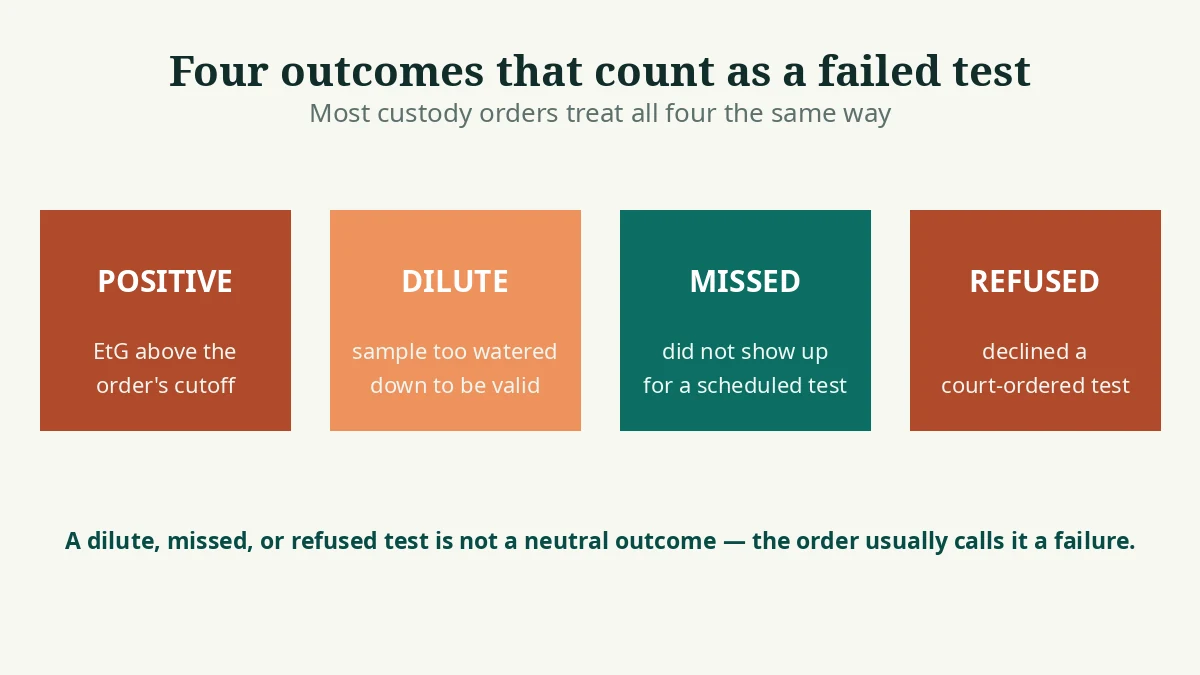
Most custody orders define failure broadly. A positive result is a failed test, but so are several other outcomes — and the order usually treats them the same way.
A dilute sample. If a parent drinks so much water before the test that the sample is too dilute to be valid, the laboratory flags it as dilute — and courts commonly treat that as a failed test, because dilution is the oldest way to try to beat a urine test. Creatinine is checked alongside EtG for exactly this reason: a very low level shows the sample was mostly water.
A missed test. Failing to show up is usually treated as a failure — courts assume a test was skipped for a reason, and most orders say so explicitly. If a genuine emergency prevents attendance, document it immediately and notify the other side and the court.
A refused test. Refusing a court-ordered test is rarely a good strategy: judges may draw a negative inference — assume the result would have been unfavorable — and refusal can lead to restricted or supervised parenting time.
The order should name all four as failures before testing starts. If yours does not, ask your attorney to clarify it.
What an EtG result can and cannot prove
First, an EtG level does not measure impairment. EtG concentrations do not track blood alcohol concentration, and a positive result says nothing about whether a parent was drunk, or drunk around the children — only that alcohol was consumed inside the detection window. A parent can test positive days after drinking, long after any impairment has passed, and can be dangerously impaired while testing negative if the drinking happened outside the window.
Second, a positive result cannot say when the drinking happened or how much was consumed. The test gives a window, not a timestamp. Third, incidental exposure can cause a positive — studies put roughly 2% of positive EtG results down to hand sanitizer, mouthwash, cosmetics, and similar products rather than drinking. That is a small share, but a single disputed positive can matter enormously, which is why confirmation matters: a positive EtG with a matching positive EtS is much stronger evidence of real drinking. Our mouthwash guide and hand sanitizer guide cover the evidence. Fourth, a negative result proves less than it seems: it proves no drinking was detected inside the window, not that a parent never drinks. A parent who drinks on Friday and tests the following Thursday at 500 ng/mL may test negative while having drunk heavily — which is why the schedule and the cutoff matter as much as the result itself.
Real-world scenario: Friday drinks, Monday test
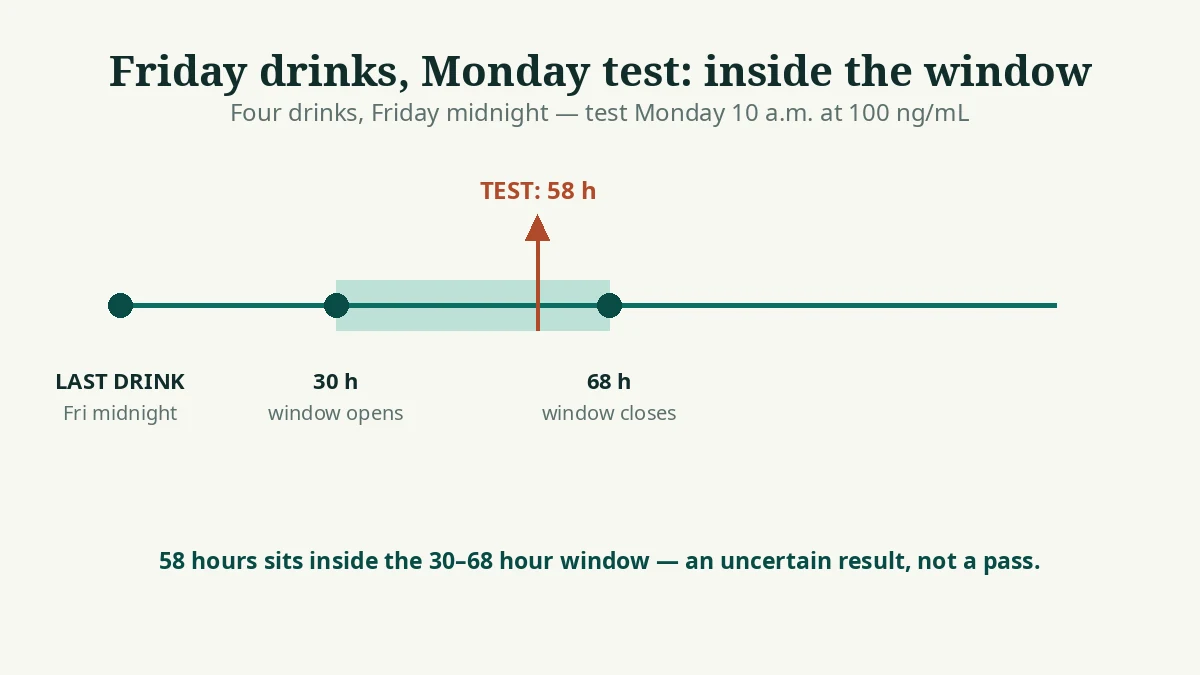
Take a common scenario. A parent must test on Mondays and Thursdays, with abstinence required at all times, at a 100 ng/mL cutoff. On Friday night they have four drinks over four hours, finishing at midnight. Monday's test is at 10 a.m. — 58 hours after the last drink. Our EtG calculator chart puts four drinks at 100 ng/mL in a roughly 30 to 68 hour window, so at 58 hours the result is genuinely uncertain and a positive is entirely plausible.
Thursday's test is 130 hours after the last drink — well past the window, so a negative there proves nothing about Friday. This is why the twice-weekly schedule exists: Monday catches the weekend, Thursday catches the midweek. At a 500 ng/mL cutoff the same four drinks give a window of roughly 20 to 46 hours, so Monday's 58-hour test would likely be negative.
| Drinks (one session) | 100 ng/mL window | 200 ng/mL window | 500 ng/mL window |
|---|---|---|---|
| 1–2 drinks | 23–53 hours | 20–46 hours | 15–36 hours |
| 3–4 drinks | 30–68 hours | 26–59 hours | 20–46 hours |
| 5–7 drinks | 38–85 hours | 33–75 hours | 26–58 hours |
These windows come from the same model our calculator uses. They are ranges, not promises.
What happens after the result
A positive EtG result does not automatically mean a parent loses custody. Courts look at the totality of the circumstances: how often the drinking happens, whether it affects parenting, whether the parent is in treatment, and the child's safety. A single positive, with an otherwise clean record and a parent in treatment, usually leads to tighter monitoring or supervised visitation. Repeated positives, or drinking during parenting time, are treated very differently.
What usually follows a positive is consistent: supervised visitation until a run of clean tests is established, an alcohol evaluation or treatment program, more frequent testing, or a Soberlink or SCRAM requirement. The parent's response matters as much as the result — engaging with treatment, complying with every test, and documenting sobriety are the fastest route back to unsupervised time. A clean run matters just as much the other way: months of negative tests, on schedule, at a strict cutoff, are strong evidence that an allegation of ongoing drinking is unfounded. If a result is disputed, the usual routes are confirmation testing, a PEth blood test, and a review of the chain of custody. This article is educational only — it is not legal advice.
Using the EtG calculator before a custody test
The EtG calculator on this site estimates the same detection windows the table above uses, from your own numbers: standard drinks, hours spent drinking, hours since your last drink, and the cutoff your order uses — usually 100 ng/mL for custody testing. It is most useful for understanding what the test can and cannot show, not for planning around it. Read the result as a range: before it starts is modeled as likely above the cutoff, after it ends as likely below, and inside it as genuinely uncertain. The low end is the earliest plausible clear time — never a pass date.
Two warnings matter. First, the calculator cannot account for a diluted sample, medications, liver function, or one person's exact half-life — only a laboratory result against your program's cutoff decides the outcome. Second, timing drinking to the gaps in a testing schedule is a losing strategy under a twice-weekly order, and a dilute or missed test counts as a failure anyway. The calculator's honest use in a custody case is understanding the window, complying with the order, and building the clean record that moves a judge. For the same tests in other legal settings, see our probation EtG guide and our DUI EtG guide, and for how programs read results, our guide to reading EtG results.
Frequently asked questions
Can a family court order an EtG test in a custody case?+
Yes. When a parent's drinking is credibly at issue, a judge can order EtG testing as part of a custody order or parenting plan, under the best interests of the child standard. Testing is not automatic — the requesting parent usually has to show concrete evidence such as a DUI, treatment history, or documented incidents — and some states, including California under Family Code section 3041.5, have statutes that specifically authorize it.
How far back can an EtG test detect drinking in a custody case?+
A urine EtG test typically detects drinking from roughly the past three to five days, up to about 80 hours after heavier drinking. The exact window depends on how much was drunk and on the cutoff: at 100 ng/mL the window is longer than at 500 ng/mL. Hair EtG extends the window to about 12 weeks, and a PEth blood test covers about two to three weeks.
Does a positive EtG test mean I will lose custody?+
Not automatically. Family courts look at the totality of the circumstances — how often the drinking happens, whether it affects parenting, whether the parent is seeking treatment, and the child's safety. A single positive usually leads to tighter monitoring, supervised visitation, or a treatment requirement rather than a loss of custody. Repeated positives, or drinking during parenting time, are treated much more seriously.
Can mouthwash or hand sanitizer cause a positive EtG test in a custody case?+
It can, though it is uncommon — roughly 2% of positive EtG results are attributed to incidental ethanol exposure from products such as hand sanitizer, mouthwash, and cosmetics rather than drinking. This is why confirmation matters: a positive EtG with a matching positive EtS is a much stronger indicator of real drinking, and a disputed result can be checked with LC-MS/MS confirmation or a PEth blood test.
What happens if I miss or refuse a court-ordered EtG test?+
Most custody orders treat a missed test the same as a failed test, and a refusal can be worse: a judge may draw a negative inference that the result would have been unfavorable, restrict the parent to supervised visitation, or treat the refusal as contempt of the court order. If a genuine emergency prevents attendance, document it immediately and notify the other side and the court.
How often are EtG tests done in custody cases?+
Two random tests a week — often on Mondays and Thursdays — is the most common schedule, because urine EtG stays detectable for up to about five days, so two evenly spaced tests leave almost no day unaccounted for. Schedules usually run for a defined period, often 90 days to six months, and the court reviews the results before deciding whether to continue, relax, or tighten testing.
Can an EtG calculator tell me if I will pass a custody test?+
No. A calculator estimates a detection window from population research — for example, roughly 30 to 68 hours for four drinks at a 100 ng/mL cutoff — but it cannot measure your EtG level, predict your personal half-life, or decide what a laboratory will report. Only the lab result against your program's cutoff decides the outcome. Use the calculator to understand the window, not as a pass predictor, and never try to time drinking to the gaps in a testing schedule — a dilute or missed test counts as a failure anyway.
Evidence and limitations
This article summarizes published research on EtG detection windows, cutoffs, and half-life, and explains how family courts use EtG testing, based on court guidance and family-law practice. Group-level findings cannot predict one person’s result, and this article is educational only — it is not medical or legal advice.
- SAMHSA Advisory: The Role of Biomarkers in the Treatment of Alcohol Use Disorders (2006, revised 2012)
- McDonell et al. (2015) — EtG immunoassay cutoff sensitivity in alcohol-dependent outpatients (1,589 samples)
- Mackus et al. (2017) — EtG detection and elimination kinetics after controlled alcohol intake
- Jatlow et al. (2014) — EtG/EtS sensitivity and specificity at low cutoffs
- AW Family Law — Parenting: Drug/Alcohol Testing: What Type of Test Should I Require? (twice-weekly EtG schedules, dilute/missed as failures, PEth)
- Resurgens Law — Drug Testing in Georgia Custody Cases (EtG up to 80 hours, PEth 2–3 weeks, refusal and negative inference)
- LegalClarity — Court-Ordered Drug Test for Child Custody (EtG ~$50 urine / ~$200 hair, PEth ~$200, supervised visitation)
- Atticus Family Law — Minnesota Custody Testing Guide (~2% incidental positives, EtG+EtS confirmation, levels do not track impairment)
- Soberlink — Soberlink vs EtG, Identifying Alcohol Use (EtG in custody cases, detection windows, breathalyzer comparison)
- California Family Code section 3041.5 — authorizes court-ordered drug or alcohol testing in custody and visitation proceedings where there is reason to believe it is necessary for the child’s welfare