The short answer: a number is a comparison, not a verdict
If you are trying to understand EtG test results, start with the most common misunderstanding: the number on the report is not a grade. A laboratory does not look at your result of, say, 420 ng/mL and decide on feeling whether that is high or low. It compares the number with a cutoff — a threshold chosen by the testing program, usually 100, 200, or 500 ng/mL. At or above the cutoff, the result is reported positive. Below it, negative. Everything else on the report exists to help you judge how much that comparison is worth.
That fact explains most result confusion. Two people can drink the same amount and get different verdicts because their programs use different cutoffs. One person can test positive Monday and negative Wednesday without drinking again, because EtG falls as the body clears it. And a result of several thousand ng/mL does not mean someone was heavily intoxicated at test time; EtG lingers after alcohol itself is gone.
This guide explains what ng/mL numbers mean, what the common bands suggest, what a number cannot tell you, and how to read positive, negative, and dilute outcomes. For the line-by-line mechanics of a printed report, see our guide to reading EtG urine test results. Here the focus is interpretation: what the science supports, and where honest uncertainty begins.
Understanding EtG test results: the five parts of any result
Before the bands and tables, get the five parts straight.
1. Concentration. The measured amount of ethyl glucuronide in urine, almost always in nanograms per milliliter (ng/mL). One nanogram is a billionth of a gram, so these numbers describe traces — even a "high" 2,000 ng/mL is two-millionths of a gram per milliliter. Small units are normal; they do not make the result trivial.
2. Cutoff. The program's decision line. The Substance Abuse and Mental Health Services Administration (SAMHSA) advisory discusses 100, 200, and 500 ng/mL cutoffs, with 500 ng/mL best avoiding false positives from incidental exposure. Lower cutoffs catch lighter or older drinking but admit more false alarms. There is no single national cutoff — the ordering program chose it, and the report should state it.
3. Units and specimen. Confirm the result is urine EtG in ng/mL. Hair EtG uses picograms per milligram and answers a months-long question, not a days-long one. Mixing the two up causes needless panic over a number that means something entirely different.
4. Creatinine. A measure of how concentrated the urine is. Dilute urine lowers EtG concentration even though total EtG excreted may be unchanged. Research on water diuresis (Dahl and colleagues, 2002) found EtG concentration falls as urine volume rises, while the EtG-to-creatinine ratio stays comparatively stable. So a low number in very dilute urine is weaker evidence than the same number in concentrated urine.
5. Method and timing. Was this an immunoassay screen or LC-MS/MS confirmation, and when was the sample collected? A screening positive is preliminary — screens trade specificity for speed, and similar molecules can cross-react. Confirmation measures EtG directly and is the result programs act on. Timing matters too: EtG typically remains detectable roughly 24 to 80 hours after heavier drinking, and a small amount may clear in about 13 to 20 hours, so any result is one moment in a falling curve.
What the ng/mL bands actually mean
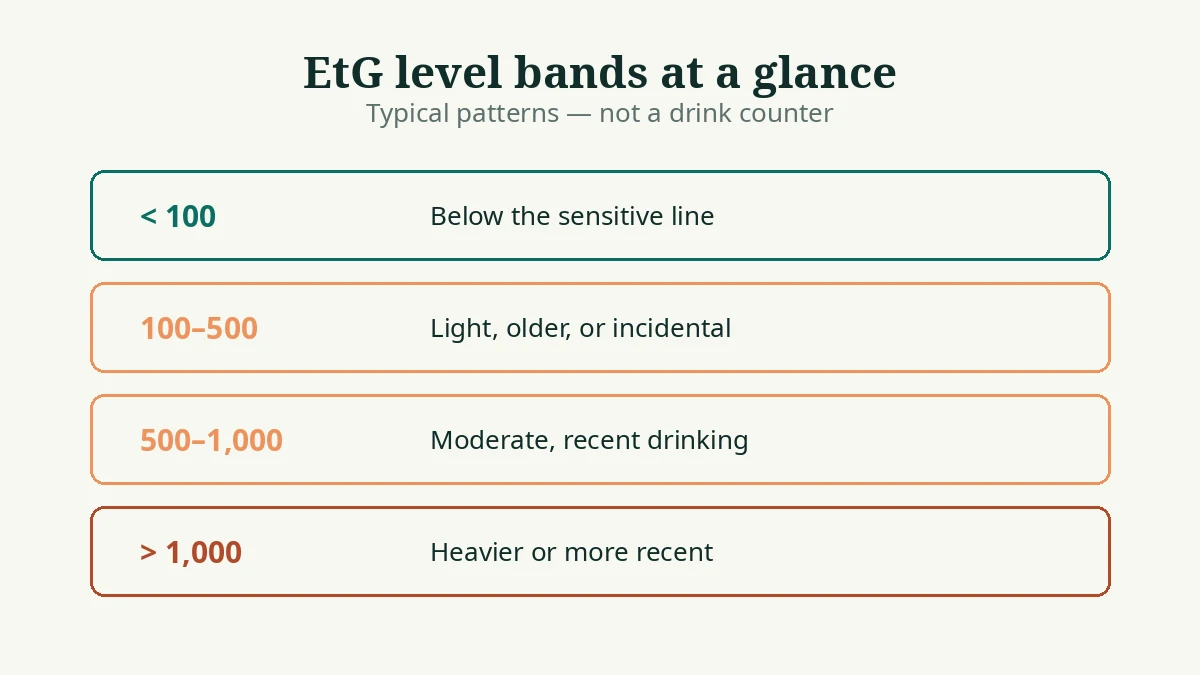
With those five parts in mind, here is how laboratories and researchers generally talk about EtG levels. Treat these bands as typical patterns from published studies, not promises about any one person — metabolism, drink size, timing, and dilution move real results across band edges.
| EtG level (ng/mL) | What it usually suggests | What it does not prove |
|---|---|---|
| Below 100 | No drinking detected at a sensitive cutoff; or drinking too light or too long ago to register | It does not prove zero lifetime exposure — only that nothing above this line was found in this sample |
| 100–500 | Light or older drinking, or incidental exposure in rare heavy-use cases (for example, intensive hand-sanitizer use) | It does not identify the source by itself; confirmation and context matter most in this band |
| 500–1,000 | Moderate drinking within the detection window, typically within the last day or two | It does not say how many drinks, or exactly when they were consumed |
| Above 1,000 | Heavier or more recent drinking; research samples after heavy drinking have reached several thousand ng/mL | It does not measure intoxication — alcohol itself may already be fully cleared |
Two research patterns matter here. First, the dose relationship is real but loose: more alcohol generally produces more EtG, but the spread between people is wide. Second, the fall is not a straight line: EtG rises after drinking, peaks within roughly a day, then declines over days. A single number cannot place someone on that curve without knowing when they drank — a moderate number could be a heavy episode days old or a light episode yesterday. That is why settings read the same band differently: a treatment program at 100 ng/mL wants to catch any return to drinking, while a workplace program at 500 ng/mL wants to avoid punishing incidental exposure. Neither misreads the chemistry; they answer different questions.
Why the same sample can be positive and negative
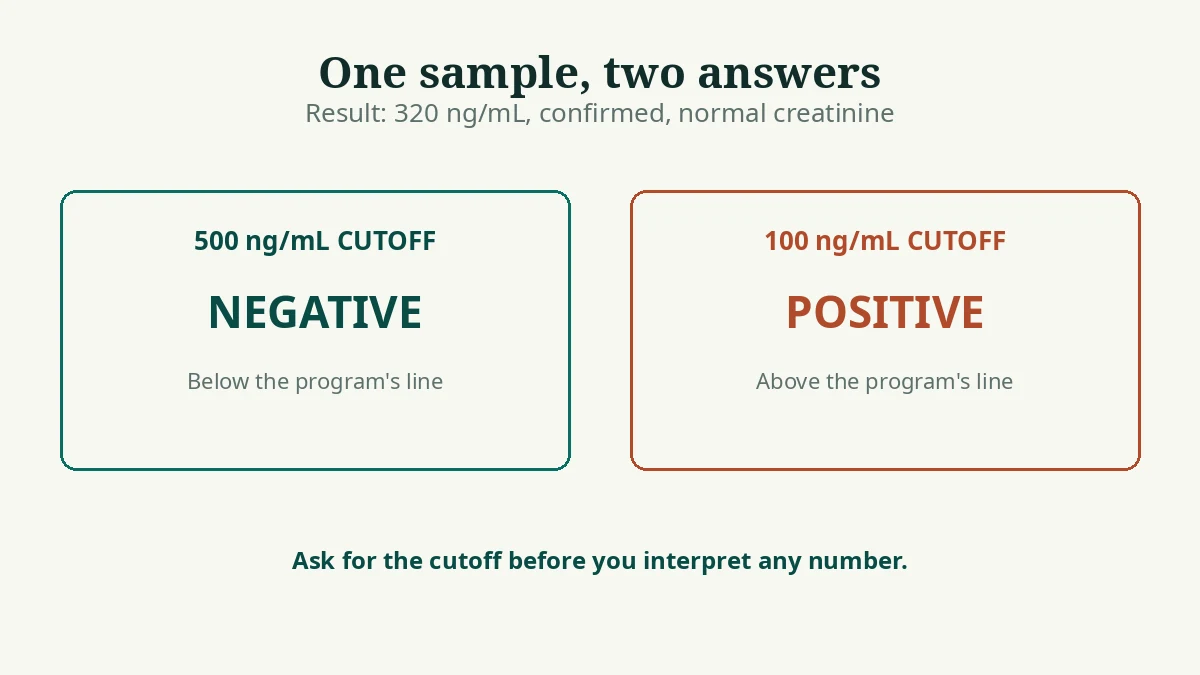
Take a concrete result: 320 ng/mL, confirmed by LC-MS/MS, normal creatinine, collected Monday morning. At 500 ng/mL this is negative; at 200 or 100 ng/mL, positive. One measurement, three possible verdicts.
This is how threshold testing works, and why asking "what was my number?" without asking "what was the cutoff?" leads nowhere. If you receive a result, first ask the program or laboratory for the cutoff, then the method: an unconfirmed screening result of 320 ng/mL deserves confirmation before anyone acts on it, because immunoassay screens can cross-react and overstate the result.
Our 100 vs 500 ng/mL cutoff guide compares the two most common thresholds, including which settings use each and how false-positive risk changes between them.
What a number cannot tell you
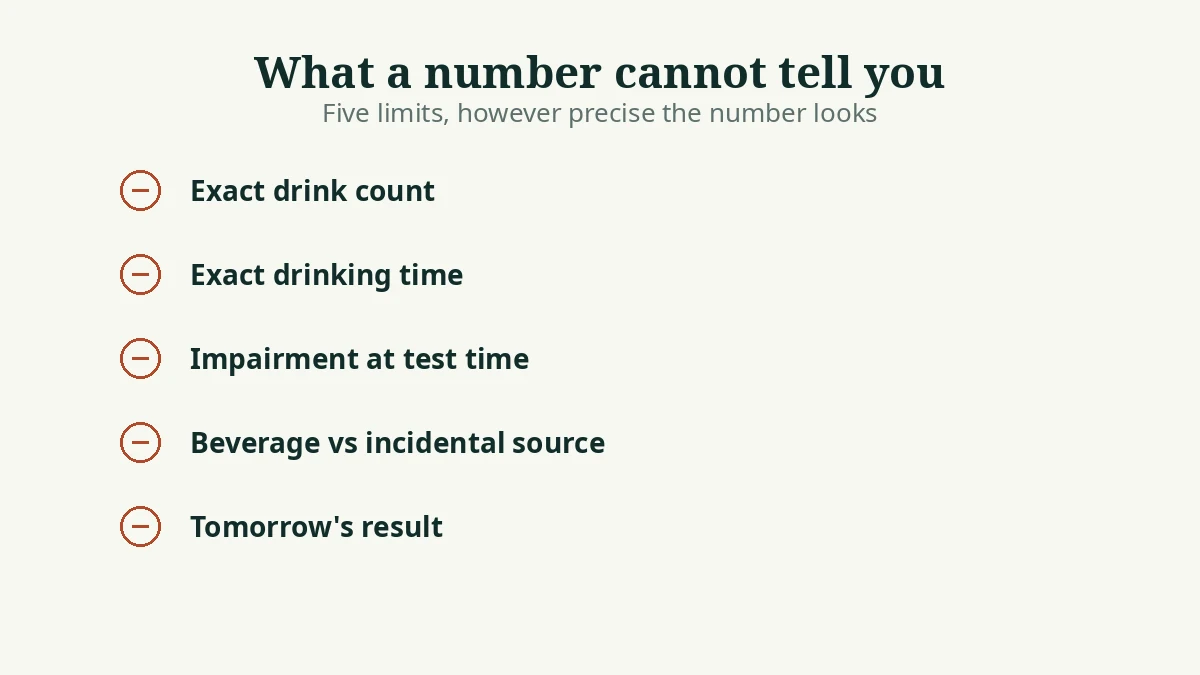
Honest interpretation means naming the limits plainly. An EtG number cannot tell you:
How many drinks someone had. Drink size, alcohol percentage, body weight, food, and metabolism all change how much EtG forms from the same drinks. Research shows a broad dose relationship, not a conversion table — any site turning a number into an exact drink count invents precision the science does not support.
Exactly when someone drank. EtG lingers for days, and its decline varies by person. A result can suggest recent versus older drinking in broad terms, but it cannot timestamp an episode to a particular evening.
Whether someone was impaired. EtG is a metabolite, not alcohol itself. By the time EtG peaks, blood alcohol may already be zero. A positive says alcohol was consumed within the window; nothing about intoxication at test time.
Whether the source was a beverage. EtG forms from any ethanol the body processes, including heavy incidental exposure — intensive hand-sanitizer use has produced positives in published studies, usually at lower levels. That is one reason low-cutoff positives deserve confirmation and context.
Whether someone will test positive tomorrow. A number is one point on a falling curve. Without a second sample, nobody can say exactly when it crosses below a cutoff — only that it is falling, and that a calculator estimate models the typical range.
Positive, negative, and dilute: reading the three outcomes
Positive (at or above cutoff, confirmed). EtG was found at or above the program's line in a confirmed test. It supports the conclusion that alcohol was consumed within the window, or that heavy incidental exposure occurred. It does not establish how much was consumed, when, or whether a program rule was violated — programs pair the result with their own rules, and some allow a medical or exposure review first.
Negative (below cutoff). No EtG above the line was found in this sample. It does not prove no drinking: drinking below the threshold, drinking too long before the sample, or a very dilute sample can all produce a negative after real drinking. A negative at 500 ng/mL is weaker evidence of abstinence than one at 100 ng/mL.
Dilute (low creatinine). Laboratories flag very low-creatinine samples as dilute. A dilute negative is less reassuring than a normal one, because dilution lowers EtG concentration; some programs require a retest. A dilute positive is still a positive — dilution makes positives harder to reach. If your creatinine is below the laboratory's normal range, ask how the program treats dilute specimens before drawing conclusions.
Across all three outcomes, one discipline prevents the most common errors: never act on a screen alone, never compare numbers across programs with different cutoffs, and never read a number without its creatinine and method.
Real-world scenario: three drinks Friday, test Monday, result 320 ng/mL
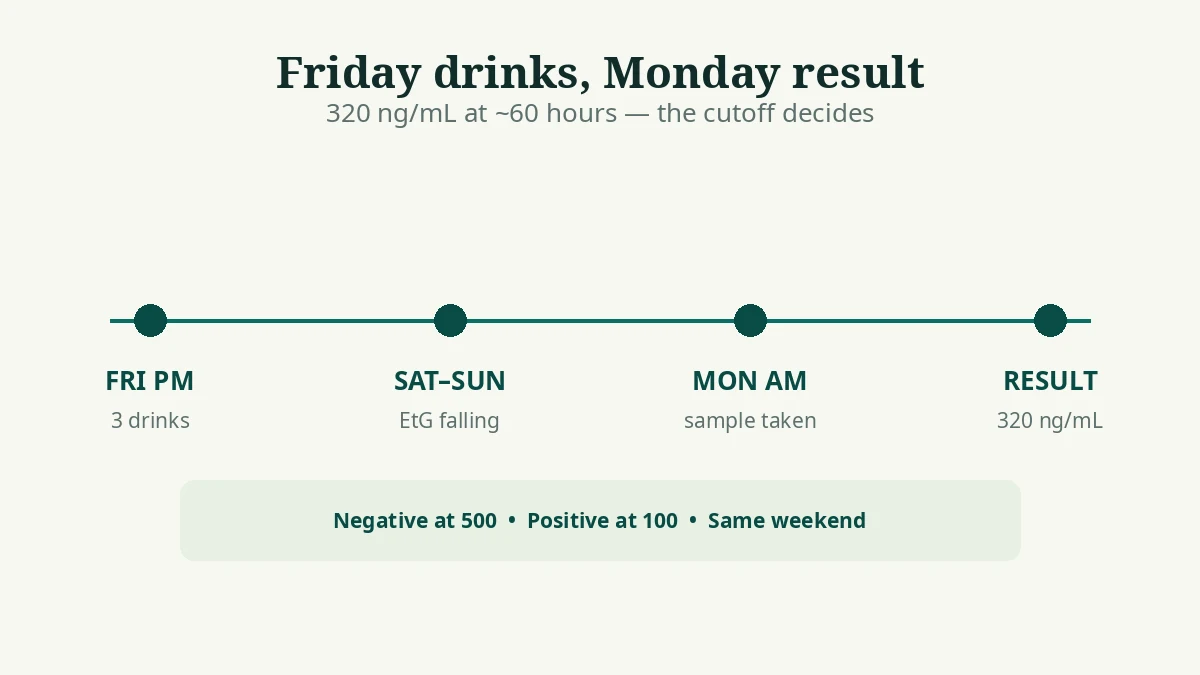
Consider a realistic case: three standard drinks Friday evening, stopping by midnight, tested Monday morning about 60 hours later. The confirmed result comes back at 320 ng/mL with normal creatinine.
At 500 ng/mL, the result is negative — EtG has fallen below the line by Monday. At 100 ng/mL, it is positive — the same Friday drinking is still visible to the more sensitive line. Both verdicts describe the same weekend; they differ because the programs chose different trade-offs between catching light drinking and avoiding false alarms.
Now change one variable: the person drinks a large amount of water first, and the sample comes back dilute, the same total EtG spread across more urine. The measured concentration could drop below 100 ng/mL even at the sensitive cutoff — a negative reflecting dilution, not abstinence. That is why laboratories report creatinine, and why programs treat dilute negatives with suspicion rather than relief.
The lesson is not to game the test — dilution is detectable, and programs have rules for it. Read the whole report, ask for the cutoff and method, and remember that timing, cutoff, and dilution together explain results that first look contradictory.
What to do with your result
If you have a result in hand, work through it in this order. First, confirm the cutoff, method, and creatinine on the report — if any is missing, ask the laboratory. Second, if it is a screening positive, ask whether LC-MS/MS confirmation has been done; do not accept consequences from a screen alone. Third, compare the number with the cutoff, not with other people's numbers or charts that ignore your program's threshold. Fourth, if it is dilute, find out the program's dilute-specimen rule before assuming it clears or condemns you. Finally, if the result will be used in a court, employment, or program decision, treat this article as background only — the program's written policy governs.
For planning rather than interpretation, our EtG calculator models the typical detection window, and the EtG calculator chart shows how windows shift with drink count and cutoff. The biomarkers research page covers EtG alongside EtS and PEth, and the calculator vs lab test guide explains where estimates and measurements each shine. Numbers stop being intimidating once you know which line they are measured against.
Frequently asked questions
What does ng/mL mean on an EtG test result?+
ng/mL means nanograms per milliliter — the concentration of ethyl glucuronide in your urine sample. One nanogram is a billionth of a gram, so EtG results describe traces. A higher number generally means more recent or heavier drinking, but the number only becomes a positive or negative verdict when compared with the program's cutoff.
Is 320 ng/mL a positive EtG result?+
It depends entirely on the cutoff. At a 500 ng/mL cutoff, 320 ng/mL is negative; at 100 or 200 ng/mL, it is positive. Always ask for the cutoff before interpreting any EtG number — the same sample can be positive under one program's rules and negative under another's.
Can an EtG number tell you how many drinks someone had?+
No. Drink size, alcohol percentage, body weight, food, and individual metabolism all change how much EtG forms from the same number of drinks. Research shows a broad dose relationship, not a conversion table — any source that turns a number into an exact drink count is inventing precision the science does not support.
Does a negative EtG result prove someone did not drink?+
No. A negative result means no EtG above that program's cutoff was found in that sample. Drinking below the detection threshold, drinking too long before the sample, or a very dilute sample can all produce a negative result after real drinking. A negative at 500 ng/mL is weaker evidence of abstinence than a negative at 100 ng/mL.
What does a dilute EtG result mean?+
Dilute means the urine sample had very low creatinine, so it was unusually watery. Dilution lowers the measured EtG concentration, which makes a dilute negative less reassuring — many programs require a retest. A dilute positive is still a positive, because dilution makes positives harder, not easier, to reach.
Why is a screening positive not the final answer?+
An immunoassay screen is fast and affordable but can cross-react with similar molecules and produce false positives. LC-MS/MS confirmation measures EtG directly by its mass signature and is far more specific. Programs act on confirmed results; a screening positive alone should always be confirmed before consequences follow.
Can a high EtG number mean someone was drunk at test time?+
No. EtG is a metabolite that lingers for days after alcohol itself is cleared, so a positive result says alcohol was consumed within the detection window — not that the person was impaired when tested. Blood alcohol, not EtG, measures intoxication.
Evidence and limitations
This article summarizes published research on ethyl glucuronide detection, cutoffs, creatinine and dilution, and confirmation testing. Group-level findings cannot predict one person's result, and this article is educational only — it is not medical or legal advice.
- SAMHSA Advisory: The Role of Biomarkers in the Treatment of Alcohol Use Disorders (2006, revised 2012)
- McDonell et al. (PMC4400217) — EtG detection and alcohol use monitoring research
- Mackus et al. (PMC5637917) — EtG excretion and detection-window research
- Jatlow et al. (PMC4107122) — EtG/EtS measurement and confirmation research
- The relationship between ingested dose of ethanol and amount of ethyl glucuronide formed in blood (PMC7733326)