How sanitizer alcohol gets from your hands to your urine
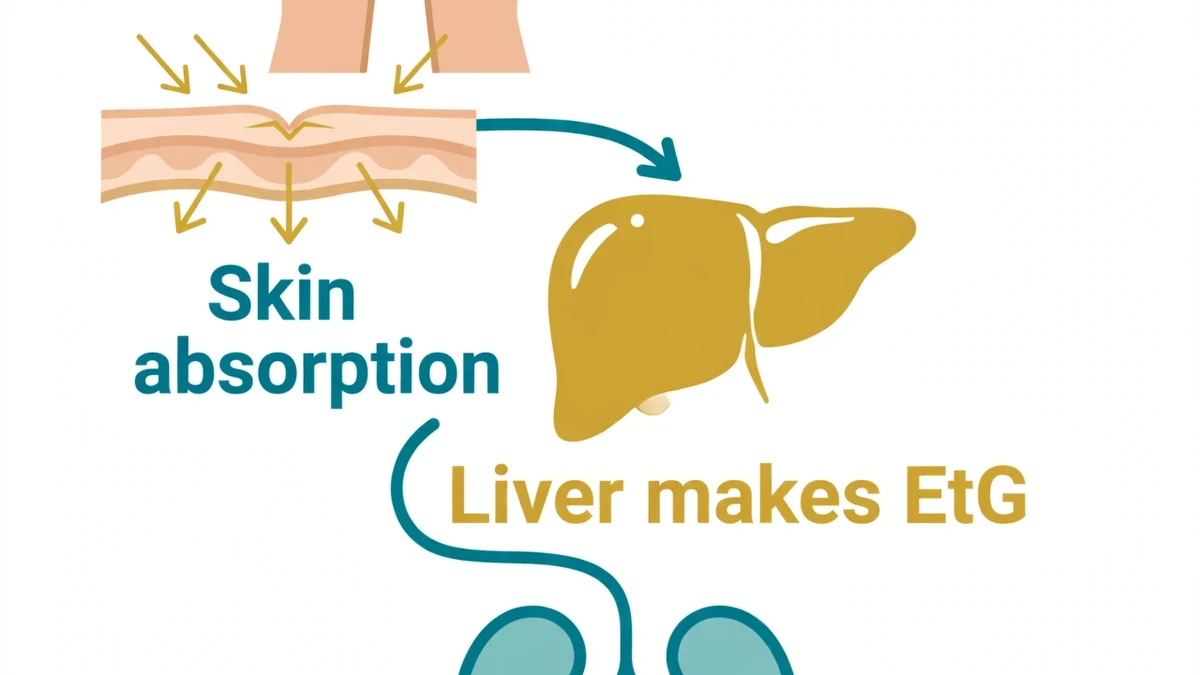
Most US hand sanitizers are ethanol-based — typically 60–95% ethanol, the same alcohol found in drinks, denatured so it cannot be consumed. When you rub it on your hands, a small amount of that ethanol enters your body through two routes:
- Inhalation of the vapor. This is the bigger contributor. As the sanitizer evaporates off your hands, you breathe the concentrated vapor — especially in small, poorly ventilated rooms. In one experiment, a bystander who never touched sanitizer tested positive from inhalation alone.
- Dermal absorption. Ethanol does pass through skin, but the amount is modest compared with what the lungs pick up. Studies that blocked inhalation (subjects sanitized inside an airflow chamber) found detectable EtG but no positive results.
Once in the bloodstream, the liver treats it like ethanol from a drink: most becomes acetaldehyde and then acetate, but a small fraction (well under 1%) is conjugated with glucuronic acid to form ethyl glucuronide (EtG). The kidneys then excrete EtG in urine — and that is the molecule the EtG test measures. This is why a hand-sanitizer positive is a true positive at the chemistry level: the EtG is real, even though no drinking happened.
One important exception: isopropanol-based sanitizers do not create real EtG. Isopropanol is metabolized to acetone, not ethyl glucuronide. But as we will see below, propanol-based products can still cause a false positive on the screening test through a different mechanism.
What the studies actually found
Researchers have tested this directly, often asking volunteers to use sanitizer at punishing frequencies. The pattern is consistent: frequency × duration × timing decides everything.
| Study | What volunteers did | Sanitizer | Highest urinary EtG | What it means |
|---|---|---|---|---|
| Reisfield et al., 2011 | 11 volunteers, sanitizer every 5 minutes for 10 hours, 3 days straight | 62% ethanol (Purell) | 2,001 ng/mL | Sustained heavy use can exceed even the 500 ng/mL cutoff |
| Arndt et al., 2012 | 7 lab staff, sanitizer every 15 minutes for 8 hours; plus passive vapor inhalation | Propanol-based (Sterillium) | 4,000 ng/mL immunoassay reading — zero true EtG | A false positive: confirmatory testing cleared every sample |
| Liepman (Michigan State experiment) | 15 hand washes in a small enclosed room | 62% ethanol | 350 ng/mL — in a bystander who only inhaled | Inhalation alone can cross the 100 ng/mL cutoff |
| Rosano & Lin, 2008 | 9 adults, 20 applications per day | Ethanol-based | Below 120 ng/mL (morning samples) | Normal occupational use stays low; no accumulation day to day |
| Salomone et al. | One teetotaler, 20 applications per day for 4 weeks | 62% ethanol gel | Above 500 ng/mL shortly after sustained use | Weeks of heavy daily use can accumulate past the high cutoff |
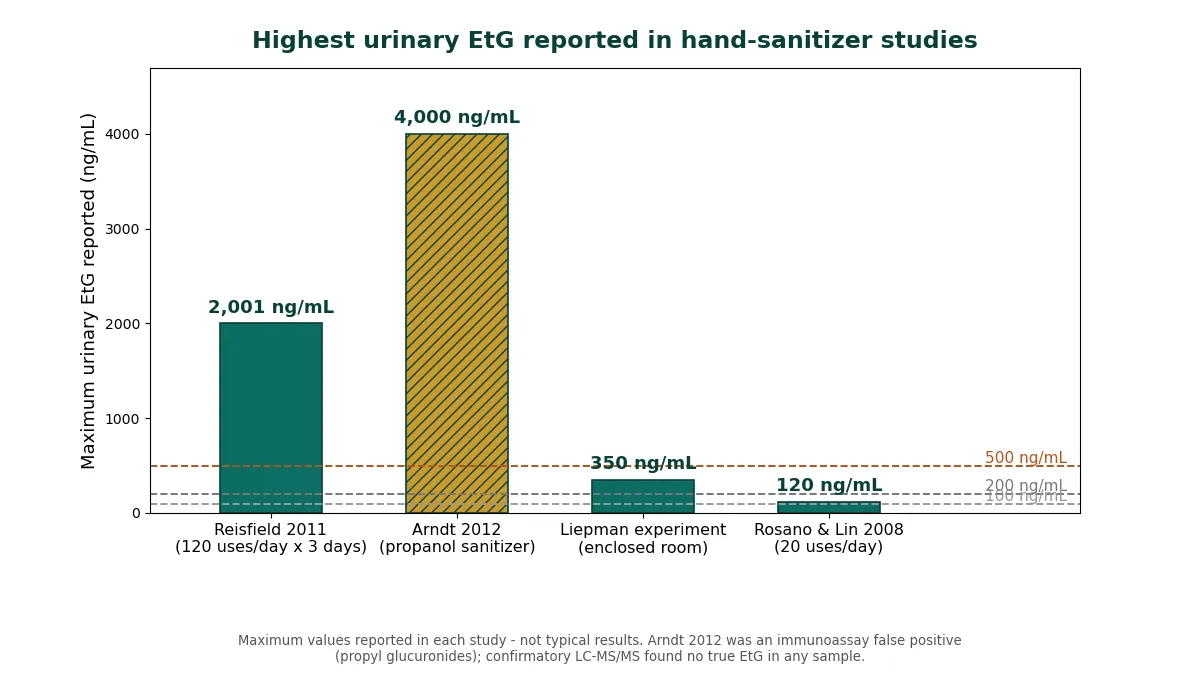
Two details from the Reisfield study shape the practical advice below. First, almost all positive specimens were collected at the end of the study days — right after the hours of use. Only two specimens showed detectable EtG at the start of a day (96 and 139 ng/mL), and morning-after values were dramatically lower. Sanitizer-derived EtG clears quickly; it does not linger the way drinking-derived EtG can. Second, the authors concluded that standard EtG cutoffs "do not distinguish between ethanol consumption and incidental exposures, particularly when urine specimens are obtained shortly after sustained use."
The cutoff you are tested at changes everything
An EtG result is only "positive" or "negative" relative to a cutoff — the same sample can fail at 100 ng/mL and pass at 500 ng/mL:
| Cutoff | Who typically uses it | Casual sanitizer use (a few pumps/day) | Heavy sustained use |
|---|---|---|---|
| 100 ng/mL | Forensic, probation, and monitoring programs that want maximum sensitivity | Possible low-level detection; studies show values approaching or crossing this line with repeated use | Likely positive — studies show 350–2,001 ng/mL |
| 200 ng/mL | Some clinical and workplace programs | Very unlikely to cross | Possible with extreme use |
| 500 ng/mL | SAMHSA-aligned clinical and workplace programs; designed to screen out incidental exposure | Effectively cannot cross — all moderate-use studies stayed far below | Possible only with the most extreme sustained use |
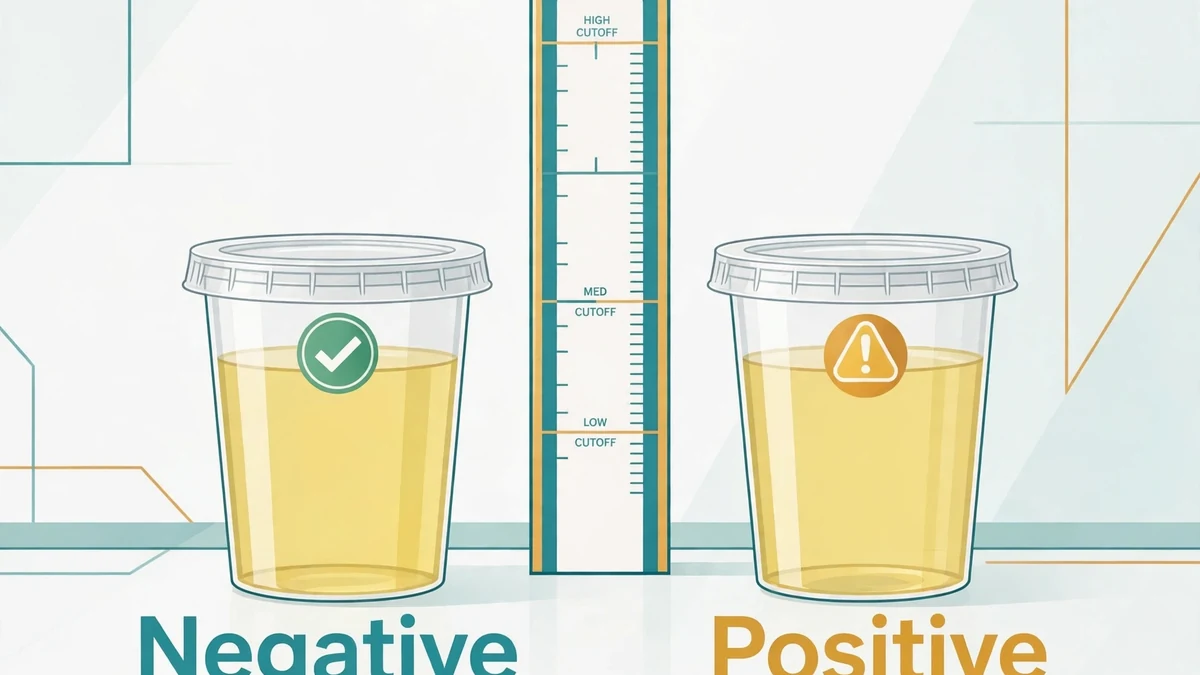
If you are unsure which cutoff applies, ask the program directly — it is the single most important variable here. Our 100 vs 500 ng/mL cutoff guide explains which programs tend to use which, and why SAMHSA's guidance favors the higher cutoff for exactly this kind of incidental-exposure concern.
The false-positive twist: propanol-based sanitizers
Everything above assumed an ethanol-based sanitizer producing genuine EtG. There is a second, stranger mechanism — and it produces positives with no EtG at all.
In 2012, Arndt and colleagues investigated lab staff who kept failing EtG screens despite not drinking. The culprit was a propanol-based hand sanitizer. The body converts propanol into propyl glucuronides, which are chemically similar enough to ethyl glucuronide that the DRI enzyme immunoassay cross-reacts with them at about 10%. The result: screening readings as high as 4 mg/L (4,000 ng/mL) — while confirmatory LC-MS/MS testing found no EtG whatsoever in any sample. Even staff who only inhaled the vapor passively produced false positives up to 890 ng/mL.
These products are common in hospitals, laboratories, and food processing. Three things distinguish this scenario:
- The screening test is positive but LC-MS/MS confirmation is negative — confirmation is the tiebreaker.
- EtS (ethyl sulfate), the companion biomarker, is absent or very low — EtS forms only from ethanol, never from propanol.
- The product label tells the story: if the active ingredient is n-propanol or isopropanol rather than ethanol/ethyl alcohol, suspect this mechanism.
Bottom line: with propanol-based products, a positive screen is more likely a testing artifact than evidence of drinking — but only a confirmatory test can prove it.
Three real-world scenarios
Scenario 1: The night-shift nurse
A nurse in a hospital monitoring program sanitizes 40 or more times per 12-hour shift and faces a random test at 7 a.m. under a 100 ng/mL cutoff. This is the highest-risk everyday pattern in the literature: the Reisfield and Salomone studies both show that this intensity of use, sampled at end of shift, can cross 100 ng/mL and occasionally approach or exceed 500 ng/mL. Timing helps most — EtG drops sharply overnight, so a first-morning sample is far safer than an end-of-shift one — plus disclosing the exposure in advance.

Scenario 2: The office worker
An office worker uses sanitizer 4–5 times a day and takes a pre-employment screen at the 500 ng/mL cutoff. The risk here is negligible: even 20 applications a day kept morning EtG below 120 ng/mL in studies — less than a quarter of the cutoff. No action needed beyond normal hygiene.
Scenario 3: The lab technician with propanol sanitizer
A lab tech whose facility uses a propanol-based sanitizer screens positive at 1,800 ng/mL despite complete abstinence. Because the product contains no ethanol, confirmatory LC-MS/MS comes back negative and the result is overturned. The lesson: always ask for confirmation before a screening result turns into a consequence — and keep the sanitizer's ingredient label.
To compare incidental exposure against actual drinking, run the numbers through our EtG detection window calculator and the one-drink scenario guide.
If you are being tested: a practical checklist
- Find out your cutoff. Ask the program whether it uses 100, 200, or 500 ng/mL and whether LC-MS/MS confirmation is automatic. This one fact reframes the entire risk.
- Disclose occupational sanitizer use in advance — ideally in writing, before any test. Programs deal with healthcare workers constantly; prior disclosure carries far more weight than an explanation offered after a positive.
- On test days, switch products. Use plain soap and water or a non-alcohol sanitizer (benzalkonium chloride-based) instead of your usual ethanol or propanol product.
- Do not sanitize in the hour before your sample, and ventilate the space if you have been using sanitizer heavily.
- If you screen positive and have not been drinking, request LC-MS/MS confirmation before any decision is made. This is the step that separates real EtG from propanol false positives.
- Keep the product label. Whether the active ingredient is ethanol, isopropanol, or n-propanol determines which mechanism — and which explanation — applies.
No checklist can give a guaranteed personal prediction: studies report group-level ranges, and metabolism, ventilation, and timing shift the numbers. Treat published ranges as honest estimates, not promises — the standard behind our EtG calculation methodology.
Frequently asked questions
Can one pump of hand sanitizer fail an EtG test?+
No. A single application delivers a trivial ethanol dose, and studies of moderate daily use found urinary EtG below 120 ng/mL. Research positives came from dozens of applications per day over many hours — not normal hand hygiene.
How long after using hand sanitizer will EtG show in urine?+
Sanitizer-derived EtG peaks within hours of heavy use and clears quickly. In the Reisfield study, nearly all positive specimens were collected at the end of the use period; by the next morning only trace levels (96–139 ng/mL) remained in two specimens. It does not linger for days the way drinking-derived EtG can.
Does Purell specifically cause positive EtG tests?+
Purell is 62% ethanol, and the Reisfield study used Purell specifically — with extreme use (every 5 minutes for 10 hours) it produced up to 2,001 ng/mL. The brand is not special: any 60%+ ethanol sanitizer behaves the same, and normal use is very unlikely to cause a positive at standard cutoffs.
Will a confirmatory test clear a sanitizer-related positive?+
It depends on the mechanism. If the EtG is genuine (heavy ethanol-sanitizer use), LC-MS/MS confirmation will also detect it — the EtG is real. If the screen was fooled by a propanol-based sanitizer, confirmation will come back negative. Either way, confirmation is the test you want.
Should I stop using hand sanitizer before an EtG test?+
You do not need to stop entirely. On test day, switch to soap and water or a non-alcohol sanitizer, and avoid sanitizing in the hour before your sample. Good ventilation after heavy use also helps, since inhalation is the main exposure route.
Can I dispute a positive EtG result I believe came from sanitizer?+
You can present the evidence: documented occupational exposure, the product's ingredient label, and a request for LC-MS/MS confirmation (plus EtS analysis, which stays absent in propanol cases). Many programs have formal review processes for exactly this situation. This is educational information, not legal advice.
Evidence and limitations
This article summarizes primary research on incidental ethanol exposure and EtG testing. Group-level findings cannot predict one person’s result.
- Reisfield GM, et al. (2011) — ethyl glucuronide, ethyl sulfate, and ethanol in urine after sustained exposure to an ethanol-based hand sanitizer (Journal of Analytical Toxicology)
- Arndt T, et al. (2012) — false-positive ethyl glucuronide immunoassay screening caused by a propyl alcohol-based hand sanitizer (Forensic Science International)
- Salomone A, et al. — ethyl glucuronide and ethyl sulfate concentrations following use of ethanol-containing hand sanitizer
- Liepman MR (Michigan State University) — sanitizer inhalation experiment; a bystander tested positive at 350 ng/mL via inhalation alone
- Rosano & Lin (2008) — ethanol hand sanitizers used 20×/day; urinary EtG below 120 ng/mL in morning specimens with no day-to-day accumulation (Journal of Analytical Toxicology)
- Ahmed-Lecheheb D, et al. (2016) — ethanol and ethyl glucuronide urine concentrations after ethanol-based hand antisepsis (American Journal of Infection Control)
- SAMHSA Advisory: The Role of Biomarkers in the Treatment of Alcohol Use Disorders (2006, revised 2012)