EtG vs PEth test: the short answer
EtG (ethyl glucuronide) and PEth (phosphatidylethanol) are both direct alcohol biomarkers — molecules the body only makes when ethanol is present. That shared property is where the similarity ends. They live in different samples, form by different chemistry, and cover very different stretches of time.
EtG is measured in urine. After drinking, the liver converts a small fraction of ethanol into EtG, which the kidneys clear into urine. It becomes detectable within hours of drinking and, after heavier drinking, can remain detectable for up to about 80 hours. PEth is measured in blood. It forms in red blood cell membranes when ethanol is present and clears slowly, with a half-life of roughly 4 to 10 days. That slow clearance is what stretches its window to about 2 to 4 weeks.
The practical consequence is simple. If the question is whether someone drank this weekend, EtG is the right test. If the question is whether someone has been drinking across the past month — the question a probation officer, a family court, or a treatment program usually asks — PEth is the right test.
| EtG test | PEth test | |
|---|---|---|
| Sample | Urine | Whole blood (venous draw or dried blood spot) |
| What it measures | Ethyl glucuronide, a urine metabolite of ethanol | Phosphatidylethanol, a phospholipid formed in red blood cells |
| Detection window | Hours to about 80 hours after drinking | About 2 to 4 weeks after drinking |
| Typical cutoff | 100, 200, or 500 ng/mL (program-dependent) | 20 ng/mL (moderate-to-heavy consumption marker) |
| Best question | Did you drink recently? | Have you been drinking over the past month? |
| Main weakness | Incidental exposure and dilution complicate low cutoffs | Cannot pinpoint the day of drinking; misses very light use |
What each test actually measures
EtG forms when ethanol passes through the liver. Enzymes attach a glucuronide group to a small share of the alcohol — under 0.1% of the dose — and the resulting molecule is water-soluble, so it leaves in urine. Because EtG itself is not alcohol, it outlasts breath and blood alcohol by days. But it is still a short-lived metabolite: its own half-life is only about 2 to 3 hours, which is why the detection window is measured in days, not weeks.
PEth forms differently. When ethanol is in the blood, the enzyme phospholipase D swaps part of a membrane phospholipid for ethanol, creating phosphatidylethanol inside red blood cells. The dominant form measured by labs is PEth 16:0/18:1. Because PEth sits in cell membranes rather than floating free in plasma, it degrades slowly as red blood cells turn over. Its half-life of roughly 4 to 10 days means that after a single heavy episode, PEth can still be measurable two weeks later, and after repeated heavy drinking it can take three to four weeks to fall below a 20 ng/mL cutoff.
That chemistry explains the two tests' different personalities. EtG rises and falls fast, so it tracks recent drinking closely. PEth accumulates with repeated drinking and clears slowly, so it reflects a pattern better than any single episode. It also explains why PEth cannot time a drink: a PEth level of 60 ng/mL tells you drinking happened sometime in the last few weeks, not which day.
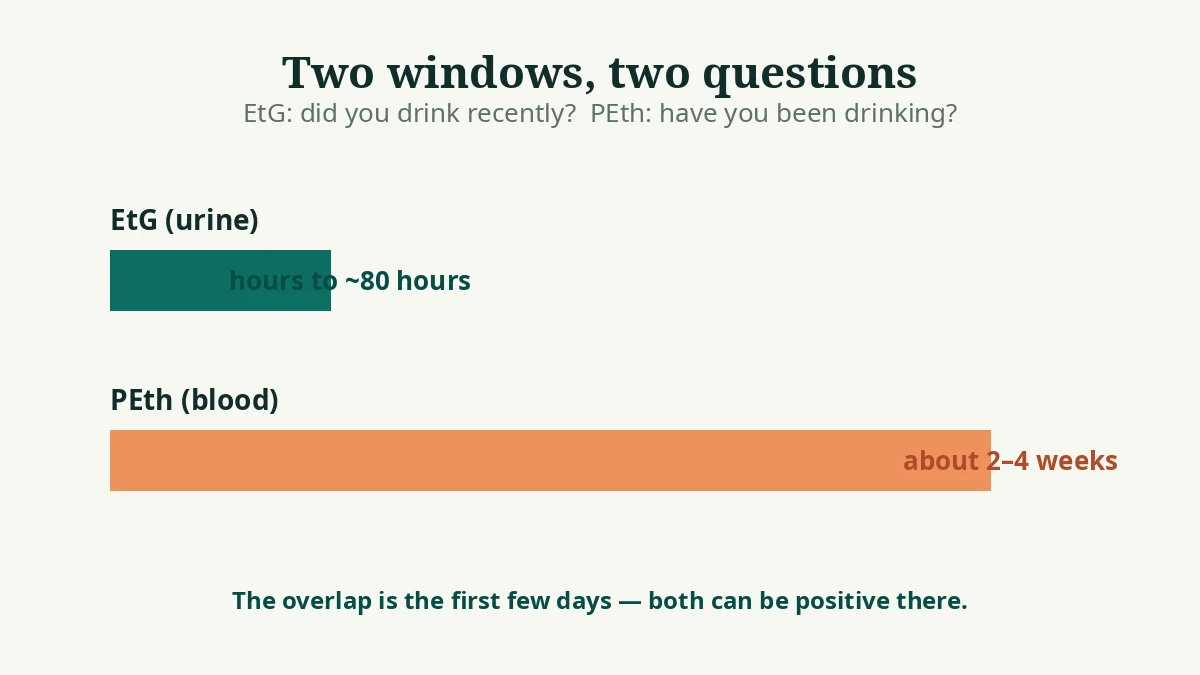
Detection windows compared, by drinking pattern
Neither window is a fixed number. Both stretch with dose and frequency, and both shrink with time. The table below gives honest ranges, not promises: individual results vary with body size, drinking pace, liver function, and the cutoff in use.
| Drinking pattern | EtG (urine) window | PEth (blood) window |
|---|---|---|
| 1–2 drinks, one occasion | Roughly 12–24 hours at 500 ng/mL; up to about 30 hours at 100 ng/mL | Often below the 20 ng/mL cutoff; if detectable, days, not weeks |
| 3–4 drinks, one evening | Roughly 24–48 hours depending on cutoff | Measurable for about 1–2 weeks |
| Heavy evening (8+ drinks) | Up to about 60–80 hours | About 2–3 weeks |
| Repeated heavy drinking over weeks | Still about 80 hours after the last drink — the window does not keep growing | About 3–4 weeks, sometimes longer, because PEth accumulates |
The last row is the key difference. EtG's window has a ceiling: once several days have passed since the last drink, EtG is gone, no matter how much someone drank over the past month. PEth has no such ceiling in practice, because each new episode tops the level up before the old PEth has cleared. That is why a program verifying a month of abstinence cannot rely on EtG alone.
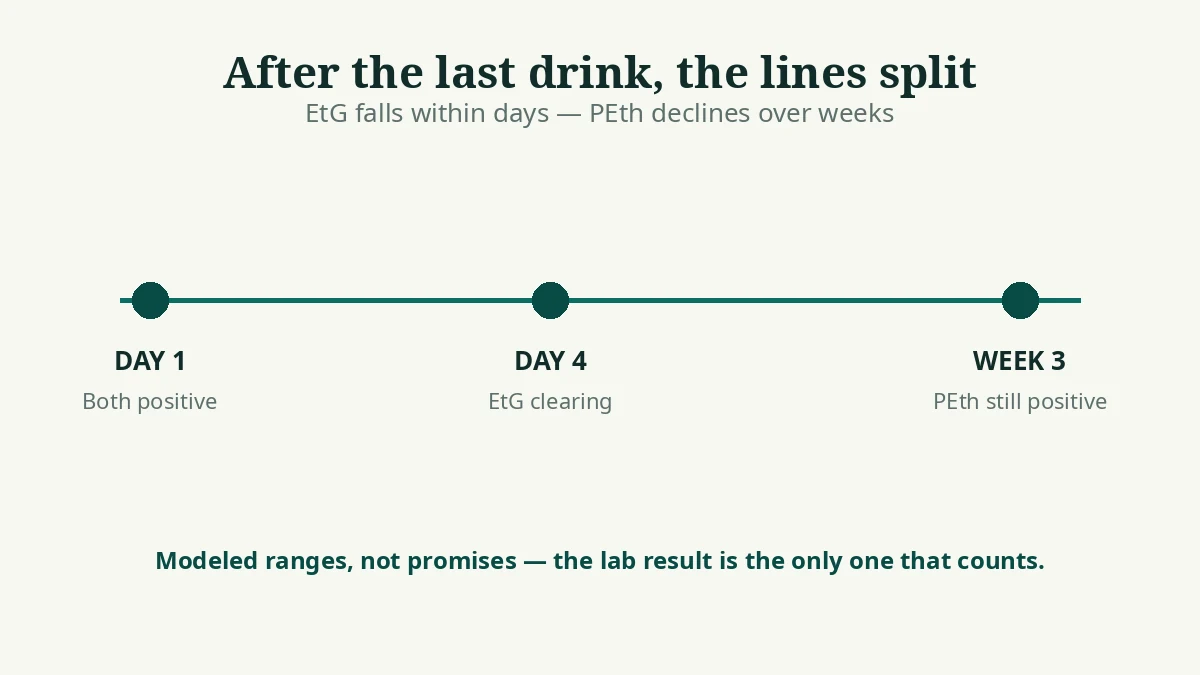
Cutoffs: what the numbers actually mean
EtG cutoffs are program choices, not biological facts. At 100 ng/mL, a test is sensitive: it catches light and recent drinking, but it is also the cutoff where incidental exposure — mouthwash, hand sanitizer, certain foods — is most likely to matter. At 500 ng/mL, the test is more specific to real drinking, but light drinking from a day or two earlier may slip under it. The 200 ng/mL cutoff sits between the two. The same urine sample can therefore be positive at one program and negative at another, with no contradiction involved.
PEth interpretation is more standardized, though labs still differ in detail. A widely used reference frame, published by Ulwelling and Smith and used by major reference labs, reads: below 20 ng/mL is consistent with abstinence or light consumption; 20 to 200 ng/mL suggests moderate consumption; above 200 ng/mL suggests heavy or chronic consumption. The limit of quantification at many labs is 10 ng/mL, so values between 10 and 20 ng/mL are measurable but below the usual decision threshold. Research cutoffs as low as 2 to 8 ng/mL exist for specialized settings such as prenatal screening, where even small amounts of alcohol matter — but 20 ng/mL remains the standard starting point for monitoring and legal use.
One caution applies to both tests: a number is not a drink count. A PEth of 150 ng/mL does not translate into a drink count, and an EtG of 800 ng/mL does not prove a binge. Both are best read as ranges with confirmation, not precise measurements.
Accuracy and blind spots
EtG's best-known blind spot is incidental exposure. Because EtG screening is done by immunoassay, and because ethanol from mouthwash, hand sanitizer, or fermented foods can genuinely produce small amounts of EtG, a low-cutoff positive deserves confirmation by liquid chromatography–tandem mass spectrometry (LC-MS/MS), which also measures EtS (ethyl sulfate) and can distinguish real drinking patterns from incidental exposure. Dilution is the other classic problem: drinking large volumes of water lowers EtG concentration in urine, though the EtG-to-creatinine ratio is far less affected, which is why labs check creatinine alongside EtG.
PEth's blind spots run the other way. Incidental exposure does not produce PEth at meaningful levels — PEth requires ethanol circulating in blood at real drinking concentrations, so mouthwash and sanitizer are not a PEth problem. But PEth cannot distinguish abstinence from very light drinking, and it cannot date an episode. It is also slower in practice: results take longer than a urine screen, and a blood draw is more involved than a urine cup. And a "negative" PEth means "no moderate or heavy drinking in the last few weeks," not "no alcohol at all."
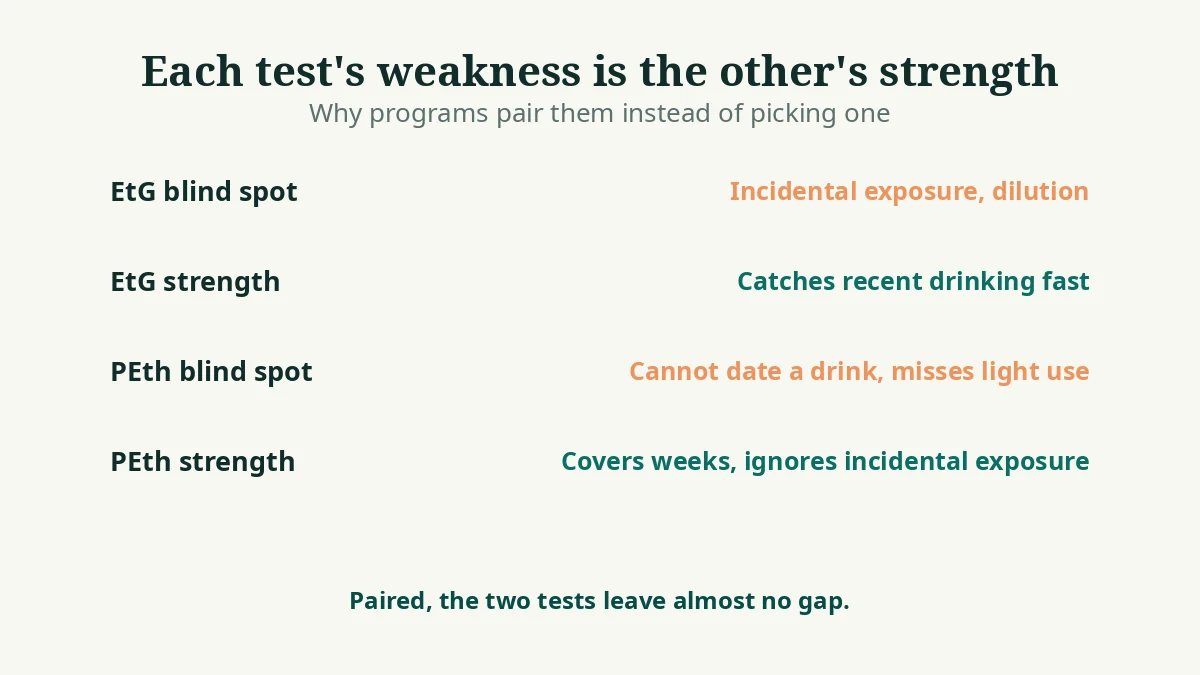
Real-world scenarios: when the two tests disagree
Scenario 1 — the monthly check. A person on probation drinks heavily at a wedding on a Saturday, then has a urine EtG test the following Friday and a PEth blood test the same week. The EtG comes back negative: six days is past the window even for heavy drinking. The PEth comes back at 90 ng/mL: moderate consumption in the last few weeks. Neither result is wrong. The EtG correctly reports no drinking in the last few days; the PEth correctly reports drinking in the last month. A program that only ran EtG would have missed the wedding entirely.
Scenario 2 — the Monday-morning test. The same wedding, but the EtG test falls on Monday morning, about 36 hours after the last drink. At a 500 ng/mL cutoff the result is borderline; at 100 ng/mL it is clearly positive. The PEth test taken the same day is also positive, but it will still be positive three weeks later, long after the EtG has cleared. If the question is "did they drink this weekend," Monday's EtG answers it fastest. If the question is "are they staying abstinent this month," only the PEth series answers it.
Scenario 3 — the return-to-duty case. An employee returning to a safety-sensitive job after treatment faces random urine EtG tests plus a PEth test every month. The random EtG tests catch any slip within days; the monthly PEth catches a pattern of drinking between the random tests. This pairing is common precisely because each test covers the other's gap: EtG is the tripwire, PEth is the audit.
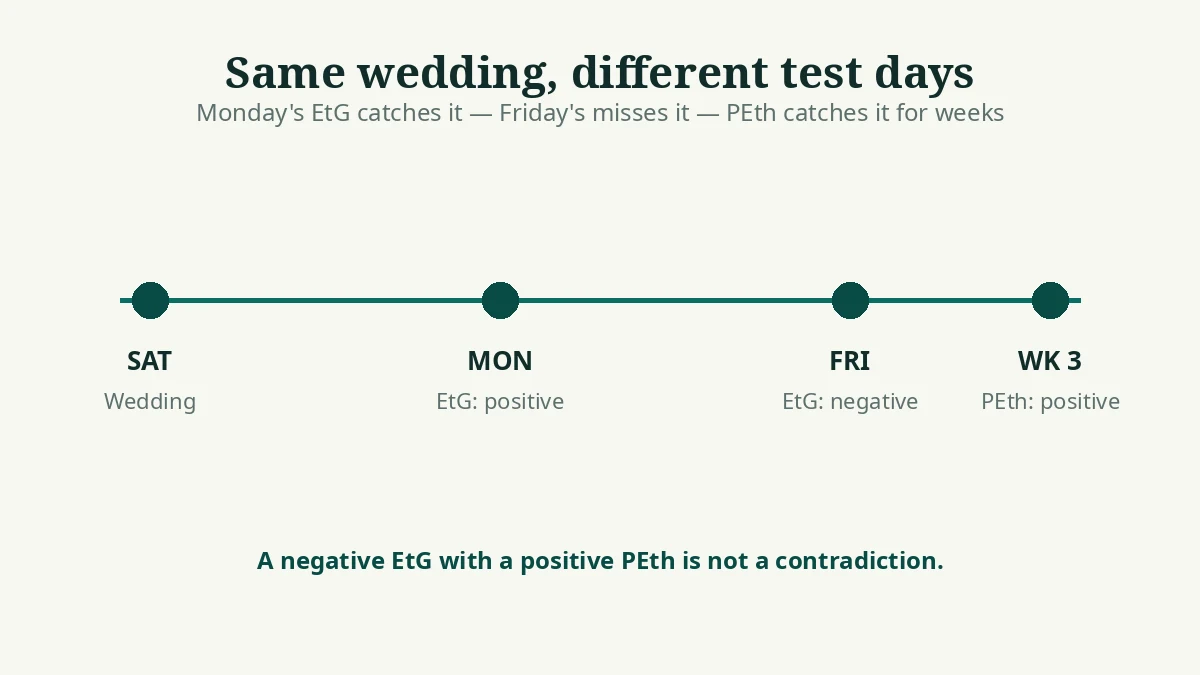
Which test fits which question
Choose EtG when the question is recent and specific: did this person drink in the last day or two, before a shift, a visit, or a hearing? EtG is fast, inexpensive, non-invasive, and well suited to frequent random testing. Its short window is a feature here, not a flaw — a positive EtG means recent drinking, which is often exactly what a program needs to know.
Choose PEth when the question spans weeks: is this person maintaining abstinence, is a treatment plan working, or did drinking occur at some point during the last month? PEth is the better tool for family court, long-term monitoring, and any setting where a single clean urine test should not settle the matter. Its cost and blood draw are the trade-off for a window no urine test can match.
Use both when the stakes are high and the gaps matter. A program that tests EtG weekly and PEth monthly gets the tripwire and the audit together, and the combination is harder to game than either test alone: passing a urine test by waiting a few days does not clear a PEth, and a PEth cannot be explained away as mouthwash the way a low-cutoff EtG sometimes can be.
For personal planning, the same logic applies in reverse. If you are estimating your own EtG window, use our EtG calculator with your real drink count and cutoff, and read the result as a modeled range, not a prediction. There is no equivalent public calculator for PEth, because PEth depends on weeks of drinking history rather than a single episode.
Frequently asked questions
Which test detects alcohol longer, EtG or PEth?+
PEth, by a wide margin. A urine EtG test detects drinking for up to about 80 hours after heavy drinking. A blood PEth test detects drinking for about 2 to 4 weeks, because PEth clears slowly from red blood cells with a half-life of roughly 4 to 10 days.
Can a PEth test detect one drink?+
Usually not at the standard 20 ng/mL cutoff. A single drink or two typically produces PEth below 20 ng/mL, so a one-time light drink is often missed by PEth. PEth is designed to detect moderate or heavy drinking over weeks, not isolated light drinking. EtG is the more sensitive test for a single recent drink.
Does a PEth test show exactly when you drank?+
No. PEth can show that drinking happened sometime in the last few weeks and roughly how heavy it was, but it cannot pinpoint the day. A PEth level of 60 ng/mL could reflect drinking last week or three weeks ago. EtG is better for timing, because its short window narrows drinking to the last few days.
Can mouthwash or hand sanitizer cause a positive PEth test?+
No, not at meaningful levels. PEth only forms when ethanol circulates in the blood at real drinking concentrations. Incidental exposure from mouthwash or hand sanitizer is a known complication for low-cutoff EtG tests, but it is not a PEth problem. That difference is one reason programs pair the two tests.
Why would a program use both EtG and PEth tests?+
Because each covers the other's gap. Frequent urine EtG tests catch recent drinking within days, while periodic blood PEth tests verify the longer pattern across weeks. Together they make it much harder to pass by simply waiting a few days after drinking, and a PEth result cannot be explained away as incidental exposure the way a low-cutoff EtG sometimes can be.
Can an EtG test be negative while a PEth test is positive?+
Yes, and it is not a contradiction. If the drinking happened more than a few days before testing, EtG will have cleared while PEth is still measurable for weeks. A negative EtG with a positive PEth usually means the drinking was real but not recent. The reverse — positive EtG with negative PEth — usually means very recent light drinking that has not built up a PEth signal.
Evidence and limitations
This article summarizes published research on ethyl glucuronide and phosphatidylethanol detection windows, cutoffs, and confirmation testing. Group-level findings cannot predict one person’s result, and this article is educational only — it is not medical or legal advice.
- SAMHSA Advisory: The Role of Biomarkers in the Treatment of Alcohol Use Disorders (2006, revised 2012)
- American Academy of Family Physicians (2023) — Phosphatidylethanol Test for Identifying Harmful Alcohol Consumption: PEth detectable up to four weeks; 20 ng/mL threshold for moderate-to-heavy consumption; cannot distinguish abstinence from light drinking
- Labcorp PEth test information: detectable approximately 2 to 3 weeks after prolonged or binge drinking; levels above 20 ng/mL evidence of moderate-to-heavy consumption
- Wurst et al. (2009) — Preliminary evaluation of PEth in liver disease and hypertension patients (Alcohol Alcohol 44(5)): PEth in red blood cells, detection window about 1–3 weeks, positive at 20 ng/mL or higher
- Dahl et al. (2002) — EtG detectable 22.5–31.5 h after ~0.5 g/kg ethanol, EtG/creatinine ratio unaffected by water diuresis, half-life ~2.5 h
- McDonell et al. (2015) — EtG immunoassay cutoff sensitivity in alcohol-dependent outpatients (1,589 samples)
- Jatlow et al. — EtG/EtS as markers of recent alcohol use, cutoff and confirmation context