Why recovery programs test for EtG at all
Alcohol is the hardest substance to monitor with a drug test. Breath tests only catch drinking from the past 10 to 12 hours, and blood tests go little further — so a participant can drink on Saturday, test clean on a Monday breath test, and nobody learns anything. Ethyl glucuronide (EtG), a minor metabolite of ethanol excreted in urine for up to around 80 hours after heavier drinking, closes most of that gap. That is why EtG is now the standard alcohol biomarker in addiction treatment, sober living, and professional monitoring programs.
But the purpose shapes everything else. ASAM's guidance on drug testing in clinical addiction medicine draws a sharp line between testing as a therapeutic tool and testing as a punishment device. Testing at intake helps a program assess a person honestly and place them at the right level of care. Testing during treatment gives an objective check on self-report — useful because people in early recovery are not always able to report accurately, as shame, fear, and denial are part of the condition being treated. Testing over time turns abstinence into something visible: a run of negative results is evidence of progress for participant and clinician alike.
That framing changes policy. A program that treats testing as therapy explains it to participants, tells them what a positive result will and will not trigger, and uses results alongside counseling attendance and self-report. A program that treats testing as surveillance risks the "us versus them" dynamic ASAM warns about — and undermines the treatment it is supposed to protect.
How a program chooses its cutoff
An EtG test does not return a simple yes or no. It returns a concentration in nanograms per milliliter (ng/mL), and the program's cutoff decides which concentrations count as positive. Set it too low and incidental exposure or a single light drink triggers alarms; too high and meaningful drinking slips through. The Substance Abuse and Mental Health Services Administration (SAMHSA) advisory on alcohol biomarkers frames the choice well: the cutoff should follow the purpose of the testing, the consequences of a positive result, and how much certainty the program needs before acting.
In practice, three levels dominate, and each corresponds to a different job:
| Cutoff | Typical setting | What it is designed to catch | Its weakness |
|---|---|---|---|
| 100 ng/mL | Abstinence monitoring, zero-tolerance programs, professional health programs | Even light or single-episode drinking | Most sensitive to incidental exposure; demands confirmation and careful review |
| 200 ng/mL | Outpatient and residential treatment programs | Recent drinking beyond a trivial amount | May miss a single drink; still needs a dilution check |
| 500 ng/mL | General screening, workplace-style programs | Clearer, heavier drinking episodes | Misses light and moderate drinking; a negative result is not proof of abstinence |
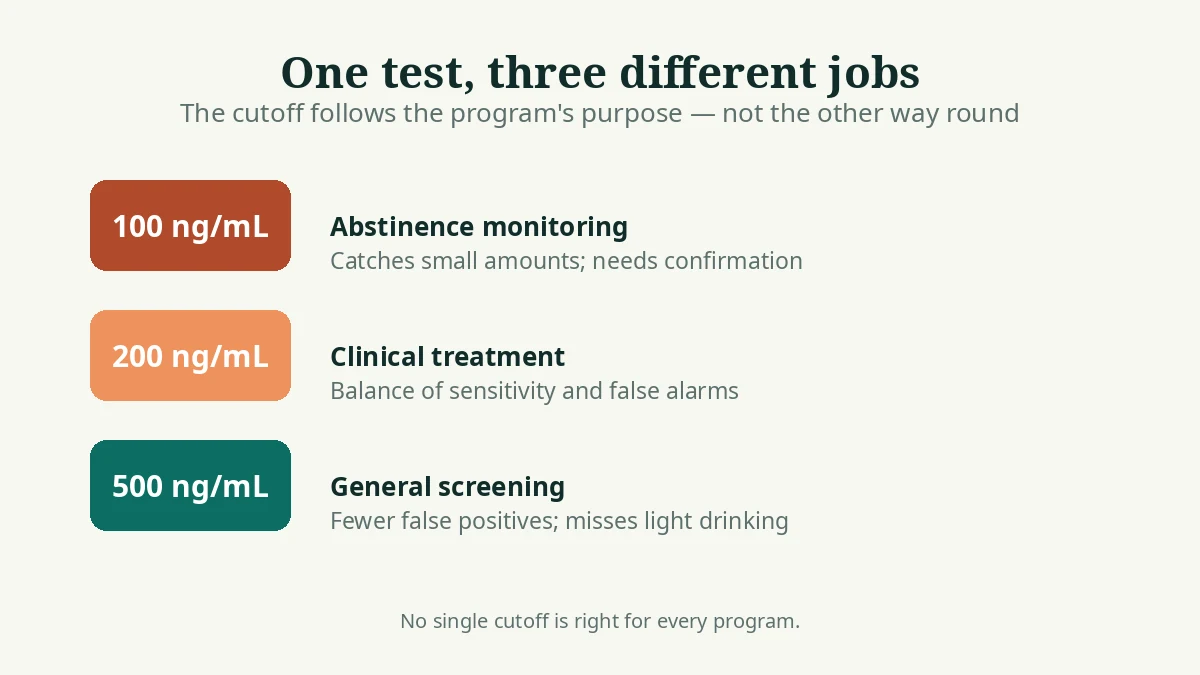
Notice what this table does not claim. No national body publishes a mandatory EtG cutoff for recovery programs, and most individual programs do not publish theirs. The levels above are the ones programs commonly use and researchers commonly discuss — not a rulebook. What matters is whether a program can explain its choice, what it does about a result near the line, and whether it confirms positives before acting. For a detailed comparison of the two most common levels, see our 100 vs 500 ng/mL cutoff guide.
One more distinction matters. Some monitoring programs, notably physician health programs in ASAM's guidance, use a "level of detection" approach rather than a fixed cutoff: the laboratory reports any detectable EtG, and a toxicologist interprets it. That maximizes sensitivity but puts enormous weight on human interpretation — incidental exposure, dilute samples, and laboratory variation all have to be weighed by a person, not a threshold.
When programs test: schedules that fit the stage of recovery
Cutoff is only half the design. The other half is timing. EtG clears within days, so a program that tests once a month can miss most drinking entirely; a program that tests every day burns money and goodwill. Programs therefore vary frequency with risk, and taper it as abstinence holds.
Testing starts at intake, establishing a baseline. In the early months it is random and frequent — participants may call in daily to learn whether that day is a test day, a pattern ASAM documents in physician health programs, where weekly random testing for the first 6 to 12 months is typical before tapering to once or twice a month. In general outpatient care the rhythm is less intense but the principle is the same: random beats scheduled, because a test you can plan around is a test you can drink around. A missed, late, or dilute test usually steps the frequency back up.
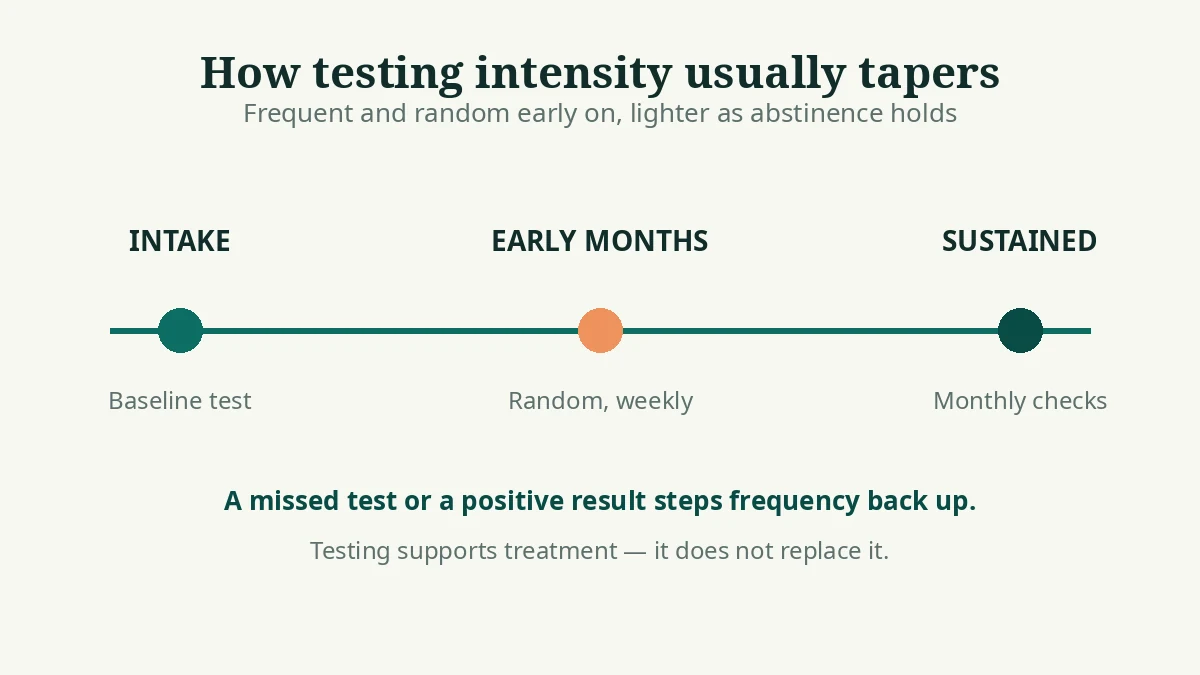
Randomness has a cost: it is stressful to live under a schedule you cannot predict. The better programs say plainly why it is necessary — random testing is what makes a negative result meaningful. If everyone knew test days in advance, the results would prove nothing.
What happens after a positive result
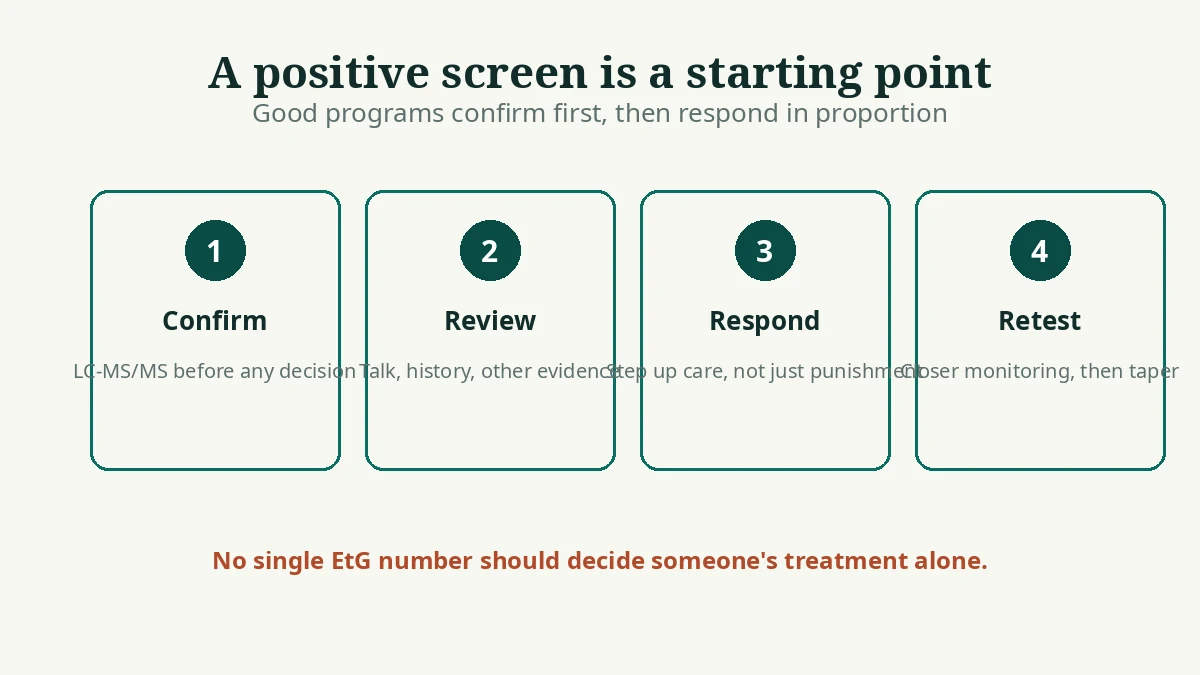
This is where good programs and bad programs separate most clearly, and it is the section participants most need to read before they ever test positive. A positive EtG screen should trigger a process, not a punishment.
First, confirmation. EtG screening is usually done by immunoassay, a fast antibody-based method that can cross-react with other substances. ASAM's guidance is unambiguous: all positive screening results must be confirmed before they are reported or acted on, and for alcohol that means LC-MS/MS confirmation — a laboratory method that identifies EtG by its molecular signature and reports a precise quantity. A program that discharges, sanctions, or reports someone on an unconfirmed screen is skipping the step that exists to protect them. If your program cannot tell you whether it confirms positives, ask. The answer matters more than the cutoff.
Second, clinical review. A confirmed positive still needs interpretation: how much EtG was found, was the sample dilute, is there a credible incidental-exposure explanation — heavy mouthwash use (see our mouthwash guide) or occupational hand-sanitizer exposure (see our hand-sanitizer guide)? A low-level positive after months of clean tests means something different from a high-level positive in week two, and a competent clinician treats them differently.
Third, a graduated response. ASAM describes the model as adjusting treatment and continuing care in proportion to the relapse: intensify counseling, increase testing frequency, add support-group requirements, revisit the treatment plan. Discharge or expulsion is the far end of that scale, reserved for repeated or serious relapse — not the automatic first step. Programs that treat every positive identically are not being rigorous; they are refusing to do the clinical work that testing is supposed to inform. The same principle applies in probation testing, where a positive result should also trigger review before consequences, though the legal stakes there are higher and the process is less forgiving.
Real-world scenario: a slip before a Monday test
Consider someone three months into an outpatient program, testing at a 200 ng/mL cutoff with random weekly tests. On Saturday night, after a stressful week, they have two drinks at a family gathering — then stop, attend their Sunday support group, and show up for a random test on Monday morning, about 36 hours after the last drink.
What does the test show? Two standard drinks produce a modest EtG peak, and 36 hours of clearance brings it down substantially — but "substantially" is a range, not a number, and body size, metabolism, hydration, and exact timing all shift it. At 200 ng/mL this sample sits near the borderline and could fall either side. At 100 ng/mL it is more likely positive; at 500 ng/mL it would very likely read negative, telling that program nothing about Saturday night.
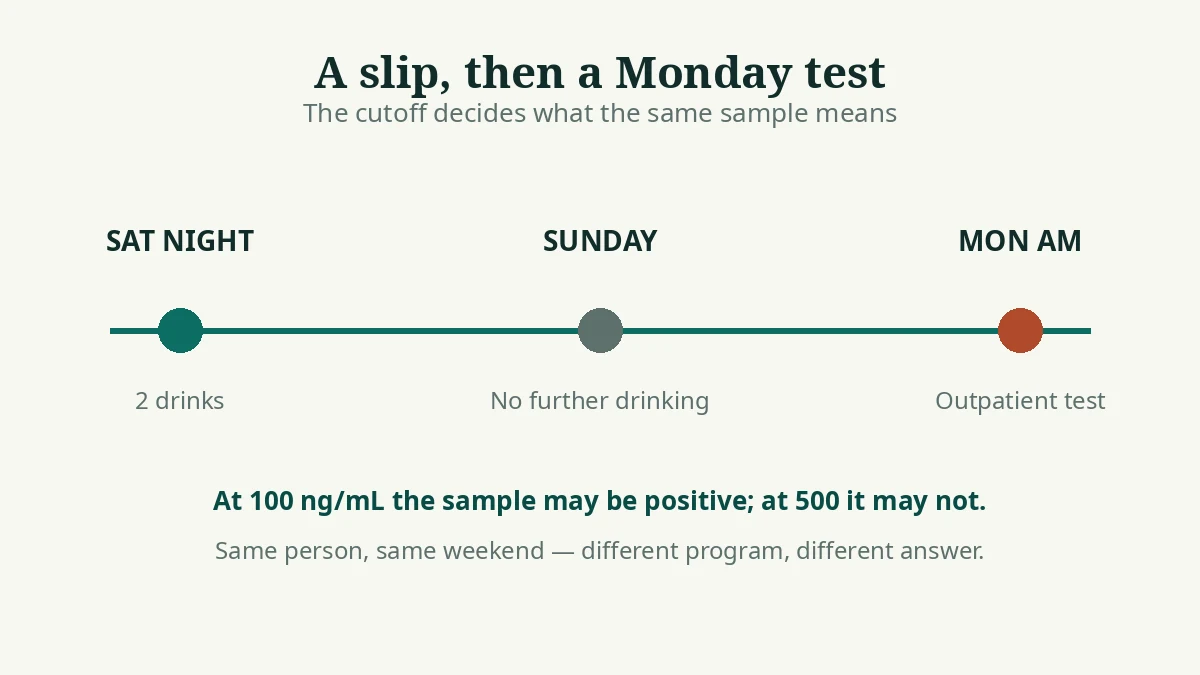
The scenario shows why the program's response matters more than the result. In a good program, a confirmed low-level positive after three clean months becomes a clinical conversation: what happened Saturday, what support was missing, what changes now. Testing steps up for a while, counseling intensifies, and the participant keeps their place. In a program with automatic sanctions, the same result becomes a discharge — and a person honest enough to show up for the test loses the treatment that was working. Our EtG calculator models how timing, drinks, and cutoff interact as an honest range, and our calculation methodology page shows how those ranges are built.
Incidental exposure: the fairness test every program must pass
EtG is sensitive enough that alcohol you never drank can raise it. Alcohol-based mouthwash, hand sanitizer used repeatedly through a work shift, and certain foods and medicines have all been studied as sources of low-level EtG. SAMHSA's advisory discusses this directly: programs need a process for handling incidental-exposure claims rather than dismissing them out of hand.
How a program handles this is a fairness test. Credible approaches: a cutoff high enough that ordinary incidental exposure rarely crosses it, LC-MS/MS confirmation of every positive, creatinine and specific-gravity checks so abnormal samples are flagged rather than misread, and a chance for the participant to explain before any consequence. Programs combining a 100 ng/mL cutoff with unconfirmed screens and automatic sanctions fail that test — everyday products can end a person's treatment there. Heavy use of alcohol mouthwash or sanitizer before a test is an avoidable risk; our guides to mouthwash and hand sanitizer give the numbers.
What EtG testing cannot do
Finally, the limits, because a tool oversold becomes a tool misused. EtG testing cannot prove long-term sobriety — it looks back days, not months. It cannot measure how much someone drank with precision; back-calculating drinks from an EtG number is unreliable. It cannot distinguish a single drink from incidental exposure at low levels without careful interpretation. And it cannot, on its own, diagnose a substance use disorder — ASAM is clear that results must be combined with patient history, psychosocial assessment, and physical examination.
Used within those limits, EtG testing is one of the best tools recovery programs have: an objective, reasonably long-window check on recent drinking that, handled fairly, reinforces abstinence and catches relapse early. Used beyond them — as a sole determinant, an automatic sanction trigger, or a precision instrument it is not — it harms the people it was meant to help. The difference is the program's cutoff, its confirmation practice, and what it does next.
Frequently asked questions
What EtG cutoff do most recovery programs use?+
There is no single standard. Abstinence-monitoring and zero-tolerance programs commonly use 100 ng/mL, general outpatient and residential treatment programs often use 200 ng/mL, and broad screening programs often use 500 ng/mL. The right cutoff depends on what the program is trying to detect and what happens after a positive result — a program should be able to explain its choice.
Can one drink show up on an EtG test in a recovery program?+
Possibly, at a low cutoff. A single drink produces a modest EtG peak that may cross a 100 ng/mL cutoff for a day or so, is less likely to cross 200 ng/mL, and will usually not cross 500 ng/mL. Timing, body size, and metabolism all shift the result, so no single drink guarantees a positive or a negative at any cutoff.
Does a positive EtG test mean automatic discharge from a recovery program?+
It should not. Good programs confirm every positive screen with LC-MS/MS, review the result against the person's history and circumstances, and respond by adjusting care — more counseling, more frequent testing, a revised treatment plan. Discharge is the far end of a graduated response, not the automatic first step.
How often do recovery programs test for EtG?+
Testing is usually random rather than scheduled, because a predictable test day can be planned around. Frequency is highest in the early months — weekly random testing is typical in intensive monitoring programs — and tapers to once or twice a month as abstinence holds. A missed test or a positive result usually steps the frequency back up.
Can mouthwash or hand sanitizer cause a positive EtG test in a recovery program?+
Heavy or repeated use of alcohol-based products can produce low-level EtG, which is why programs should confirm positives by LC-MS/MS, check sample validity, and hear the participant's explanation before acting. Ordinary single use rarely crosses a 200 or 500 ng/mL cutoff, but at 100 ng/mL the risk is higher — one reason strict programs need the most careful review process.
Is EtG testing in recovery programs accurate?+
EtG screening is sensitive for recent drinking, but it is not precise about how much was drunk, and it cannot prove long-term sobriety — it looks back days, not months. Accuracy depends on the cutoff, LC-MS/MS confirmation of positives, dilution checks, and clinical interpretation. A result should never be used as the sole basis for a treatment decision.
What should I ask a recovery program about its EtG testing policy?+
Ask four things: what cutoff you use and why, whether every positive is confirmed by LC-MS/MS before any consequence, what happens after a confirmed positive, and how incidental exposure and dilute samples are handled. Clear answers to all four are a sign of a fair program; vague answers are a warning sign.
Evidence and limitations
This article summarizes clinical guidance and research on EtG testing in addiction treatment. Program practices vary and are often unpublished; cutoff levels described here are the levels commonly used and discussed in the literature, not a mandatory national standard. Group-level findings cannot predict one person's result.
- ASAM — Appropriate Use of Drug Testing in Clinical Addiction Medicine (2017): testing as motivation, confirmation of all positives, graduated response, physician health program monitoring patterns
- SAMHSA Advisory: The Role of Biomarkers in the Treatment of Alcohol Use Disorders (2006, revised 2012) — cutoff choice by testing purpose, incidental exposure, confirmation
- McDonell MG, et al. — ethyl glucuronide monitoring in alcohol treatment research (PMC4400217)
- Mackus M, et al. — EtG and EtS as alcohol biomarkers (PMC5637917)
- Jatlow P, et al. — EtG/EtS detection windows and cutoff behavior (PMC4107122)