How EtG testing fits into a DUI case
A DUI charge actually contains two different alcohol questions, and courts use two different kinds of testing to answer them. Question one: were you intoxicated while driving? That is answered by a breathalyzer or a blood alcohol test near the time of the stop — the evidence behind a per-se DUI charge. Question two: have you stayed sober since? That is where EtG comes in. It is a monitoring tool, not an intoxication test.
Ethyl glucuronide (EtG) is a minor metabolite the liver makes from ethanol, and it lingers in urine far longer than alcohol itself — exactly why judges and probation officers favor it. A breathalyzer catches alcohol still in your system (~12–24 hours); EtG can flag drinking from two to three days earlier, or longer at sensitive cutoffs.

That is the most misunderstood part of an etg test dui: it cannot tell a court you were over the legal limit that night — only that ethanol passed through your body within the detection window.
An EtG test cannot prove you drove drunk
A breath alcohol test measures ethanol currently in your body — evidence of present intoxication. An EtG test measures a breakdown product that appears hours after drinking and persists for days — evidence of past exposure. Courts use them for entirely different purposes.
| Test | What it measures | Typical window | Role in DUI cases |
|---|---|---|---|
| Urine EtG | EtG metabolite in urine | ~24–80 hours, cutoff-dependent | Abstinence monitoring during probation, pretrial release, DUI court |
| Breathalyzer | Alcohol in breath right now | ~12–24 hours | Roadside screening for current impairment |
| Blood alcohol test | Ethanol in blood right now | ~12–24 hours, dose-dependent | Evidentiary test behind most per-se DUI charges |
| EtG hair test | EtG trapped in hair shaft | Up to ~90 days | Pattern evidence; not routine DUI probation |
| SCRAM ankle monitor | Alcohol in perspiration, sampled ~every 30 minutes | Continuous | Ordered for repeat offenders, sometimes alongside urine tests |
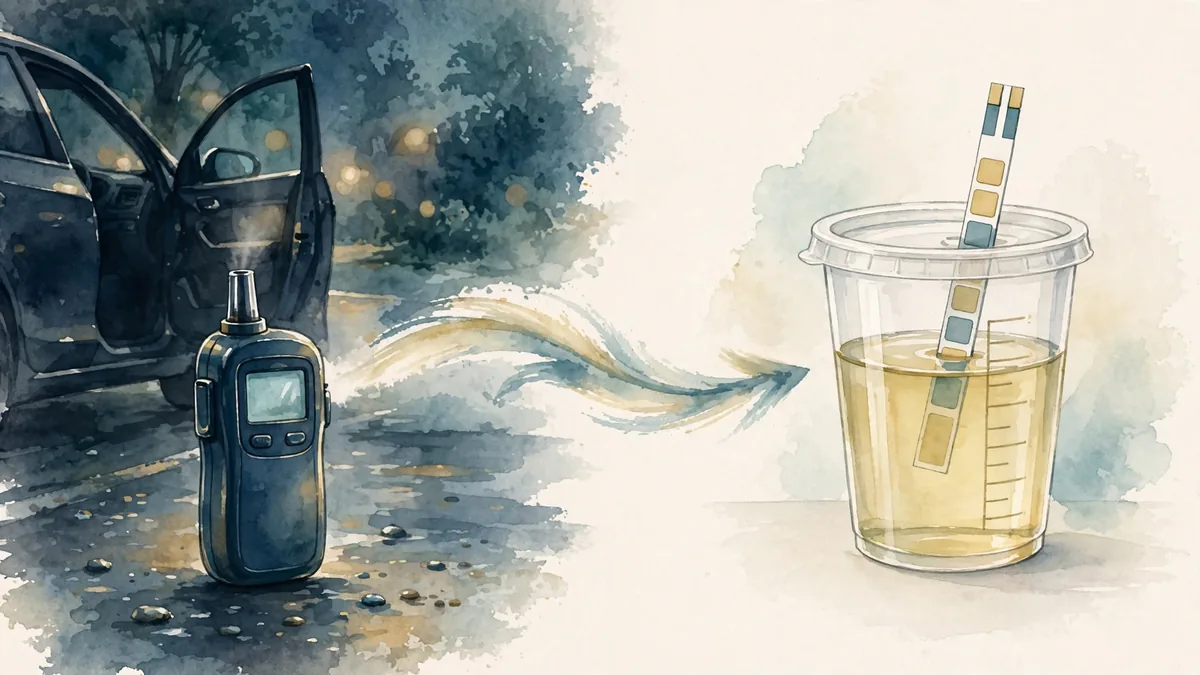
The takeaway: under a no-drinking order, the EtG window — not the breathalyzer window — defines the risk. A beer on Friday can be long gone for a breath test by Sunday and still visible on EtG. Run your numbers through our EtG detection window calculator.
How courts and probation actually use EtG
EtG urine testing shows up in DUI cases at several stages, and the rules change a little at each one:
- Pretrial / bond conditions. After an arrest, a judge may order no alcohol as a condition of release — with scheduled or random testing that can run for months before the case resolves.
- Probation supervision. The most common use. A DUI sentence often includes probation with an abstinence condition, and probation officers order EtG urine tests — scheduled or random — to verify compliance, under documented protocols: notice of the requirement, controlled collection, and chain of custody to a certified lab.
- DUI / drug courts. Specialized treatment courts lean heavily on EtG because the whole model is abstinence verification, often combined with counseling.
- Pretrial diversion programs. First-time-offender diversion sometimes conditions charge reduction or dismissal on an alcohol-free period with testing.
Testing is rarely one-and-done. Frequency, cutoff, and randomness together define how strict a program really is: weekly testing at 100 ng/mL covers nearly the whole week, while monthly testing at 500 ng/mL leaves gaps. Practices vary by state and even county — our Texas state guide shows how one state's probation programs handle EtG testing in practice.
The cutoff is the whole argument: why courts use 500 ng/mL
An EtG number means nothing without the cutoff it is judged against — the same sample can be positive at 100 ng/mL and negative at 500 ng/mL. In a legal setting, that is the difference between a violation and nothing at all.
The federal guidance here is unusually blunt. In 2006, the Substance Abuse and Mental Health Services Administration (SAMHSA) warned that EtG testing was not reliable enough to serve as the sole basis for legal or disciplinary action, citing its sensitivity to incidental alcohol exposure. The 2012 revision added guidance for criminal-justice settings and endorsed a conservative 500 ng/mL cutoff for forensic use — acknowledging that research-grade sensitivity and forensic-grade certainty are different standards: at forensic cutoffs, the chance of a false positive must be negligible.
| Result band | What labs typically report | Common interpretation |
|---|---|---|
| High positive — above 1,000 ng/mL | EtG well over the cutoff | Heavy drinking the same day or the day before; or light drinking the same day |
| Low positive — 500–1,000 ng/mL | Above the forensic cutoff | Heavy drinking within 1–3 days; light drinking within ~24 hours; extraneous exposure still possible |
| Very low positive — 100–500 ng/mL | Positive only at sensitive cutoffs | Heavy drinking 1–3 days prior; light drinking 12–36 hours prior; or recent exposure to alcohol-containing products |
| Below cutoff — negative | Under the program's threshold | No basis to suspect recent consumption at that sensitivity |

The trade-off is why courts prefer 500 ng/mL. In a large study of alcohol-dependent outpatients, the 100 ng/mL cutoff still detected drinking about 78% of the time five days later — but specificity was only 67–85%, so more non-drinking explanations can produce positives. At 500 ng/mL, specificity rose to 86–97%. In a legal proceeding, a positive should mean drinking, not maybe-drinking. Our 100 vs 500 ng/mL cutoff guide walks through this trade-off in detail.
EtG test for DUI: how far back it can detect drinking
The numbers below are population-level estimates from published clearance data — honest ranges, not lab-certified predictions. Your own result depends on how much you drank, your metabolism, hydration, and the lab's cutoff.
| Drinking amount | At 100 ng/mL cutoff | At 500 ng/mL cutoff |
|---|---|---|
| 1–2 drinks (light) | ~24–36 hours | ~12–24 hours |
| 3–5 drinks (moderate) | ~36–72 hours | ~24–36 hours |
| 6+ drinks (heavy) | Up to ~80 hours (about 3+ days) | ~36–60 hours |
Two things stretch the window after heavy drinking: EtG's urinary half-life is only ~2.5–3 hours, so the long window comes from very high peak concentrations taking many half-lives to clear — and studies show the fraction of alcohol converted to EtG rises disproportionately with dose, so a binge produces more EtG per drink than light drinking.
For a single-drink scenario, see our one-drink guide; for personalized estimates, the EtG detection window calculator applies the same research ranges to your numbers — the standard behind our calculation methodology.
A real-world scenario: probation, a wedding, and a random test
Consider a common pattern. In March, a driver is charged with DUI and placed on probation with a standard condition: no alcohol, verified by random EtG urine testing at the 500 ng/mL cutoff. The testing is genuinely random — sometimes weekly, sometimes with two quiet weeks, so there is no safe calendar to game.
In June, the driver has four drinks at a wedding, finishing around 11 p.m. Saturday. A random test call comes Monday morning, ~36 hours later. At 500 ng/mL, four drinks sit right in the ~24–48 hour band — the test could go either way, and there is no way to know which side. A test on Tuesday would more likely be clear; at the 100 ng/mL cutoff, Monday would very likely be positive.

What happens after a positive depends on the court: a violation hearing, additional conditions, or (rarely for a first low-level positive) jail time. This article is educational information, not legal advice — talk to your attorney. Under an abstinence order, complete abstinence for the full supervision period is the only strategy with no failure mode.
Incidental exposure still matters at low cutoffs
Even in legal settings, the incidental-exposure problem does not disappear. Hand sanitizer, mouthwash, some medications, and even foods like very ripe fruit or kombucha can produce low-level urinary EtG. At 500 ng/mL, ordinary use of these products essentially never produces a positive — a large part of why SAMHSA's forensic guidance lands there. At 100 ng/mL, the picture is murkier: studies have measured values crossing that line from heavy sanitizer use or repeated mouthwash gargling.
That is the core of the SAMHSA warning: at sensitive cutoffs, standard thresholds cannot reliably distinguish drinking from incidental exposure. If you are tested at 100 ng/mL, ask — before any test — whether the program has a written incidental-exposure policy and whether confirmation is automatic. See our hand sanitizer and EtG guide for the full science.
Screen first, confirm second: the testing chain
Court-ordered EtG testing is almost never a single test. The standard chain has two stages:
- The immunoassay screen. A fast, inexpensive enzyme immunoassay gives a semi-quantitative EtG reading, usually within an hour. Most court-program positives are born here. Screens are good but not perfect — they can cross-react with related compounds, which is how some non-drinking exposures produce apparent positives.
- Confirmatory testing. For disputed results, the sample goes to a certified lab for LC-MS/MS, which identifies EtG by its exact molecular signature — far more specific, and the step that separates genuine EtG from cross-reacting lookalikes. Labs often report EtS (ethyl sulfate) alongside EtG: a second ethanol metabolite that tracks with real drinking and is absent in several false-positive scenarios.
The cutoff applies at the screening stage. In legal contexts, confirm the program's confirmation policy — and whether a screening positive alone can trigger consequences. Per SAMHSA's advisory, it should not.
If you are subject to court-ordered EtG testing
- Know your cutoff. Ask the program — in writing if possible — whether it tests at 100, 200, or 500 ng/mL and whether confirmation is automatic. This single fact reframes every risk in this article.
- Treat the abstinence order as absolute. Detection windows are ranges, and no calculator or anecdote predicts your result. Complete abstinence is the only strategy with no failure mode.
- Avoid alcohol-containing products before tests. Switch to alcohol-free mouthwash and sanitizers where practical, especially under a 100 ng/mL cutoff — there is no reason to add noise to a legal test.
- Disclose occupational exposure in advance. Healthcare workers, bartenders, and lab staff who handle alcohol products daily should document it with the program before any test, not explain it after a positive.
- If a result is disputed, request LC-MS/MS confirmation (and EtS analysis) before any consequence is finalized.
- Talk to your attorney, not the internet. Probation conditions, violation standards, and challenge procedures vary by court and state. Nothing here is legal advice.
Related reading: EtG testing for employment and EtG testing in monitoring programs.
Frequently asked questions
Can an EtG test prove I drove drunk?+
No. An EtG test measures a metabolite that appears hours after drinking and persists for days, so it cannot show you were intoxicated while driving. Breathalyzers and blood alcohol tests measure current alcohol in the body — those are the evidence behind the DUI charge itself. Courts use EtG afterward, to verify abstinence during probation or pretrial release.
How far back can a court-ordered EtG test detect drinking?+
It depends on the cutoff. At the 500 ng/mL cutoff most court and probation programs use, EtG typically detects moderate-to-heavy drinking for about 24–48 hours. At the more sensitive 100 ng/mL cutoff, detection can stretch to roughly 80 hours after heavy drinking. These are population ranges — dose, metabolism, hydration, and timing shift the real number, so treat any window as an estimate, never a guarantee.
Why do DUI courts use the 500 ng/mL cutoff instead of 100 ng/mL?+
Federal guidance. SAMHSA's 2006 advisory — revised in 2012 with criminal-justice guidance — warned that EtG should not be the sole basis for legal or disciplinary action, and endorsed a conservative 500 ng/mL cutoff for forensic use. At 500 ng/mL, ordinary incidental exposure (hand sanitizer, mouthwash) essentially never produces a positive, while recent meaningful drinking still does. Courts prefer a positive to mean drinking, not maybe-drinking.
Can hand sanitizer or mouthwash make me fail a court EtG test?+
At 500 ng/mL, ordinary use of these products essentially never produces a positive — this is a major reason courts use the higher cutoff. At 100 ng/mL the picture is murkier: studies have measured EtG crossing that line from heavy sanitizer use or repeated mouthwash gargling. If you are tested at a sensitive cutoff in a legal program, ask in advance about the program's incidental-exposure policy and whether confirmatory testing is automatic.
What happens if I fail an EtG test on DUI probation?+
That depends on the court, the program, and whether it is a first violation — it can mean a violation hearing, added conditions, or in rare cases jail time. What matters most: per SAMHSA's advisory, a positive EtG result should not be the sole basis for legal action, and disputed results deserve LC-MS/MS confirmation before consequences are finalized. This is educational information, not legal advice — talk to your attorney before the test, not after.
Is an EtG screen enough, or is a confirmation test required?+
A screening positive should always be confirmable, not automatically final. The standard chain is a fast immunoassay screen, then LC-MS/MS confirmation — a far more specific test that identifies EtG by its exact molecular signature — for disputed results. Labs often report EtS (ethyl sulfate) alongside EtG as a companion biomarker. Always confirm the program's confirmation policy and whether a screen alone can trigger consequences.
Evidence and limitations
This article summarizes primary research and federal guidance on EtG testing in DUI and court programs. Group-level findings cannot predict one person’s result, and this article is educational information, not legal advice.
- SAMHSA Advisory: The Role of Biomarkers in the Treatment of Alcohol Use Disorders (2012 revision, PDF)
- McDonell et al. — Determining Ethyl Glucuronide Cutoffs When Detecting Self-Reported Alcohol Use (PMC4400217)
- Ethylglucuronide and Ethyl Sulfate Assays: Dose-Ranging Alcohol Challenge Study (PMC4107122)
- Biomarkers of the Alcohol Hangover State: EtG and EtS (PMC5637917)
- ToxiPharm Clinical Toxicology FAQ — EtG detection windows and cutoff interpretation
- LegalClarity — EtG cutoff levels for probation and the SAMHSA warning
- LegalClarity — How drug and alcohol testing on probation works (breathalyzer windows, SCRAM)
- LegalClarity — Do probation officers use EtG urine tests for alcohol monitoring?
- Barone Defense Firm — EtG testing for alcohol by DUI court
- Verywell Mind — The EtG alcohol test (medically reviewed)
- USA Mobile Drug Testing — SAMHSA-style EtG interpretive bands
- National Drug Screening — EtG testing for DUI/DWI and court programs