The short answer: an ETG test in a divorce checks recent drinking, not impairment
An ETG test in a divorce is a urine test for ethyl glucuronide, a direct metabolite of alcohol. It answers one question: has this person drunk alcohol in roughly the past one to three days? It does not measure impairment, it does not say someone was drunk while parenting, and it does not diagnose an alcohol problem.
Divorce cases turn on the best interests of the child, and a parent's alcohol use is directly relevant. A breath test can only show intoxication right now; EtG looks back about 80 hours, so it catches drinking a breath test would miss — a parent who drank on Friday can blow zero on Monday and still test positive.
Testing is usually ordered by the judge, not volunteered. Court-ordered EtG testing is available nationwide through certified labs, with results sent to the court or the attorneys. The order names the test, the lab, the frequency, and who gets the results — read it word for word.
Why family courts order EtG testing
When alcohol use is alleged in a divorce, the court has to decide whether it affects parenting. A history of substance abuse, a DUI arrest, a child reporting drinking in the other parent's home, or a treatment record can all trigger an order. Courts can order testing on their own initiative or at a parent's request, and the threshold is low: the question is whether testing could help decide custody and visitation, not whether drinking is already proven.
EtG fits this job for one reason — its window. Ethanol clears from urine within hours, so a standard alcohol screen is useless for anything before yesterday. EtG is detectable for one to three days, and SAMHSA's 2012 advisory puts the window at up to about 80 hours after heavy drinking. For a court asking whether a parent drank over the weekend, that three-day lookback is the whole point.
The test is also cheap, non-invasive, and hard to time around: random testing is the usual pattern, so drinking on Friday and hoping the test lands on Wednesday does not work. Divorce testing and custody testing are the same tool in different procedural moments — our child-custody testing guide covers how EtG is used once custody itself is being decided.
The ETG test divorce process: from court order to result
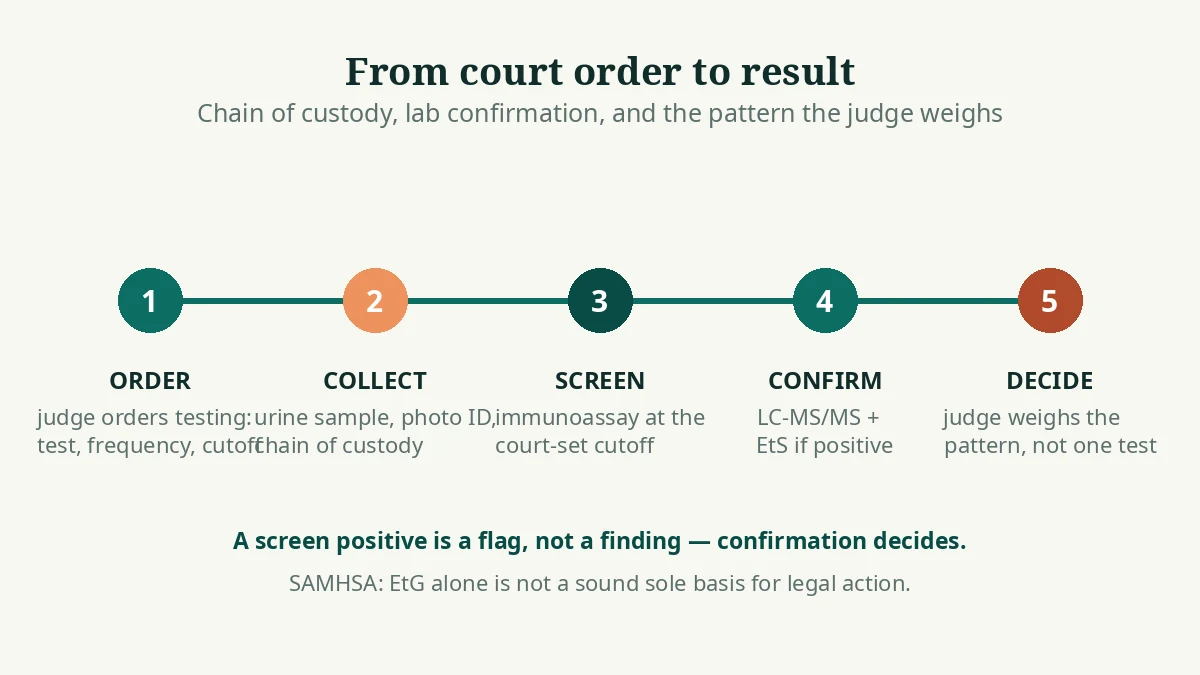
A court-ordered test follows a fixed chain so the result holds up in front of a judge: the order names the test and terms; the parent gives a urine sample at a certified site, with photo ID checked and a chain-of-custody form started; the lab screens by immunoassay at the ordered cutoff; any positive is confirmed by LC-MS/MS with EtS measured; results go to the court and the attorneys within three business days.
Two details decide whether a result is trusted: chain of custody — the sample is sealed, labeled, and tracked to the lab — and confirmation. A screen alone is a flag; court labs confirm positives with mass spectrometry before reporting them. Some labs, including Quest Diagnostics, require EtS alongside EtG before calling a urine positive — a guard against fermentation, where ethanol forms in a stored sample without any drinking.
Frequency is whatever the order says: a fixed schedule, such as weekly testing, or random testing, where the parent is notified and must test the same day. Random testing is stricter, because a fixed schedule lets a parent drink in the gap. If the order does not say which, ask the court or your attorney — testing on the wrong schedule can itself count as non-compliance.
Cutoffs: what level counts as a positive in a divorce case
There is no national EtG cutoff for divorce or family court. The cutoff is set by the court order or the lab it uses, and it changes what the test catches: a lower cutoff catches lighter and older drinking but also more incidental exposure; a higher one misses light drinking but rarely flags anything but real drinking.
| Cutoff | What it catches | What it misses | Where it shows up |
|---|---|---|---|
| 100 ng/mL | Light drinking and drinking up to about 80 hours back | Almost nothing recent | Strict or zero-tolerance orders |
| 200 ng/mL | Moderate drinking over roughly two to three days | One drink more than about a day earlier | Middle-ground orders |
| 500 ng/mL | Heavier or recent drinking | Light drinking and anything older than about two days | Standard lab screens |
The same drinking can be a positive under one order and a negative under another: three drinks on Saturday can still top 100 ng/mL on Tuesday morning and fall under 500 ng/mL by Sunday. The cutoff, not the drinking, decides the result — so the first question after any order is always which cutoff applies.
SAMHSA's advisory carries a warning for every divorce case: EtG is "scientifically unsupportable as the sole basis for legal or disciplinary action." A single EtG number should not decide custody. Courts that use the test well treat it as one piece of evidence — alongside treatment records, the parent's own account, and the pattern across many tests — rather than as a verdict.
How long EtG stays detectable before a divorce test
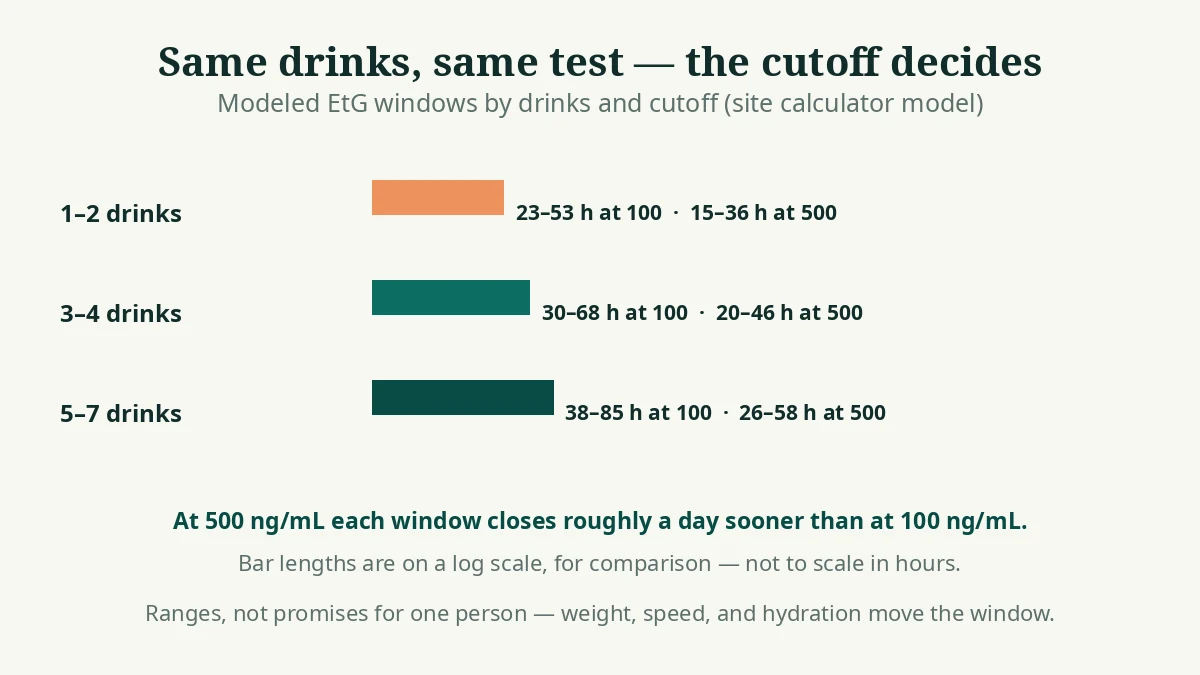
Detection windows are ranges, not dates, because weight, drinking speed, hydration, and liver function all move them. The table below uses the same modeled ranges our EtG calculator uses — honest ranges for a typical adult, never a promise for one person.
| Drinking | At 100 ng/mL | At 200 ng/mL | At 500 ng/mL |
|---|---|---|---|
| 1–2 drinks | 23–53 hours | 19–44 hours | 15–36 hours |
| 3–4 drinks | 30–68 hours | 26–59 hours | 20–46 hours |
| 5–7 drinks | 38–85 hours | 32–72 hours | 26–58 hours |
Two patterns matter. Heavier drinking stretches the window by roughly a day at every cutoff — two drinks versus six is the difference between clearing on Monday and still testing positive on Tuesday. And the cutoff moves the window by about a day too: at 500 ng/mL each window closes roughly a day sooner than at 100 ng/mL.
Real-world scenario: three drinks Saturday, a court-ordered test Tuesday
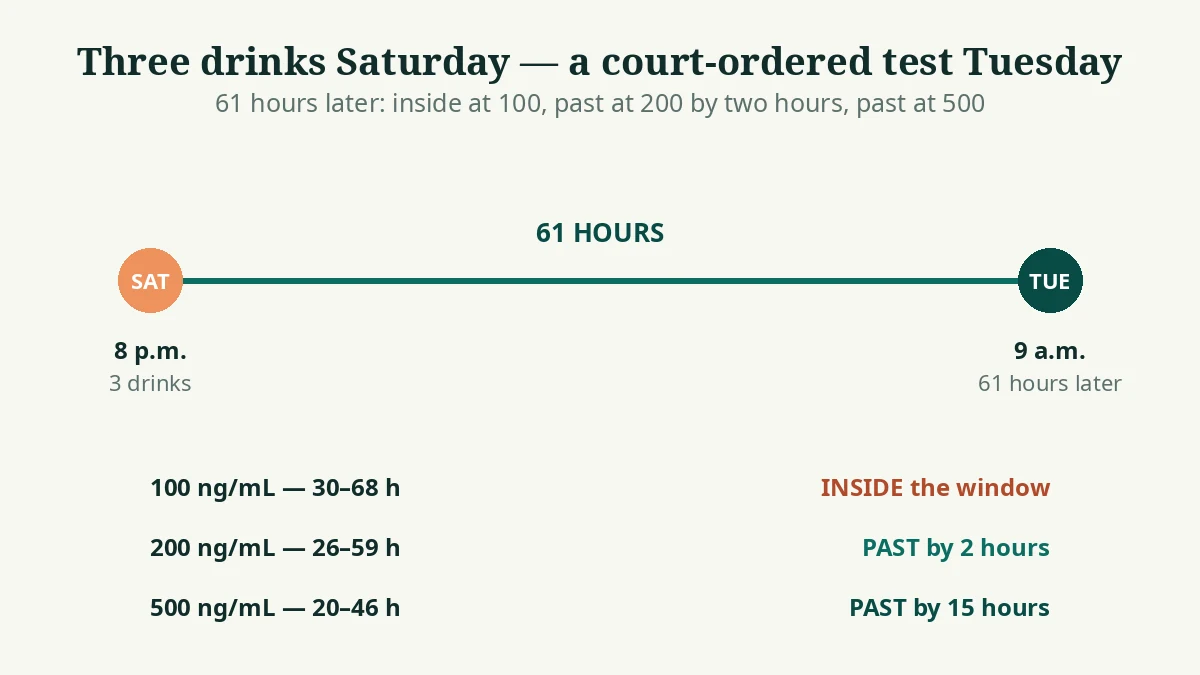
A parent has three drinks at a Saturday dinner, finishing around 8 p.m. The court-ordered test is Tuesday at 9 a.m. — 61 hours later. The question is only what the test shows.
At 100 ng/mL the window for three to four drinks is 30 to 68 hours, so 61 hours is inside it: likely positive. At 200 ng/mL the window is 26 to 59 hours, so the same sample is past it by about two hours: likely negative. At 500 ng/mL the window is 20 to 46 hours, so it is past by fifteen hours: negative. One Saturday night, three different answers — and none says anything about how that parent was on Sunday morning, when the children were with them. EtG measures recent drinking, not parenting on a given day.
Timing games fail for the same reason: at the strict cutoff the window runs to Tuesday, so there is no safe day to aim for. The only reliable way to test negative is not to drink — which is exactly what the court is monitoring for.
What a positive result can change
A positive EtG test does not automatically end a parent's custody rights. What it usually does is change the conditions: the court may restrict or suspend unsupervised visitation, order supervised visitation, require more frequent random testing, order treatment, or modify custody temporarily while the pattern is assessed. The result is evidence the judge weighs, not a switch that flips custody by itself.
What weighs heaviest is the pattern around the positive. A parent who discloses drinking before the test, has started treatment, and then produces a run of clean tests is in a very different position from one who denies drinking, tests positive repeatedly, and misses tests. A missed test looks like a test that would have been positive — courts commonly count a missed or refused test against the parent who missed it.
The same logic works in reverse: a run of negative tests over weeks, especially random ones, is strong evidence of sustained abstinence, and courts revisit orders as it accumulates. Parents often volunteer for testing beyond the order, because a longer clean record is the fastest way to restore unsupervised time.
Incidental exposure comes up in almost every contested case: at 100 ng/mL, heavy use of alcohol-based mouthwash or hand sanitizer can push EtG over the line; at 500 ng/mL it is unlikely. The defense is procedural: disclose the exposure before the sample, not after the result, and ask for LC-MS/MS confirmation with EtS. Our mouthwash guide and our hand sanitizer guide cover the numbers, and our water-and-dilution guide explains why drinking water before a test backfires — labs check creatinine, and a dilute sample reads as a problem, not a pass.
Other tests courts use alongside EtG
EtG is rarely the only test in a divorce case, because its three-day window leaves gaps. The other tools each cover a different stretch of time, and courts often combine two or more.
| Test | Window | What it shows |
|---|---|---|
| Urine EtG | Up to ~80 hours | Recent drinking; best for abstinence monitoring |
| PEth blood test | About 2–4 weeks | Sustained or heavy drinking over weeks |
| Hair EtG | Up to ~90 days | Long-term pattern; hardest to time around |
| Remote breath (Soberlink) | At the moment of the test | Real-time sobriety around parenting time |
| SCRAM ankle monitor | Continuous | Any drinking, day or night, as it happens |
The combination is the point: EtG catches a weekend, PEth catches a month of regular drinking EtG would miss between spaced-out tests, hair EtG covers a quarter, and a breath device or ankle monitor answers the question EtG cannot — was this parent sober during parenting time? Our EtG vs PEth comparison explains the two biomarkers, and our probation testing guide shows the same pattern in another court setting.
What helps if alcohol comes up in a divorce case
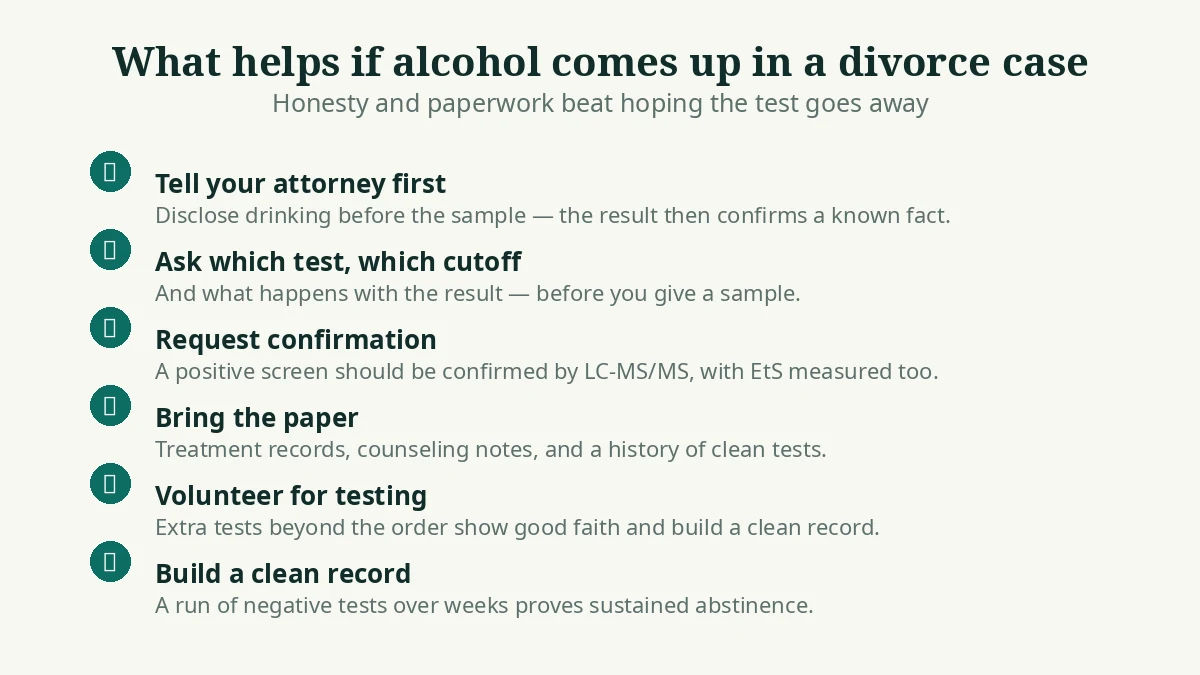
Tell your attorney — and, through them, the court — before the sample. If you drank, say so: the result then confirms what the court already knows, instead of arriving as a surprise that also damages your credibility. Ask three questions first: which test, which cutoff, and what happens with the result. Ask for LC-MS/MS confirmation of any positive screen, and whether EtS was measured too.
Bring the paper: treatment records, counseling notes, and a history of clean tests are what a judge weighs alongside the numbers. If you are in treatment, make sure the court knows. A run of negative tests over weeks is the strongest evidence you can build.
This article is educational only — not legal advice. Rules, cutoffs, and consequences vary by state, judge, and order; talk to a family law attorney about a live order.
Using the EtG calculator before a test
The EtG calculator estimates the same windows the table above uses. Read the result as a range, never a pass date. Run your numbers through the calculator.
Frequently asked questions
Can a judge order an EtG test during a divorce?+
Yes. Family courts can order EtG testing on their own initiative or at the request of a parent, usually when alcohol use is alleged or there is a documented history, a DUI arrest, or a child reporting drinking in the home. The order names the test, the lab, how often testing happens, and who receives the results. It can apply to either parent.
How far back does an EtG test go in a divorce case?+
Urine EtG detects drinking from roughly the past one to three days, up to about 80 hours after heavy drinking, according to SAMHSA's 2012 advisory. The exact window depends on how much was drunk and the cutoff the court set — at 500 ng/mL the window closes about a day sooner than at 100 ng/mL. Hair EtG reaches up to about 90 days and PEth blood testing about two to four weeks.
What EtG cutoff do divorce courts use?+
There is no national EtG cutoff for divorce or family court — the court order or the lab sets it. Strict or zero-tolerance orders often use 100 ng/mL, which catches light and older drinking but also more incidental exposure; standard lab screens often use 500 ng/mL, which misses light drinking. Ask for the cutoff in writing before you give a sample.
Can one positive EtG test make you lose custody in a divorce?+
Not automatically. A positive EtG test does not by itself end a parent's custody rights. The court may restrict or suspend unsupervised visitation, order supervised visitation, require more frequent random testing, or order treatment — and it weighs the pattern, honesty, and treatment far more than one result. Repeated positives or missed tests are what most often lead to lasting changes.
Can mouthwash or hand sanitizer cause a positive EtG in a divorce test?+
At a 100 ng/mL cutoff, heavy use of alcohol-based mouthwash or hand sanitizer can push EtG over the line; at 500 ng/mL it is unlikely. Disclose any use before the sample, not after the result, and ask for LC-MS/MS confirmation with EtS measured — confirmation is what separates incidental exposure from drinking.
How do I prove I have not been drinking during a divorce?+
A run of negative court-ordered tests over weeks, especially random ones, is the strongest evidence — it is hard to fake and it accumulates. Voluntary testing beyond what the order requires, treatment and counseling records, and a PEth or hair EtG test for a longer window all help, because they show sustained abstinence rather than a single clean day.
Evidence and limitations
This article summarizes published guidance and research on EtG testing in divorce and family court, plus the science of alcohol biomarkers. Group-level findings cannot predict one person’s result, and this article is educational only — it is not legal or medical advice. Testing rules vary by state, by judge, and by the order in your case; talk to a family law attorney about a live order.
- SAMHSA Advisory: The Role of Biomarkers in the Treatment of Alcohol Use Disorders (2006, revised 2012) — EtG detectable up to ~80 hours; EtG “scientifically unsupportable as the sole basis for legal or disciplinary action”
- e7 Health — Hair Follicle & Alcohol EtG Testing: EtG the popular test for court-ordered alcohol testing; urine lookback about 80 hours, hair up to 90 days; testing available for divorce, child custody and other monitoring programs; results can go to the court or an attorney
- National Drug Screening — EtG Alcohol Test: urine EtG shows alcohol use up to 80 hours; results accepted in court hearings; Quest Diagnostics requires EtS also present; court-ordered testing for divorce and child custody
- Enos Family Law — Drug Testing in Texas Custody Cases: courts order testing on their own initiative or at a parent’s request; urine EtG detects metabolites up to 80 hours; a positive test does not automatically end custody, but the court may restrict or suspend unsupervised visitation and order ongoing random testing
- US Health Testing — Child Custody Drug Testing: court-ordered testing follows strict chain-of-custody procedures in certified labs; EtG urine testing detects alcohol use up to approximately 80 hours
- McDonell et al. (2015) — EtG immunoassay cutoff sensitivity in alcohol-dependent outpatients (1,589 samples)
- Mackus et al. (2017) — EtG detection and elimination kinetics after controlled alcohol intake
- Jatlow et al. — EtG and EtS in urine after controlled alcohol administration
- EtG Calculator Pro — ETG Testing in Child Custody Cases: the same test once custody itself is being decided
- EtG Calculator Pro — How EtG Testing Works in DUI/DWI Cases: court-ordered testing in another proceeding
- EtG Calculator Pro — ETG Testing for Probation: the screen-then-confirm pattern in supervision
- EtG Calculator Pro — Can Mouthwash Cause a Positive EtG Test?: incidental exposure at low cutoffs
- EtG Calculator Pro — Does Hand Sanitizer Affect an EtG Test?: incidental exposure at low cutoffs
- EtG Calculator Pro — Does Drinking Water Reduce EtG Levels?: creatinine, dilution, and why a dilute sample reads as a problem