The short answer: water dilutes the sample, not the EtG
Ask anyone who has faced an EtG test and the folk advice comes up fast: drink lots of water before the test and you will flush it out. The advice is half right in a way that makes it dangerous. Water does change the number on a urine test — but by watering down the sample, not by getting alcohol's metabolite out of your body any sooner. That distinction decides whether the trick helps, does nothing, or backfires.
EtG (ethyl glucuronide) is a minor metabolite of ethanol. After you drink, your liver converts a tiny fraction of the alcohol — roughly 0.02 to 0.06 percent of the dose — into EtG, which the kidneys excrete in urine over hours to days. A urine EtG test measures a concentration: nanograms of EtG per milliliter of urine (ng/mL). Anything that adds water to the urine lowers that concentration even though the amount of EtG in your body has not changed. The reading drops. The EtG itself is still there, still clearing on its own schedule.
Concentration versus total amount: the distinction that matters
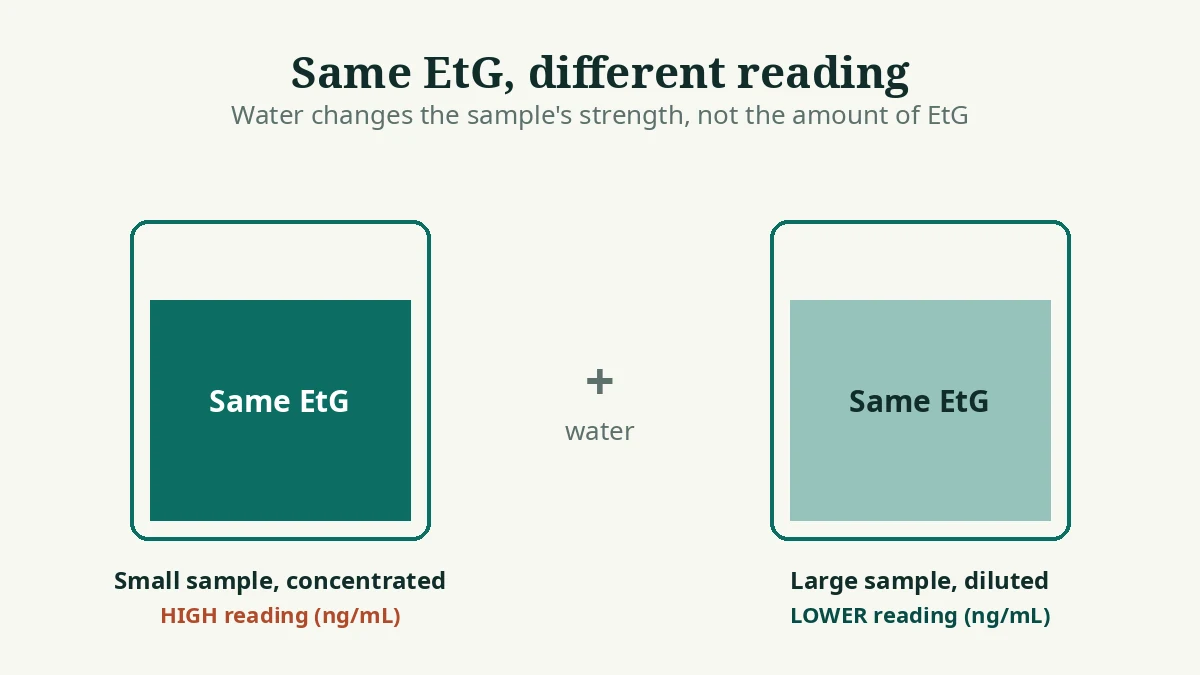
Think of sugar in tea. Stir a teaspoon into a small glass and it tastes very sweet. Pour the same tea into a large jug and top it up with water, and it tastes weak — but you have not removed any sugar. You have only spread it thinner. Urine EtG works the same way: the test reads sweetness (concentration), not total sugar (amount).
This is why two people with identical drinking histories can get different EtG readings on the same day. The person who drank little water and produced a small, concentrated sample reads higher. The person who drank heavily and produced a large, dilute sample reads lower. Neither body cleared EtG faster. Their samples were simply different strengths — and dilution can only move a result that is already close to the cutoff. If your level is far above it, no plausible amount of water brings it below, and trying can create a bigger problem than the one you started with.
What the water-diuresis study actually showed
The cleanest evidence comes from a controlled experiment by Dahl and colleagues, published in the Journal of Analytical Toxicology in 2002. Six healthy volunteers drank a measured dose of beer (0.5 grams of ethanol per kilogram of body weight, about 25 to 41.5 grams of alcohol) over 30 minutes, then drank the same volume of water three hours later. Researchers collected urine at timed intervals for 31.5 hours and measured both ethanol and EtG.
The results draw the line between what water does and does not do with unusual clarity. EtG first became detectable about one hour after drinking and remained detectable for 22.5 to 31.5 hours, long after ethanol itself had disappeared from urine at 6.5 hours. When the volunteers drank the water at three hours, urine volume rose again, creatinine concentration fell, and the EtG concentration dropped distinctly. But when EtG was expressed relative to creatinine — the EtG-to-creatinine ratio — the ratio was, in the authors' words, seemingly not affected by the water at all. Only about 0.02 percent of the alcohol dose was recovered in urine as EtG, which is why EtG levels are so sensitive to sample concentration in the first place.
So the honest answer to "does drinking water reduce EtG levels?" has to be split in two. Does it reduce the EtG concentration in a given urine sample? Yes, measurably. Does it reduce your EtG levels in the sense of clearing the metabolite from your body? No — and any source that gives you only the first half of that answer is misleading you.
Creatinine: the number that gives dilution away
If dilution worked invisibly, it would be a reliable trick. It does not work invisibly, because urine contains a built-in dilution gauge: creatinine. Creatinine is a waste product your muscles produce at a fairly steady rate, so its concentration tracks how watered-down a sample is. Concentrated urine has high creatinine; dilute urine has low creatinine. Laboratories use it, along with specific gravity, to judge whether a sample is valid.
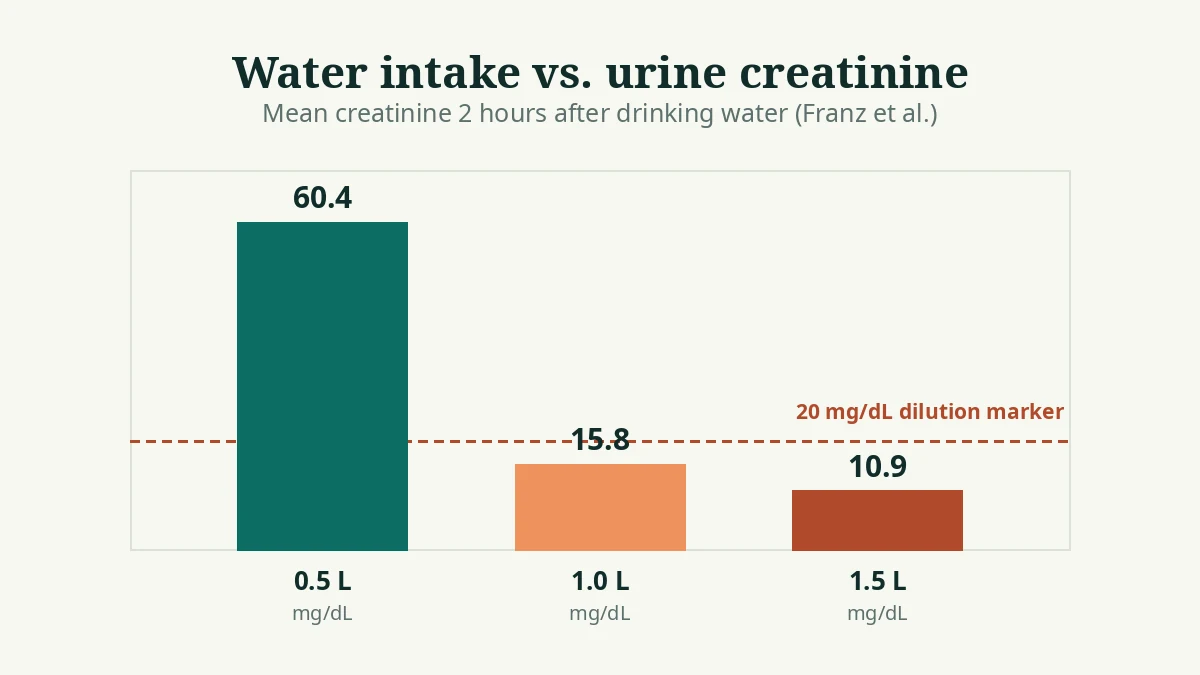
A study by Franz and colleagues on internal dilution put numbers on how fast water moves that gauge. Twenty-two volunteers drank 0.5, 1.0, or 1.5 liters of water within 15 minutes, and researchers measured creatinine two hours later:
| Water drunk in 15 minutes | Mean creatinine 2 hours later | Below the 20 mg/dL dilution marker? |
|---|---|---|
| 0.5 liters | 60.4 mg/dL | No |
| 1.0 liter | 15.8 mg/dL | Yes — flagged dilute |
| 1.5 liters | 10.9 mg/dL | Yes — flagged dilute |
One liter of water in a quarter of an hour was enough, on average, to push creatinine below the 20 mg/dL threshold commonly used to mark a sample as dilute. Half of the volunteers with a body mass index under 20 fell below the threshold, and women and lighter participants tended to excrete lower creatinine than men. The authors concluded that for legally defensible testing, sex and body weight may need to be taken into account when judging dilution.
What happens to a dilute sample depends on the program, and none of the outcomes is a clean pass. A workplace or clinical program may report it as dilute and require a retest, often observed. A probation or court program may treat a dilute sample as a violation or as an attempt to tamper. Either way, the water strategy has converted a straightforward test into a second test taken later — when your EtG level may be lower, but your credibility is not. For a deeper look, see our guide to EtG and creatinine dilution.
How dilution plays out at each cutoff
Whether dilution changes your result also depends on the cutoff your program uses. The common cutoffs are 100, 200, and 500 ng/mL. A sample reading 120 ng/mL fails at 100, passes at 200, and passes easily at 500. Dilution only matters when it moves a reading across the line that applies to you — and the stricter the cutoff, the less room there is for dilution to help without tripping the creatinine flag.
| Cutoff | Who typically uses it | What dilution can (and cannot) do |
|---|---|---|
| 100 ng/mL | Probation, courts, zero-tolerance programs | Small drops can cross the line — but these programs check dilution and retest most aggressively |
| 200 ng/mL | Clinical and treatment programs | Moderate room for a marginal reading to drop below the line; creatinine check still applies |
| 500 ng/mL | Workplace screening, SAMHSA-style programs | Most room for dilution to matter — but readings this high usually need time, not water, to fall |
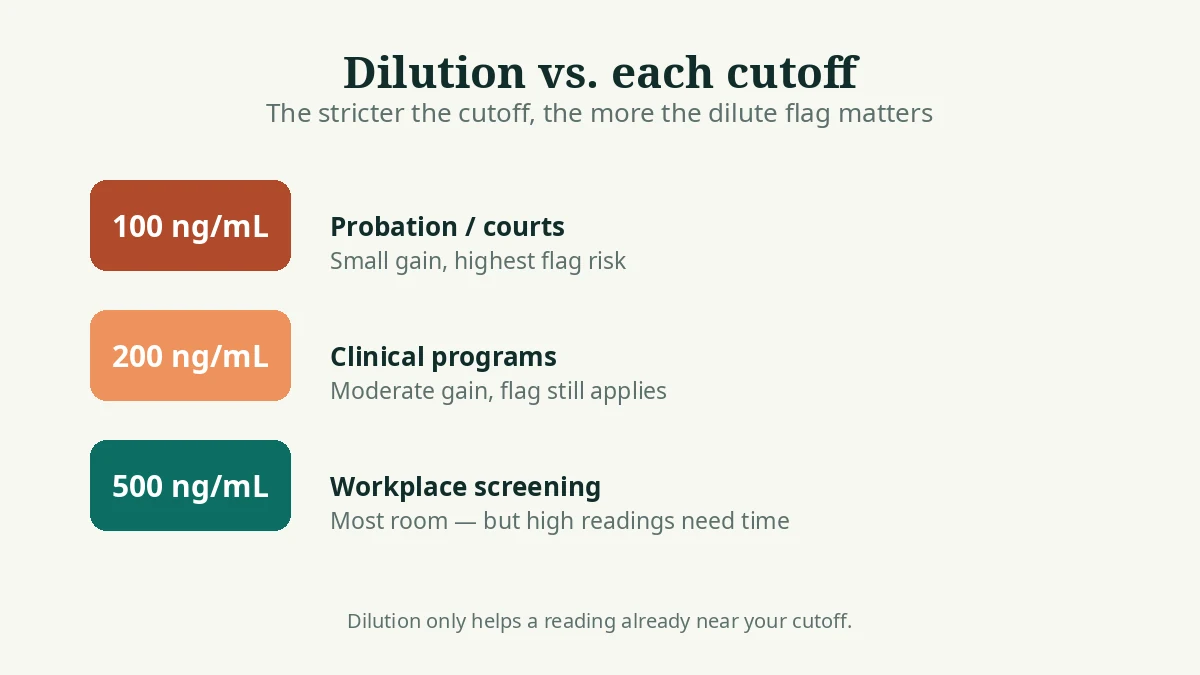
The irony is sharpest at the strict end. The programs where a marginal result matters most — probation and court monitoring at 100 ng/mL — are exactly the programs most likely to check creatinine, require LC-MS/MS confirmation, and treat a dilute sample as its own problem. Our 100 vs 500 ng/mL cutoff guide explains how each level changes detection windows.
Real-world scenario: Saturday drinks, Monday test
Consider a realistic case. Someone has four standard drinks on Saturday night and faces a random probation test on Monday morning — roughly 36 hours later. They spend Sunday drinking water steadily, hoping to flush the EtG out before the test. What actually happens? By Monday morning, time has done most of the work: EtG from Saturday's drinking has been clearing for a day and a half, and the level may already be near the cutoff. Sunday's water does not accelerate that clearance by a single hour. What it changes is Monday's sample: drink heavily on Monday morning and the sample may read lower in raw concentration — and may also read dilute on creatinine, triggering a retest or a flag. Drink normally and the sample reads what it reads, reflecting where 36 hours of clearance has actually taken you.
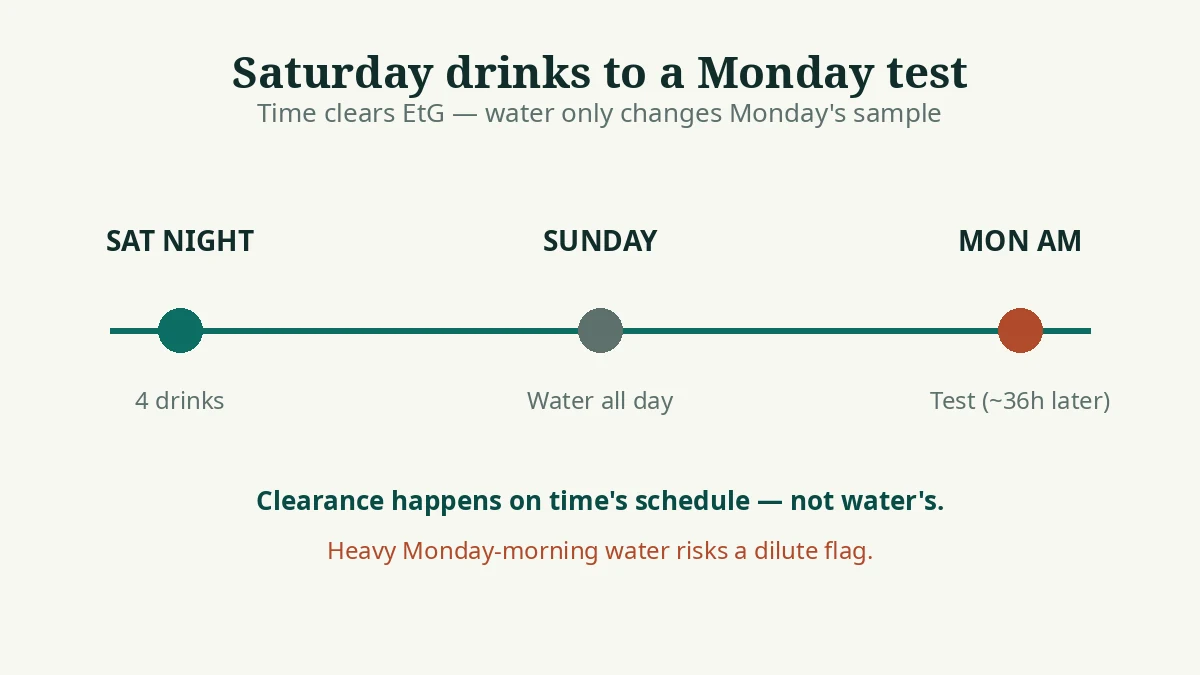
The honest version of this scenario has no hero move. The person who passes on Monday passes mostly because 36 hours elapsed, not because of Sunday's water. The person who fails despite the water fails because their level was still above the cutoff — and if their sample also comes back dilute, they may now face two problems instead of one. If you want a realistic sense of where you stand, our EtG calculator models the detection window as a range based on drinks, timing, and cutoff, rather than a single invented number.
What water cannot do — and what actually moves your window
It is worth being explicit, because the myths around this topic are confident and wrong. Drinking water does not speed up your liver's metabolism of alcohol. It does not convert EtG into something else or break it down faster. It does not help on a test that reports EtG corrected for creatinine, and it does not help on LC-MS/MS confirmation testing, which measures EtG with far greater precision and is routinely paired with validity checks. Taken to extremes, forcing down very large volumes of water in a short time can cause water intoxication (hyponatremia) — a real medical danger — and the volumes needed to move a high EtG reading are exactly the volumes most likely to produce a dilute flag.
What actually determines whether you test positive? Four things, in rough order of importance. First, time since your last drink — EtG clears steadily, and every hour matters most in the first two days. Second, how much you drank. Third, the cutoff your program uses — the same sample passes at 500 ng/mL and fails at 100. Fourth, your own metabolism and body composition, which shift the range but never override the first three. Our calculation methodology page shows how these factors combine into the honest ranges our calculator reports.
The bottom line is simple enough to carry with you: drinking water before an EtG test lowers the concentration in that sample, can flag it as dilute, and does not clear EtG from your body any faster. If your result is close to the cutoff, normal hydration gives you a fair sample. If it is not close, no amount of water closes the gap — only time does. Read any estimate as the range it is: an honest window, not a promise.
Frequently asked questions
Does drinking water reduce EtG levels?+
Drinking water lowers the concentration of EtG in a urine sample by diluting it, but it does not remove EtG from your body faster or shorten the detection window. In the Dahl water-diuresis study, water lowered urinary EtG concentration while the EtG-to-creatinine ratio stayed unchanged.
Can drinking water help you pass an EtG test?+
Only in a narrow case: if your EtG level is already very close to the cutoff and the test reads raw concentration without a dilution check. If the sample comes back dilute on creatinine, most programs require a retest or treat the dilute result as its own problem, so the strategy often backfires.
How much water makes a urine sample dilute?+
In the Franz internal-dilution study, drinking 1.0 liter of water within 15 minutes pushed average urine creatinine to 15.8 mg/dL two hours later, below the commonly used 20 mg/dL dilution marker. Half a liter averaged 60.4 mg/dL and did not cross the marker. Women and lighter people tended to fall below the threshold more easily.
Does water affect EtG creatinine ratio results?+
No. That is the key finding of the Dahl study: water-induced diuresis caused a distinct drop in EtG concentration but left the EtG-to-creatinine ratio seemingly unaffected. Tests that correct EtG for creatinine are designed to see through dilution.
Will drinking a lot of water before an EtG test cause a failed test?+
It can cause a dilute or invalid result, which is not the same as a pass. Depending on the program, a dilute sample leads to a retest (sometimes observed), a flag on your record, or, in probation and court programs, treatment as a violation. Extremely heavy water intake also carries a risk of hyponatremia.
What actually clears EtG from your body?+
Time. Your liver converts alcohol to EtG and your kidneys excrete it over hours to days, regardless of water intake. The main factors are time since your last drink, how much you drank, the test cutoff (100, 200, or 500 ng/mL), and your own metabolism. Use an EtG calculator for an honest range, not a single predicted number.
Evidence and limitations
This article summarizes primary research on water-induced diuresis, EtG excretion, and urine dilution. Group-level findings cannot predict one person’s result.
- Dahl H, Stephanson N, Beck O, Helander A (2002) — comparison of urinary excretion characteristics of ethanol and ethyl glucuronide (Journal of Analytical Toxicology)
- Franz S, Skopp G, Böttcher M, Musshoff F, et al. — excretion profiles of ethyl glucuronide in human urine after internal dilution (creatinine, specific gravity, and osmolality after water intake)
- Dahl H, et al. — ethyl glucuronide and ethyl sulphate in urine: caution in their use as markers of recent alcohol use
- SAMHSA Advisory: The Role of Biomarkers in the Treatment of Alcohol Use Disorders (2006, revised 2012)