The quick answer: an EtG test for security clearance checks recent drinking
An EtG test for security clearance is a urine test for ethyl glucuronide, a direct metabolite of alcohol. It answers one narrow question: has this person drunk alcohol in roughly the past one to three days? It does not measure impairment — it is a check on recent drinking.
Why would a clearance process care about a weekend drink? Because the standard is about reliability, not morality. Under Guideline G of the National Security Adjudicative Guidelines (Security Executive Agent Directive 4, or SEAD 4), excessive alcohol consumption is a security concern because it "often leads to the exercise of questionable judgment, unreliability, failure to control impulses, and increases the risk of unauthorized disclosure of classified information due to carelessness."
The test itself is simple — a urine sample, confirmed by laboratory mass spectrometry if contested — but where it fits in a clearance case is not: no single federal cutoff, no standard schedule, and no single consequence for a positive result. What matters is the stage of the case.
Guideline G: what the government actually looks at
SEAD 4, effective June 8, 2017, sets out 13 adjudicative guidelines that federal adjudicators use to decide eligibility for access to classified information. Guideline G is Alcohol Consumption. It lists conditions that "could raise a security concern and may be disqualifying": an alcohol-related incident away from work, "such as driving while under the influence," counts regardless of how often the person drinks or whether there is a diagnosis. So does habitual or binge consumption to the point of impaired judgment, and failure to follow any court order on alcohol treatment or abstinence.
A single incident does not usually end a clearance on its own. Adjudicators look for a pattern and apply a whole-person analysis: the nature and seriousness of the conduct, its frequency and recency, rehabilitation, and the likelihood it will happen again. The same directive lists what can mitigate a concern: enough time has passed, or the behavior was so infrequent it is unlikely to recur; the person completed counseling or treatment and shows sustained changed behavior; or the person has acknowledged the problem.
The published decisions show both sides. In one Defense Office of Hearings and Appeals (DOHA) case, an applicant with a DWI arrest, two alcohol-related Army disciplinary actions, and a discharge for failing to complete an alcohol program was denied. In a Department of Energy case from March 2023, a contractor with two DWIs had his access authorization restored after a 90-day intensive outpatient program, sustained abstinence, and months of negative random breath tests and monthly PEth tests. The difference was the record built after it.
Where EtG and PEth fit — and where they don't
Clearance work uses direct biomarkers — molecules formed only when alcohol is actually consumed. Each one covers a different window:
| Test | Sample | What it shows | Detection window |
|---|---|---|---|
| Urine EtG | Urine | Drinking in the last few days | About 24–80 hours |
| Urine EtS | Urine | Drinking in the last few days | About 24–80 hours |
| PEth | Blood | Pattern of drinking over weeks | About 2–4 weeks |
| Hair EtG | Hair | Drinking over months | Months, by hair length |
| Breath alcohol | Breath | Current intoxication only | About 12–24 hours |
PEth has a special place in this world. A 2018 Journal of Forensic Science review written for security and employment use proposes three bands: below 20 ng/mL light or no consumption, 20 to 199 significant consumption, and above 200 heavy consumption. PEth forms only when ethanol is present and clears with a half-life of about 4 to 10 days — so a few sober days cannot clear it. Our PEth calculator guide explains the bands, and the biomarkers research page compares the three.
EtG's window depends on how much was drunk and on the cutoff. The table below uses the same modeled ranges as our calculator: at 500 ng/mL — the level SAMHSA's 2012 advisory recommended — EtG detects heavy drinking from the previous day; at 100 ng/mL it can flag light drinking for two days and heavy drinking for five.
| Drinks | 100 ng/mL | 200 ng/mL | 500 ng/mL |
|---|---|---|---|
| 1–2 drinks | 23–53 hours | 20–46 hours | 15–36 hours |
| 3–4 drinks | 30–68 hours | 26–59 hours | 20–46 hours |
| 5–7 drinks | 38–85 hours | 33–75 hours | 26–58 hours |
Two limits matter. First, no federal agency publishes a single EtG cutoff for clearance purposes — whoever orders the test sets it, commonly 100 or 500 ng/mL. Second, SAMHSA's 2012 advisory cautions that EtG is "scientifically unsupportable as the sole basis for legal or disciplinary action," because it cannot distinguish drinking from exposure to alcohol in everyday products. In a clearance case a low-level EtG result is one piece of evidence among many — never the whole case. Our cutoff guide explains the two levels.
EtG is not part of DOT alcohol testing: under 49 CFR Part 40, DOT-regulated alcohol testing runs on breath — an evidential breath test is the only permitted confirmation. A clearance holder in a DOT-regulated job therefore faces two systems: breath tests at work and EtG or PEth testing in the clearance process. Our DOT testing guide explains the breath-test rules.

When testing happens: application, investigation, and continuous vetting
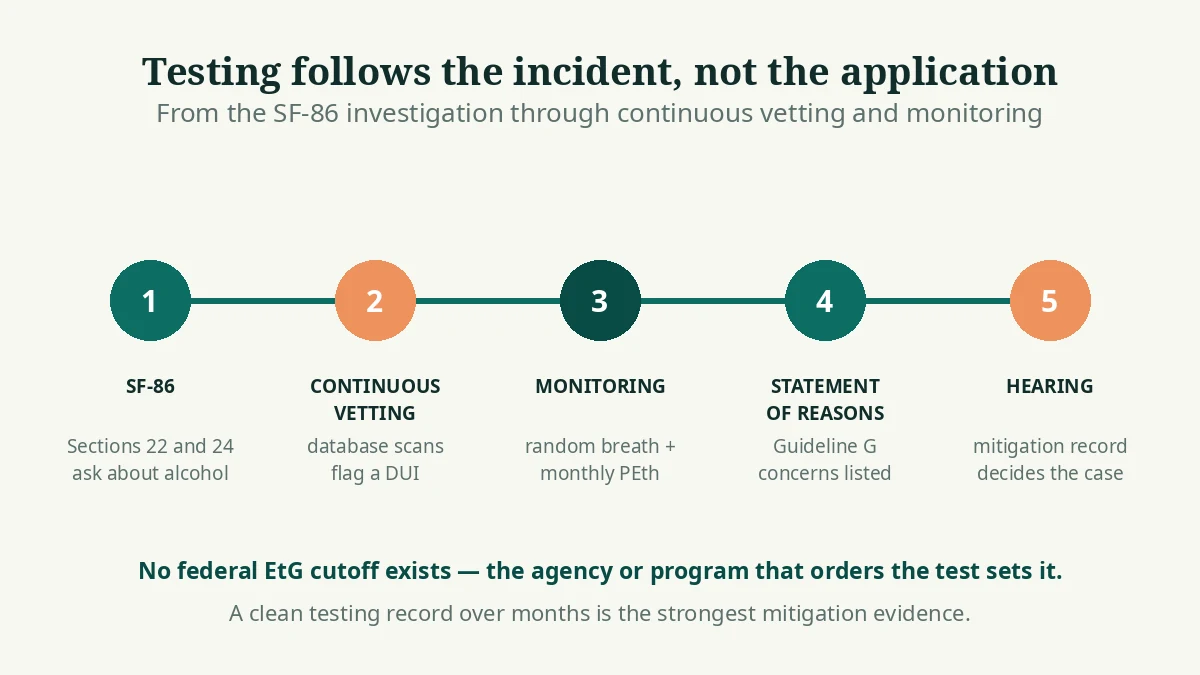
During the investigation. The Questionnaire for National Security Positions, Standard Form 86 (SF-86), asks about alcohol in two places. Section 22 covers the police record — in the last seven years, summonses, citations, arrests, charges, and convictions, plus a separate "ever charged" question for alcohol-related offenses. Section 24 asks whether alcohol has had a negative impact on the applicant's work or personal life in the past seven years, and whether the applicant has ever been ordered, advised, or asked to seek alcohol counseling or treatment. EtG or PEth testing is not a standard part of the SF-86 investigation — it appears when an alcohol concern already exists.
After an incident, under continuous vetting. Clearance holders must self-report arrests under Security Executive Agent Directive 3 (SEAD 3), and DCSA guidance says to report any arrest regardless of charges. Continuous vetting runs database scans in the background, so a DUI will be uncovered during an initial investigation, a reinvestigation, or a continuous-evaluation scan even if it is never self-reported. Once an incident surfaces, the security office may order monitoring while the concern is adjudicated — random breath testing and monthly PEth, exactly as in the 2023 Department of Energy case, where the negative results helped restore it.
While a concern is being resolved. If the adjudicator issues a Statement of Reasons (SOR) setting out the Guideline G concerns, the holder can respond in writing and request a hearing before a DOHA administrative judge. Testing during this period is usually voluntary but strategic: a run of negative EtG and PEth results, documented over months, is evidence of sustained abstinence.
What a positive result can mean
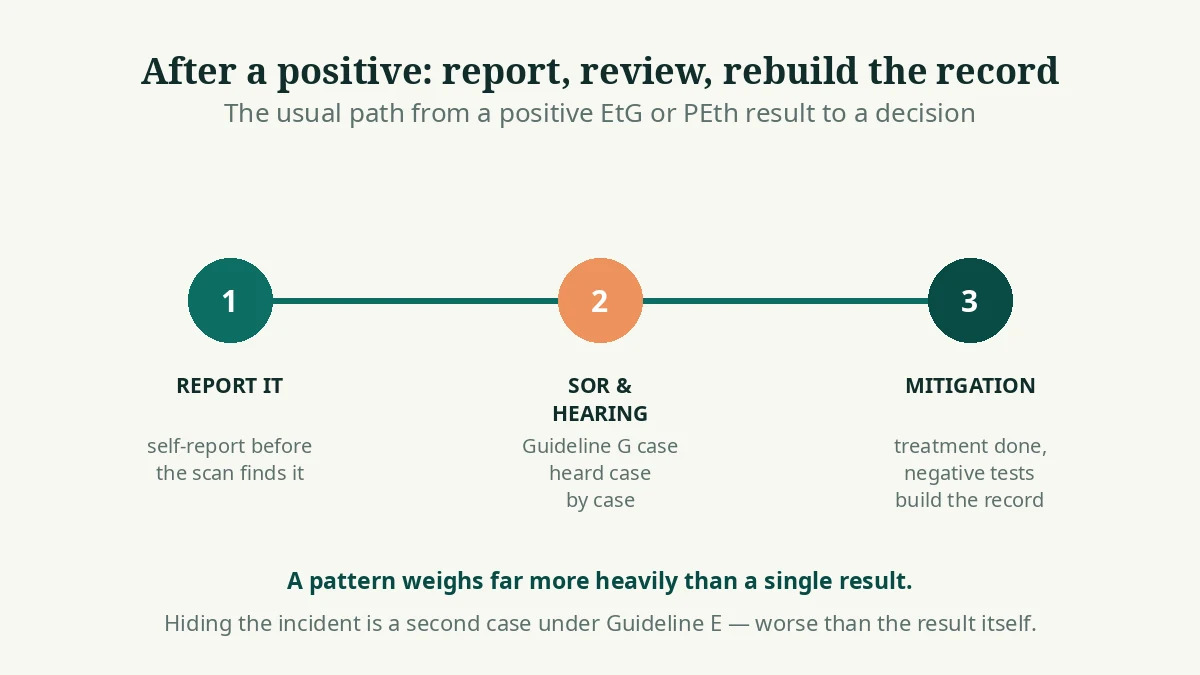
A positive EtG or PEth result is evidence of drinking inside the window, not a verdict. In an active investigation it becomes a fact the adjudicator weighs alongside everything else: the circumstances, how recent the drinking was, whether it was a single incident or a pattern, and what the person has done since. In monitoring, a positive usually means the security office is told. It does not by itself end a clearance.
What ends clearances more reliably is the pattern around the result. The DOHA denial turned on a pattern — repeated incidents, a failed program, continued drinking — not on a single test. The Department of Energy restoration turned on the opposite pattern: treatment completed, abstinence sustained, months of negative tests to prove it. Context matters: a low-level EtG positive at 100 ng/mL is treated differently from a PEth above 200 ng/mL. Our guide to reading EtG results explains what different levels mean.
And there is one result worse than a positive test: a lie about it. Any incident of intentional material falsification on the SF-86 is itself a disqualifying condition under Guideline E (Personal Conduct) — and adjudicators are told to consider whether the person "voluntarily reported the information" and "was truthful and complete in responding to questions." A self-reported DUI with treatment underway is a manageable Guideline G case. The same DUI discovered by a database scan, after a false answer on the form, is a Guideline G case plus a Guideline E case. Our DUI testing guide covers how courts use EtG.
Real-world scenario: four drinks Saturday, a clearance test Tuesday
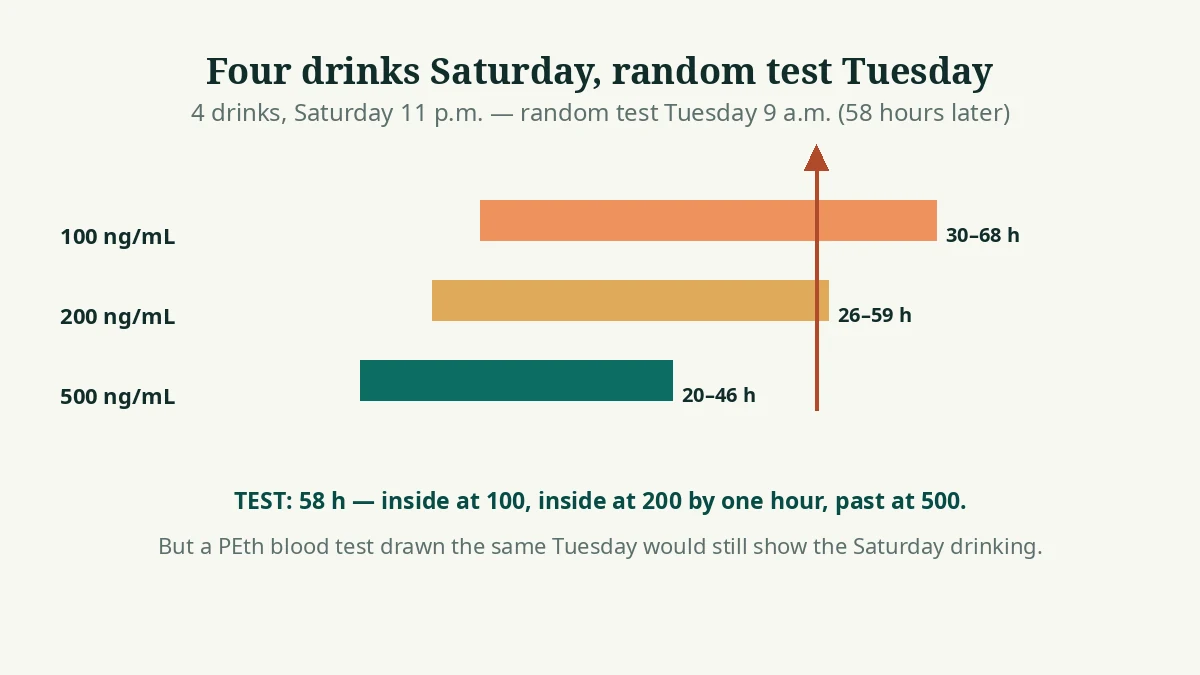
A federal contractor holds a Secret clearance and is under employer-ordered monitoring after a DUI. He has four drinks on Saturday night, the last at 11 p.m. Tuesday at 9 a.m. — 58 hours later — he is called for a random sample.
At 100 ng/mL, three to four drinks are modeled at roughly 30 to 68 hours — inside the window. At 200 ng/mL (26 to 59 hours) it is still open, by one hour. At 500 ng/mL (20 to 46 hours) it closed twelve hours earlier. Same person, same weekend, same test — the cutoff decides the EtG answer.
But the EtG answer is not the whole answer. A PEth blood test drawn the same Tuesday would still show the Saturday drinking — PEth reflects the past two to four weeks, and four drinks can push it above 20 ng/mL. Under monitoring, a single positive after a DUI undermines the mitigation the whole case rests on.
What clearance holders should know before a test
Report before you are caught. If you are arrested for a DUI, tell your facility security officer before the database scan does — SEAD 3 requires it. On the SF-86, answer the alcohol questions completely.
Tell your security office about incidental exposure first. At the sensitive 100 ng/mL cutoff, heavy use of alcohol-based hand sanitizer or mouthwash can produce low EtG levels that cross the threshold. At 500 ng/mL that is unlikely. If a result is contested, ask for LC-MS/MS confirmation.
Keep the paper: treatment certificates, counseling records, and a run of negative test results are what adjudicators weigh — assertions without documents carry little weight. Two cautions: an EtG level is not a blood alcohol level — there is no 0.08 equivalent, and a positive proves drinking inside the window, not impairment. And drinking water does not erase EtG — labs check creatinine to catch diluted samples.
Using the EtG calculator before a test
The EtG calculator estimates the same detection windows the table above uses, from drinks, hours since your last drink, and the cutoff that applies. Read the result as a range, never a pass date — it cannot tell you whether you are meeting your clearance obligations, and it says nothing about PEth. Run your numbers through the calculator. For the monitoring side, the monitoring programs guide explains how programs use EtG results, and the employment testing guide covers what happens when a job is on the line.
Frequently asked questions
Does a security clearance investigation include an EtG test?+
Not as a standard part of the SF-86 investigation. The investigation itself is records, interviews, and the questionnaire — Section 22 covers the police record and Section 24 covers alcohol use. EtG or PEth testing appears when an alcohol concern already exists: after a DUI surfaces in continuous vetting, during employer-ordered monitoring, or as part of a mitigation plan the clearance holder builds to show sustained abstinence. The test follows the incident; it is not a routine step in applying.
What EtG cutoff do federal agencies use for security clearance?+
No single federal EtG cutoff exists for security clearances. No federal agency publishes one, and SEAD 4 sets adjudication standards, not laboratory thresholds. Where EtG is used, the cutoff is set by the agency, employer, or laboratory that orders the test — commonly 100 ng/mL where abstinence must be verified strictly, or 500 ng/mL where the program wants to screen out incidental exposure, the level SAMHSA's 2012 advisory recommended. Ask whoever ordered the test which cutoff applies, because the same urine sample can be positive at one cutoff and negative at the other.
How long after drinking will an EtG test for security clearance be positive?+
It depends on how much was drunk and the cutoff. At 100 ng/mL, our modeled ranges are: 1–2 drinks, 23–53 hours; 3–4 drinks, 30–68 hours; 5–7 drinks, 38–85 hours. At 500 ng/mL the same amounts clear roughly a day sooner. These are ranges, not promises for one person — weight, drinking speed, and hydration all move the window. And in a clearance case the EtG window is only half the story: a PEth blood test can still show drinking from two to four weeks earlier, long after EtG has cleared.
Can PEth catch drinking that EtG misses in a clearance case?+
Yes — that is exactly why the security environment pairs them. Urine EtG catches drinking from roughly the past one to three days (up to about 80 hours after heavy drinking); PEth, measured in blood, reflects drinking over the past two to four weeks, with a half-life of about 4 to 10 days. The interpretation bands proposed for security use are below 20 ng/mL light or no consumption, 20 to 200 ng/mL significant consumption, and above 200 ng/mL heavy consumption. Stopping drinking a few days before a test may clear EtG, but it will not clear PEth — which is why monitoring programs rely on the pair, not on EtG alone.
Will a positive EtG test cost me my security clearance?+
Not automatically. A positive EtG or PEth result is evidence of drinking, and adjudicators weigh it with the whole person: the circumstances, how recent the drinking was, whether it was a single incident or a pattern, and what the person has done since. A Statement of Reasons may follow, and the holder can respond and request a hearing. Documented mitigation — treatment completed, sustained abstinence shown by negative tests, honest self-reporting — has restored clearances in published cases. What damages a case far more is a pattern of drinking, or hiding the incident: intentional falsification on the SF-86 is a separate disqualifying condition under Guideline E.
Do I have to report a DUI to my security office?+
Yes. Under Security Executive Agent Directive 3, clearance holders must report arrests, and Defense Counterintelligence and Security Agency guidance tells contractor personnel to report any arrest regardless of whether charges were filed. A DUI will also be uncovered by continuous-vetting database scans even if it is never self-reported. Reporting it yourself — before the scan finds it — is weighed in your favor when the case is adjudicated, and complying with all court orders and completing any required treatment are part of the mitigation record.
Evidence and limitations
This article summarizes published guidance and public records on EtG and PEth testing in security clearance cases, the SEAD 4 adjudicative guidelines, and the science of alcohol biomarkers. Group-level findings cannot predict one person’s result, and this article is educational only — it is not legal advice. Clearance cases are decided on the whole person, and agency practice differs; check your own agency’s or employer’s current requirements and consider qualified counsel for a live case.
- The Adjudicative Guidelines for Security Clearances: What Each Means — SEAD 4, the 13 guidelines, Guideline G (Alcohol Consumption), and the whole-person concept
- Security Clearances and a DUI: Reporting — SEAD 3 reporting duties, SEAD 4 Guideline G disqualifying conditions (para 22) and mitigating conditions (para 23), SF-86 Sections 22 and 24
- Alcohol Can Threaten Your Security Clearance Eligibility — how Guideline G concerns arise, SF-86 alcohol questions, continuous evaluation scans, and mitigation
- Public Intoxication and a Background Investigation — SF-86 Sections 22 and 24 in detail, SEAD 3 self-reporting, DCSA guidance to report any arrest
- DOE Office of Hearings and Appeals, PSH-23-0015 (March 29, 2023) — access authorization restored: two DWIs, random breath alcohol testing and monthly PEth testing at the employer’s behest (all negative), 90-day intensive outpatient program completed
- DOHA ISCR Case No. 04-11029 (March 27, 2006) — clearance denied: DWI arrest, two alcohol-related Army disciplinary actions, discharge for failing to complete an alcohol program, continued drinking
- Ulwelling W, Smith K. The PEth Blood Test in the Security Environment. J Forensic Sci. 2018;63(6):1634-1640 — PEth interpretation bands for security use: below 20 ng/mL light or no consumption, 20–199 significant, above 200 heavy
- Mayo Clinic Laboratories — Phosphatidylethanol Confirmation, Blood: PEth correlates with amount consumed in the previous 2 weeks, detectable 2 to 4 weeks; 20–200 ng/mL moderate, above 200 ng/mL heavy consumption
- Performance of PEth Compared With Other Alcohol Biomarkers in Occupational and Pre-Employment Medical Examination (2020) — PEth the single most positive biomarker; combination of short- and long-term biomarkers best
- SAMHSA advisory summary — EtG “scientifically unsupportable as the sole basis for legal or disciplinary action”; cannot distinguish drinking from incidental exposure
- SAMHSA Advisory: The Role of Biomarkers in the Treatment of Alcohol Use Disorders (2006, revised 2012)
- McDonell et al. (2015) — EtG immunoassay cutoff sensitivity in alcohol-dependent outpatients (1,589 samples)
- Mackus et al. (2017) — EtG detection and elimination kinetics after controlled alcohol intake
- EtG Calculator Pro — PEth Calculator: how PEth complements EtG with a longer detection window, and how the 20 / 200 ng/mL bands are read
- EtG Calculator Pro — Alcohol Biomarkers: EtG, EtS, and PEth compared