PEth calculator: the short answer
A PEth test is a different kind of test from the EtG urine test most people know. A PEth calculator estimates a window in weeks, not hours — PEth (phosphatidylethanol) is measured in blood, builds up in red blood cell membranes while you drink, and clears very slowly once you stop.
The calculation is simple: take the measured PEth level, apply the half-life of roughly 4 to 10 days, and count half-lives down to the 20 ng/mL cutoff. A level of 250 ng/mL at a 7-day half-life falls to about 125 after one week, about 63 after two, about 31 after three, and about 16 — below the cutoff — after four. At a 4-day half-life it clears in about two and a half weeks; at 10 days, in about five.
| EtG test | PEth test | |
|---|---|---|
| Full name | Ethyl glucuronide | Phosphatidylethanol |
| Sample | Urine (also blood, hair) | Whole blood, or dried blood spot |
| How it forms | Glucuronidation in the liver | Phospholipase D, only when ethanol is present |
| Detection window | Hours to about 80 hours after heavy drinking | 2–4 weeks; up to ~5 weeks |
| Cutoffs | 100, 200, or 500 ng/mL | 20 and 200 ng/mL, agreed by international consensus |
| What it answers | Recent drinking, last few days | Drinking pattern over the last few weeks |
| Incidental exposure | Mouthwash can matter at 100 ng/mL | Cannot produce a meaningful level |
| Test method | Immunoassay screen, LC-MS/MS confirmation | Quantitative LC-MS/MS only |
What PEth is, and why it only forms after drinking
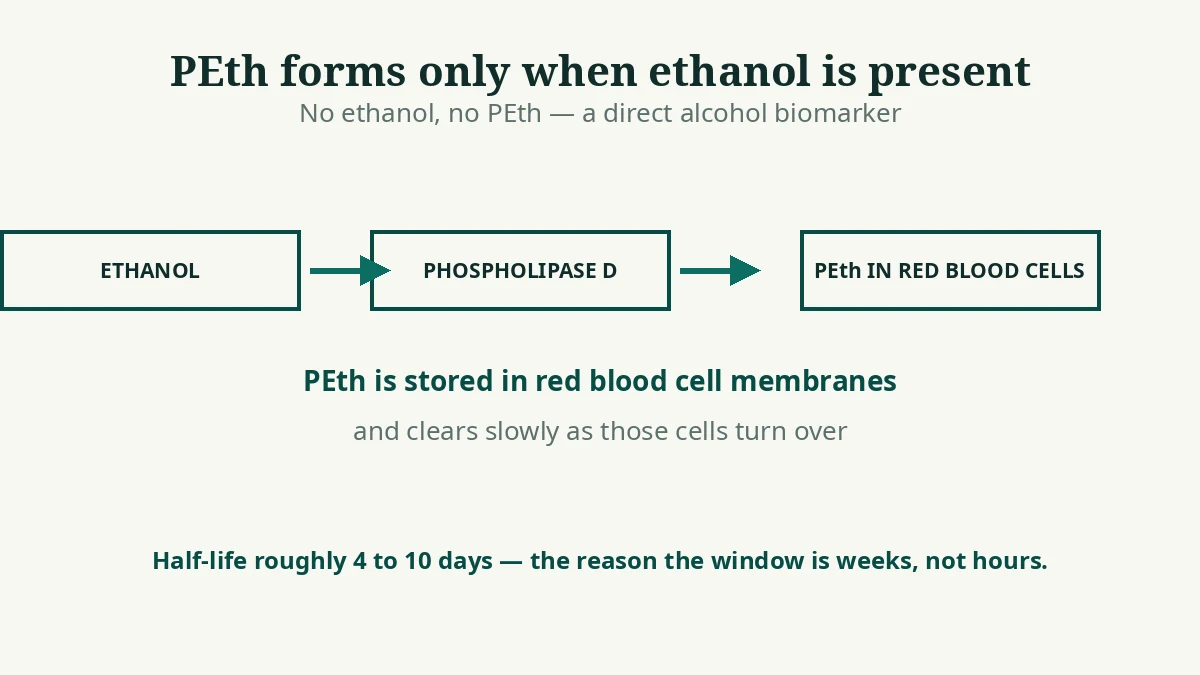
PEth is an abnormal phospholipid that forms only when ethanol is present — not a metabolite the liver makes as part of normal metabolism. An enzyme called phospholipase D normally breaks down phosphatidylcholine, a membrane fat. When ethanol is around, the enzyme instead attaches the ethanol to the fat molecule, creating phosphatidylethanol. No ethanol, no PEth — which is why PEth is described as a direct alcohol biomarker with effectively 100% alcohol specificity.
Once formed, PEth is incorporated into red blood cell membranes, where it accumulates while drinking continues. Red blood cells live about 120 days, so PEth has a long, protected home. It becomes detectable in blood as soon as 1 to 2 hours after a single drinking episode and keeps rising with the amount and frequency of drinking. When drinking stops, the level falls slowly as red blood cells turn over.
How to read a PEth result: the 20 and 200 ng/mL cutoffs
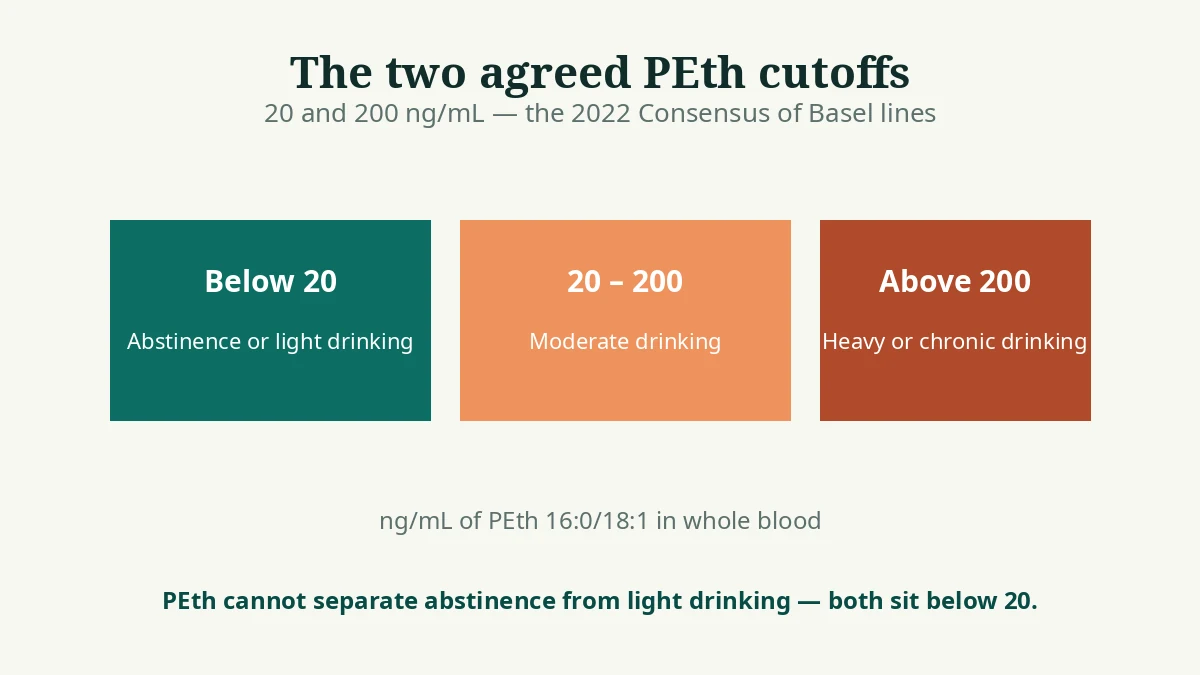
Unlike EtG, where every program picks its own cutoff from 100, 200, or 500 ng/mL, PEth interpretation has been harmonized. The 2022 Consensus of Basel — the first international agreement on PEth interpretation — defined the target measurement as PEth 16:0/18:1 in whole blood and set two cutoffs: 20 ng/mL and 200 ng/mL. Most laboratories now report against those same two lines.
Below 20 ng/mL is read as consistent with abstinence or very light, infrequent drinking — the negative line for most programs. Between 20 and 200 ng/mL suggests moderate, significant drinking over the preceding weeks. Above 200 ng/mL is read as strong evidence of heavy, frequent, or chronic drinking, roughly four or more standard drinks per day.
| PEth level (16:0/18:1) | Usual interpretation | What it suggests |
|---|---|---|
| Below 20 ng/mL | Negative | Abstinence or very light, infrequent drinking |
| 20 to 200 ng/mL | Moderate drinking | Significant alcohol consumption over the last few weeks |
| Above 200 ng/mL | Heavy drinking | Heavy, frequent, or chronic use, roughly 4+ drinks a day |
Two cautions belong next to that table. First, PEth cannot distinguish abstinence from light drinking — a person having a single drink most days and a person having none can both sit below 20 ng/mL. Second, the level does not convert into a drink count: the same intake produces different levels in different people. People with a body mass index of 30 or higher are less likely to show detectable PEth, while normal or high hemoglobin and advanced liver fibrosis raise the odds. The cutoffs guide interpretation; they are not a formula for reconstructing a drinking diary.
PEth vs EtG: detection windows side by side
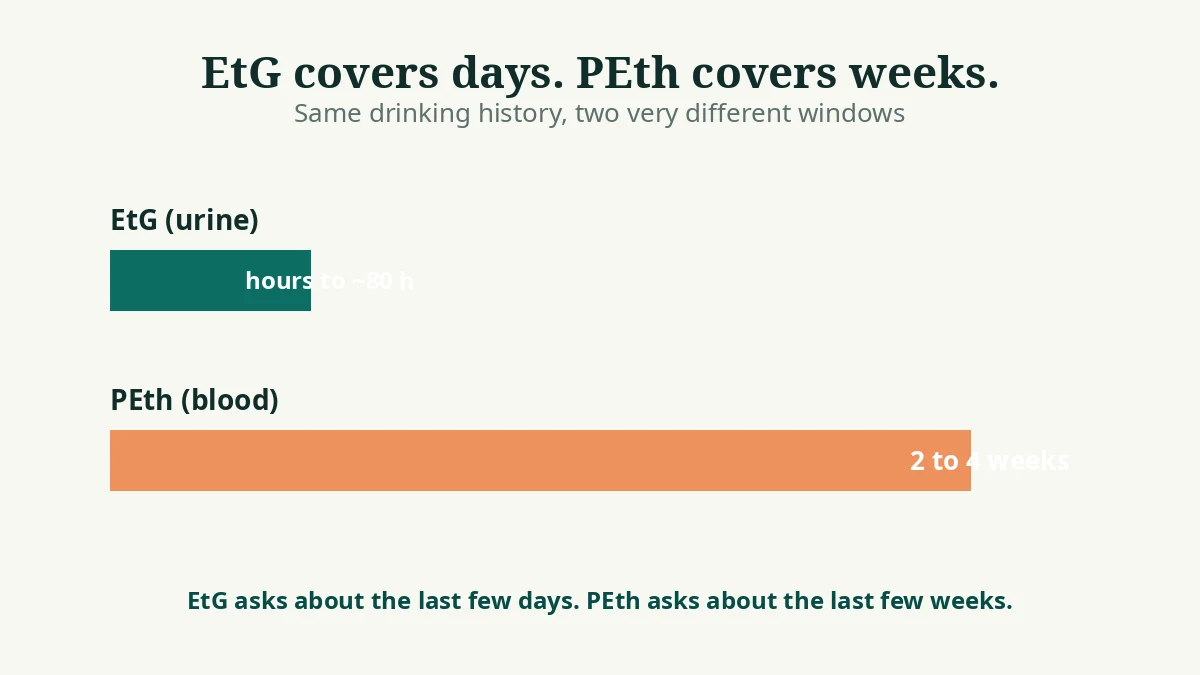
The window is where the two tests differ most, and it is the reason programs choose one or the other. EtG is a short-window test: after a single occasion it clears within about a day, and even after heavy drinking it is gone in about 80 hours. PEth is a long-window test: 3 to 12 days after a single occasion, and 2 to 4 weeks after regular drinking.
That difference also changes what a negative result means. A negative EtG says nothing about drinking more than a few days ago; a negative PEth says no significant drinking in the last few weeks. A positive EtG at 100 ng/mL could be one evening of drinking, or even heavy mouthwash use. A positive PEth at 150 ng/mL means a pattern of drinking over weeks — a single drink cannot produce it.
| Drinking pattern | EtG window (urine) | PEth window (blood) |
|---|---|---|
| 1–2 drinks, one occasion | Roughly 12–30 hours depending on cutoff | About 3–12 days |
| 3–4 drinks, one evening | Roughly 24–48 hours depending on cutoff | About 1–2 weeks |
| Heavy evening (8+ drinks) | Up to about 60–80 hours | About 2–3 weeks |
| Regular drinking over weeks | Still about 80 hours after the last drink | About 2–4 weeks; up to about 5 weeks |
How long does PEth stay positive? The half-life math
This is the calculation a PEth calculator actually performs, and it is worth seeing the arithmetic once so you can judge any estimate you are given. PEth declines with a half-life of roughly 4 to 10 days — the time it takes for the level to fall by half. The best-studied figure is a mean of about 7 days in people with alcohol use disorder going through withdrawal, with the decline slowing over subsequent weeks. After a single drinking episode, one study found a mean half-life closer to 3 days.
To estimate a clearance time, halve a measured level repeatedly until it drops below 20 ng/mL. At a 7-day half-life, 250 ng/mL needs about four half-lives — roughly four weeks; 60 ng/mL needs about two — roughly two weeks; 30 ng/mL needs less than one — under a week. At a 4-day half-life the same levels clear in about two and a half weeks, ten days, and four days; at 10 days, in about six weeks, three weeks, and ten days.
| Starting PEth level | Half-life 4 days | Half-life 7 days | Half-life 10 days |
|---|---|---|---|
| 250 ng/mL (heavy) | About 2.5 weeks | About 4 weeks | About 5–6 weeks |
| 120 ng/mL (moderate) | About 10 days | About 2.5 weeks | About 4 weeks |
| 60 ng/mL (moderate) | About 6 days | About 2 weeks | About 3 weeks |
| 30 ng/mL (light-moderate) | About 3 days | About 4–5 days | About 1 week |
Read that table as a range, not a schedule. The half-life is a population average, and an individual's clearance can sit anywhere in the 4-to-10-day band — or outside it, since the decline slows over weeks of abstinence. A calculator that returns a single date from one PEth level is hiding that uncertainty.
How PEth testing actually works
A PEth test starts with a blood sample, not urine: a standard venous blood draw into a lavender- or grey-top tube, or a dried blood spot from a finger prick — a few drops of blood dried on filter paper, mailed to the laboratory. The dried blood spot option is one reason PEth testing has spread into monitoring programs: collection is simpler than a supervised urine sample.
In the laboratory, PEth is measured by liquid chromatography–tandem mass spectrometry (LC-MS/MS), the same confirmation method used for EtG/EtS. There is no immunoassay screen for PEth, so there is no screening-versus-confirmation two-step: the LC-MS/MS result is the result. The laboratory reports PEth 16:0/18:1 — the most common PEth species, roughly 37 to 46% of total PEth — against the 20 and 200 ng/mL cutoffs.
Real-world scenarios: when a PEth test is ordered
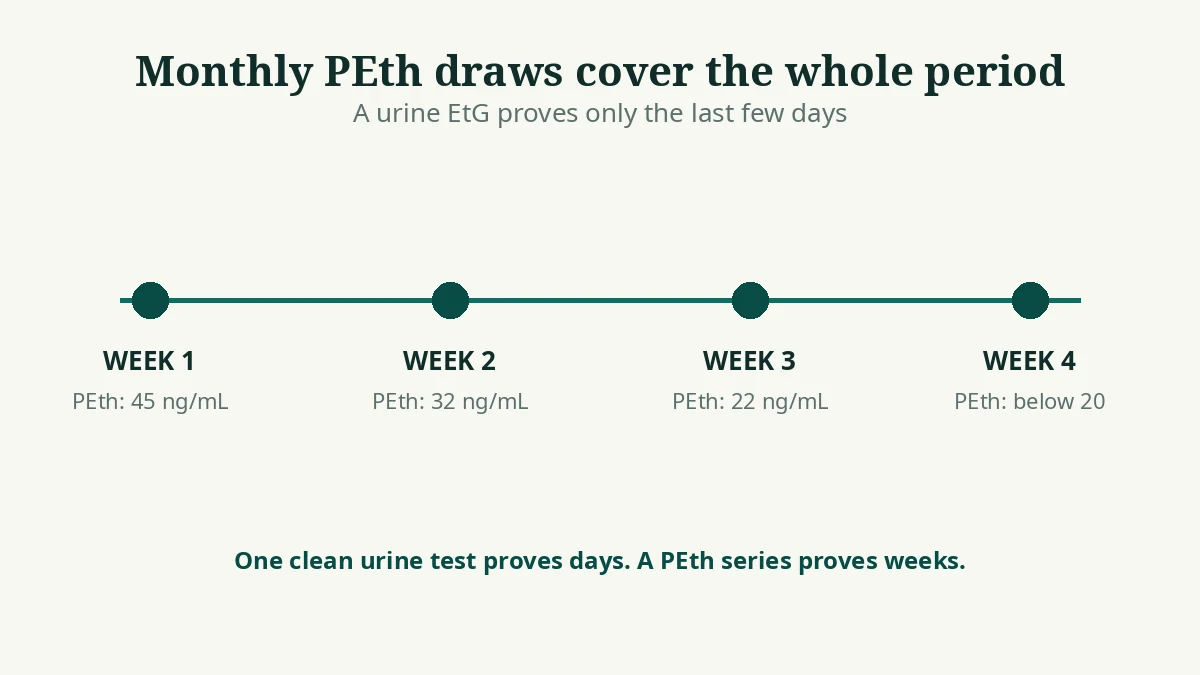
Scenario 1 — the monthly monitoring check. A person in a treatment program gives a blood sample once a month. Their PEth comes back at 45 ng/mL — moderate drinking in the last few weeks, clear evidence that abstinence was not maintained. A urine EtG test given a week after the last drink would have come back negative.
Scenario 2 — the Monday test after a heavy weekend. Someone drinks heavily at a wedding on Saturday and faces a urine EtG test on Monday morning, about 36 hours later, plus a PEth blood test the same day. The EtG is positive, as expected. The PEth comes back at 18 ng/mL — below the cutoff — because one heavy weekend does not build a large PEth store. Had the same person been drinking heavily for a month, the PEth would have been far above 200 ng/mL.
Scenario 3 — return to duty, or a custody decision. A commercial driver returning to duty after treatment, or a parent in a custody case, needs to demonstrate sustained abstinence over weeks, not just a clean urine sample on one morning. A PEth below 20 ng/mL, repeated over two or three monthly draws, is the kind of evidence programs accept — a single clean urine test proves only the last few days, while a PEth series covers the whole period.
What a PEth calculator can and cannot tell you
A PEth calculator is useful for one thing: estimating, from a measured level and a half-life range, roughly when the level should fall below 20 ng/mL. It cannot tell you how much someone drank, on which days, or whether they are safe to test next Tuesday. PEth levels rise with quantity and frequency, but the relationship is loose: the same intake produces different levels in different people, and the level reflects weeks of history, not a single episode. It cannot distinguish abstinence from light drinking, because both sit below 20 ng/mL, and it cannot predict your personal half-life, which varies with body mass, hemoglobin, and liver health.
Which test fits your situation
If the question is whether you drank in the last few days — a probation check, a random workplace test, a test the morning after an event — EtG is the test, and its window is the one to model. Our EtG vs PEth comparison walks through the two tests side by side.
If the question is whether you have been drinking regularly over the last month — monthly monitoring, a return-to-duty case, a custody evaluation — PEth is the test, and the half-life table above is the estimate to use.
Frequently asked questions
How long does PEth stay positive after drinking?+
Usually 2 to 4 weeks after regular or heavy drinking, and up to about 5 weeks after heavy, sustained drinking. After a single drinking occasion, PEth can remain detectable for 3 to 12 days. The exact time depends on the starting level and the half-life, which ranges from roughly 4 to 10 days between people.
What PEth level means you failed the test?+
Most programs use 20 ng/mL as the cutoff: below 20 is read as abstinence or very light drinking, 20 to 200 suggests moderate drinking, and above 200 points to heavy or chronic drinking. A level above 20 is usually treated as evidence of meaningful alcohol consumption, but the program ordering the test decides what consequence, if any, follows.
Can one night of drinking cause a positive PEth test?+
A single heavy night can produce a detectable PEth level for 3 to 12 days, but it rarely pushes the level above 200 ng/mL, and often stays below 20 ng/mL after a moderate evening. PEth measures accumulated drinking over weeks, so one isolated episode is much less likely to produce a high result than a pattern of regular drinking.
Is PEth more accurate than EtG?+
It answers a different question, not a better version of the same one. PEth is more sensitive for detecting a drinking pattern over weeks, and it cannot be affected by mouthwash, hand sanitizer, or urine dilution the way EtG can. But EtG is better for detecting drinking in the last few days, and PEth cannot distinguish abstinence from light drinking. Programs often order both.
Can drinking water or detox products lower a PEth level?+
No. PEth is stored in red blood cells and reflects weeks of drinking history, so hydration, detox drinks, and dilution do not change the level. Only time lowers it, at a half-life of roughly 4 to 10 days. Claims that a product can clear PEth quickly are not supported by research.
Does a PEth test show exactly how much I drank?+
No. PEth levels rise with the amount and frequency of drinking, but the relationship is loose: the same intake produces different levels in different people, and factors such as body mass, hemoglobin, and liver health shift the result. PEth is best read as evidence of a drinking pattern over weeks — light, moderate, or heavy — not as a drink count.
What is the difference between a PEth calculator and an EtG calculator?+
An EtG calculator estimates a detection window in hours, from a drink count and a urine cutoff, usually up to about 80 hours. A PEth calculator estimates a window in weeks, from a measured blood PEth level and a half-life of 4 to 10 days, counting down to the 20 ng/mL cutoff. Use the EtG calculator for the last few days and the PEth estimate for the weeks before them.
Evidence and limitations
This article summarizes published research on phosphatidylethanol (PEth) detection windows, cutoffs, and half-life, and how PEth compares with EtG. Group-level findings cannot predict one person’s result, and this article is educational only — it is not medical or legal advice.
- SAMHSA Advisory: The Role of Biomarkers in the Treatment of Alcohol Use Disorders (2006, revised 2012)
- American Family Physician (2023) — Phosphatidylethanol Test for Identifying Harmful Alcohol Consumption (PEth detectable up to 4 weeks; 20 ng/mL threshold for moderate to heavy use)
- Labcorp — Phosphatidylethanol (PEth) test information (LC-MS/MS; detectable ~2–3 weeks after prolonged or heavy drinking; >20 ng/mL = moderate to heavy consumption)
- Phosphatidylethanol — 2022 Consensus of Basel (PEth 16:0/18:1 target measurand; 20 and 200 ng/mL cutoffs; half-life 4.5–10 days in the first week)
- Wurst et al. (2009) — PEth as a direct alcohol biomarker (formation, half-life, and detection window)
- Dahl et al. (2002) — EtG detectable 22.5–31.5 h after ~0.5 g/kg ethanol, half-life ~2.5 h
- McDonell et al. (2015) — EtG immunoassay cutoff sensitivity in alcohol-dependent outpatients (1,589 samples)