Does DOT use an EtG test?
Ask a truck driver what a "DOT EtG test" is and you will get a confident answer — and it is usually wrong. The U.S. Department of Transportation does not use urine EtG testing for its alcohol tests. Under 49 CFR Part 40, the federal rule that governs all DOT drug and alcohol testing, an alcohol test is a breath test or a saliva test. The screening sample is collected with an alcohol screening device or an evidential breath testing device (EBT) approved by the National Highway Traffic Safety Administration, and any confirmation test must use an EBT.
So where does the phrase "DOT EtG test" come from? From the places around the DOT rules, not from the rules themselves. A carrier can run its own non-DOT alcohol testing alongside the DOT program — many do, using urine EtG to check whether a driver has been drinking at all in the past few days. A Substance Abuse Professional (SAP) overseeing a driver's return to duty can order EtG urine tests as part of follow-up monitoring, and a treatment program can require them. The confusion is understandable — same driver, same company, same clinic — but a different rulebook, with different windows, thresholds, and consequences.
What DOT alcohol testing actually uses
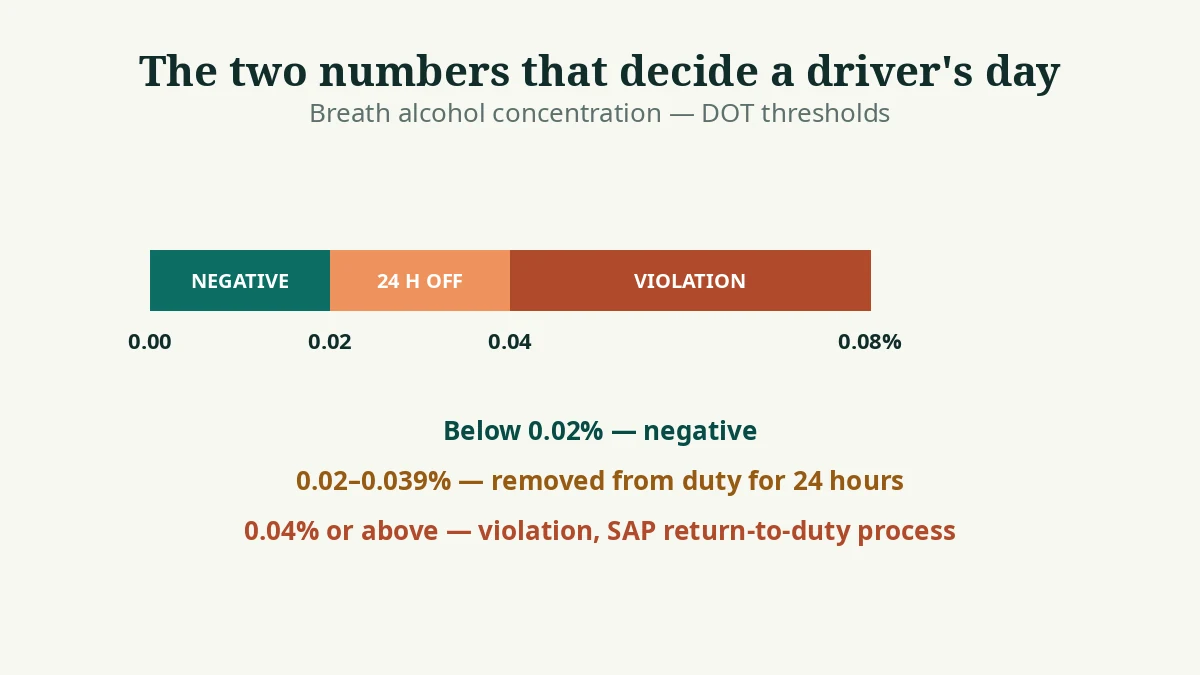
DOT alcohol testing answers one question: is this driver under the influence right now? A breath test measures alcohol concentration in the breath at the moment of the test, which tracks blood alcohol concentration closely. The screening test gives a quick reading; if it shows 0.02% or higher, a confirmation test with an EBT must follow, at least 15 minutes later so mouth alcohol can dissipate. The result is a number: 0.04% or above is a violation, 0.02% to 0.039% means 24 hours off duty, below 0.02% is negative.
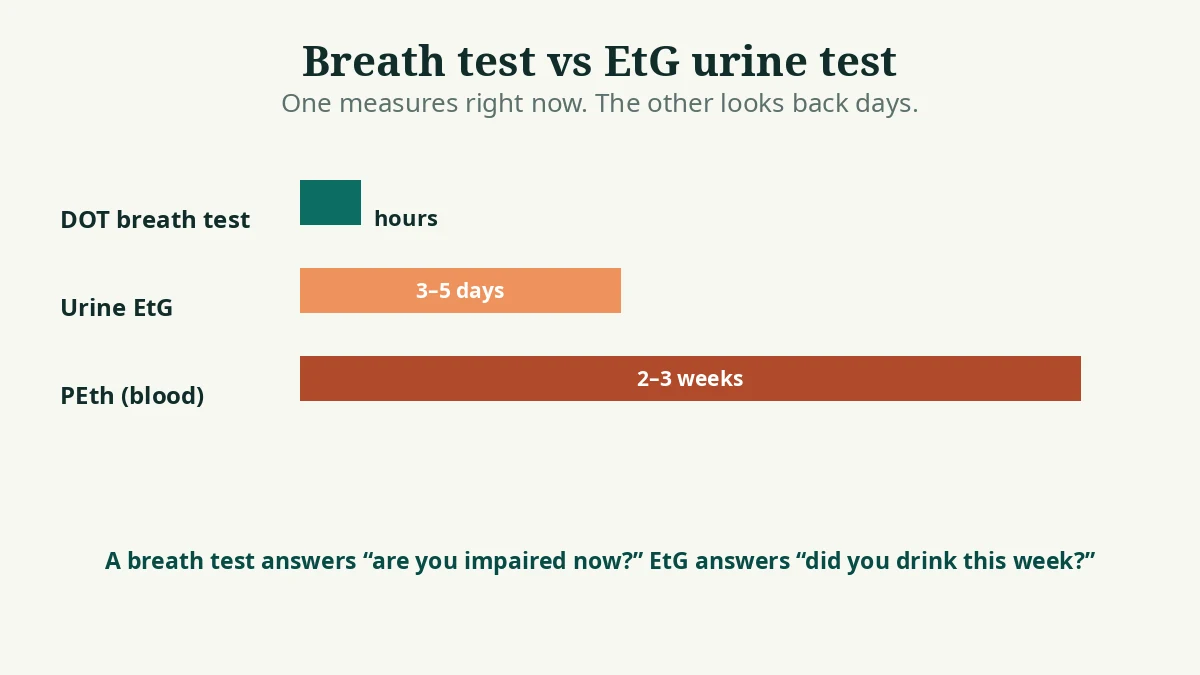
EtG works the opposite way. Ethyl glucuronide is a direct metabolite of alcohol that urine tests can detect for roughly three to five days after drinking — up to about 80 hours — long after alcohol itself has left the bloodstream. It cannot tell whether someone is impaired right now, which is exactly why the DOT does not use it: a driver can test positive on EtG days after drinking, long after any impairment has passed, and can be dangerously impaired while testing negative if the drinking happened outside the window. National Drug Screening puts it bluntly: EtG testing is "not at all recommended for workplace testing programs" because "the test is not measuring current impairment." For a safety-sensitive job, the question that matters is whether the driver is impaired at the wheel — and only a breath test answers it.
DOT breath test vs urine EtG compared
| DOT alcohol test (breath) | Urine EtG test | |
|---|---|---|
| What it measures | Alcohol concentration right now | Drinking in the past 3–5 days |
| Sample | Breath (or saliva screening) | Urine, usually lab-confirmed |
| Result | A number: 0.02%, 0.04%, and so on | Positive or negative at a cutoff (100 or 500 ng/mL) |
| Shows impairment? | Yes — the test is about the moment | No — only that drinking happened |
| DOT status | The official DOT alcohol test | Not a DOT test; used by employers, SAPs, treatment programs |
The practical consequence: a driver who drank on Saturday and is breath-tested on Monday morning will almost certainly test negative — the alcohol is gone. The same driver given a urine EtG test on Monday could still test positive, because EtG lingers for days. Both results would be "correct." They measure different things.
When DOT tests a truck driver
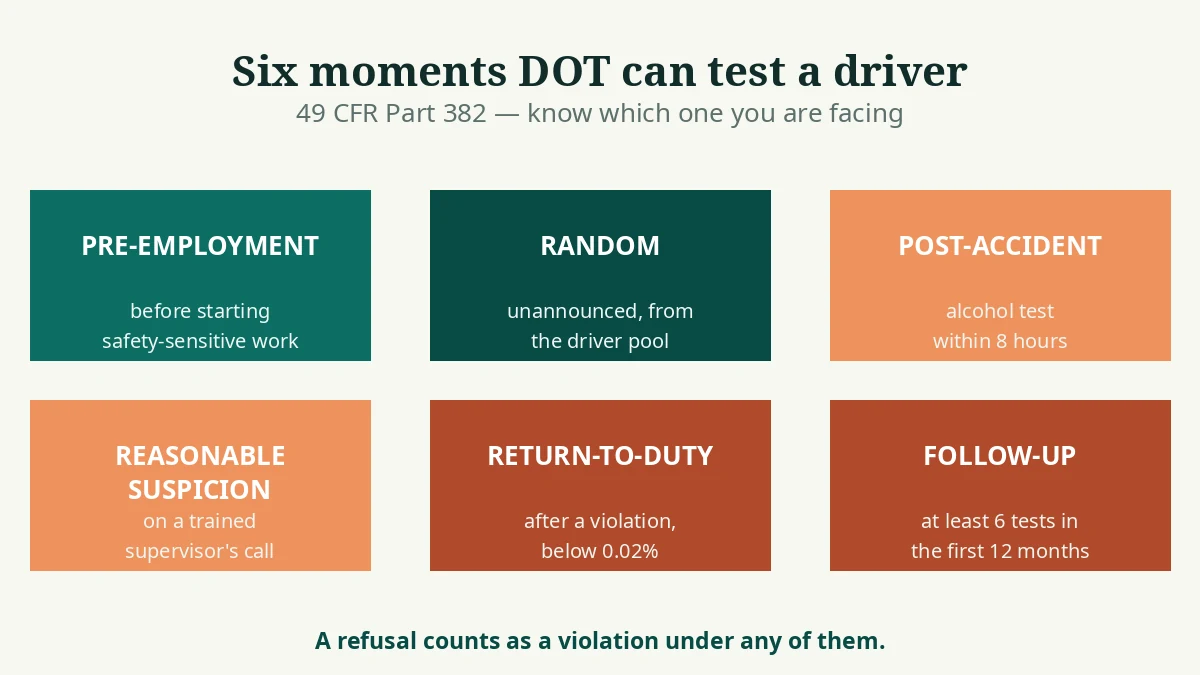
DOT testing is a program with six defined circumstances, under 49 CFR Part 382 for motor carriers and Part 40 procedures.
| Testing circumstance | When it happens | Alcohol test? |
|---|---|---|
| Pre-employment | Before starting safety-sensitive work | Permitted, not required (drug test required) |
| Random | Unannounced, from the employer's driver pool | Yes — 2026 rates: 10% alcohol, 50% drugs |
| Post-accident | After a qualifying accident (fatality or moving-violation citation) | Yes — alcohol within 8 hours, drugs within 32 |
| Reasonable suspicion | On a trained supervisor's observation of misuse signs | Yes — breath test, on the supervisor's determination |
| Return-to-duty | After a violation, once the SAP process is complete | Yes — must be below 0.02% |
| Follow-up | After returning to duty, on the SAP's schedule | Yes — at least 6 unannounced tests in 12 months, up to 5 years |
Two details catch drivers out. First, a random alcohol test can only be given around a safety-sensitive function — just before, during, or just after one — unlike a random drug test. Second, refusing a required DOT test counts as a violation, just like a positive result: the refusal is reported to the FMCSA Drug and Alcohol Clearinghouse, the driver is placed on prohibited status, and since November 18, 2024, the state must remove the driver's commercial driving privileges until the return-to-duty process is complete.
The two numbers that decide a driver's day: 0.02 and 0.04
Two thresholds decide a driver's day.
0.02% to 0.039%. This is not a violation, but the driver must be removed from safety-sensitive functions for at least 24 hours. No SAP process is required for this range, and no Clearinghouse report is made.
0.04% or above. This is a violation. The driver is immediately removed from safety-sensitive duties, the result is reported to the FMCSA Clearinghouse, and the driver cannot return to any DOT-regulated safety-sensitive job until they complete the full return-to-duty process: evaluation by a DOT-qualified SAP, completion of the education or treatment the SAP prescribes, and a return-to-duty test showing an alcohol concentration below 0.02%. An EtG cutoff is a different kind of number — a laboratory threshold, not an impairment measure; our 100 vs 500 ng/mL cutoff guide explains the difference.
Where EtG actually shows up for truck drivers
Non-DOT employer testing. A carrier is free to run its own alcohol testing program on top of the DOT program, as long as the DOT tests themselves follow Part 40. Many use urine EtG, which answers the question the DOT test cannot: has this driver been drinking in the past few days? These tests are governed by company policy and state law, not by the DOT — but a positive can still cost a driver the job, and a refusal can still have employment consequences under company policy.
SAP follow-up monitoring. After a violation, the SAP designs the follow-up plan: at least six unannounced tests in the first 12 months back on duty, spread across the year rather than bunched together, and potentially continuing for up to five years. The DOT follow-up tests themselves are breath or urine drug tests under Part 40 — but SAPs and treatment programs commonly add EtG urine tests, because EtG is the practical tool for verifying abstinence between the official tests.
Treatment and monitoring programs. Drivers in treatment, in a company return-to-work program, or in a court-ordered program after a DUI are often tested with EtG, because those programs care about abstinence over days and weeks, not impairment in the moment. Our recovery-program guide and probation EtG guide cover how those programs use the test.
Real-world scenario: Saturday drinks, Monday random test
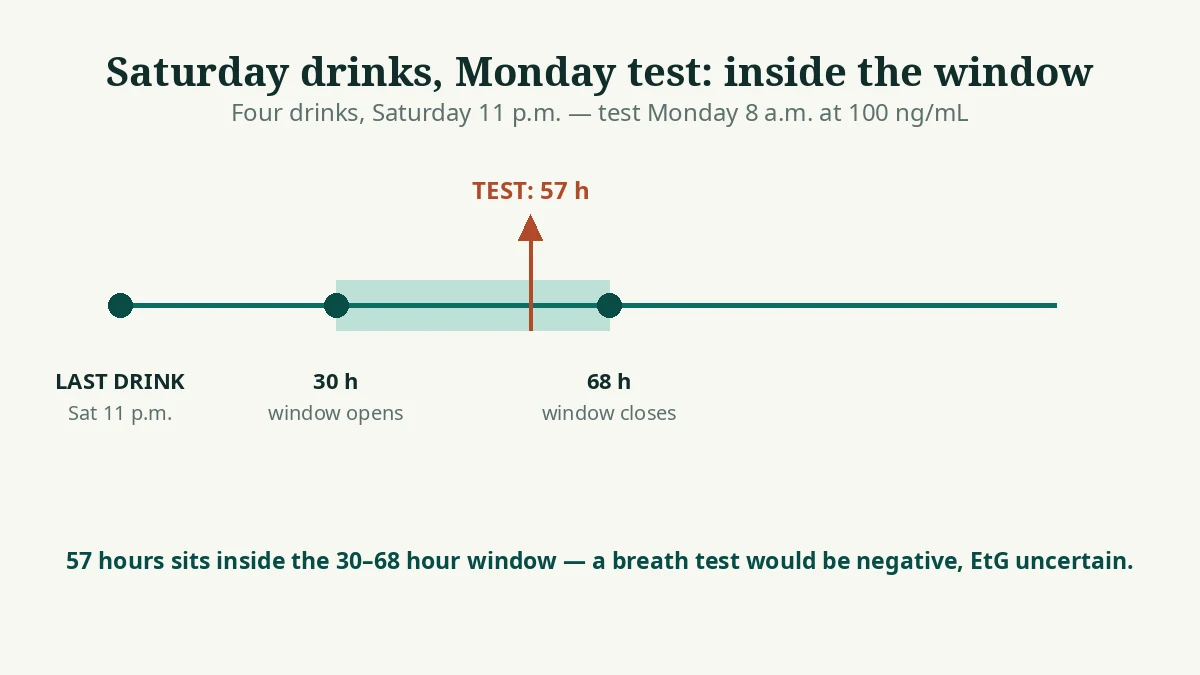
Take a driver with no violation history. On Saturday night he has four drinks over four hours, finishing at 11 p.m. On Monday morning at 8 a.m. — 57 hours after the last drink — his name comes up in the random pool and he is tested.
On a DOT breath test, he is almost certainly negative: 57 hours is far beyond the time alcohol stays in the breath. On a urine EtG test at 100 ng/mL, the picture is different — our EtG calculator chart puts four drinks at 100 ng/mL in a roughly 30 to 68 hour window, so at 57 hours a positive is entirely plausible. At 500 ng/mL the same four drinks give roughly 20 to 46 hours, so the 57-hour test would likely be negative. The test type, not just the timing, decides the outcome.
| Drinks (one session) | 100 ng/mL window | 200 ng/mL window | 500 ng/mL window |
|---|---|---|---|
| 1–2 drinks | 23–53 hours | 20–46 hours | 15–36 hours |
| 3–4 drinks | 30–68 hours | 26–59 hours | 20–46 hours |
| 5–7 drinks | 38–85 hours | 33–75 hours | 26–58 hours |
These windows come from the same model our calculator uses. They are ranges, not promises — and they apply to EtG urine tests, not to DOT breath tests, where the window is measured in hours.
What happens after a DOT alcohol violation
A violation at 0.04% or above — or a refusal — sets off a fixed sequence. First, immediate removal from safety-sensitive duties and a report to the FMCSA Clearinghouse, which puts the driver on prohibited status and triggers a CDL downgrade until the process is complete. Second, evaluation by a DOT-qualified SAP, who prescribes an education or treatment program Third, completion of the program, then a return-to-duty test under direct observation showing alcohol below 0.02% and a verified negative drug result. Fourth, the follow-up schedule: at least six unannounced tests in the first 12 months, and potentially up to 60 tests over five years.
The employer is not required to pay for return-to-duty or follow-up testing, and is not required to rehire the driver even after a successful return to duty. This article is educational only — it is not legal advice, and a driver facing a violation should talk to a qualified SAP and, where needed, an attorney who knows FMCSA rules.
Using the EtG calculator before a test
The EtG calculator on this site estimates the same detection windows the table above uses, from your own numbers: standard drinks, hours spent drinking, hours since your last drink, and the cutoff your program uses — usually 100 ng/mL when the test is about abstinence. It is most useful for understanding what an EtG test can and cannot show. Read the result as a range — before it starts is modeled as likely above the cutoff, after it ends as likely below, and inside it as genuinely uncertain — and treat the low end as the earliest plausible clear time, never a pass date.
Two warnings matter for drivers. First, the calculator models EtG urine tests only — it says nothing about a DOT breath test, where the relevant question is hours, not days. Second, timing drinking to the gaps in a testing schedule is a losing strategy under random testing: the tests are unannounced by design, a dilute or missed test can count as a failure in a follow-up program, and a refusal is a violation in its own right. The calculator's honest use is understanding the window, complying with the program, and building the clean record that gets a CDL back. For the same tests in other legal settings, see our DUI EtG guide and probation EtG guide.
Frequently asked questions
Does DOT use an EtG test for truck drivers?+
No. DOT alcohol testing under 49 CFR Part 40 uses a breath test (or a saliva screening test), not a urine EtG test. The DOT test measures alcohol concentration right now; EtG measures drinking from the past three to five days. When a truck driver takes an EtG test, it is almost always a non-DOT employer test, a treatment-program test, or follow-up monitoring ordered by a Substance Abuse Professional — not a DOT test itself.
Can a truck driver fail a DOT test days after drinking?+
Not on a DOT breath test — alcohol leaves the breath within hours, so a driver who drank on Saturday will normally test negative on a Monday breath test. But the same driver can fail a urine EtG test on Monday, because EtG stays detectable for roughly three to five days. The two tests measure different things, so the answer depends on which test is given.
What is the DOT alcohol limit for CDL drivers?+
A breath alcohol concentration of 0.04% or above is a DOT violation: the driver is removed from safety-sensitive work, reported to the FMCSA Clearinghouse, and must complete the Substance Abuse Professional return-to-duty process. A result of 0.02% to 0.039% is not a violation, but the driver must be removed from safety-sensitive duties for at least 24 hours. Below 0.02% is negative.
What happens if a CDL driver refuses a DOT alcohol test?+
A refusal counts as a violation, just like a positive result. The driver is immediately removed from safety-sensitive work, the refusal is reported to the FMCSA Drug and Alcohol Clearinghouse, and the driver is placed on prohibited status. Since November 18, 2024, the state must remove the driver's commercial driving privileges until the return-to-duty process is complete.
How many follow-up tests does a driver face after a DOT violation?+
At least six unannounced follow-up tests in the first 12 months after returning to duty, spread across the year rather than bunched together. The Substance Abuse Professional can order more, and the schedule can continue for up to five years. Follow-up tests are unannounced by design, and EtG urine tests are commonly added to the monitoring even though the official DOT follow-up tests are breath or drug tests.
Does a DOT violation go on a driver's record?+
Yes. A violation at 0.04% or above, or a refusal, is reported to the FMCSA Drug and Alcohol Clearinghouse, and the driver is placed on prohibited status. Employers must check the Clearinghouse before hiring a CDL driver, so a new employer will see the violation — and the completed return-to-duty process, once it is done.
Can an employer EtG-test a truck driver without DOT rules?+
Yes. A carrier can run its own non-DOT alcohol testing program alongside the DOT program, and many use urine EtG to check whether a driver has been drinking in the past few days. These tests are governed by company policy and state law, not by 49 CFR Part 40 — but a positive can still cost the driver the job, and a refusal of a non-DOT test, while not a DOT refusal, can still have employment consequences under company policy.
Evidence and limitations
This article summarizes published research on EtG detection windows, cutoffs, and half-life, and explains how DOT alcohol testing works under 49 CFR Part 40 and Part 382, based on FMCSA guidance and testing-industry practice. Group-level findings cannot predict one person’s result, and this article is educational only — it is not medical or legal advice.
- FMCSA — Implementation Guidelines for Alcohol and Drug Regulations, Chapter 7 (alcohol testing procedures: saliva, screening device, or EBT; confirmation by EBT; 0.04 and 0.02 thresholds)
- FMCSA Motor Carrier Safety Planner — Return-to-Duty Process and Testing (SAP evaluation, return-to-duty test below 0.02%, follow-up schedule, Clearinghouse reporting)
- National Drug Screening — DOT Alcohol Testing (EBT testing, 49 CFR Part 40 Subparts J–N, return-to-duty and follow-up testing, Clearinghouse consequences)
- National Drug Screening — Alcohol Testing: EtG, Urine, Breathalyzer, Saliva (EtG not recommended for workplace impairment testing; EtG used in follow-up monitoring, treatment, court and probation contexts)
- LegalClarity — What Is 49 CFR Part 40? DOT Drug & Alcohol Testing (six agencies, 0.04 violation and 0.02–0.039 removal, 50% drug / 10% alcohol random rates, follow-up minimums)
- SAMHSA Advisory: The Role of Biomarkers in the Treatment of Alcohol Use Disorders (2006, revised 2012)
- McDonell et al. (2015) — EtG immunoassay cutoff sensitivity in alcohol-dependent outpatients (1,589 samples)
- Mackus et al. (2017) — EtG detection and elimination kinetics after controlled alcohol intake