Why employers use EtG instead of a breath test
A breath test answers one question: are you impaired right now? An EtG urine test answers a different one: have you been drinking in the past few days? That difference is exactly why employers reach for it.
Breath alcohol clears within hours. EtG, formed in the liver when ethanol is conjugated with glucuronic acid, lingers in urine with a half-life of roughly 2–3 hours and remains detectable for up to about 80 hours after heavy drinking at the sensitive 100 ng/mL cutoff. For an employer, that window is the point: a Monday-morning EtG screen can see weekend drinking that a Monday-morning breath test never could.
This matters most where the stakes are highest. Safety-sensitive roles, healthcare positions, transportation jobs, and return-to-duty programs after an alcohol violation are the settings where EtG shows up most often. It is also common in monitoring-style arrangements — nursing boards, professional license programs, and employer-mandated abstinence programs — where the question is not “are you drunk at work” but “are you staying abstinent.”
Two federal-program boundaries worth making early. First, the DOT alcohol testing program itself does not use EtG at all — DOT alcohol testing is breath- and saliva-based under 49 CFR Part 40, and DOT does not require pre-employment alcohol testing; when transportation employers use EtG, it is under their own company policy or a professional monitoring program (more on this below). Second, the well-known federal workplace drug testing program covers five drug classes, and alcohol is not one of them — when an employer orders an EtG test, it is doing so under its own policy or a program-specific requirement, which is also why practices vary so much from one employer to the next. The employer writes the rules; the lab just runs the test.
EtG vs the other alcohol tests employers use
EtG urine testing is one tool in a kit. Employers choose between methods based on what question they need answered:
| Test | What it detects | Detection window | Typical employment use |
|---|---|---|---|
| Breath alcohol | Current impairment (BAC) | Hours | DOT reasonable-suspicion and post-incident testing |
| Urine EtG | Recent drinking (metabolite) | Up to ~80 hours | Pre-employment, random, return-to-duty |
| Blood PEth | Pattern of heavy drinking | 2–4 weeks | License monitoring, high-stakes abstinence programs |
| Hair EtG | Chronic use pattern | Up to ~3 months | Rare in employment; more common in family court |
| Oral fluid | Very recent use | ~24 hours | DOT screening step, on-site testing |
The pattern is straightforward: the closer a test gets to “right now,” the shorter its window and the better it answers impairment questions. The further back it reaches, the better it answers abstinence questions. EtG sits in the middle — recent enough to be relevant to workplace behavior, long enough to make abstinence verifiable. That middle ground is why it dominates return-to-duty and monitoring programs: PEth reaches further but costs more and requires blood, while breath cannot see last weekend at all.
Employers sometimes combine methods. A post-incident protocol might use a breath test for immediate impairment and an EtG test for the wider picture. If your paperwork mentions more than one test type, that is usually why.
When employment testing happens
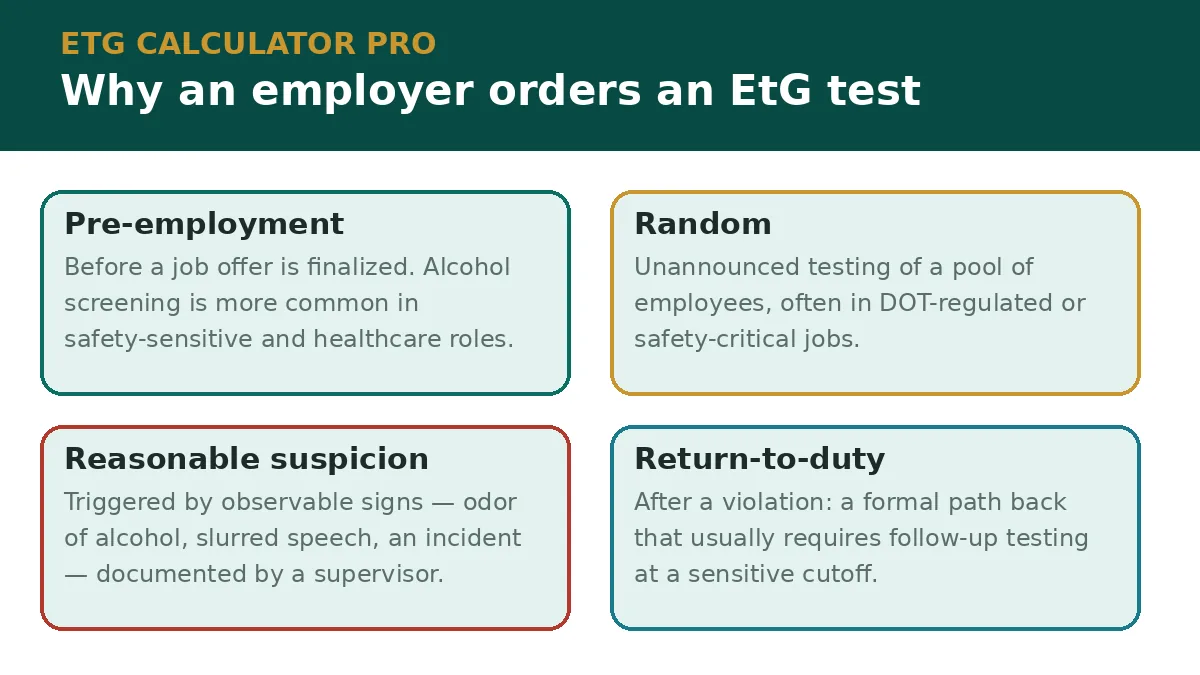
Not every job applicant faces an EtG test. Alcohol screening is far less universal than the standard 5-panel drug screen, and it tends to appear in specific situations:
Pre-employment. Some employers include alcohol screening before a job offer is finalized. It is more common in safety-sensitive, healthcare, transportation, and government roles than in general office hiring. If alcohol testing is part of your pre-employment screen, the offer letter or testing paperwork usually says so.
Random testing. Employees in a testing pool can be selected without warning. Random EtG testing is a creature of employer policy — most common in safety-critical jobs and workplaces with written zero-tolerance alcohol policies. (DOT’s own random alcohol program uses breath testing, not EtG.)
Reasonable suspicion / for cause. A supervisor who observes signs of alcohol use — the odor of alcohol, slurred speech, impaired coordination — can order a test. These tests are typically documented and time-sensitive, because the question is recent use.
Post-incident. After a workplace accident or safety incident, many employers test everyone involved. The goal is to establish whether alcohol was a factor, and the test happens as soon as practical after the event.
Return-to-duty and follow-up. After an alcohol violation, getting back to work usually runs through a formal process: evaluation, a treatment or education recommendation, and then follow-up testing. This is where EtG appears most aggressively — return-to-duty programs commonly test at the sensitive 100 ng/mL cutoff, precisely because the program needs to verify abstinence, not just sobriety on the day.
The DOT exception: federal alcohol testing is breath-based, not EtG
This deserves its own section because so much online content gets it wrong. The U.S. Department of Transportation’s alcohol testing rules (49 CFR Part 40) use breath and saliva testing — never urine EtG. DOT urine tests are for drugs only. The DOT framework also does not require pre-employment alcohol testing (pre-employment testing is required for controlled substances; an employer may add an alcohol test voluntarily but must apply it uniformly).
What DOT does require for safety-sensitive transportation employees: reasonable-suspicion testing, post-accident testing (attempted within 2 hours, up to 8), random testing (FMCSA rates: 50% of drivers per year for drugs, 10% for alcohol), and a formal return-to-duty process after a violation — evaluation by a Substance Abuse Professional, completed treatment/education, a negative return-to-duty test, then a minimum of 6 unannounced follow-up tests in the first 12 months. A breath result of 0.04 or higher is a violation; 0.02–0.039 means removal from duty for at least 24 hours.
So where does EtG fit for transportation workers? Through the employer’s own policy layered on top of DOT rules, or through professional monitoring programs (aviation’s HIMS program, for example, uses biomarker monitoring for participants). If you are a CDL driver, your DOT tests are breath tests — any EtG test you face comes from a separate company or program requirement. Knowing which regime ordered your test tells you which rules apply.
Pre-employment screening: what applicants should know
Pre-employment EtG testing raises the most questions, because applicants meet the process with no prior relationship to the employer. A few practical points:
Notice is usually short. Many employers send you to a collection site within 24–48 hours of the conditional offer, and some require same-day collection. The short fuse is deliberate — a longer delay would let the detection window close. If your offer letter mentions alcohol screening, assume the clock is already running.
Consent is part of the paperwork. You will sign forms authorizing the test and the release of results to the employer. Read the cutoff and the panel: the form sometimes names the substances tested and occasionally the cutoff. If it does not, you can ask the collection site what panel was ordered — they can usually tell you it includes EtG even if they cannot interpret policy.
A positive usually ends the candidacy. Most employers treat a failed pre-employment screen as a failed condition of the offer. Unlike return-to-duty programs, there is generally no treatment track for applicants — the employer simply moves to the next candidate. This is also why confirmation matters: a screening-only positive that costs someone a job offer is exactly the failure mode confirmation testing exists to prevent.
Know your program’s rules before you need them. Policies differ on retests, on whether prescription information or product-use explanations are accepted, and on waiting periods before reapplying. The time to read the policy is when you sign the consent form, not after a result comes back.
One boundary to keep in mind: this article describes how testing works, not your legal rights. Alcohol-related employment rules interact with disability and privacy law in ways that vary by state and situation. If a result threatens your livelihood and you believe the process was flawed, that is a conversation for an employment attorney, not a calculator site.
From collection cup to employer: the 5 steps
If you have never been through workplace testing, the process itself is the biggest unknown. It follows a standard sequence:
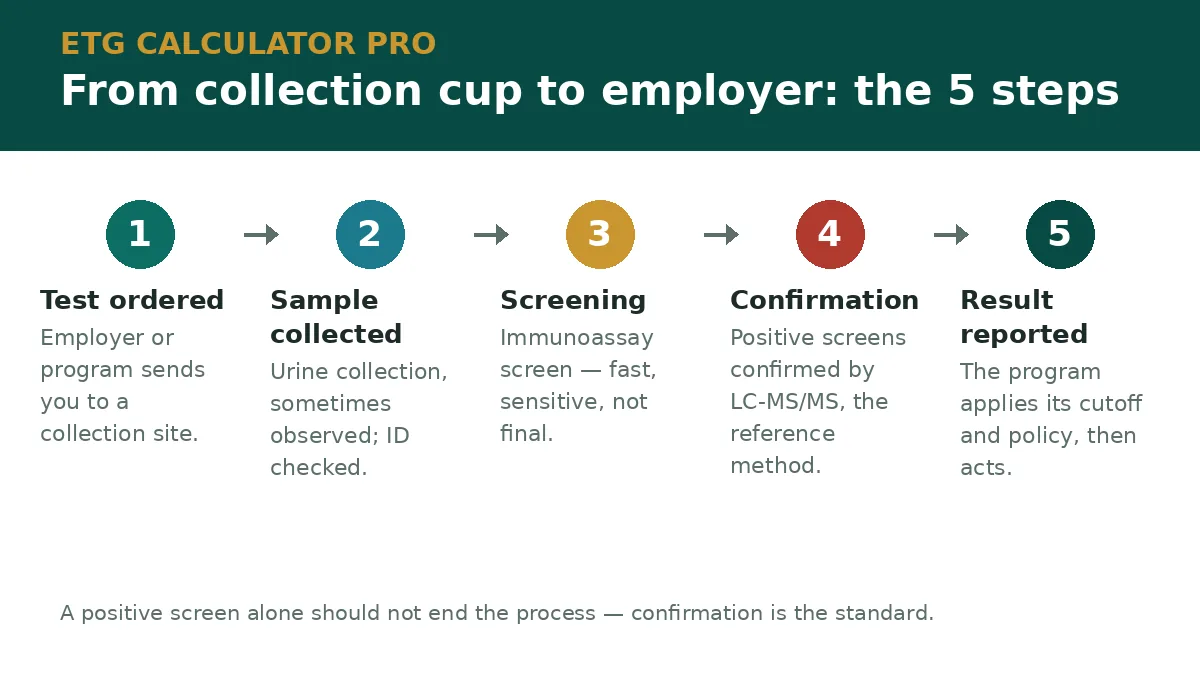
1. The test is ordered. Your employer or program directs you to a collection site — usually a clinic or lab patient service center — and gives you a deadline, sometimes same-day.
2. The sample is collected. You provide a urine sample under controlled conditions. For employment testing this is sometimes directly observed and sometimes not, depending on the program’s rules. Your ID is checked, the sample is sealed and labeled in front of you, and a chain-of-custody form is started.
3. Screening. The lab first runs an immunoassay screen: fast, automated, and sensitive. A screen is designed to catch everything suspicious — it is not the final word.
4. Confirmation. Any positive screen that carries consequences should be confirmed with a more specific method, typically LC-MS/MS (liquid chromatography–tandem mass spectrometry), which identifies EtG by its molecular signature rather than by antibody binding. Confirmation is what separates a careful program from a careless one.
5. The result goes to the employer. The lab reports a concentration (or negative). The employer then applies its own cutoff and policy: negative below the cutoff, positive at or above it, and whatever consequence the policy specifies. Note the division of labor — the lab measures; the employer decides.
Turnaround is usually 1–3 business days for a screen, longer if confirmation testing is needed.
The cutoff is the whole story
Workplace EtG results are reported in nanograms per milliliter, and two cutoffs dominate US practice. Everything about “will I pass” flows from which one your employer uses. Our 100 vs 500 ng/mL cutoff guide compares them in full; here is the employment short version.
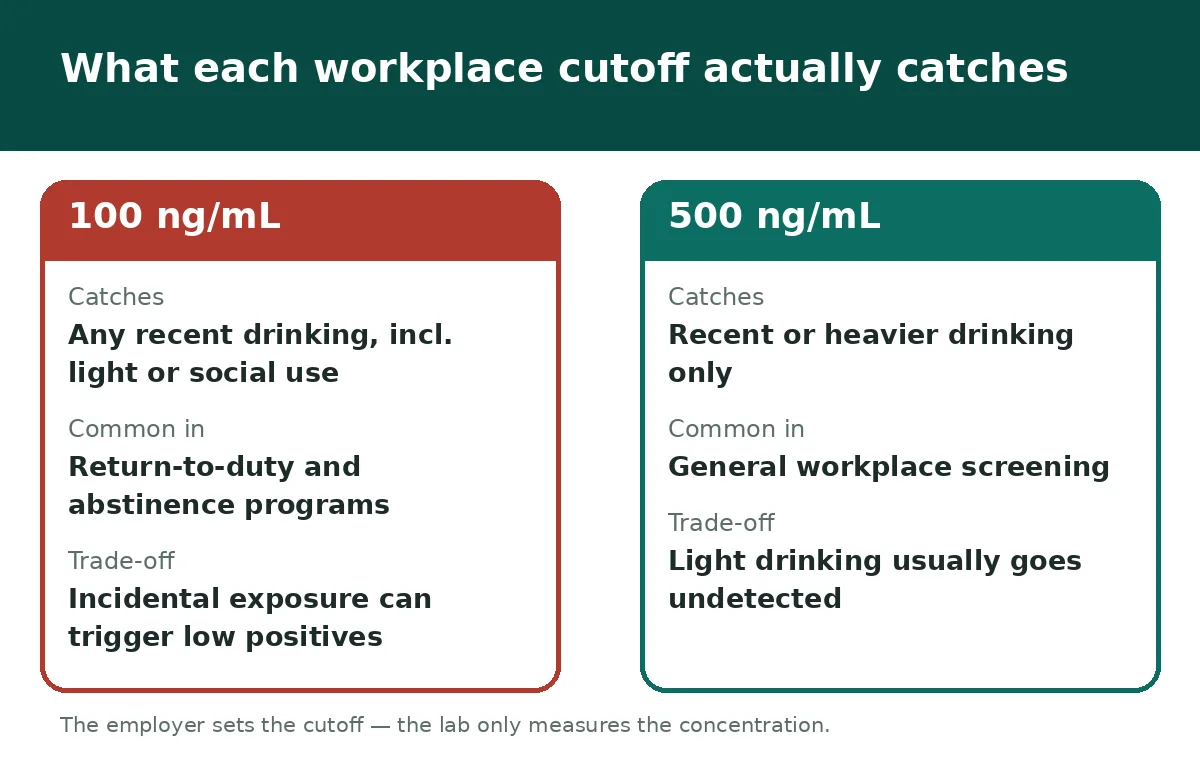
100 ng/mL — the sensitive cutoff. Catches any recent drinking, including light or social use. The numbers behind this come from McDonell et al. (2015), who analyzed 2,761 urine samples: at 100 ng/mL, the test detected 84% of heavy drinking one day out and 79% at five days, and caught more than three-quarters of light drinking for two days. The price of that sensitivity: at this level, a single drink is commonly detectable for up to about 24 hours, and incidental alcohol exposure (mouthwash, hand sanitizer, certain foods and medications) can occasionally produce low-level positives. Return-to-duty and abstinence-based programs favor it because missing drinking is the bigger risk for them.
500 ng/mL — the specific cutoff. Catches recent or heavier drinking only — in the same McDonell study, the 500 ng/mL cutoff detected 78% of heavy drinking for one day only, with light-drinking detection below 58% at two to five days. Light drinking usually goes undetected, and incidental exposure effectively disappears from the picture. General workplace screening leans this way when the goal is catching meaningful use without chasing every low-level result.
The same person, the same weekend, the same sample can be positive at 100 and negative at 500. If you are facing a test, the single most useful thing you can learn is which cutoff applies — it changes the answer more than any physiological factor.
One fairness note carries the weight of a federal advisory: SAMHSA’s biomarker advisory (2006, revised 2012) called using EtG as the sole basis for legal or disciplinary action “inappropriate and scientifically unsupportable,” and recommended confirming presumptive positives with GC/MS or LC-MS/MS. A careful employer treats a positive screen as the start of a process — confirmation, cutoff check, review — not as a verdict.
Detection windows: what a workplace test catches
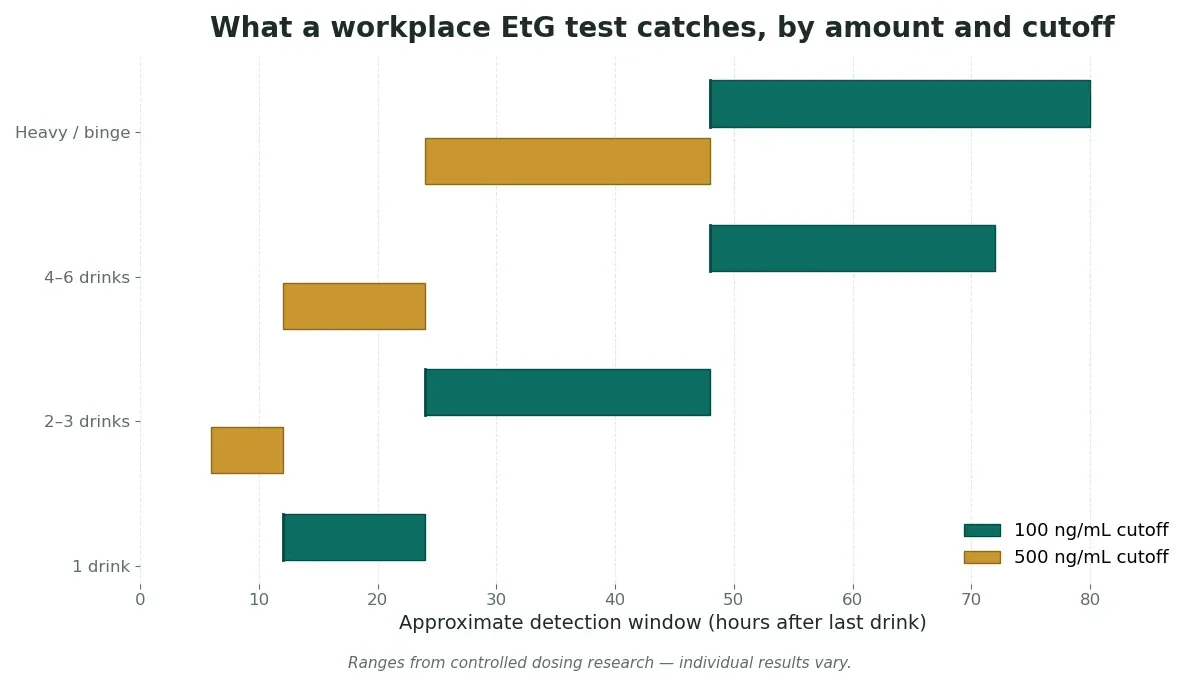
The table below compiles approximate urinary EtG detection windows from controlled dosing research, at each of the two common workplace cutoffs. These are ranges, not promises — pace of drinking, food, body composition, hydration, and individual metabolism move real results around.
| Amount consumed | ~100 ng/mL cutoff | ~500 ng/mL cutoff |
|---|---|---|
| 1 standard drink | Up to ~12–24 hours | Usually not detected |
| 2–3 drinks | ~24–48 hours | ~6–12 hours, often negative |
| 4–6 drinks | ~48–72 hours | ~12–24 hours |
| Heavy / binge episode | Up to ~80 hours | ~24–48 hours |
Read the table the way an employer does: at 100 ng/mL, the test is a wide net that reaches back three-plus days after heavy drinking and still catches a single drink from yesterday. At 500 ng/mL, it is a narrower net aimed at recent or substantial use.
Real-world scenarios
Friday night drinks, pre-employment screen Monday morning. Four or five drinks Friday, sample Monday at 9 AM — about 60 hours later. At 100 ng/mL, EtG from that episode is likely still detectable (the heavy-use window reaches ~80 hours). At 500 ng/mL, probably negative — the concentration has fallen below the higher threshold by then. This is the scenario where the cutoff decides everything.
Random test Tuesday after a quiet weekend. Two glasses of wine with dinner Saturday, random selection Tuesday morning — roughly 60+ hours after two drinks. Negative at either cutoff; even the sensitive threshold clears two drinks within about 48 hours.
Return-to-duty follow-up at 100 ng/mL after one beer. This is the strictest common setting. One beer Sunday evening, observed follow-up test Monday afternoon — about 20 hours later. At 100 ng/mL, likely positive: a single drink sits inside the ~24-hour window. In a return-to-duty program, that result can restart the process.
Post-incident test two hours after drinking. A workplace incident at 3 PM, test at 5 PM, after two drinks at lunch. EtG is still climbing toward its peak, which arrives a few hours after drinking — the result may understate what a later sample would show. Post-incident programs know this; some retest or combine EtG with breath testing for the full picture.
Healthcare worker, heavy sanitizer use, 100 ng/mL screen. A nurse in a monitoring program uses alcohol-based hand sanitizer dozens of times per shift and tests at 140 ng/mL — above the cutoff, but inside the band where SAMHSA urges careful interpretation. Published case reports document exactly this pattern. The right next step is confirmation testing and a documented review of exposure sources, not an automatic violation. At 500 ng/mL this scenario does not occur.
Safety-sensitive random test, wedding Saturday, test Monday. A warehouse forklift operator at a zero-tolerance facility attends a wedding Saturday (4–5 drinks) and is selected for a random EtG test Monday morning — about 40 hours later, at the facility’s 100 ng/mL cutoff. Verdict: likely positive — 4–5 drinks sit in the 48–72 hour band at the sensitive cutoff. The same Monday test at 500 ng/mL would likely be negative. Note this is the employer’s own program: a DOT-regulated random alcohol test would have been a breath test, not EtG.
What your result can and cannot prove
An EtG result is a concentration, not a story. It cannot tell your employer exactly when you drank, how much you drank, or whether you were impaired at work — and honest programs do not pretend otherwise. Research supports ranges, not reverse-engineering a Saturday night from a nanogram number. Any tool or person claiming to convert your result into an exact drink count is selling precision the science does not have. Our analysis of monitoring programs covers the gap between a lab number and a program decision in depth.
Incidental exposure. At the 100 ng/mL cutoff, frequent use of alcohol-containing mouthwash, heavy hand-sanitizer use (documented in healthcare workers), and certain medications and foods have produced low-level positives in published case reports. At 500 ng/mL this is effectively a non-issue. If your result is low and your cutoff is 100, incidental exposure is a legitimate question — and one reason SAMHSA urged careful interpretation of results in the 100–500 band.
Dilution. Labs routinely measure creatinine alongside EtG to check whether a sample was diluted — extra water lowers the EtG concentration, but a creatinine below about 20 mg/dL flags the sample as dilute. Most employment programs treat a dilute result as its own problem: a required retest, an observed recollection, or in some policies a violation. Drinking large volumes of water before the test is not a reliable strategy, and under monitoring rules it carries consequences of its own. How creatinine normalization works explains the science.
If the result comes back positive
This article cannot advise you on your employer’s policy — every program writes its own rules, and they differ. But the research literature supports a short checklist of questions any careful process should be able to answer:
Was the positive confirmed? A screening immunoassay alone, without LC-MS/MS confirmation, is not the standard for consequential decisions.
What cutoff was applied? A result of 180 ng/mL is positive at 100 and negative at 500. Make sure you know which threshold your program uses.
Is there a retest or appeal path? Evidence-informed programs have a defined process for disputed results rather than treating the first number as final.
Was the sample valid? Dilute or substituted samples get flagged by creatinine and other validity checks — know what your result actually says.
Document everything: the cutoff, the confirmation method, the collection conditions, any medications or products you used. If the stakes are high — a job offer, a license, a return-to-duty determination — programs expect disputes to arrive with specifics, not with general objections.
Frequently asked questions
Do all employers run EtG tests?+
No. The standard pre-employment 5-panel drug screen does not include alcohol, and most general employers never order EtG. It appears where the employer has a specific reason to check recent drinking: safety-sensitive and transportation roles, healthcare and license-monitoring programs, DOT-regulated follow-up pools, and return-to-duty programs.
How far back does an employment EtG test go?+
It depends on the cutoff and the amount. At the sensitive 100 ng/mL cutoff, heavy drinking is detectable up to about 80 hours, moderate drinking 48–72 hours, and a single drink up to roughly 24 hours. At 500 ng/mL those windows shrink to about 24–48 hours, 12–24 hours, and usually undetected for one drink.
Will one beer show up on a pre-employment EtG test?+
It can — at 100 ng/mL, one standard drink is commonly detectable for up to about a day. At 500 ng/mL, one beer usually stays below the threshold and goes undetected.
Can mouthwash make me fail an employment EtG test?+
At the 100 ng/mL cutoff, vigorous use of alcohol-containing mouthwash has produced low-level positives in published case reports — uncommon but real. At 500 ng/mL, mouthwash effectively cannot trigger a positive. Switching to an alcohol-free rinse removes the question entirely.
Can I dispute a positive EtG result?+
You can ask for the process to be checked: was the screen confirmed by LC-MS/MS, what cutoff was applied, is there a retest or appeal path, and was the sample validity confirmed. Document the cutoff, the confirmation method, collection conditions, and any medications or alcohol-containing products you used.
Does my employer see the exact ng/mL number?+
It depends on the program. The lab measures a concentration, but many employers receive only a positive/negative against their cutoff. In monitoring and return-to-duty programs the actual number is more often shared, because low-level results trigger a careful-interpretation process.
How long should I wait after drinking before an employment EtG test?+
There is no safe exact number of hours anyone can honestly give you — metabolism, dose, hydration, and the cutoff all move the answer. The research-backed ranges in this article are the best guide: at 100 ng/mL, allow the better part of 3–4 days after heavy drinking; at 500 ng/mL, roughly 1–2 days. No product sold to “beat” the test changes the underlying chemistry.
Where an EtG calculator fits
An EtG calculator takes the same inputs the research uses — drinks, timing, body weight, and the cutoff — and estimates a detection window from published pharmacokinetic ranges. For employment questions, the useful output is always a range (“up to ~48 hours at 100 ng/mL; likely clear at 500 ng/mL”), never an exact hour or an exact ng/mL number. If you want to check your own scenario, run your numbers through the calculator and compare the estimate against the ranges in this article — and treat any tool that promises a precise “you will pass at 2:30 PM” as entertainment, not evidence. Our detection timeline calculator and half-life explainer show how the underlying math works.
Evidence and limitations
This article summarizes primary research and public guidance on ethyl glucuronide testing in workplace and monitoring settings. Group-level findings cannot predict one person’s result.
- McDonell et al. (2015) — detection of light and heavy drinking at 100–500 ng/mL cutoffs across 2,761 samples
- Rosano & Lin — single-drink EtG kinetics and incidental hand-sanitizer exposure
- Mayo Clinic Laboratories — EtG/EtS test catalog: confirmation cutoffs and interpretation tiers
- Quest Diagnostics — EtG/EtS testing FAQ: detection windows and the EtS confirmation gate
- SAMHSA Advisory: The Role of Biomarkers in the Treatment of Alcohol Use Disorders (2006, revised 2012)
- U.S. DOT ODAPC — employee guide to 49 CFR Part 40 drug and alcohol testing
- FMCSA — implementation guidelines for alcohol and drug testing regulations
- Grodin et al. (2020) — reliability of point-of-care EtG tests at 100–500 ng/mL thresholds