The short answer: an EtG test for adoption checks recent drinking — it is not a routine home-study step
An EtG test for adoption is a urine test for ethyl glucuronide, a direct metabolite of alcohol. It answers one question: has this person drunk alcohol in roughly the past one to three days? It does not measure impairment, and it says nothing about whether someone is a good parent. In adoption and foster care, it is not a routine step.
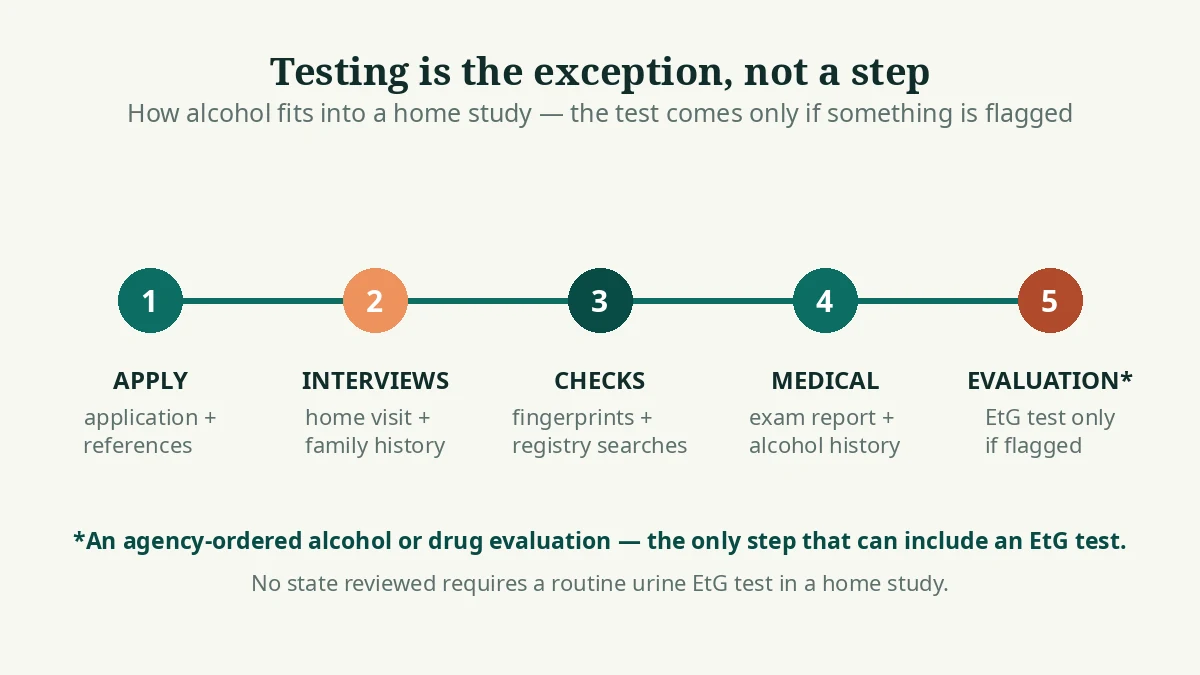
A home study — the preplacement assessment every prospective adoptive or foster parent goes through — is built from interviews, a home visit, references, a medical report, and background checks. The federal Adam Walsh Act of 2006 requires fingerprint-based crime database and child abuse registry checks for prospective foster and adoptive parents. Alcohol use is assessed through the interviews and the medical history, not a lab test. An EtG test appears only when an agency or a court orders one — and that distinction matters.
What a home study actually checks about alcohol
Every state asks about alcohol in the home study, but what happens when the answer is a problem varies — and no state reviewed names EtG, or any urine test, as a routine step.
| Rule | What it says about alcohol |
|---|---|
| Federal — Adam Walsh Act, P.L. 109-248 (2006) | Fingerprint-based national crime database + child abuse registry checks for all adults in the home. No alcohol test in the federal rule. |
| New York — 18 NYCRR § 421.16 | “Current abuse of alcohol or other drugs requires the rejection of an application.” The strictest wording reviewed. |
| Wisconsin — Ann. Stat. § 48.88; DCF 50.05(7)(d) | Petitioner must “not abuse alcohol or drugs.” Agency may require an alcohol or drug abuse evaluation and treatment records. |
| North Carolina — 10A NCAC 70E.1104 (foster) | “No indication of alcohol abuse, drug abuse, or illegal drug use”; the assessment covers drug or alcohol abuse history. |
| Florida — 65C-45.003 (foster) | The Unified Home Study covers current or past alcohol and substance abuse and treatment; the inspection notes where alcohol is stored. |
| Maryland — COMAR 07.02.25.06 | Cannot approve an applicant unable to provide for a child's welfare “because of abuse of alcohol or other controlled dangerous substances.” |
| Missouri — 13 CSR 35-73.080 | Social history must record “the extent of alcohol and drug use”; medical reports no more than 12 months old. |
The pattern is consistent: the standard is about abuse, not a single drink — a pattern of use that affects the ability to care for a child, judged from the whole record, not from one urine sample. Our CPS testing guide covers the other side: how EtG is used when child protective services is already involved with existing parents.
When an EtG test enters the picture
An EtG test shows up in a home study in four situations — in each one, someone has decided to order it.
An agency-ordered evaluation. Wisconsin's rules spell out the mechanism: the agency may require an alcohol or drug abuse evaluation of the applicant or any household member, and a release of evaluation or treatment records. For foster licensing, the same assessment can be a condition of the license. An evaluation can include urine testing — EtG is the usual test — and the agency, not the applicant, chooses the test and the cutoff.
A disclosure. The home study asks directly about alcohol history, past treatment, and arrests. A past DUI, a completed program, or a drug-related conviction in the fingerprint check can prompt the agency to want objective evidence of current use.
A concern during the study. Inconsistent answers, a reference who mentions drinking, or something observed during the home visit can lead the worker to order an evaluation — Wisconsin's statute allows a clinical assessment when the agency has a special concern about the placement.
A court order. In contested, kinship, or stepparent cases, a judge can order testing as part of the proceedings. Our child-custody testing guide covers how courts use EtG when a parent's drinking is at issue.
Two things are true in every one of these situations. First, no national EtG cutoff exists for home studies — whoever orders the test sets it, commonly 100 ng/mL where abstinence must be verified strictly, or 500 ng/mL where the program wants to screen out incidental exposure, the level SAMHSA's 2012 advisory recommended. Second, private agencies set their own policies on top of state minimums. Ask your agency which test and cutoff applies before you give a sample.
How an EtG test works in this setting
EtG is a direct biomarker: it forms only when alcohol is actually consumed, and it clears in urine over roughly one to three days. SAMHSA's 2012 advisory puts the window at up to about 80 hours after heavy drinking. The test is usually an immunoassay screen, with LC-MS/MS confirmation if contested. The table below uses our calculator's ranges.
| Drinks | 100 ng/mL | 200 ng/mL | 500 ng/mL |
|---|---|---|---|
| 1–2 drinks | 23–53 hours | 20–46 hours | 15–36 hours |
| 3–4 drinks | 30–68 hours | 26–59 hours | 20–46 hours |
| 5–7 drinks | 38–85 hours | 33–75 hours | 26–58 hours |
Three limits matter. First, SAMHSA's advisory cautions that EtG is “scientifically unsupportable as the sole basis for legal or disciplinary action” — it cannot distinguish drinking from incidental exposure, so one low-level result is not proof of a drinking problem. Second, incidental exposure can matter at the sensitive 100 ng/mL cutoff: heavy use of alcohol-based hand sanitizer or mouthwash can produce low EtG levels that cross the threshold; at 500 ng/mL that is unlikely. Disclose it before the sample. Third, labs check creatinine — drinking water does not erase EtG, and a dilute sample reads as a problem, not a pass. Our guide to reading EtG results explains the levels.

What a positive result can mean
A positive EtG result is evidence of drinking inside the window, not a verdict on a family. In most states the home study weighs the whole picture: recency, pattern, treatment, and honesty. What typically follows is a conversation, an evaluation, a treatment plan, or re-testing — not an automatic denial.
New York is the exception. Its regulation says current abuse of alcohol or other drugs requires rejection of the application — the one state reviewed where the wording is categorical rather than discretionary. Even there, the operative word is “current abuse”: a single low-level EtG result is not, on its own, a finding of abuse.
For foster care, the stakes repeat at every renewal: a license is issued for a term, and the alcohol standard applies at each one. A positive during licensing can delay approval; after licensing it can trigger a review or a condition — in Wisconsin, an assessment can be a condition of continuing the license. For adoption, a positive during the preplacement process can pause a placement — and because most preplacement assessments are valid only for a limited window (18 months in North Carolina, 12 in Vermont and Utah), a long delay can mean starting the study again.
One factor weighs more than the result itself: honesty. Home studies compare answers against records. A past DUI disclosed upfront, with treatment completed and a clean record since, is a manageable fact. The same DUI discovered by the background check, after a denial on the application, becomes a second problem: the drinking history plus a credibility problem.
Real-world scenario: three drinks Friday, a home-study test Monday
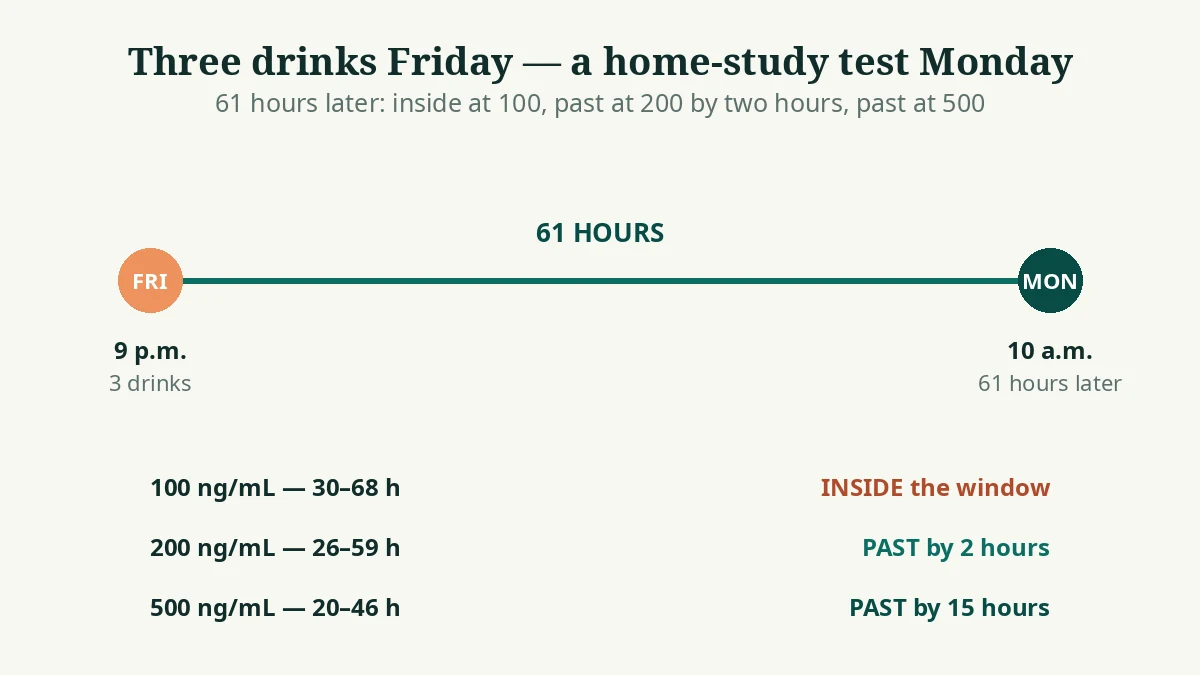
A couple is midway through an adoption home study. On Friday evening they have three drinks at a family dinner, the last at 9 p.m. On Monday at 10 a.m. — 61 hours later — the agency calls for a sample.
At 100 ng/mL, three to four drinks are modeled at 30 to 68 hours — 61 hours is inside, so a positive is likely. At 200 ng/mL (26 to 59 hours) the window closed two hours earlier — a negative is likely. At 500 ng/mL (20 to 46 hours) it closed fifteen hours earlier. Same couple, same dinner, same test — the cutoff decides.
But the EtG answer is not the whole answer. A PEth blood test drawn the same Monday would still show the Friday drinking — PEth reflects the past two to four weeks, and three drinks can push it above 20 ng/mL. Home-study agencies rarely order PEth; EtG is the usual tool. A negative EtG at 500 ng/mL does not prove abstinence, and a positive at 100 ng/mL does not prove a drinking problem. Our PEth calculator guide explains the longer window.
Adoption vs foster care: what is different
Adoption and foster care share the same alcohol standard — no abuse of alcohol or drugs — but the process differs.
Adoption is a one-time approval with an expiry date. The preplacement assessment is completed before placement and valid only for a limited window — 18 months in North Carolina, 12 in Vermont and Utah. A delay from a positive test can push a family past that window.
Foster care is a license, renewed. Foster parents are licensed for a term, with ongoing oversight and relicensing checks; the alcohol standard applies at application and at every renewal. A family fostering for years faces the standard repeatedly, not once.
Kinship placements are sometimes different. Vermont, for example, does not require a preplacement evaluation when a parent or guardian places a child directly with a relative.
For both paths, the same advice holds: the test is ordered by someone, for a reason, at a cutoff they choose.
What helps if alcohol comes up in your home study
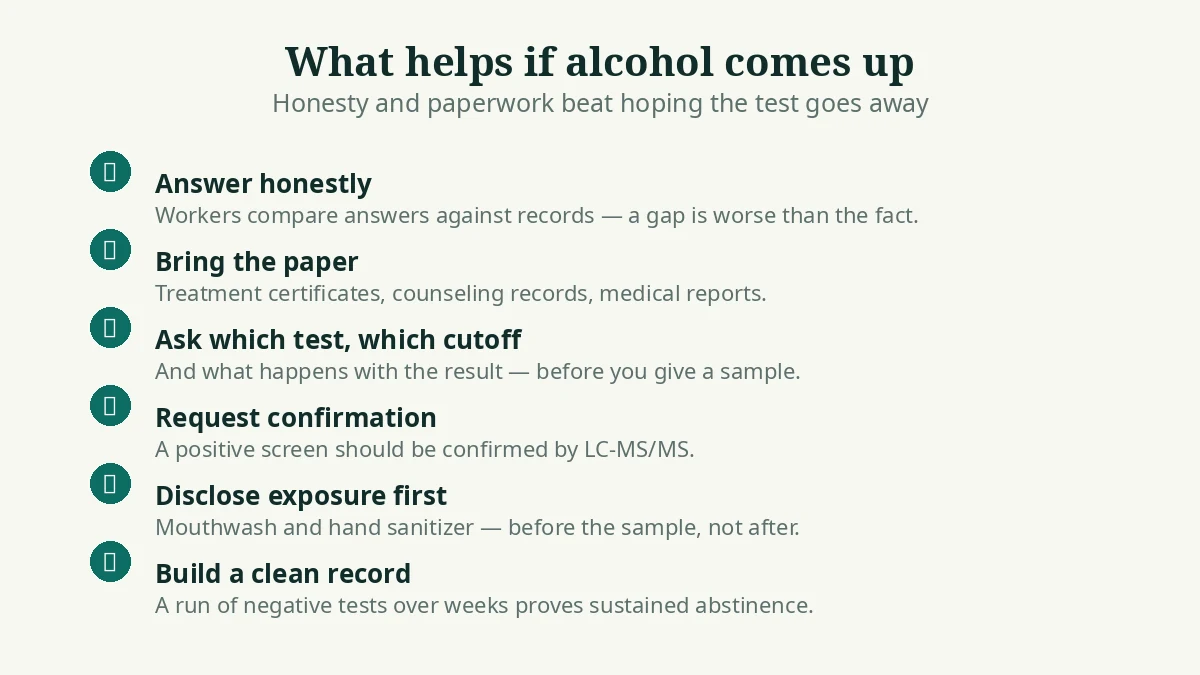
Answer honestly, and completely. Workers compare your answers against the records — a gap is harder to explain than the fact itself. Bring the paper: treatment completion certificates, counseling records, and medical reports are what a worker weighs. If you completed a program years ago, bring the discharge summary.
If a test is ordered, ask three questions first: which test, which cutoff, and what happens with the result. A positive screen should be confirmed by LC-MS/MS — ask for that. Disclose incidental exposure — mouthwash, hand sanitizer, cough syrup — before the sample, not after.
If monitoring is ordered, a run of negative tests over weeks is the strongest evidence. And do not try to dilute or “flush” a sample: labs check creatinine, and a dilute result reads as a problem, not a pass.
This article is educational only — not legal advice. Rules vary by state and by agency, and a live case deserves qualified counsel.
Using the EtG calculator before a test
The EtG calculator estimates the same detection windows the table above uses, from drinks, hours since your last drink, and cutoff. Read the result as a range, never a pass date — it cannot tell you what your agency will decide. Run your numbers through the calculator.
Frequently asked questions
Does every adoption home study include an EtG test?+
No. No state or federal rule reviewed requires a routine EtG test as part of an adoption or foster-care home study. The home study assesses alcohol use through interviews, medical reports, and background checks. An EtG test appears only when an agency or court orders one — for example, after a disclosure, a past DUI or treatment history, or a concern raised during the study. Private agencies can also set their own testing policies on top of the state minimums.
What EtG cutoff do adoption agencies use?+
No national EtG cutoff exists for adoption or foster-care home studies. No state or federal rule sets one. Where EtG is used, the cutoff is set by the agency, employer, or laboratory that orders the test — commonly 100 ng/mL where abstinence must be verified strictly, or 500 ng/mL where the program wants to screen out incidental exposure, the level SAMHSA's 2012 advisory recommended. Ask your agency which cutoff applies before you give a sample, because the same urine can be positive at one cutoff and negative at the other.
How long after drinking will an EtG test for adoption be positive?+
It depends on how much was drunk and the cutoff. At 100 ng/mL, our modeled ranges are: 1–2 drinks, 23–53 hours; 3–4 drinks, 30–68 hours; 5–7 drinks, 38–85 hours. At 500 ng/mL the same amounts clear roughly a day sooner. These are ranges, not promises for one person — weight, drinking speed, and hydration all move the window. A PEth blood test can still show drinking from two to four weeks earlier, long after EtG has cleared.
Will a positive EtG test stop my adoption?+
Not automatically, in most states. The home study weighs the whole picture: how recent the drinking was, whether it was a single incident or a pattern, what treatment or support is in place, and how honest the applicant has been. A positive usually leads to a conversation, an evaluation, a treatment plan, or re-testing — not an automatic denial. New York is the strict exception: its rule says current abuse of alcohol or other drugs requires rejection of the application. In every state, a DUI or treatment history hidden from the study and later found in the background check does far more damage than the same fact disclosed upfront.
Does foster care testing differ from adoption testing?+
The alcohol standard is the same — no abuse of alcohol or drugs — but the process differs. Adoption is a one-time preplacement approval, valid only for a limited window (within 18 months of placement in North Carolina, within 12 months in Vermont and Utah). Foster care is a license, renewed, with ongoing oversight — the standard applies at application and at every renewal, and the agency can order an assessment as a condition of continuing the license. Foster-to-adopt (resource) parents go through one study for both roles.
Can mouthwash or hand sanitizer cause a positive EtG in a home study?+
At the sensitive 100 ng/mL cutoff, yes — heavy use of alcohol-based hand sanitizer or mouthwash can produce low EtG levels that cross the threshold. At 500 ng/mL that is unlikely. If your agency orders a test, disclose that exposure before the sample, not after the result, and ask for LC-MS/MS confirmation of any positive screen. SAMHSA's 2012 advisory also cautions that EtG is scientifically unsupportable as the sole basis for legal or disciplinary action, because it cannot distinguish drinking from incidental exposure.
What should I do if my agency orders an alcohol evaluation?+
Cooperate, and bring the paper. Ask which test and which cutoff was ordered, and what happens with the result. Bring treatment completion certificates, counseling records, and medical reports — documented evidence is what a worker weighs. Ask for LC-MS/MS confirmation of any positive screen. If monitoring is ordered, a run of negative tests over weeks is the strongest evidence of sustained abstinence. Do not try to dilute or flush a sample — labs check creatinine, and a dilute result reads as a problem, not a pass. This is general information, not legal advice; a live case deserves qualified counsel.
Evidence and limitations
This article summarizes published home-study rules and public records on EtG testing for adoption and foster care, plus the science of alcohol biomarkers. Group-level findings cannot predict one person’s result, and this article is educational only — it is not legal advice. Home-study rules vary by state and by agency; check your own agency’s current requirements and consider qualified counsel for a live case.
- Child Welfare Information Gateway — Home Study Requirements, New York: 18 NYCRR § 421.16, “Current abuse of alcohol or other drugs requires the rejection of an application”
- Child Welfare Information Gateway — Home Study Requirements, Wisconsin: Ann. Stat. § 48.88, petitioner “does not abuse alcohol or drugs”; clinical AODA assessment on special concern
- Wisconsin Admin. Code DCF 50.05(7)(d) — agency may require an alcohol or drug abuse evaluation and a release of treatment records
- Wisconsin Admin. Code DCF 56.05 — foster parent shall “not abuse alcohol or drugs”; agency may require an AODA assessment as a condition of issuing or continuing a license
- Child Welfare Information Gateway — Home Study Requirements for Prospective Foster Parents, North Carolina: 10A NCAC 70E.1104, “no indication of alcohol abuse, drug abuse, or illegal drug use”
- Florida Admin. Code 65C-45.003 — Unified Home Study covers current or past alcohol and substance abuse and treatment; home inspection includes storage of alcoholic beverages
- Child Welfare Information Gateway — Home Study Requirements, Maryland: COMAR 07.02.25.06, cannot approve an applicant who cannot provide for a child’s welfare “because of abuse of alcohol or other controlled dangerous substances”
- Child Welfare Information Gateway — Home Study Requirements, Missouri: 13 CSR 35-73.080, social history must record “the extent of alcohol and drug use”
- Child Welfare Information Gateway — Home Study Requirements, North Carolina: Gen. Stat. § 48-3-309, preplacement assessment within 18 months of placement, covering addiction to alcohol or drugs
- Adam Walsh Child Protection and Safety Act of 2006, P.L. 109-248 — fingerprint-based checks of national crime information databases and child abuse registry checks for prospective foster and adoptive parents
- SAMHSA Advisory: The Role of Biomarkers in the Treatment of Alcohol Use Disorders (2006, revised 2012) — EtG detectable up to ~80 hours; EtG “scientifically unsupportable as the sole basis for legal or disciplinary action”
- McDonell et al. (2015) — EtG immunoassay cutoff sensitivity in alcohol-dependent outpatients (1,589 samples)
- Mackus et al. (2017) — EtG detection and elimination kinetics after controlled alcohol intake
- EtG Calculator Pro — ETG Testing for CPS: how EtG is used when child protective services is involved with existing parents
- EtG Calculator Pro — ETG Testing in Child Custody Cases: how courts use EtG when a parent’s drinking is at issue
- EtG Calculator Pro — PEth Calculator: how PEth complements EtG with a longer detection window, and how the 20 / 200 ng/mL bands are read