The quick answer: an EtG test for CPS is about child safety, not punishment
If Child Protective Services asks you to take an EtG test, the first thing to understand is what the test is for. CPS — the Division of Family and Children Services (DFCS) in Georgia, the Department of Children and Families (DCF) in Florida — gets involved when a report suggests a child's safety may be at risk. An occasional drink does not trigger that. Alcohol becomes the agency's business when it affects a parent's ability to supervise or care for a child: driving under the influence with a child in the car, leaving a child unsupervised, violence, or chronic impairment.
EtG, the metabolite urine tests can find for days after drinking, answers one narrow question: has this parent been drinking recently, and how recently? It cannot prove a parent is an alcoholic, cannot show whether a parent was impaired while caring for a child, and on its own cannot decide a case. Federal child-welfare guidance says the same: a drug test is one part of a larger assessment, not proof by itself of a substance use disorder or of neglect. That distinction shapes everything.
When CPS orders an EtG test
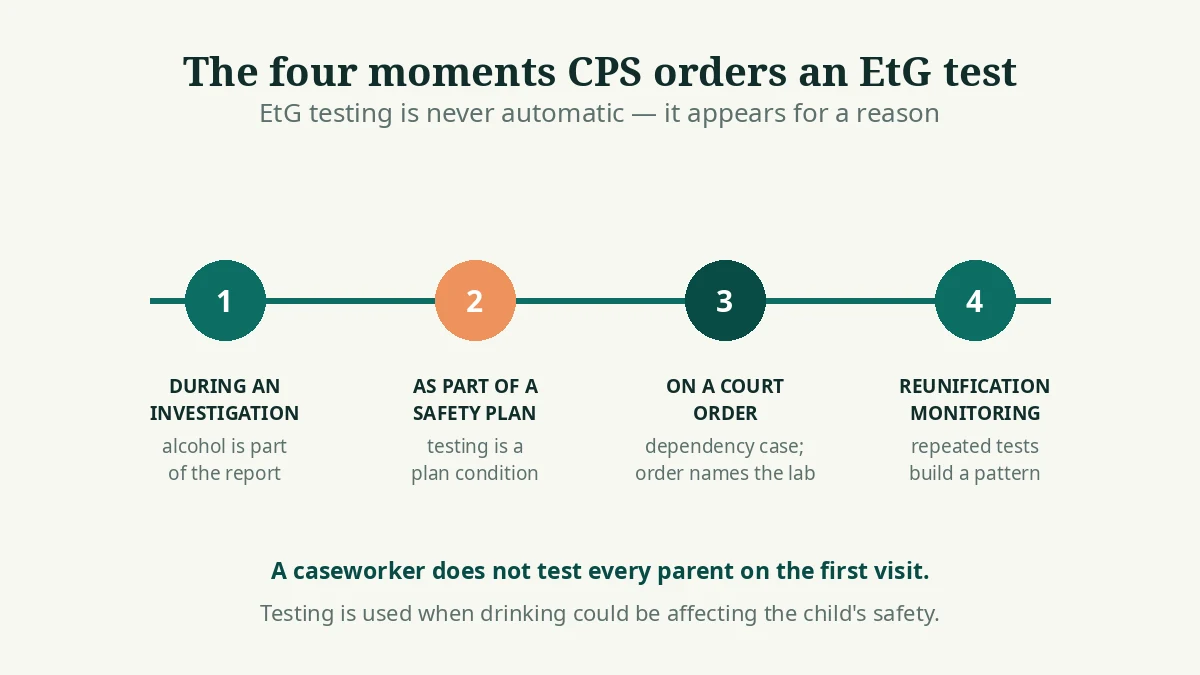
EtG testing is never automatic. A caseworker does not test every parent on the first visit; testing is used when substance use is part of the allegations, or when the caseworker has reason to believe drinking could be affecting the child's safety. It shows up at four moments.
1. During an investigation. When a report alleges alcohol-related neglect or abuse, the caseworker interviews the parents, speaks with the child, observes the home, and may ask for a drug or alcohol test. The test is one piece of evidence among many.
2. As part of a safety plan. A safety plan is a written agreement between CPS and the family that identifies the risks, lists the steps that keep the child safe, names the people who will help, and explains how the agency will monitor it. Safety plans are temporary, designed to address an immediate concern and avoid removal while the underlying issue — in this case, drinking — is addressed. Testing is often one of the plan's conditions.
3. On a court order. When a case reaches juvenile or family court, a judge can order EtG testing as part of a dependency case. Courts can also order testing in custody disputes between parents — the difference is who is asking: in a custody case the dispute is between two parents, while with CPS the agency itself seeks the test. A court-ordered test is not voluntary, and the order usually names the laboratory, the frequency, and who receives the results.
4. During reunification monitoring. After a child has been placed elsewhere, or after a parent has completed treatment, EtG testing verifies abstinence over time. In one documented program for CPS-involved families, parents took a 12-panel urine screen three times a week plus a lab sample for an 80-hour EtG test — repeated tests build a pattern the court can trust.
What an EtG test for CPS actually measures
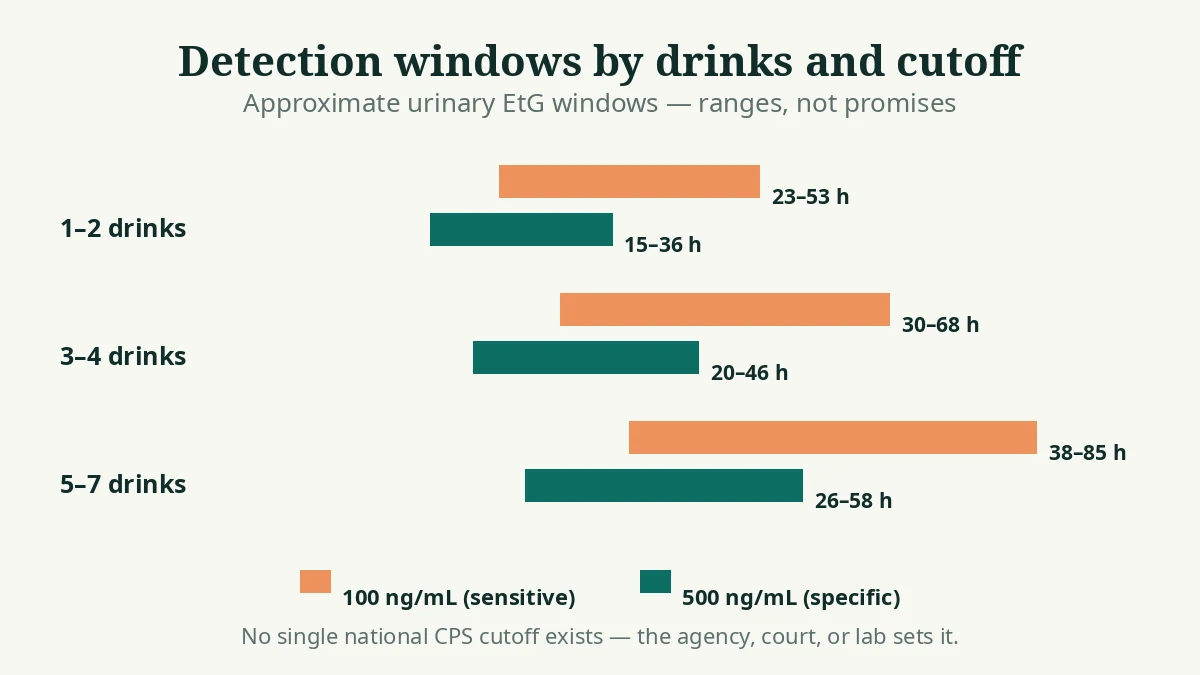
No national standard sets a CPS EtG cutoff. Each agency, court, or laboratory picks its own — commonly 100 ng/mL where abstinence must be verified strictly, or 500 ng/mL where the program wants to screen out incidental exposure, the level SAMHSA's 2012 advisory recommended. Ask your caseworker which one applies — the cutoff changes the answer completely: 180 ng/mL is positive at 100 and negative at 500.
The cutoff is only half the story — the other half is how much was drunk. The table uses the same modeled ranges as our calculator: at 500 ng/mL, EtG detects heavy drinking from the previous day; at 100 ng/mL, it can flag light drinking for up to about two days and heavy drinking for up to five (McDonell et al.).
| Drinks | 100 ng/mL | 200 ng/mL | 500 ng/mL |
|---|---|---|---|
| 1–2 drinks | 23–53 hours | 20–46 hours | 15–36 hours |
| 3–4 drinks | 30–68 hours | 26–59 hours | 20–46 hours |
| 5–7 drinks | 38–85 hours | 33–75 hours | 26–58 hours |
Two things the number does not mean. First, an EtG level is not a blood alcohol level: there is no 0.08 equivalent, and a positive does not prove a parent was impaired while caring for a child — only that alcohol was consumed inside the window. Second, the window is a range: weight, drinking speed, hydration, and liver function move it. The cutoff guide explains the levels, and the formula page shows how the windows are modeled. A standard urine drug panel does not test for alcohol at all. If the agency or court wants to assess alcohol use, it must specifically order an alcohol-specific test — and EtG is the one most commonly ordered.
How often does CPS test?
Frequency is set by the agency or the court, and it varies widely. In Georgia, DFCS policy requires parents in active cases to complete a minimum of two random drug screens per month, and a single positive can reshape an entire case plan. In Michigan, the manual takes the opposite approach: case managers should not screen a parent more than twice a month unless there is a need to verify use or abstinence, or a court order requires more. Both states agree: testing should be tied to a reason, not used as a punishment or as the only evidence in a case. Iowa's child-welfare guidance says the same — testing alone cannot determine whether someone has a substance use disorder, cannot predict parenting ability, and cannot by itself ensure a child is safe.
Random testing is the norm in open cases: the parent does not know which days the call will come. Court-ordered monitoring can be more frequent — the order controls. EtG is usually one test among several, as the table below shows.
| Test | What it shows | Window |
|---|---|---|
| Urine EtG / EtS | Recent drinking, from a urine sample | Often 24–72 hours, longer after heavy drinking |
| PEth blood test | Alcohol use over the prior weeks | About 2–4 weeks |
| Hair EtG | Pattern of heavy use over months | About 3 months |
| Breath test | Impairment right now | Hours |
| Sweat patch | Continuous monitoring | 7–14 days per patch |
Every positive screen should be confirmed. A urine EtG screen is an immunoassay — a fast, sensitive first pass — and any result that will be used to make decisions about a child should be confirmed by LC-MS/MS, the laboratory method that identifies the molecule itself. If a result is contested, ask for confirmation before it becomes the basis for action.
What happens after a positive EtG test?
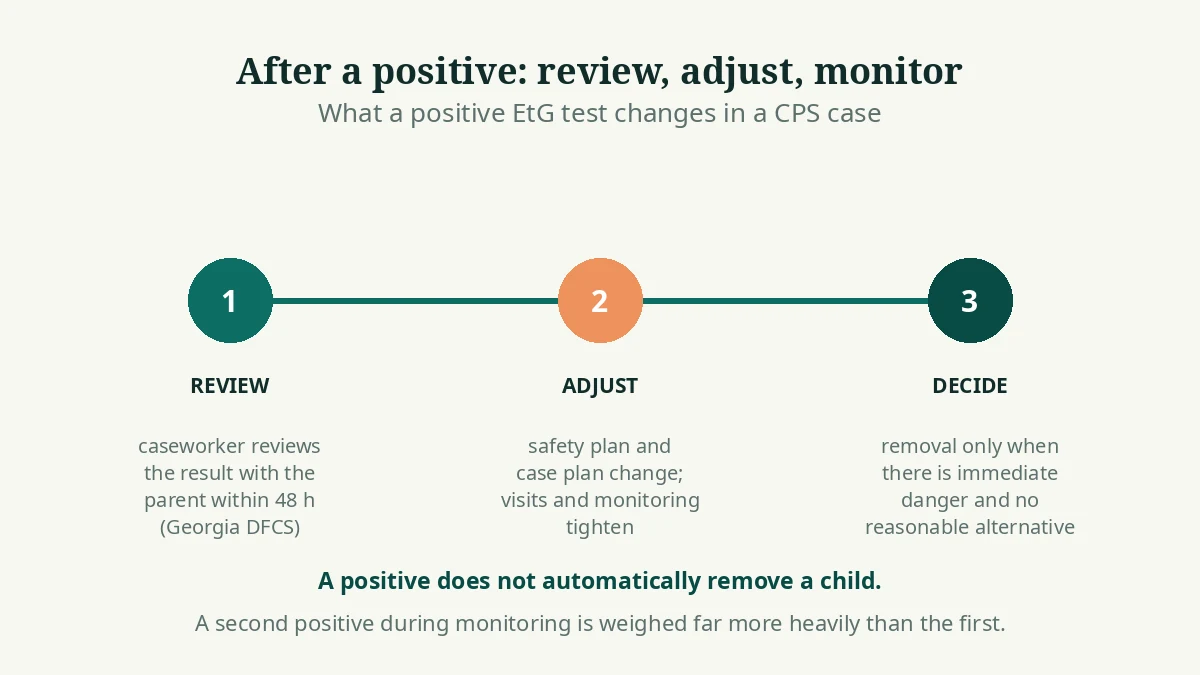
A positive EtG test does not automatically mean a child is removed — the most misunderstood fact in CPS alcohol testing. The agency considers the frequency and level of use, the parent's overall functioning, the support available, the child's condition, and whether a safety plan can protect the child. Removal is usually considered only when the agency believes there is an immediate danger and no reasonable alternative to keep the child safe. In Michigan, substance use by a parent, on its own, is not enough to confirm child abuse or neglect — the agency must evaluate its impact on child safety.
What a positive does change is the case. In Georgia, DFCS policy requires the caseworker to review a positive result with the parent within 48 hours of receiving it, and the conversation is supposed to adjust the case plan rather than simply punish. Depending on the case, the agency may increase home visits, tighten monitoring, require treatment or an evaluation, change the safety plan, or file a dependency petition. A second positive during monitoring is weighed far more heavily than the first — it suggests the plan is not working. The same logic applies on probation, where a positive is a technical violation decided by a judge.
Real-world scenario: three drinks Friday, caseworker test Monday
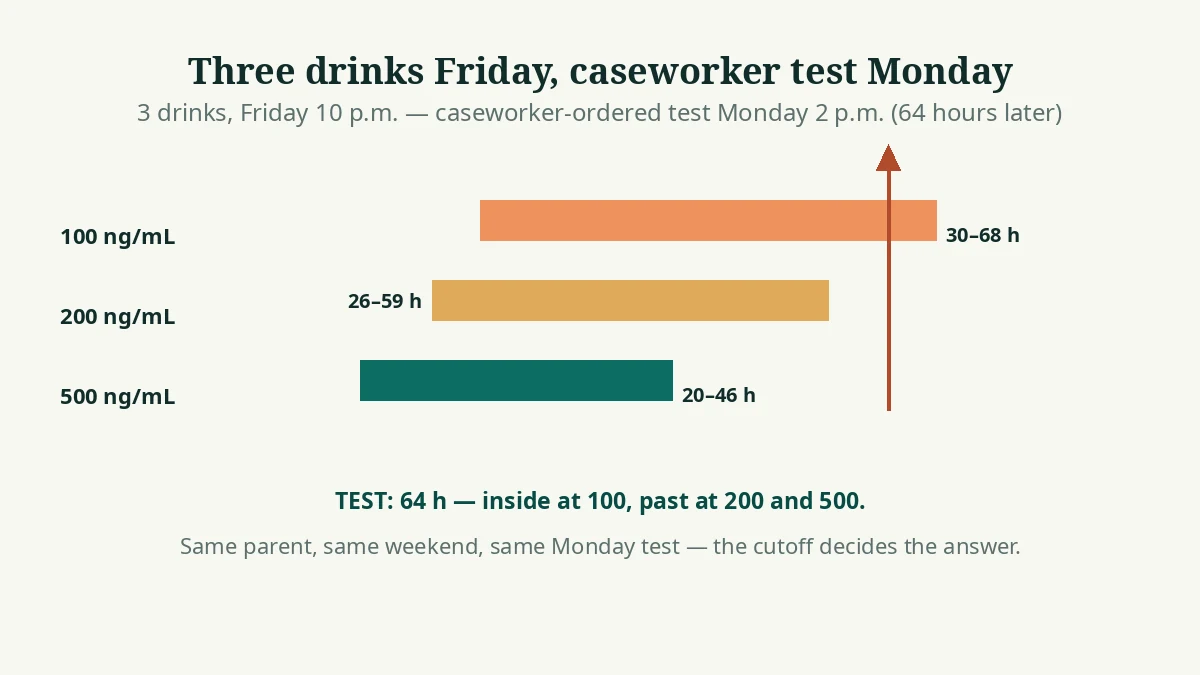
A parent has three drinks on Friday night, the last at 10 p.m. Over the weekend, a report reaches the agency, and a caseworker visits on Monday. At 2 p.m. — 64 hours after the last drink — the caseworker orders an EtG test.
At 100 ng/mL, three drinks are modeled at roughly 30 to 68 hours — inside the window, and a positive is likely. At 200 ng/mL (26 to 59 hours) the window closed five hours earlier; at 500 ng/mL (20 to 46 hours) it closed the previous evening. Same parent, same weekend, same Monday test — the cutoff decides the answer.
The scenario does not say the parent was impaired on Monday, or that the child was unsafe: EtG says nothing about impairment, only that alcohol was consumed inside the window. But the test was never about Monday afternoon — it was about Friday night, and the EtG test reaches back to that evening, days after a breath test would have cleared. That reach is why agencies order it — and why the cutoff in the order or safety plan matters so much.
What parents should know before a test
If the test is a voluntary request, you can decline — but understand the trade-off first. The agency can note the refusal in the case file and ask a judge to order the test, and a court-ordered test is not voluntary. If testing is already in a court order or a signed safety plan, refusing it can itself be treated as a violation. Talk to a family lawyer before deciding; this article is educational, not legal advice.
Incidental exposure matters at the sensitive cutoff: mouthwash and hand sanitizer can produce low EtG levels that cross a 100 ng/mL threshold, especially with repeated use, so tell your caseworker and the collection staff about heavy use before testing, and ask for any contested result to be confirmed by LC-MS/MS. Drinking water does not erase EtG, and labs check creatinine — a diluted sample is flagged, not passed. Bring identification, arrive on time, and keep copies of any paperwork about the test, including the laboratory and the cutoff used. If you are in treatment, tell your caseworker: documented treatment progress is one of the strongest things a parent can show.
Using the EtG calculator before a test
The EtG calculator estimates the same detection windows the table above uses, from your own numbers: drinks, hours since your last drink, and the cutoff your agency or court uses. Read the result as a range, never a pass date. It models EtG urine tests only — it cannot tell you whether you are complying with a safety plan or a court order. To check your scenario, run your numbers through the calculator.
Frequently asked questions
Can CPS order an EtG test without a court order?+
CPS can ask for a test as part of an investigation or a safety plan when alcohol is alleged to affect a child's safety. A voluntary request can be declined, but the agency can note the refusal and ask a judge to order the test — and a court-ordered test is not voluntary. If testing is already in a court order or a signed safety plan, refusing it can be treated as a violation of that order or plan. Talk to a family lawyer before deciding.
Will one positive EtG test take my child away?+
Not automatically. The agency considers the frequency and level of use, the parent's overall functioning, the support available, the child's condition, and whether a safety plan can protect the child. Removal is usually considered only when the agency believes there is an immediate danger and no reasonable alternative. In Georgia, a positive means the caseworker reviews the result with the parent within 48 hours and adjusts the case plan; in Michigan, substance use alone is not enough to confirm abuse or neglect.
How long after drinking will a CPS EtG test be positive?+
It depends on how much was drunk and the cutoff. At 100 ng/mL, light drinking is flagged for up to about two days and heavy drinking for up to about five days (McDonell et al.). Our modeled ranges: 1–2 drinks, 23–53 hours at 100 ng/mL; 3–4 drinks, 30–68 hours; 5–7 drinks, 38–85 hours. At 500 ng/mL the same amounts clear roughly a day sooner. These are ranges, not promises for one person.
How often does CPS test in an open case?+
It is set by the agency or the court, and it varies. Georgia's DFCS policy requires at least two random drug screens a month in active substance-related cases. Michigan caps routine screening at twice monthly unless there is a need to verify use or abstinence, or a court order requires more. Court-ordered monitoring can be more frequent than agency screening, and random testing is the norm in open cases.
Does a standard CPS drug screen test for alcohol?+
No. A standard urine drug panel does not test for alcohol at all. If the agency or the court wants to assess alcohol use, it must specifically order an alcohol-specific test — and EtG is the one most commonly ordered in custody and child-welfare cases. If your panel did not include EtG, alcohol was not tested.
Can mouthwash or hand sanitizer fail a CPS EtG test?+
At the sensitive 100 ng/mL cutoff, yes, it is possible: mouthwash and hand sanitizer can produce low EtG levels that cross that threshold, especially with repeated use. At 500 ng/mL it is unlikely. Tell your caseworker and the collection staff about heavy sanitizer or mouthwash use before testing, and ask for any contested result to be confirmed by LC-MS/MS before it becomes the basis for action.
What EtG cutoff does CPS use?+
There is no single national CPS EtG cutoff. The agency, the court, or the laboratory sets it — commonly 100 ng/mL where abstinence must be verified strictly, or 500 ng/mL where the program wants to screen out incidental exposure, the level SAMHSA's 2012 advisory recommended. Ask your caseworker or check the court order or safety plan for which one applies to you.
Evidence and limitations
This article summarizes published research, state child-welfare policy, and public guidance on EtG testing in child protective services cases. Agency names and policies vary by state, and individual case plans and court orders control what happens in any one case. Group-level findings cannot predict one person’s result, and this article is educational only — it is not medical or legal advice. Talk to a family lawyer about your own case.
- LegalClarity — Georgia DFCS Drug Testing Policy (Georgia Division of Family and Children Services Policy 19.26): at least two random drug screens per month in active substance-related cases; 12-panel urine includes EtG; caseworker reviews a positive with the parent within 48 hours; a single positive can reshape a case plan
- Michigan Department of Health and Human Services — Children’s Protective Services Manual PSM 716-7, Cases Involving Substances (April 1, 2026): substance use alone is insufficient for investigation or confirmation of abuse or neglect; screening frequency should not exceed twice monthly unless there is a need to verify use or abstinence or a court order requires more; positive infant toxicology alone does not indicate abuse or neglect
- Iowa Department of Health and Human Services — Comm. 626, Drug Testing: Practice, Policy and Protocols (October 2025): testing alone cannot determine a substance use disorder, predict parental abilities, or fully ensure child safety; testing is inappropriate as a punitive measure or sole determinant; National Center on Substance Abuse and Child Welfare Briefs 1 & 2 (2021)
- Detox to Rehab — Drug Testing in CPS Cases: EtG/EtS urine window often 24–72 hours (longer with heavy episodes); PEth 2–3 weeks; sweat patch 7–14 days; CPS does not automatically drug test every parent on the first visit; testing is one part of a larger assessment
- LegalClarity — How to Prove Alcoholism in Custody Cases: urine EtG detects alcohol use for up to 80 hours; hair follicle about three months; PEth two to four weeks; SCRAM bracelet tests perspiration every 30 minutes; courts can mandate specific alcohol testing
- Suffolk County Custody Lawyer — Positive Drug Test in a Custody Case: standard urine drug panels do not test for alcohol, so the court must specifically order an alcohol-specific test; EtG is the most common alcohol test in custody litigation; New York Family Court Act § 1034 investigation
- MST Services — Multisystemic Therapy – Building Stronger Families: in a CPS-involved family case, parents took a 12-panel urine screen three times a week and submitted a lab sample for an 80-hour EtG test
- EtG Calculator Pro — ETG Testing in Child Custody Cases: how EtG is used when two parents dispute custody, and how the agency side (CPS) differs
- SAMHSA Advisory: The Role of Biomarkers in the Treatment of Alcohol Use Disorders (2006, revised 2012)
- McDonell et al. (2015) — EtG immunoassay cutoff sensitivity in alcohol-dependent outpatients (1,589 samples)
- Mackus et al. (2017) — EtG detection and elimination kinetics after controlled alcohol intake