The quick answer: fire-service EtG testing runs on department policy
If you are a firefighter facing an EtG test, first know there is no single national firefighter EtG standard. No federal agency publishes a firefighter EtG cutoff, and EtG is not part of any nationwide fire-service drug panel. Your department's written drug and alcohol policy — negotiated with the union where one exists — decides when you are tested, what cutoff the lab uses, and what a positive means.
That policy-first reality is what makes fire-service testing different from the military's command-directed system or a DOT program. The International Association of Fire Chiefs (IAFC) recommends every agency have a written policy covering random testing, testing for cause, and critical-event testing after any incident that damages apparatus or property, or injures someone. But the IAFC recommends — it does not regulate.
No national standard: what the IAFC, NFPA, and your department each actually say
The IAFC's position statement on drug and alcohol-free awareness, adopted September 13, 2012, is the closest thing the fire service has to a national line: no member should take part in any operational or support activity while under the influence of alcohol, and anyone who drank within the previous eight hours — or is still impaired — should voluntarily remove themselves from duty. It also calls for written testing procedures covering random testing, testing for cause, and critical-event testing after any incident that damages apparatus or property, or injures someone.
NFPA 1582, the standard on comprehensive occupational medical programs for fire departments, adds the medical side — pre-placement and annual evaluations with a fitness-for-duty classification from the department physician — but it is a medical standard, not a drug-testing program: it sets no EtG cutoffs and no testing triggers.
The actual testing rules live in the department policy and, where firefighters are unionized, the collective bargaining agreement. Some agreements ban random testing outright and allow testing only on reasonable suspicion — the Sterling, Illinois IAFF Local 2301 agreement and the Key West IAFF Local 1424 agreement both do. Others authorize random testing at any time as a condition of employment, as Yakima County Fire District 12's Policy 2130 does. Read your own policy — no article can tell you which version your department runs.
The five moments a firefighter gets EtG tested
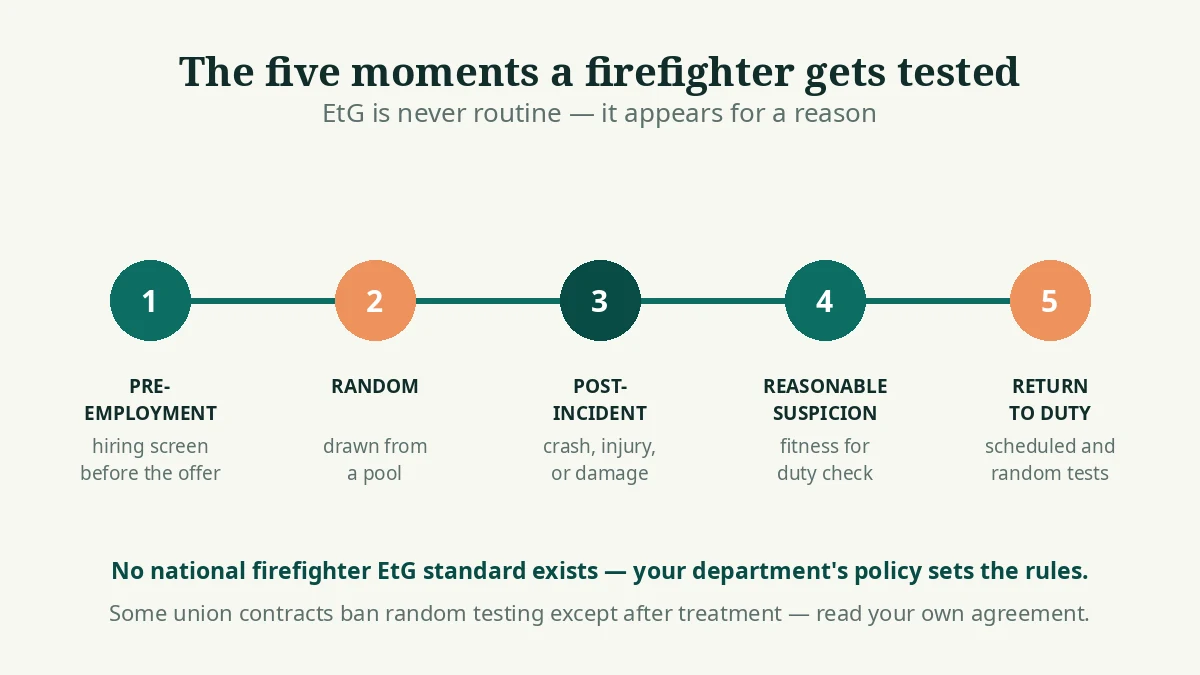
EtG testing is never the default fire-service drug screen — it shows up at five recognizable moments, and knowing which one you are in tells you what the result can be used for.
1. Pre-employment and hiring. Most career departments test applicants before a conditional offer becomes final — usually a standard drug panel plus a breath alcohol test, with EtG added where the department wants a longer look-back than a breath test gives.
2. Random testing. Where the policy allows it, names are drawn from a pool — sometimes the whole department, sometimes only drivers or safety-sensitive roles. Random tests are designed as much to deter as to catch: after a series of substance-abuse incidents in 2004 the New York Fire Commissioner announced random drug and alcohol tests for all uniformed FDNY members. But random testing is not universal — some union contracts forbid it except after treatment.
3. Post-incident and critical-event testing. The IAFC calls for testing after any incident that causes measurable damage to apparatus or property, or injury or death. In practice that means apparatus crashes, fireground injuries, and training accidents. Many departments test every member involved in a major vehicle accident.
4. Reasonable suspicion and fitness-for-duty testing. A supervisor who observes slurred speech, the smell of alcohol, erratic behavior, or a sudden drop in performance can order a test. Some contracts set a high bar — Key West requires objective factors corroborated by another member above the rank of firefighter, with the order coming from the Fire Chief. A fitness-for-duty exam is the related route: the department physician decides whether a member is fit to work.
5. Return-to-duty monitoring. This is where EtG is most at home in the fire service. After treatment, a firefighter on a last-chance agreement is typically tested on a schedule — and at random — for months. The Sterling agreement requires twelve months of random testing after rehab as a condition of continued employment. EtG's multi-day window is what makes it useful here: it verifies abstinence.
What an EtG test for firefighters actually measures
No department publishes a firefighter-specific EtG cutoff — and none should be invented here. Where EtG is used, the cutoff is set by the program or laboratory that ordered the test: commonly 100 ng/mL where abstinence must be verified strictly, or 500 ng/mL where the program wants to screen out incidental exposure, the level SAMHSA's 2012 advisory recommended.
The cutoff changes the answer completely: 180 ng/mL is positive at 100 and negative at 500. The table below uses the same modeled ranges as our calculator: at 500 ng/mL, EtG detects heavy drinking from the previous day; at 100 ng/mL, it can flag light drinking for up to two days and heavy drinking for up to five (McDonell et al.).
| Drinks | 100 ng/mL | 200 ng/mL | 500 ng/mL |
|---|---|---|---|
| 1–2 drinks | 23–53 hours | 20–46 hours | 15–36 hours |
| 3–4 drinks | 30–68 hours | 26–59 hours | 20–46 hours |
| 5–7 drinks | 38–85 hours | 33–75 hours | 26–58 hours |
Two things the number does not mean: an EtG level is not a blood alcohol level — there is no 0.08 equivalent, and a positive does not prove impairment, only that alcohol was consumed inside the window. And the window is a range: weight, drinking speed, hydration, and liver function all move it. The cutoff guide explains the levels, and the formula page shows how the windows are modeled.

DOT or not? Most firefighters are not DOT-tested
The most common misunderstanding about fire-service testing is the DOT question. Federal guidance is clear: Part 382 alcohol and drug testing applies only to people required to hold a commercial driver's license under federal law who actually perform safety-sensitive duties. States have the option of waiving firefighters from CDL requirements, and a state that lets firefighters choose between a CDL and a non-commercial license restricted to operating fire equipment has exercised that option — so Part 382 does not apply. The regulation itself, 49 CFR 382.103, excepts firefighters who operate commercial motor vehicles necessary for the preservation of life or property, equipped with audible and visual signals and not subject to normal traffic regulation.
So the split is practical, not theoretical. A firefighter who drives apparatus in a state that requires a CDL for it is DOT-tested: pre-employment, random, post-accident, reasonable suspicion, return-to-duty, and follow-up testing, with a 0.04 alcohol prohibition and an eight-hour post-accident alcohol testing window. A firefighter in a waiver state — or one who never drives apparatus — is tested under department policy instead, which often mirrors DOT procedures without being DOT. Our DOT EtG guide covers the federal side in detail.
What happens after a positive EtG test?
A positive EtG test is evidence, not a verdict — and what it triggers depends on department policy, the circumstances, and your history. The first step is usually referral for evaluation and a recommendation for education or treatment.
The second step is where departments diverge sharply. Some run a zero-tolerance model: in 2007 the FDNY imposed a zero-tolerance policy on its EMS workers, under which a positive drug test — or a refusal to provide a specimen — means termination for a first offense, a provision the courts upheld in 2013. The same policy lets workers who voluntarily come forward use counseling services without disciplinary consequences. Other departments run a treatment-first model built on last-chance agreements: complete treatment, accept scheduled and random testing for a year or more, and keep your job; a second positive during monitoring ends it. The Sterling agreement spells out the bargain — no discipline for a first-time voluntary entrant, twelve months of random testing after rehab.
Two resources are worth knowing by name. The IAFF Center of Excellence in Upper Marlboro, Maryland, is a residential facility exclusively for IAFF members treating substance use alongside PTSD, with a typical stay of four to six weeks, confidential treatment, and return-to-work planning. Most departments also have a peer support team — trained members who act as a first point of contact. Referrals most often come through peers, by design: a peer referral is a phone call, not a report. Police officers face a similar regime, and our monitoring-programs guide covers EtG accuracy and fairness in these programs.

Real-world scenario: four drinks Saturday, random test Monday
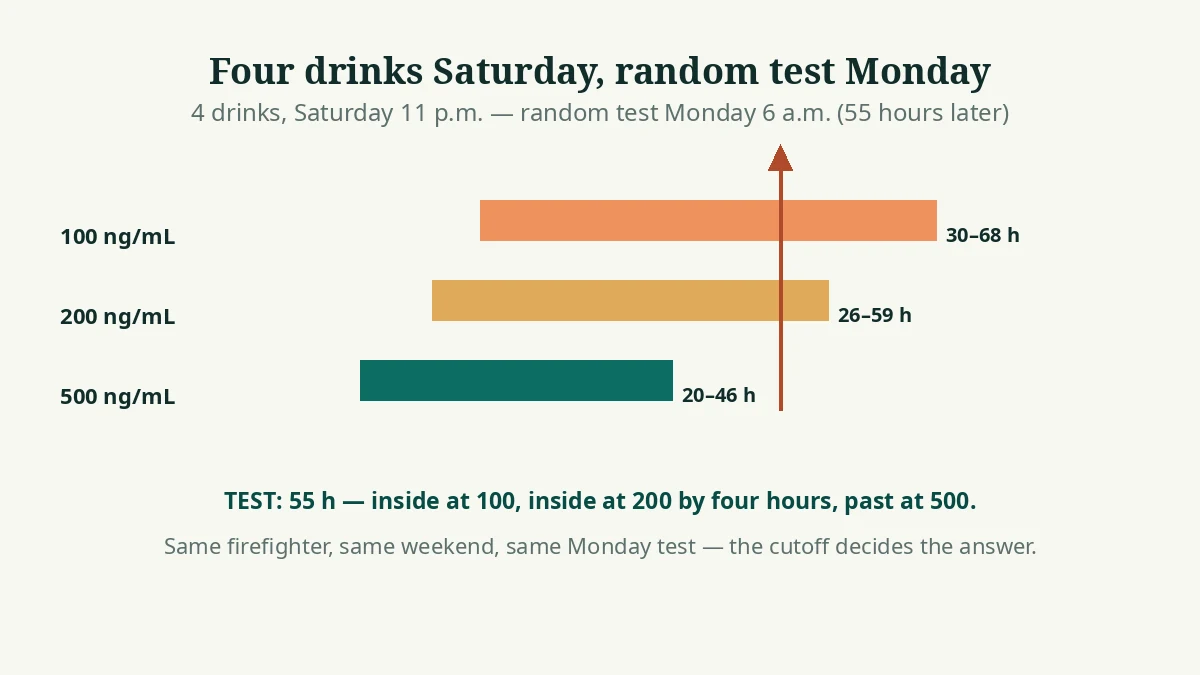
A firefighter has four drinks on Saturday night, the last at 11 p.m. Monday at 6 a.m. — 55 hours later — his name comes up in the random pool.
At 100 ng/mL, four drinks are modeled at roughly 30 to 68 hours — inside the window, and a positive is likely. At 200 ng/mL (26 to 59 hours) the window is still open, by four hours. At 500 ng/mL (20 to 46 hours) it closed nine hours earlier. Same firefighter, same weekend, same Monday test — the cutoff decides the answer.
EtG says nothing about impairment on Monday morning — only that alcohol was consumed inside the window. The test was never about Monday; it was about Saturday night, and the random test reaches back to that weekend.
What firefighters should know before a test
Self-referral is the safest door in: every department treats voluntary identification as the best way to find a problem, and first-time voluntary entrants are often protected from discipline. But the door closes once you are notified of a test or an incident is reported — and refusing a lawful order to test can itself be grounds for discipline up to termination.
Incidental exposure matters at the sensitive cutoff, and firefighters are a high-exposure group: hand sanitizer is used constantly in firehouse and EMS work, and mouthwash can produce low EtG levels that cross a 100 ng/mL threshold with repeated use. Tell the collection staff about heavy sanitizer or mouthwash use before testing, and ask for any contested result to be confirmed by LC-MS/MS. Drinking water does not erase EtG, and labs check creatinine.
Know your contract before you need it: whether random testing exists at all, who can authorize a reasonable-suspicion test, and your right to union representation. And if you are ordered to test after an incident, document the timeline yourself — when you last drank, what you used, and who ordered the test — while it is fresh.
Using the EtG calculator before a test
The EtG calculator estimates the same detection windows the table above uses, from your own numbers: drinks, hours since your last drink, and the cutoff your program uses. Read the result as a range, never a pass date — it cannot tell you whether you are in compliance with department policy. To check your scenario, run your numbers through the calculator.
Frequently asked questions
Do firefighters get random EtG tests?+
It depends on your department's policy — and in unionized departments, the collective bargaining agreement. The IAFC recommends written procedures covering random testing, and some departments do random-test all uniformed members, as the FDNY announced in 2004. But other contracts ban random testing outright and allow it only on reasonable suspicion or after treatment. EtG specifically is most common in return-to-duty monitoring, where its multi-day window verifies abstinence; routine random pools more often use a drug panel and a breath test. Check your own policy — no national rule decides it.
What EtG cutoff do fire departments use?+
There is no national firefighter EtG cutoff. No federal agency and no fire-service standard publishes one. Where EtG is used, the cutoff is set by the program or laboratory that ordered the test — commonly 100 ng/mL where abstinence must be verified strictly, or 500 ng/mL where the program wants to screen out incidental exposure, the level SAMHSA's 2012 advisory recommended. Ask your department or program which one applies to you.
How long after drinking will a firefighter EtG test be positive?+
It depends on how much was drunk and the cutoff. At 100 ng/mL, our modeled ranges are: 1–2 drinks, 23–53 hours; 3–4 drinks, 30–68 hours; 5–7 drinks, 38–85 hours. At 500 ng/mL the same amounts clear roughly a day sooner. These are ranges, not promises for one person — weight, drinking speed, hydration, and liver function all move the window.
Are firefighters DOT tested?+
Most are not. Federal Part 382 testing applies only to people required to hold a commercial driver's license under federal law who actually perform safety-sensitive duties, and states may waive firefighters from CDL requirements — a state that lets firefighters choose a CDL or a non-commercial license restricted to fire equipment has exercised that option, so Part 382 does not apply. A firefighter who drives apparatus in a state that requires a CDL for it is DOT-tested; everyone else is tested under department policy, which often mirrors DOT procedures without being DOT.
Can hand sanitizer fail a firefighter EtG test?+
At the sensitive 100 ng/mL cutoff, yes, it is possible — and firefighters are a high-exposure group, since hand sanitizer is used constantly in firehouse and EMS work. Mouthwash can do the same with repeated use. At 500 ng/mL it is unlikely. Tell the collection staff about heavy sanitizer or mouthwash use before testing, and ask for any contested result to be confirmed by LC-MS/MS before it becomes the basis for action.
Will a positive EtG test cost a firefighter their job?+
Not automatically. The first step is usually referral for evaluation and a recommendation for education or treatment, not termination. But some departments run a zero-tolerance model — in 2007 the FDNY imposed one on its EMS workers, under which a positive drug test or a refusal to provide a specimen means termination for a first offense. Other departments use last-chance agreements: complete treatment, accept scheduled and random testing for a year or more, and keep your job. A second positive during monitoring is weighed far more heavily than the first.
Evidence and limitations
This article summarizes published guidance and public records on EtG testing in the fire service, department alcohol-testing policy, and federal DOT testing rules. Group-level findings cannot predict one person’s result, and this article is educational only — it is not medical or legal advice. Department policies and collective bargaining agreements differ widely; check your own department’s current policy and agreement.
- IAFC Position: Drug and Alcohol-Free Awareness (adopted September 13, 2012) — no member works while under the influence; anyone who drank within the previous eight hours, or is still impaired, should voluntarily remove themselves from duty; agencies should have written testing procedures covering random testing, testing for cause, and critical-event testing after any incident causing measurable damage to apparatus or property, or injury or death
- Firehouse — Strong Testing Policy Needed To Address Drug & Alcohol Abuse (Fire Law, December 2003) — IAFC zero-tolerance standard and the eight-hour rule; FDNY incidents in 2004 and the Fire Commissioner’s announcement of random drug and alcohol tests for all uniformed members; government agencies may test on reasonable suspicion, and firefighters should face pre-employment, periodic, post-accident, and random testing
- FMCSA guidance — Part 382 alcohol and drug testing requirements and firefighters (April 4, 1997): Part 382 applicability is coextensive with the CDL requirements; states may waive firefighters from CDL requirements, and a state that lets firefighters choose a CDL or a non-commercial license restricted to fire equipment has exercised that option, so Part 382 does not apply
- 49 C.F.R. § 382.103 — Applicability: Part 382 reaches CDL drivers; the exceptions include firefighters who operate commercial motor vehicles necessary for the preservation of life or property, equipped with audible and visual signals and not subject to normal traffic regulation
- Yakima County Fire District 12, Policy 2130 — Alcohol & Drug Abuse (revised November 11, 2008): post-accident testing after any on-duty accident or incident; random testing reserved at any time as a condition of continued employment; refusal to submit is grounds for discipline up to immediate termination
- City of Sterling, Illinois and IAFF Local 2301, Collective Bargaining Agreement (2023–2026) — no across-the-board or random drug testing; testing only on reasonable suspicion; after rehabilitation, random testing for twelve months as a condition of continued employment; no discipline for a first-time voluntary entrant
- City of Key West and IAFF Local 1424, Collective Bargaining Agreement — no routine fitness-for-duty medical examinations or drug testing; individual fitness-for-duty exams only for job-related reasons, with drug or alcohol testing only on reasonable suspicion corroborated by another member above the rank of firefighter
- NFPA 1582 — Medical History and Examination Form for Firefighters: the standard’s medical evaluation asks whether the candidate has been diagnosed with or treated for alcoholism or alcohol dependence, and classifies medical conditions that could prevent safe performance of essential job tasks
- Matter of Roberts v New York City Office of Collective Bargaining (2013) — FDNY’s 2007 zero-tolerance alcohol and drug testing policy for EMS workers: a positive test or a refusal to provide a specimen means termination for a first offense; workers who voluntarily come forward can use counseling services without disciplinary consequences
- IAFF — IAFF Center of Excellence for Behavioral Health Treatment and Recovery (Upper Marlboro, Maryland): residential treatment exclusively for IAFF members for PTSD, substance abuse, and addiction, with return-to-work planning and confidential treatment
- EtG Calculator Pro — ETG Testing in DUI Cases: how EtG is used after a drunk-driving arrest in civilian courts, and how the fire-service incident process differs
- EtG Calculator Pro — PEth Calculator: how PEth complements EtG with a longer detection window for programs that need to verify abstinence over weeks
- SAMHSA Advisory: The Role of Biomarkers in the Treatment of Alcohol Use Disorders (2006, revised 2012)
- McDonell et al. (2015) — EtG immunoassay cutoff sensitivity in alcohol-dependent outpatients (1,589 samples)
- Mackus et al. (2017) — EtG detection and elimination kinetics after controlled alcohol intake