What an EtG calculator actually does
An EtG calculator takes three inputs — how much you drank, when you stopped, and the cutoff your test uses — and estimates the window during which ethyl glucuronide (EtG), a metabolite of alcohol, is likely to remain detectable in urine. EtG leaves the body far more slowly than alcohol itself: while a breath test only catches drinking from the past 10 to 12 hours, EtG can remain detectable for around 24 to 80 hours after heavier drinking, depending on dose, timing, and cutoff.
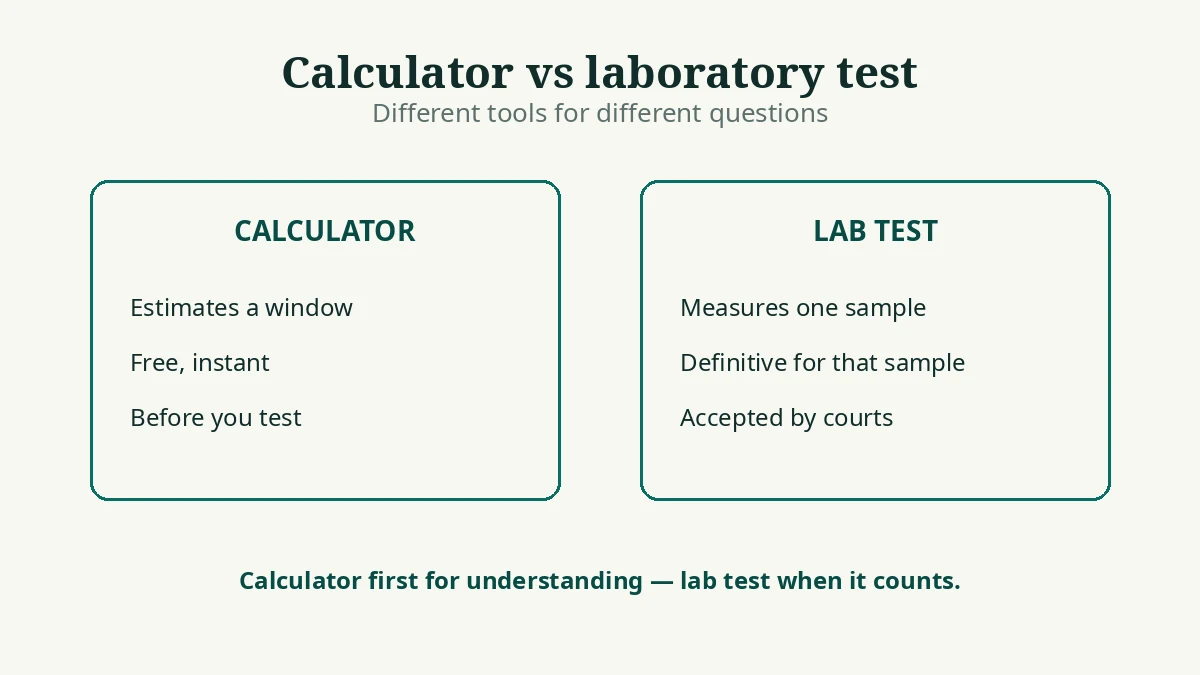
That window is the whole point of the tool. It answers the question people actually ask before a test: "roughly how long am I in the detection zone?" Our EtG calculator answers it as a range, built from the published research on EtG excretion — the methodology explained on our calculation methodology page. A range is not a hedge; it is the honest output. Body size, metabolism, hydration, and the exact timing of each drink all shift an individual's result, so two people with the same drinks on the same night can test differently on the same morning.
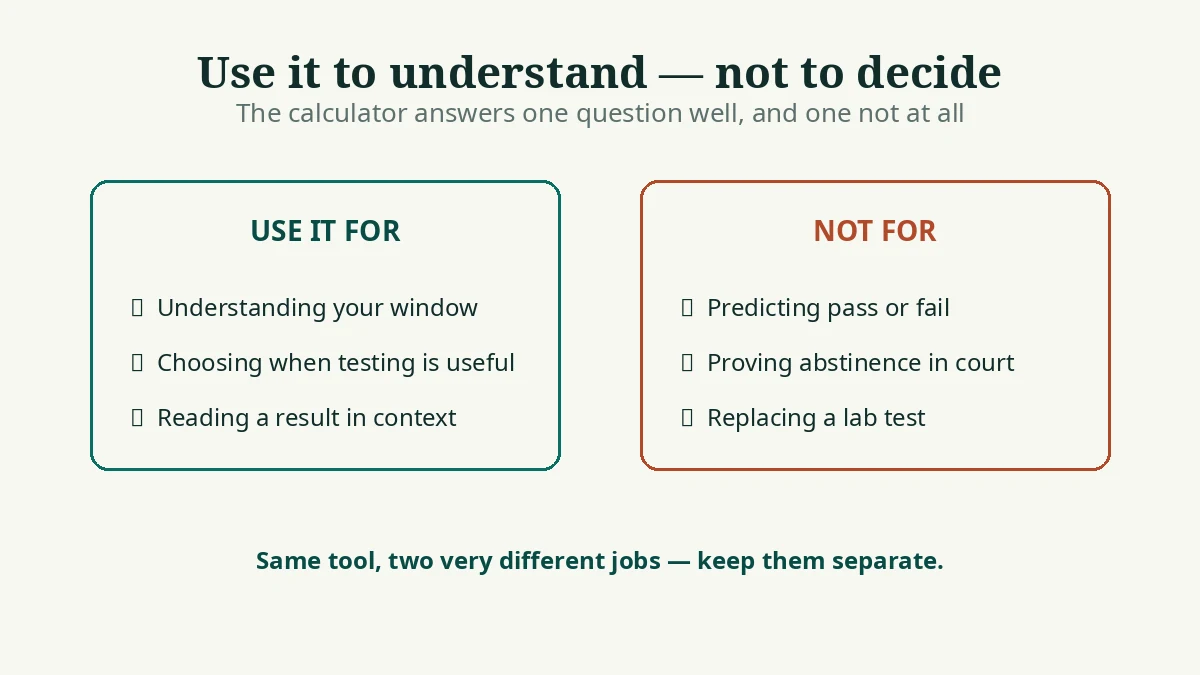
What the calculator does not do matters just as much. It cannot tell you whether you will pass or fail a specific test, read your metabolism or your lab's exact method, or overrule a laboratory result. Any tool that claims otherwise — a single hour, or a promised pass date — is inventing certainty. The Substance Abuse and Mental Health Services Administration (SAMHSA) advisory on alcohol biomarkers is explicit that EtG results require interpretation in context, never as a standalone verdict on a person.
Who benefits most from an EtG calculator
The people who get the most from a calculator share one thing: they have a test coming, or a testing decision to make, and they want to understand the timing before they act.
| Situation | What the calculator helps you do | What to do with the answer |
|---|---|---|
| Facing a probation or court-ordered test | See how your last drinking episode maps against your program's cutoff and test date | Understand the window; follow your program's rules exactly — do not try to game the test |
| Pre-employment or return-to-work testing | Estimate whether recent drinking falls inside the detection window for a workplace cutoff | Plan honestly; a workplace test is usually at 500 ng/mL, but confirm your employer's policy |
| In a treatment or recovery program | Understand why random testing catches drinking days later, and why honesty beats timing | Use the result to support abstinence, not to plan around test days |
| After a DUI charge, awaiting testing | Put the detection window in context before a court-ordered test | Talk to your lawyer about what the test can and cannot prove |
| Considering an at-home test | Decide whether testing now is informative, or too early or too late to mean anything | Compare with a lab test if the result will matter to anyone else |
Notice the pattern: in every useful case, the calculator informs a decision; it does not make it for you. Someone on probation who learns their Saturday drinking sits inside Monday's window has learned why the program tests randomly. Our probation, employment, and DUI guides walk through those situations.
A second group benefits too: people helping someone else. A parent, partner, or clinician trying to understand a result needs the same honest range — a single EtG number without a window, cutoff, and timeline is easy to misread in either direction.
When a calculator is not enough
There are situations where an estimate, however honest, is the wrong tool. If any of these apply, get a real test or real advice instead.
When the result has legal consequences. A court, probation department, or child-custody proceeding does not accept a calculator printout. It accepts a laboratory result, interpreted by a toxicologist, with a chain of custody. If a result could affect your freedom, custody, employment, or licence, the calculator can help you understand the process — it cannot substitute for it. Talk to your lawyer before the test, not after an unexpected result.
When you need a medical answer. EtG testing is not a health diagnostic. It cannot tell you whether you have a substance use disorder, how much damage drinking has done, or whether you are safe to drive, work, or take medication. Those are clinical questions for a clinician, with a full history and examination — the American Society of Addiction Medicine is clear that test results must be combined with patient history and assessment, never read alone.
When you need certainty about one specific test. A calculator models a typical person. Your metabolism, hydration, medications, and exact drinking pattern all move the window, and near the edges of the range an estimate is at its least reliable — exactly when people want it most. If you need to know what one specific sample on one morning will show, test that sample in a laboratory.
When you are trying to beat the test. Plain language: dilution tricks, timing games, and "flush" products do not reliably change a laboratory result, and they can create new problems — a dilute sample is usually flagged and retested, and a substituted sample can be treated worse than a positive one. A calculator used to plan evasion will not protect you. Our water and dilution guide explains why heavy water intake lowers concentration without speeding clearance, and why it usually ends in a retest.
Calculator versus laboratory test: what each one is for
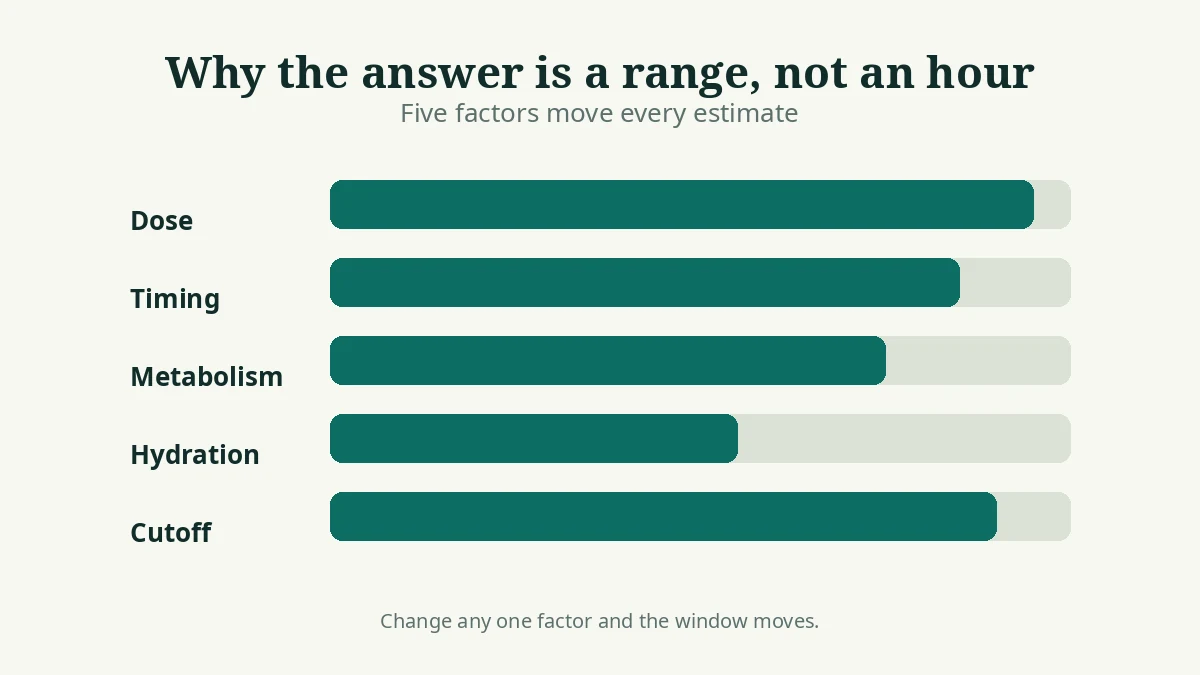
The calculator and the lab test are different tools for different jobs — the comparison makes the boundary clear.
| Question | Calculator | Laboratory test |
|---|---|---|
| How long might EtG be detectable? | Yes — an honest range from dose, timing, and cutoff | No — it reports one sample at one moment |
| Will this specific sample test positive? | No — it cannot know your body or the lab's method | Yes — that is exactly what it measures |
| Will a court or employer accept it? | No | Yes — with chain of custody and confirmation |
| Can it distinguish drinking from incidental exposure? | No — it models drinking only | Partly — LC-MS/MS confirmation plus a toxicologist's review can weigh the evidence |
| Cost and speed | Free, instant | Days, and a fee — but definitive for that sample |
The right sequence is calculator first, lab test when it counts. Use the calculator to understand the window and decide whether testing now is informative; use the lab test when someone else will act on the result, or when you need to know about a specific sample. Our recovery-program guide shows how good programs follow exactly this logic: the estimate informs the conversation, the confirmed laboratory result informs the decision — and the two are never confused.
Real-world scenario: a test on Monday, drinks on Saturday
Take a case. Someone on probation has a scheduled test on Monday morning; on Saturday night they had three drinks at a family dinner, then nothing further. Their program tests at 500 ng/mL, the common screening cutoff.
What does a calculator say? Three drinks produce a moderate EtG peak, and by Monday morning — roughly 36 hours later — much of it has cleared. At 500 ng/mL, the modelled window for three drinks typically runs around 24 to 54 hours, so Monday sits inside the window but toward its later part: the sample could read either side, depending on metabolism, hydration, and drink timing. At 100 ng/mL, the same Monday sample would be far more likely to read positive.
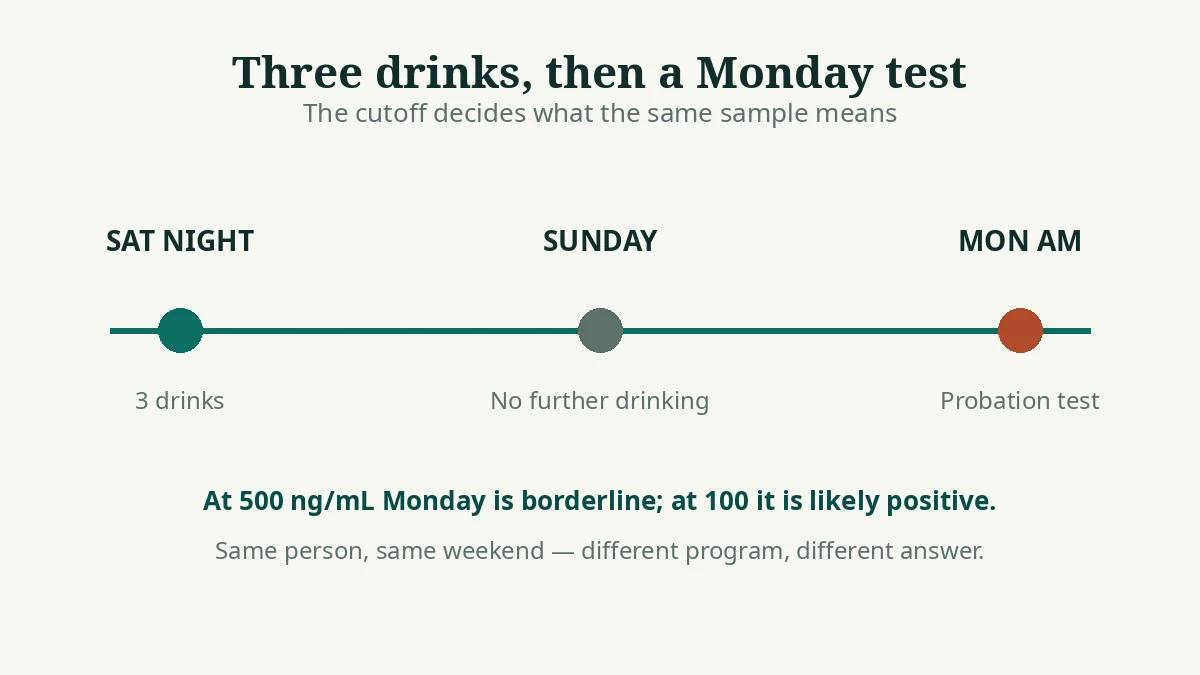
The scenario shows both value and limit in one picture. Without the calculator, this person might assume Saturday is safely "long ago" by Monday, or panic that any drinking guarantees failure — both wrong. But the calculator cannot resolve the borderline: Monday's sample is genuinely uncertain, and no honest tool can say which side of 500 ng/mL it will land on. That uncertainty is information, not a flaw — it tells them the test matters and the program's rules matter. See our 100 vs 500 ng/mL cutoff guide and half-life calculator for the detail.
How to use a calculator result responsibly
Four habits separate a useful estimate from a misleading one:
First, enter honest inputs. A calculator fed with two drinks when you had five returns a reassuring window that belongs to someone else. Round up, not down, when unsure — and remember a "standard drink" is about 14 grams of pure alcohol, not whatever was in your glass. Our one-drink guide shows how even a single drink behaves at different cutoffs.
Second, read the whole range. If the window is 30 to 68 hours, the meaningful fact is the spread, not the midpoint. Planning around the early end is planning to be surprised. Treat the late end as the point after which detection becomes unlikely, and everything inside the range as genuinely uncertain.
Third, check the cutoff. Most bad estimates come from the wrong cutoff, not the wrong calculator. Workplace, probation, and abstinence-monitoring programs can all use different levels, and the same drinking gives a different window at each. If you do not know your program's cutoff, find out before you rely on any estimate.
Fourth, act on the uncertainty, not against it. A window that includes your test date is a reason to follow your program's rules and be honest with the people testing you — not to drink more water, delay the test, or buy a product promising to change the result. Those moves do not reliably work, and can turn a difficult situation into a worse one.
The bottom line
So, who should use an EtG calculator? Anyone facing an EtG test who wants to understand the detection window before it matters — probation, employment, court-ordered, or treatment-program testing — and anyone helping someone in those situations understand a result. It is a useful tool for that job: free, instant, and grounded in published research on how EtG rises and clears.
And when is it not enough? Whenever the answer will be acted on by someone else, whenever the stakes are legal or medical, and whenever you need certainty about one specific sample. Then the calculator has done its job by showing you the window — and the laboratory test and the professional advising you take over from there. Use the estimate to understand, the test to decide, and never let a range pretend to be a verdict.
Frequently asked questions
Should I use an EtG calculator before a probation test?+
Yes, to understand your detection window — but not to decide whether to follow your program's rules. A calculator shows roughly how long EtG from your last drinking episode may remain detectable at your program's cutoff. It cannot predict your specific result, and it never replaces the laboratory test your program relies on.
Can an EtG calculator tell me if I will pass my test?+
No. A calculator models a typical range from drinks, timing, and cutoff; it cannot know your metabolism, hydration, body composition, or the lab's exact method. Near the edges of the window, an estimate is at its least reliable. Only a laboratory test of your actual sample gives a definitive answer for that sample.
Is an EtG calculator accurate?+
As a window estimator, yes — when fed honest inputs and the correct cutoff, it reflects the published research on EtG excretion, roughly 24 to 80 hours for most drinking. As a pass-or-fail predictor for one person on one day, no tool is accurate, because individual variation is too large. Judge a calculator by its range, not by a single hour.
Who should not rely on an EtG calculator?+
Anyone whose result carries legal consequences — court, probation, custody, or employment decisions — anyone needing a medical answer, and anyone trying to beat a test. In those cases you need a laboratory test and professional advice. A calculator estimate is not accepted by courts or employers and cannot prove abstinence.
What cutoff should I enter in the calculator?+
The cutoff your test actually uses. Common levels are 100 ng/mL for strict abstinence monitoring, 200 ng/mL for many treatment programs, and 500 ng/mL for general screening and many workplaces. The same drinking gives a very different window at each level, so a wrong cutoff is the most common cause of a misleading estimate — confirm your program's cutoff first.
Is an EtG calculator better than an at-home EtG test?+
They answer different questions. A calculator estimates a window for free and instantly, before you test. An at-home test measures one sample at one moment, but with lower accuracy than a laboratory test and no confirmation step. If the result will matter to anyone else, a laboratory test with LC-MS/MS confirmation is the reliable route.
Can a calculator help me understand someone else's test result?+
Yes — that is one of its best uses. A parent, partner, clinician, or probation officer can use the window, cutoff, and timeline to avoid misreading a single number: a low-level positive is not proof of heavy drinking, and a negative result is not proof of abstinence. The result still needs a toxicologist's interpretation in context.
Evidence and limitations
This article summarizes published research on EtG detection windows, cutoffs, and the interpretation of alcohol biomarker results. Group-level findings cannot predict one person's result, and this article is educational only — it is not legal or medical advice.
- SAMHSA Advisory: The Role of Biomarkers in the Treatment of Alcohol Use Disorders (2006, revised 2012)
- American Society of Addiction Medicine — drug testing in clinical addiction medicine guidance (testing as a therapeutic tool; results combined with history and assessment)
- McDonell et al. (PMC4400217) — EtG detection and alcohol use monitoring research
- Mackus et al. (PMC5637917) — EtG excretion and detection-window research