What “one drink” actually means
Before the science, the serving. In the United States, one standard drink contains about 14 grams of pure alcohol (NIAAA): 12 ounces of 5% beer, 5 ounces of 12% wine, or 1.5 ounces of 40% spirits. This definition matters because real-world pours routinely exceed it — a generous restaurant wine pour can be 7–8 ounces, a pint of strong IPA can hold the alcohol of nearly two standard drinks, and a heavy-handed home cocktail can be two or three.
Everything below assumes one true standard drink. If your “one drink” was larger, read the 2–3 drink row of the detection table instead.
How one drink becomes detectable EtG
Ethyl glucuronide (EtG) is a minor, direct metabolite of ethanol. After drinking, the liver conjugates a tiny fraction of the alcohol dose — well under 0.1% — with glucuronic acid, and the kidneys excrete the resulting EtG in urine. Because EtG forms only from ethanol that was actually metabolized, it is a highly specific marker of alcohol exposure. Older indirect markers such as GGT or CDT can be nudged by liver disease, medications, or other conditions; EtG does not have that problem, which is why courts and monitoring programs adopted it.
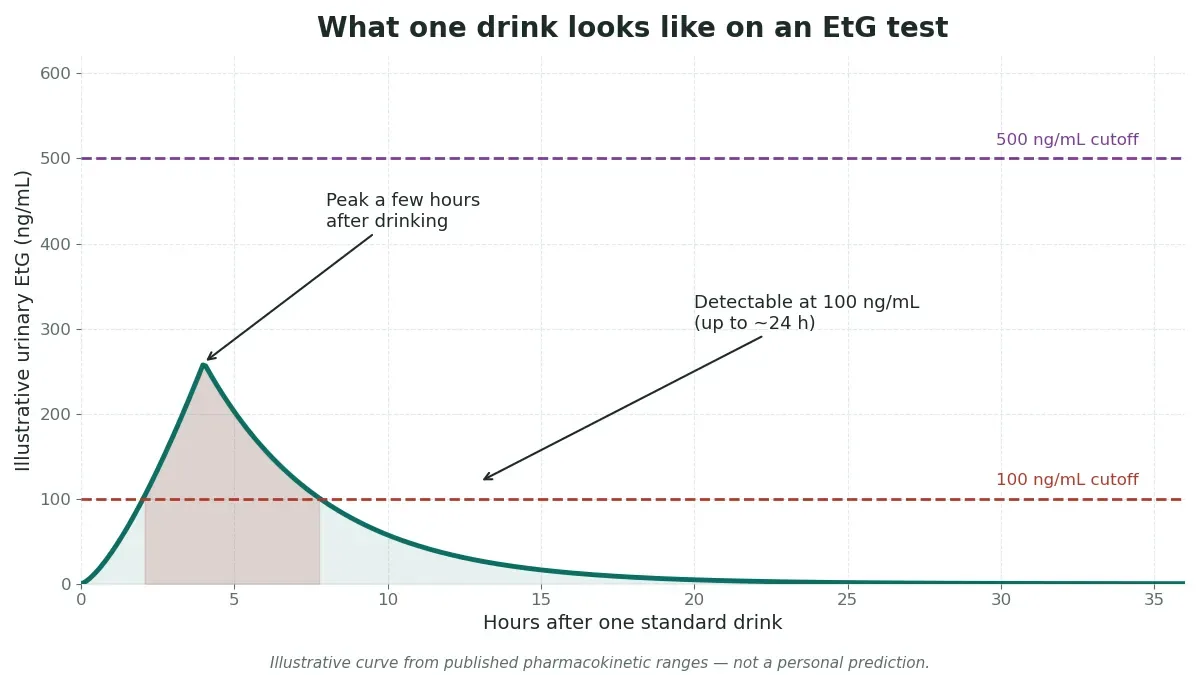
The pharmacokinetic story after a single drink runs in three phases. First, ethanol absorbs and distributes over 30–90 minutes. Second, EtG formation lags slightly behind blood alcohol: urinary EtG typically peaks a few hours after the last drink, which is why a sample taken 30 minutes after one beer can look different from a sample taken six hours later. Third, EtG clears with a half-life of roughly 2–3 hours in most published estimates (the literature range runs about 2–5 hours depending on the study population and dose). That short half-life is precisely why a single drink clears in about a day while a heavy episode lingers for three.
Why two cutoffs exist — and why they answer differently
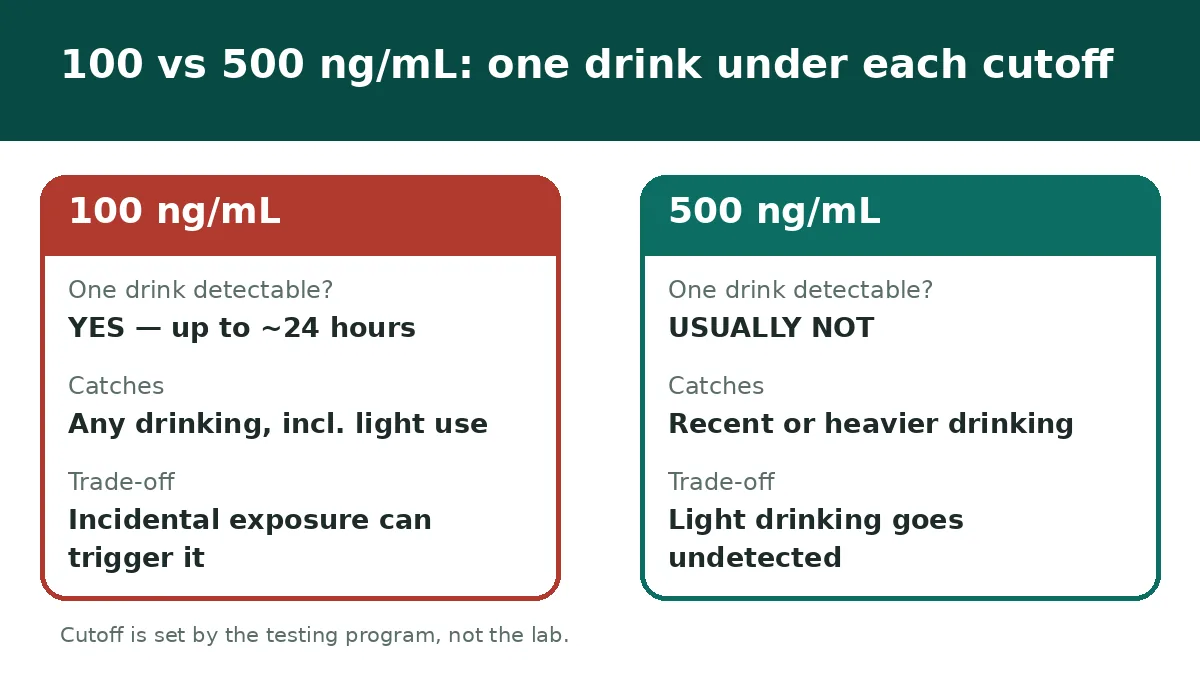
Laboratories report EtG as a concentration in nanograms per milliliter, and the program — not the lab — sets the cutoff that separates negative from positive. Two cutoffs dominate US practice, and they were chosen for opposite reasons. Our 100 vs 500 ng/mL cutoff guide compares them in full; here is the short version for a single drink.
The 100 ng/mL cutoff maximizes sensitivity. Programs that must catch any drinking — many probation departments, drug courts, family-court monitoring, and abstinence-based treatment — accept the tradeoff that comes with it: at this level, incidental alcohol exposure can occasionally produce low-level positives. Alcohol-based mouthwash used vigorously, heavy hand-sanitizer use, and certain foods and medications have all produced results in the low hundreds of ng/mL in published case reports. SAMHSA’s biomarker advisory explicitly cautioned that results between 100 and 500 ng/mL deserve careful interpretation and, where the stakes are high, confirmation testing.
The 500 ng/mL cutoff maximizes specificity. SAMHSA’s advisory discussed this higher threshold as a way to screen out incidental exposure while still catching meaningful drinking. At 500 ng/mL, mouthwash and sanitizer effectively disappear from the picture — but so does a single drink. In most people, one standard drink never pushes urinary EtG above 500 ng/mL at all; in the occasional fast absorber it may briefly cross and fall back within a few hours.
This is the honest answer to the headline question: there is no single yes or no, because the question is incomplete without the cutoff. At 100 ng/mL the answer is usually yes for about a day; at 500 ng/mL it is usually no.
Detection windows by amount: the data
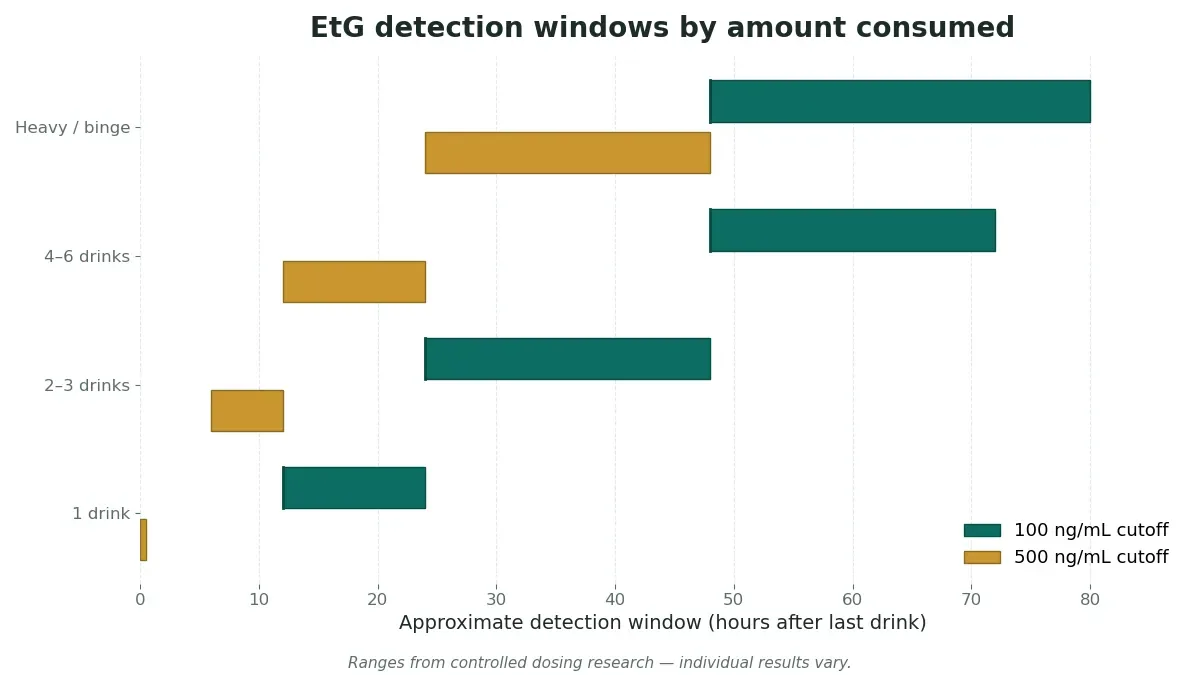
The table below compiles approximate urinary EtG detection windows from controlled dosing studies. Every value is a range, not a promise. Dose pace, food, body composition, hydration, urine concentration, and individual metabolic differences move real results within — and occasionally beyond — these bands. No calculator, chart, or article can convert a last drink into an exact ng/mL number; the research supports ranges, and ranges are what we publish.
| Amount consumed | ~100 ng/mL cutoff | ~500 ng/mL cutoff |
|---|---|---|
| 1 standard drink | Up to ~12–24 hours | Usually not detected |
| 2–3 drinks | ~24–48 hours | ~6–12 hours, often negative |
| 4–6 drinks | ~48–72 hours | ~12–24 hours |
| Heavy / binge episode | Up to ~80 hours | ~24–48 hours |
Two patterns in the data deserve emphasis. First, the lower the dose, the more the cutoff matters: after heavy drinking the cutoffs differ by about a day, but after a single drink they are the entire difference between positive and negative. Second, EtG does not scale linearly with drinks — doubling the dose does not double the window.
Real-world scenarios
One glass of wine with dinner Friday, test Monday morning. About 60 hours later. The EtG from a single drink peaked Friday night and cleared by sometime Saturday. Negative at either cutoff, with wide margin.
Two beers at a Saturday barbecue, random test Sunday afternoon. Roughly 20 hours later. Likely positive at 100 ng/mL — two drinks sit squarely in the 24–48 hour band. At 500 ng/mL, probably negative, though a slow-drinking session that ended late could still be catching the tail.
One beer finished an hour before a 500 ng/mL test. EtG from that drink is still climbing toward its peak, which arrives a few hours after drinking. Even at peak, a single standard drink rarely reaches 500 ng/mL in most people — most likely negative. Run the same scenario at 100 ng/mL and the answer flips: very likely positive.
One drink, then a gallon of water before the test. Extra fluid dilutes the urine and lowers the measured EtG concentration — the cutoff measures concentration, not total EtG excreted. But laboratories routinely measure creatinine alongside EtG precisely to catch this: a creatinine below about 20 mg/dL flags the sample as dilute, and many programs treat a dilute result as a violation, require an observed retest, or count it as a positive. How creatinine normalization works explains the science. Dilution is unreliable as a strategy and risky under monitoring rules.
Daily single drink with dinner, tested every Monday. One drink per evening clears within about a day, so a Monday-morning test after a Sunday dinner drink can still be positive at 100 ng/mL — even without any heavy drinking.
What shifts the result after a single drink
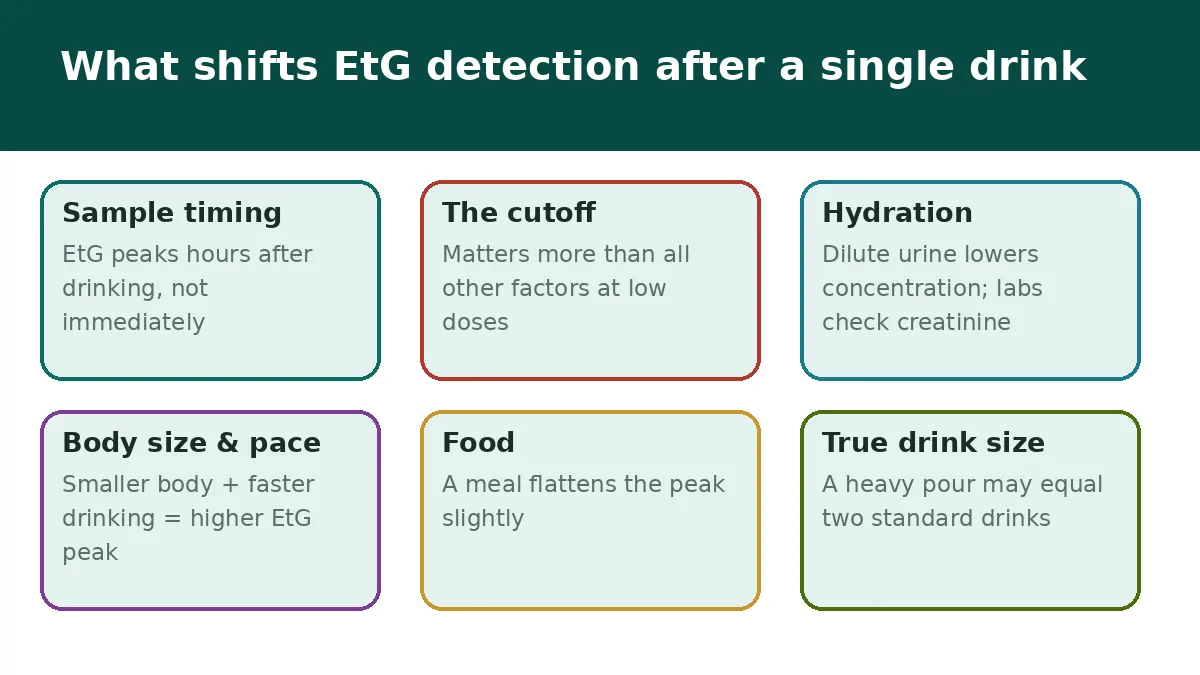
Timing of the sample. Because urinary EtG peaks hours after drinking, the clock that matters runs from the last drink, not the first. A test at hour 2 and a test at hour 8 after the same single drink can give different concentrations.
Hydration and urine concentration. Dilute urine lowers EtG concentration; concentrated morning urine raises it. Creatinine normalization helps laboratories adjust for this, but the correction is approximate — hydration still moves results.
Body size and drinking pace. A smaller person who drinks quickly reaches a higher blood-alcohol peak, which drives a higher EtG peak, than a larger person sipping the same drink slowly. “One drink” is not the same pharmacokinetic event for everyone.
Food. Drinking with a meal slows absorption and flattens the ethanol curve, which slightly lowers and shortens the EtG peak compared with drinking on an empty stomach.
Medications and health conditions. Anything that alters liver or kidney function can shift EtG kinetics slightly, though far less than the cutoff does.
The cutoff. Restated because it dominates: at low doses, the program’s chosen threshold matters more than all the physiological factors combined.
How this connects to EtG calculators
An EtG calculator takes your inputs — drinks, timing, body weight, and the cutoff — and estimates a detection window from the same pharmacokinetic ranges summarized above. For a single drink, a good calculator should show you a range (roughly “up to 24 hours at 100 ng/mL; likely below detection at 500 ng/mL”) rather than a precise hour count. If you want to check your own scenario, run your numbers through the calculator and compare the estimate against the ranges in this article.
Be skeptical of any tool that converts one drink into an exact ng/mL reading or an exact “you will pass at 2:30 PM” — the research does not support that precision. Ranges are the honest output; anything more exact is theater.
Frequently asked questions
Will one beer show up on an EtG test?
It can. At a 100 ng/mL cutoff, one standard beer is commonly detectable for up to about 24 hours. At 500 ng/mL, one beer is unlikely to produce a positive result.
How long after one drink can EtG be detected in urine?
For most people, up to roughly 12–24 hours at the 100 ng/mL cutoff. Faster metabolisms, larger body size, and good hydration sit at the short end; slower clearance and concentrated urine sit at the long end.
Does one glass of wine register differently than one beer?
No — if both are true standard drinks containing about 14 grams of alcohol, the EtG produced is comparable. A heavy restaurant pour of wine, however, may be closer to two standard drinks and behaves like the larger dose.
Can one drink cause a false positive?
A positive after one drink is not a false positive: EtG correctly detected genuine alcohol exposure. The term properly applies to positives from incidental exposure — mouthwash, hand sanitizer, certain medications — or, rarely, laboratory error.
Does drinking lots of water after one drink help pass?
Water dilutes urine and lowers EtG concentration, but labs check creatinine to flag dilution, and monitored programs commonly penalize dilute samples or demand retests. It is not a reliable approach.
Will one drink show up on an EtG hair test?
Hair EtG testing detects patterns of repeated use over weeks to months; a single drink does not deposit enough EtG to exceed hair cutoffs. “EtG test” without qualification almost always means the urine test covered in this article.
I had one drink and I am in a testing program — what should I do?
Programs set their own rules, and no article can advise you on yours. What the research establishes: at 100 ng/mL, one drink is detectable for about a day; EtG cannot be masked by products sold for that purpose; and attempting to dilute the sample carries consequences of its own in most programs. If you are unsure of your program’s cutoff and policies, ask the program directly.
Evidence and limitations
This article summarizes primary research and public-health guidance on ethyl glucuronide detection after low alcohol doses. Group-level findings cannot predict one person’s result.
- SAMHSA Advisory: The Role of Biomarkers in the Treatment of Alcohol Use Disorders (2006, revised 2012)
- Helander et al. — detection times for urinary EtG and EtS during alcohol detoxification
- Høiseth et al. — pharmacokinetics of ethyl glucuronide in blood and urine
- Wurst et al. — ethyl glucuronide as a marker of alcohol consumption and relapse
- NIAAA — What Is a Standard Drink?