How long does EtG stay in urine after 24 hours, dose by dose
How long does EtG stay in urine after 24 hours? For most drinking, the answer is simple: it is still there. At the 24-hour mark after your last drink, EtG is usually still detectable after any real drinking episode — one drink or twelve, at a 100, 200, or 500 ng/mL cutoff. Twenty-four hours sounds long, but EtG windows are measured in days, and the 24-hour checkpoint falls early in the window for nearly every dose.
The rest of this article exists for the borderline cases: "usually still detectable" is not "always," and the exceptions cluster in one corner of the table — light drinking at a high cutoff. A single light drink at a 500 ng/mL screening cutoff is the one common scenario where 24 hours can land near the edge. Everything heavier, and everything at 100 or 200 ng/mL, is still comfortably inside the window.
This post is a single-checkpoint guide, not a dose guide. For the full window of a specific drink count, see our dose posts — including EtG detection after 2 drinks — and for the later checkpoint, see how long EtG stays in urine after 48 hours.
What "24 hours" counts from: your last drink, not your first
The most common mistake in reading a 24-hour question is starting the clock at the wrong moment. The clock starts at your last drink — more precisely, at the EtG peak that follows it, roughly 2–5 hours after the last drink. The liver converts a small fraction of alcohol — roughly 0.5 to 1.5 percent — into ethyl glucuronide, and that takes time. The EtG level in urine climbs for a few hours after drinking stops, peaks, and only then begins its long decline.
That matters on a long night. Start at 8 p.m., finish at 1 a.m., and a test at 8 p.m. the next day is 24 hours after your first drink but only 19 hours after your last — roughly 15 hours past the peak. Programs, probation officers, and labs all mean time since the last drink.
The 24-hour verdict, dose by cutoff
The table below gives the site's consistent modeled windows for each dose at the three cutoffs used most often in the United States, with the verdict at exactly 24 hours after the last drink. These ranges come from the detection model behind our calculator, built on published EtG pharmacokinetics: a peak a few hours after drinking, then a decline with a half-life of roughly 2.5 hours and a slower tail. They are group-level estimates.
| Dose | 100 ng/mL window | 200 ng/mL window | 500 ng/mL window | Verdict at 24 hours |
|---|---|---|---|---|
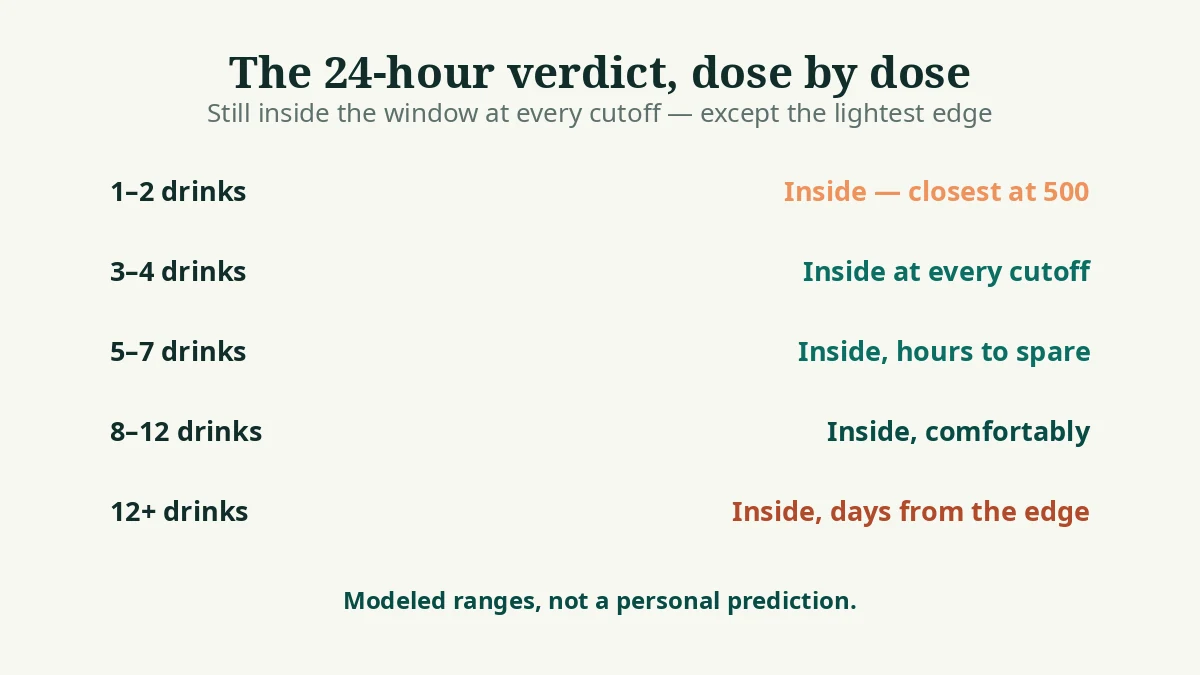
| 1–2 drinks | 22–52 hours | 20–46 hours | 15–36 hours | Inside at every cutoff; closest at 500 ng/mL |
| 3–4 drinks | 30–68 hours | 26–59 hours | 20–46 hours | Inside at every cutoff |
| 5–7 drinks | 38–85 hours | 33–75 hours | 26–58 hours | Inside at every cutoff, with hours to spare |
| 8–12 drinks | 50–105 hours | 44–92 hours | 34–71 hours | Inside at every cutoff, comfortably |
| 12+ drinks | 65–130 hours | 57–114 hours | 44–88 hours | Inside at every cutoff, days from the edge |
Read the table the way a lab would. At 24 hours, the lightest row is the only one with any real doubt, confined to the 500 ng/mL column: 24 hours sits past the midpoint of the 15–36 hour window, so a negative is possible but a positive remains more likely. At 100 ng/mL, the same 24 hours sits near the start of the 22–52 hour window — a positive is expected. From 3–4 drinks upward, there is no borderline at 24 hours at any cutoff.
The cutoff still matters, just not in the way people hope. At 24 hours it does not flip the answer for most doses — it changes how far inside the window you are. The difference shows up later, at 36 or 48 hours, when the 500 ng/mL window closes while the 100 ng/mL window is still open.
Why 24 hours is not a clearance point
Twenty-four hours feels like it should be enough: a full day has passed, the alcohol itself is gone — blood alcohol is typically zero within 8–12 hours of a moderate session — and you feel sober. But EtG is not alcohol. It is a metabolite that lingers after the alcohol is gone, and its decline is measured in halvings, not in hours of feeling sober.
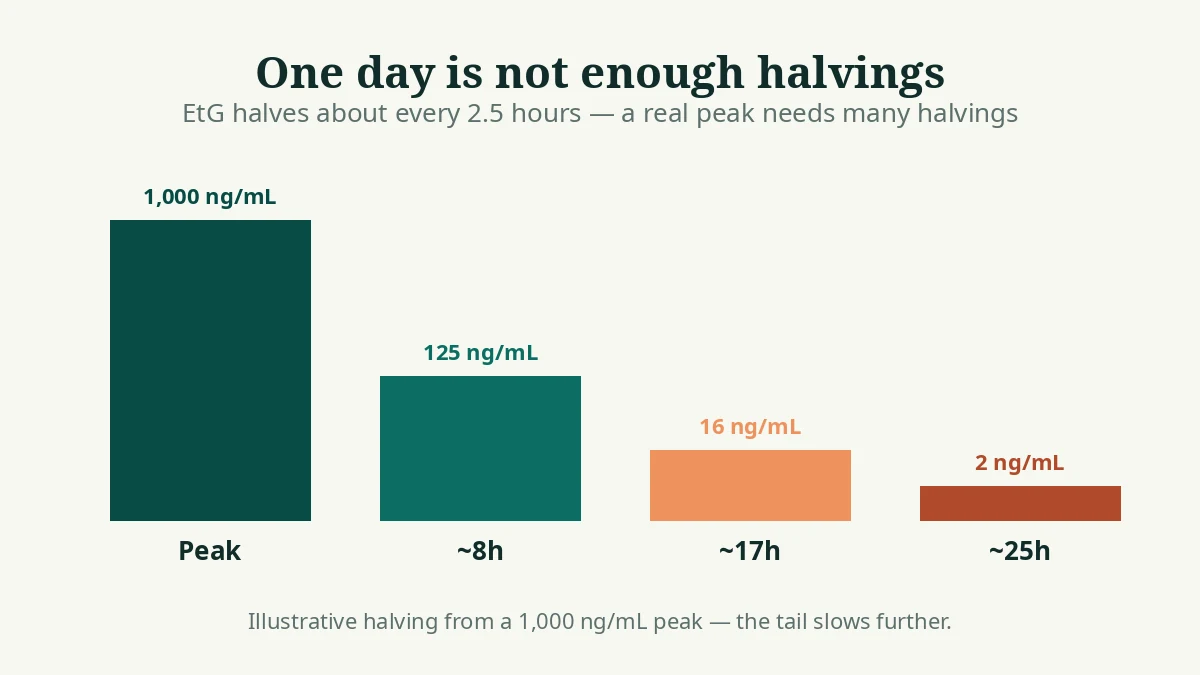
EtG falls by roughly half every 2.5 hours in the early phase. That sounds fast until you count the halvings: falling from a peak of 10,000 ng/mL to below 100 ng/mL takes about seven halvings — roughly 17 hours — and to below 500 ng/mL takes about four to five halvings, roughly 11 hours. Heavier drinking starts higher, needs more halvings, and each halving costs the same 2.5 hours. The table below shows the simple halving math for three illustrative peaks, counting from the peak itself (roughly 2–5 hours after the last drink).
| Illustrative peak | Hours from peak to below 500 ng/mL | Hours from peak to below 100 ng/mL | What it means at 24 hours |
|---|---|---|---|
| 1,000 ng/mL | About 2.5 hours | About 8 hours | Below both cutoffs on pure halving math — light drinking only |
| 10,000 ng/mL | About 11 hours | About 17 hours | Still above 100 ng/mL at 24 hours after the last drink |
| 50,000 ng/mL | About 17 hours | About 22 hours | Still above both cutoffs at 24 hours, even before the slow tail |
Two caveats keep this honest. First, real elimination slows in the tail phase, so simple halving math understates detection — which is why the modeled windows above run longer than this illustration suggests. Second, the peak varies enormously between light and heavy drinkers. The lesson is not a formula for your own clearance: one day simply does not contain enough halvings to bring a real peak down to a sensitive cutoff.
What can shift a 24-hour result
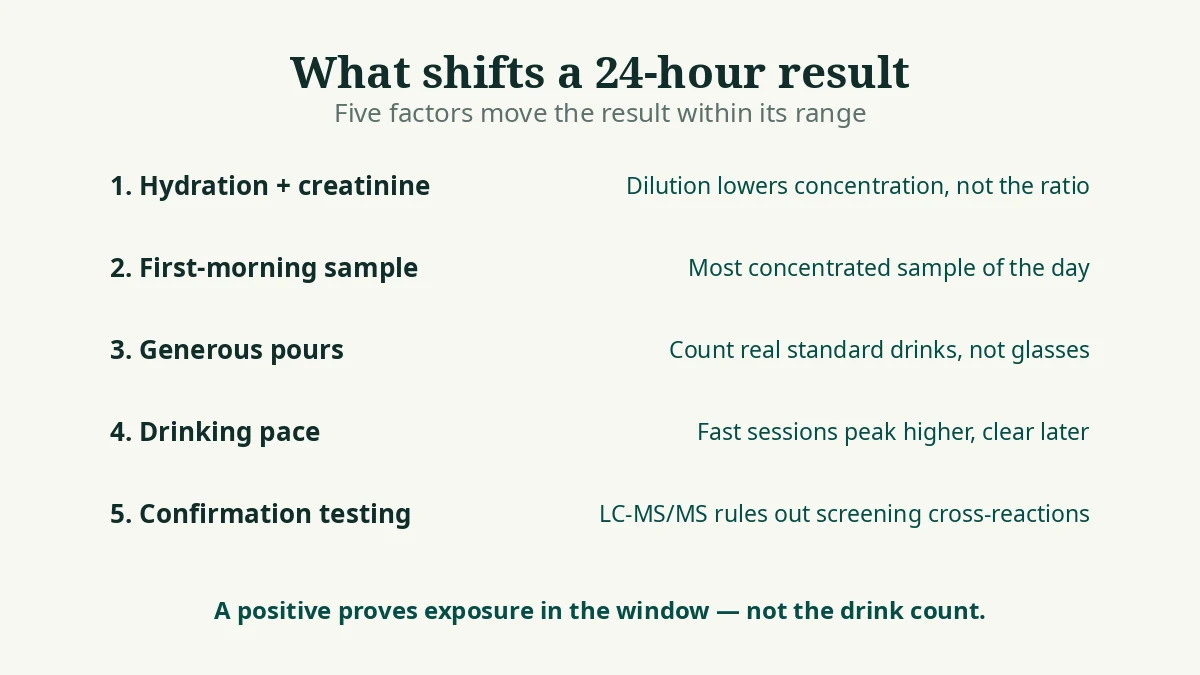
The table gives the expected verdict, but individual results move around it. Five factors do most of the moving. First, hydration and creatinine: drinking a lot of water lowers the EtG concentration in that sample, but labs also measure creatinine, a marker of urine concentration, and the EtG-to-creatinine ratio is largely unaffected by water intake. A very dilute sample can also be flagged as dilute on its own.
Second, first-morning versus later samples. The first urine of the day is usually the most concentrated, having collected overnight without new water intake, so a first-morning sample at 24 hours tends to read higher than one given later the same day. A 24-hour first-morning test is the version most likely to come back positive.
Third, generous pours undercounted. The dose rows assume standard drinks — 12 oz of 5% beer, 5 oz of 12% wine, 1.5 oz of 40% spirits. A restaurant wine pour, a pint of strong beer, or a double shot each exceed one standard drink, so "two drinks" that were really three or four belong in a heavier row. Fourth, drinking pace: the same total produces a higher, sharper peak when finished quickly than when spread over hours with food, and a higher peak needs more halvings to clear. Fifth, confirmation testing: screening immunoassays can cross-react near the cutoff, while LC-MS/MS confirmation measures EtG and EtS directly. If a 24-hour result carries consequences, ask whether it was confirmed and what cutoff was applied — a positive proves exposure within the window, not how many drinks you had or exactly when.
Real-world scenarios: Friday night drinks, Saturday test
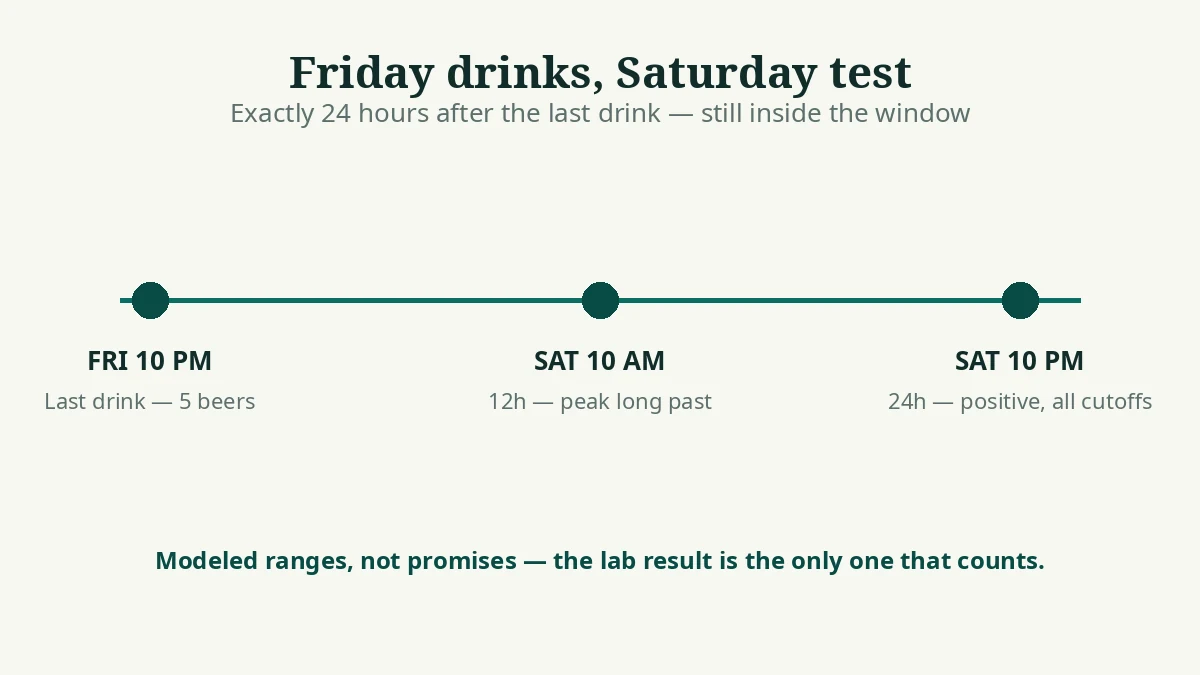
Daniel has five beers at a Friday gathering, finishing his last at 10 p.m., and faces a random workplace test on Saturday at 10 p.m. — exactly 24 hours later. Five beers put him in the 5–7 drink row: 38–85 hours at 100 ng/mL, 33–75 at 200, and 26–58 at 500. At 24 hours he is inside every window, nowhere near the edge — at 500 ng/mL, the most forgiving cutoff, he is still two hours short of even the earliest end. A positive is expected at every cutoff.
Now the lighter variant. Sarah has two glasses of wine at dinner on Friday, finishing at 9 p.m., and a probation test on Saturday at 9 p.m., 24 hours later. Her row is 1–2 drinks: 22–52 hours at 100 ng/mL, 20–46 at 200, and 15–36 at 500. At 24 hours she is inside all three. At 100 ng/mL she is barely past the start of the window, so a positive is strongly expected; at 500 ng/mL she is past the midpoint, so a negative is possible — but a positive remains more likely if the sample is concentrated. Neither is clear at 24 hours.
How this 24-hour checkpoint differs from the 48-hour post and the realistic-times page
The three pages answer different questions. This post answers one checkpoint — exactly 24 hours after drinking. The 48-hour post answers the later checkpoint, where the picture genuinely splits by cutoff: at 48 hours, light drinking is usually clear at 500 ng/mL but still detectable at 100 ng/mL, and the borderline zone is the whole story. At 24 hours there is barely a borderline zone — almost everything is still positive, and the useful information is how far inside the window each dose sits.
The realistic detection times page answers the wider question: the full window for each dose, from first detection to final clearance. Think of it as the map, this post as one marked point on it, and the 48-hour post as a second point further along the road. If you know your test date, the checkpoint posts give the faster answer.
How to estimate your own window
Start with the facts that change the answer. Count your real standard drinks, including generous pours — not the number of glasses. Note the time of your last drink, not your first, and add the 2–5 hour peak delay: a test 24 hours after your last drink is roughly 20 hours past the peak. Find out which cutoff your program uses; if you do not know, run the estimate at all three, because at 24 hours the cutoff tells you your margin.
Then run the numbers. Use our EtG calculator with your real drink count, drinking window, and cutoff, or work backwards with the EtG elimination calculator. If your test date falls inside the modeled window at your cutoff, a positive is the expected outcome — plan accordingly, rather than hoping the range is wrong. Keep the estimate in perspective: it is built from group-level pharmacokinetics, and your personal result depends on factors no calculator knows — pour sizes, metabolism, hydration, and sample concentration. Treat the calculator as a planning tool and the lab result as the only result that counts.
Frequently asked questions
How long does EtG stay in urine after 24 hours?+
At 24 hours after your last drink, EtG is usually still detectable after any real drinking episode — at 100, 200, and 500 ng/mL alike. The only common exception is a single light drink near the low end of its window at a 500 ng/mL cutoff. These are modeled ranges for healthy adults, not a personal prediction.
Can EtG be detected 24 hours after drinking?+
Yes, in most cases. A test 24 hours after drinking falls inside the modeled window for every dose from 1–2 drinks upward at every common cutoff, so a positive is the expected outcome at 24 hours. The borderline zone starts later, around 36–48 hours, depending on dose and cutoff.
Is EtG positive after 24 hours at a 500 ng/mL cutoff?+
Usually yes. At 500 ng/mL, 24 hours is inside the modeled window for every dose row — 15–36 hours for 1–2 drinks, 20–46 for 3–4 drinks, and longer for heavier drinking. Only a single light drink sits near the edge at 24 hours, and even there a positive remains plausible.
Does an EtG test 24 hours after drinking always come back positive?+
No — “usually” is not “always.” A single light drink at a 500 ng/mL cutoff can land near the low end of its window at 24 hours, and sample concentration, pour size, and drinking pace all move the result. No calculator or article can promise a particular result; the lab result is the only one that counts.
Does drinking water help pass an EtG test 24 hours after drinking?+
Not reliably. Water lowers the EtG concentration in that sample, but labs measure creatinine and use the EtG-to-creatinine ratio, which research shows is largely unaffected by water intake. A very dilute sample can also be flagged as dilute on its own.
Is a first-morning sample more likely to be positive at 24 hours?+
Yes. The first urine of the day is usually the most concentrated, having collected overnight, so a first-morning sample at 24 hours tends to read higher than a later sample the same day. If your 24-hour test is a first-morning sample, it is the version most likely to come back positive.
How is the 24-hour EtG checkpoint different from the 48-hour checkpoint?+
At 24 hours, almost every dose is still detectable at every cutoff, so the question is how far inside the window you are. At 48 hours the picture splits by cutoff: light drinking is usually clear at 500 ng/mL but still detectable at 100 ng/mL. The realistic detection times page covers the full window for each dose.
Evidence and limitations
This article summarizes published research on ethyl glucuronide formation, detection windows, cutoffs, dilution, and confirmation testing. Group-level findings cannot predict one person’s result, and this article is educational only — it is not medical or legal advice.
- SAMHSA Advisory: The Role of Biomarkers in the Treatment of Alcohol Use Disorders (2006, revised 2012)
- Dahl et al. (2002) — Comparison of urinary excretion characteristics of ethanol and ethyl glucuronide (J Anal Toxicol 26(4):201–204); EtG detectable 22.5–31.5 h after ~0.5 g/kg ethanol, EtG/creatinine ratio unaffected by water diuresis, half-life ~2.5 h
- Goll et al. (2002) — Excretion profiles of ethyl glucuronide in human urine after internal dilution (J Anal Toxicol 26(5):262–266); 25 g ethanol, EtG measurable the following day
- McDonell et al. (2015) — EtG immunoassay cutoff sensitivity in alcohol-dependent outpatients (1,589 samples)
- Mackus et al. — EtG/EtS detection and cutoff performance in alcohol research samples
- Jatlow et al. — EtG/EtS as markers of recent alcohol use, cutoff and confirmation context