The short answer: two drinks can show up for one to two days — the cutoff decides which
EtG detection after 2 drinks is not a single number. Two standard drinks produce a modest EtG peak, and that peak takes roughly one to two days to fall below common test cutoffs. At the widely used 500 ng/mL screening cutoff, two drinks usually clear within about 36 hours. At the sensitive 100 ng/mL cutoff used by some probation and treatment programs, the same two drinks can remain detectable for up to about 52 hours. In other words, a test 24 hours after two drinks will very likely be positive at every cutoff, a test at 48 hours is a genuine borderline case, and a test at 72 hours is usually negative — with real exceptions in both directions.
That spread is the whole story of EtG testing. The test does not measure how many drinks you had or when you had them. It measures the concentration of ethyl glucuronide in one urine sample and compares it with a cutoff. Two people who each had two drinks can test differently on the same day, because their peaks, their drinking pace, their hydration, and the timing of the sample all differ. This article gives the honest ranges for two drinks, explains why the range is wide, and walks through two realistic scenarios so you can read your own situation more accurately.
First, what counts as two drinks?
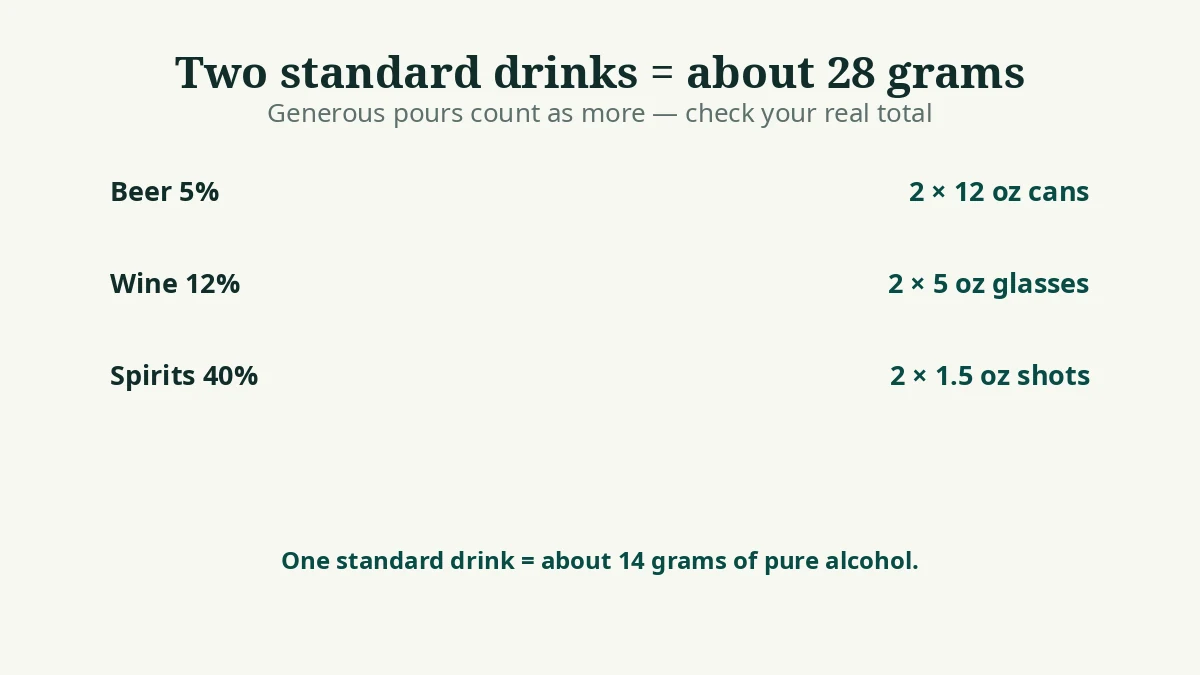
In the United States, one standard drink contains about 14 grams of pure alcohol. Two standard drinks are therefore about 28 grams. That sounds small, but most real pours are bigger than the standard, and that is where people underestimate their dose. A pint of strong beer, a generous restaurant wine pour, or a double shot each count as more than one standard drink.
| Drink | One standard drink | Two standard drinks |
|---|---|---|
| Beer (5% ABV) | 12 oz — one regular can | 24 oz — two cans, or one large pint plus a bit |
| Wine (12% ABV) | 5 oz — one modest glass | 10 oz — two modest glasses |
| Spirits (40% ABV) | 1.5 oz — one shot | 3 oz — two shots, or one double |
| Strong beer (8% ABV) | About 7.5 oz | About 15 oz — less than a pint and a half |
If your two drinks were actually two large glasses of wine at a restaurant, you may have had closer to three standard drinks, and the detection window below shifts toward the heavier end. The ranges in this article assume two true standard drinks, finished within a couple of hours, by a healthy adult.
EtG detection after 2 drinks, by cutoff
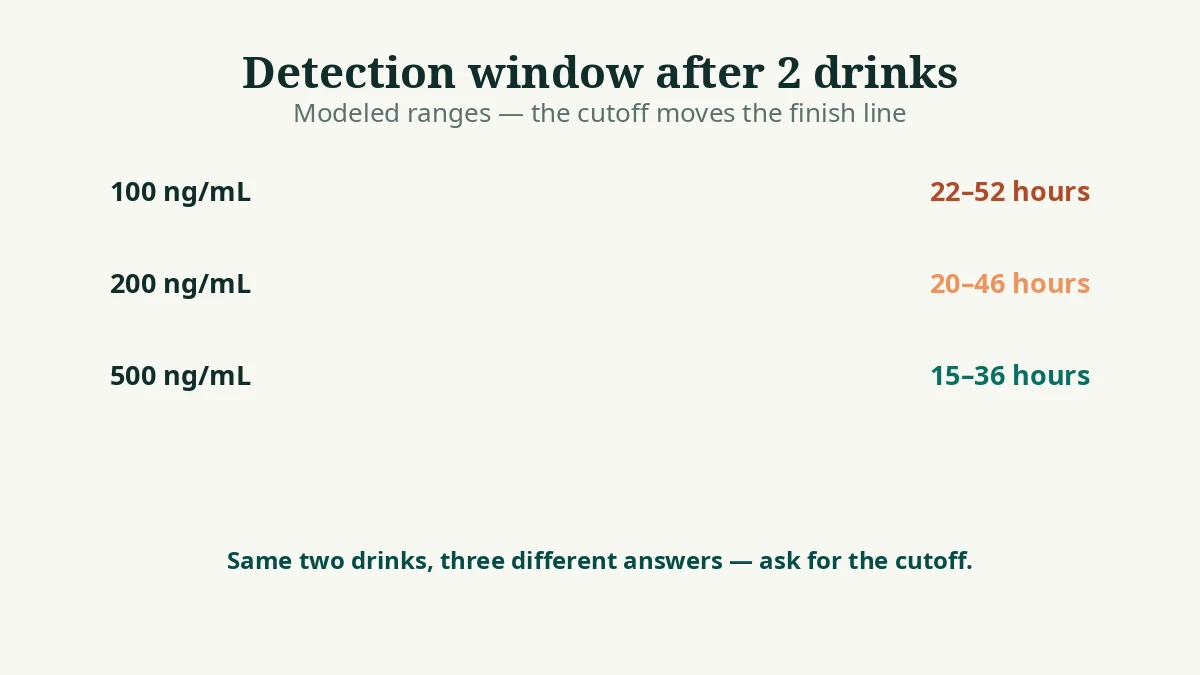
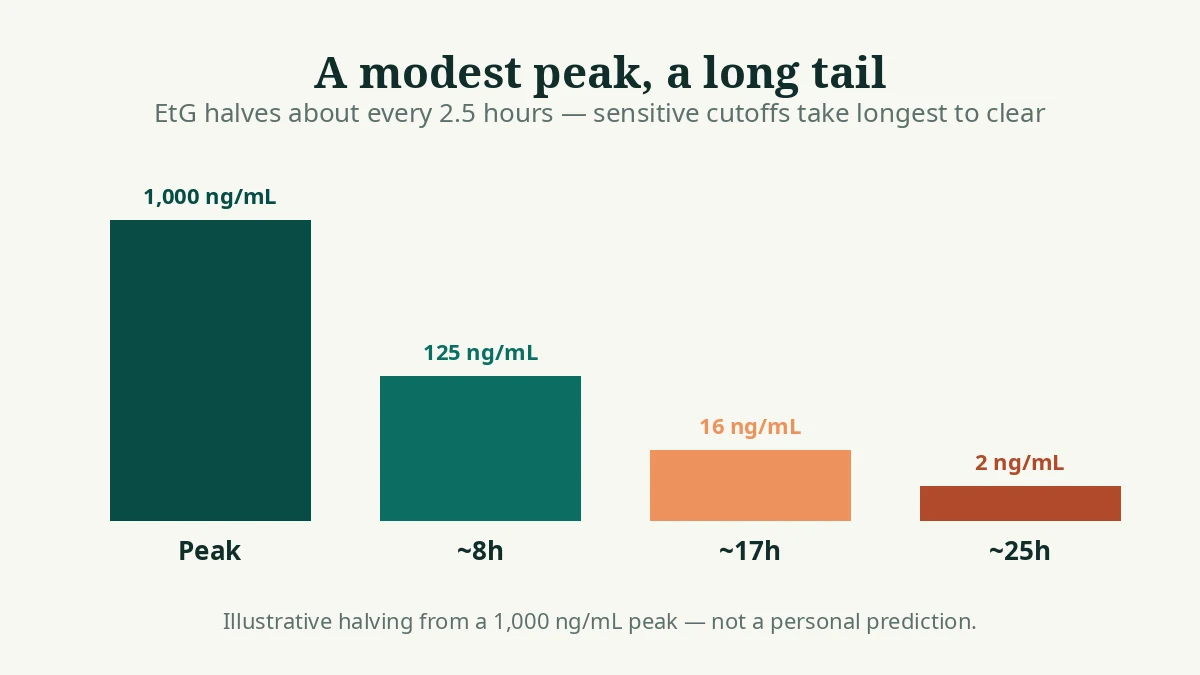
The table below gives modeled detection ranges for two standard drinks at the three cutoffs used most often in the United States. These ranges come from the detection model behind our calculator, which is built on published EtG pharmacokinetics: a peak a few hours after drinking, then a decline with a half-life of roughly 2.5 hours. They are group-level estimates, not a promise about any one person. Research studies support the same shape: after about 25 grams of ethanol — roughly two drinks — EtG was still measurable in urine the following day, and after a moderate dose of about 0.5 grams per kilogram, EtG remained detectable for roughly 22.5 to 31.5 hours.
| Test cutoff | Where it is used | Modeled window after 2 drinks |
|---|---|---|
| 100 ng/mL | Probation, treatment programs, some courts | About 22–52 hours |
| 200 ng/mL | Some workplace and monitoring programs | About 20–46 hours |
| 500 ng/mL | SAMHSA-recommended screening cutoff, many employers | About 15–36 hours |
Read the table from the test's point of view, not the drinker's. A test taken 30 hours after two drinks will usually be positive at 100 ng/mL, borderline at 200 ng/mL, and often negative at 500 ng/mL. Before you interpret any result, find out which cutoff your program uses. A result without its cutoff is only half a result.
Why the range is so wide for just two drinks
A range of 22 to 52 hours for the same dose looks imprecise, but it reflects real biology. EtG forms when the liver attaches glucuronic acid to a small fraction of the alcohol you drink — only about 0.5 to 1.5 percent of the dose becomes EtG, which is why the peak after two drinks is modest and why small differences in the peak translate into large differences in how long it takes to fall below a sensitive cutoff.
Four factors move you within the range. First, pace: two drinks finished in 30 minutes produce a higher, sharper peak than the same two drinks spread over three hours with food. Second, body size and composition: a smaller person reaches a higher blood alcohol concentration from the same 28 grams, and therefore a higher EtG peak. Third, urine concentration at the time of the sample: a concentrated morning sample carries more EtG per milliliter than a dilute sample after a liter of water, which is exactly why labs also check creatinine. Fourth, timing: EtG peaks roughly 2 to 5 hours after the last drink, so a test taken the morning after drinking catches the peak's long tail, not its start.
None of these factors can be adjusted after the fact to guarantee a result, and none of them should be. The honest use of the range is planning and interpretation: if your test is inside the range for your cutoff, a positive is plausible; if it is well outside the range, a positive deserves a second look — including a confirmation test.
Real-world scenario: two drinks Saturday night, test Monday morning
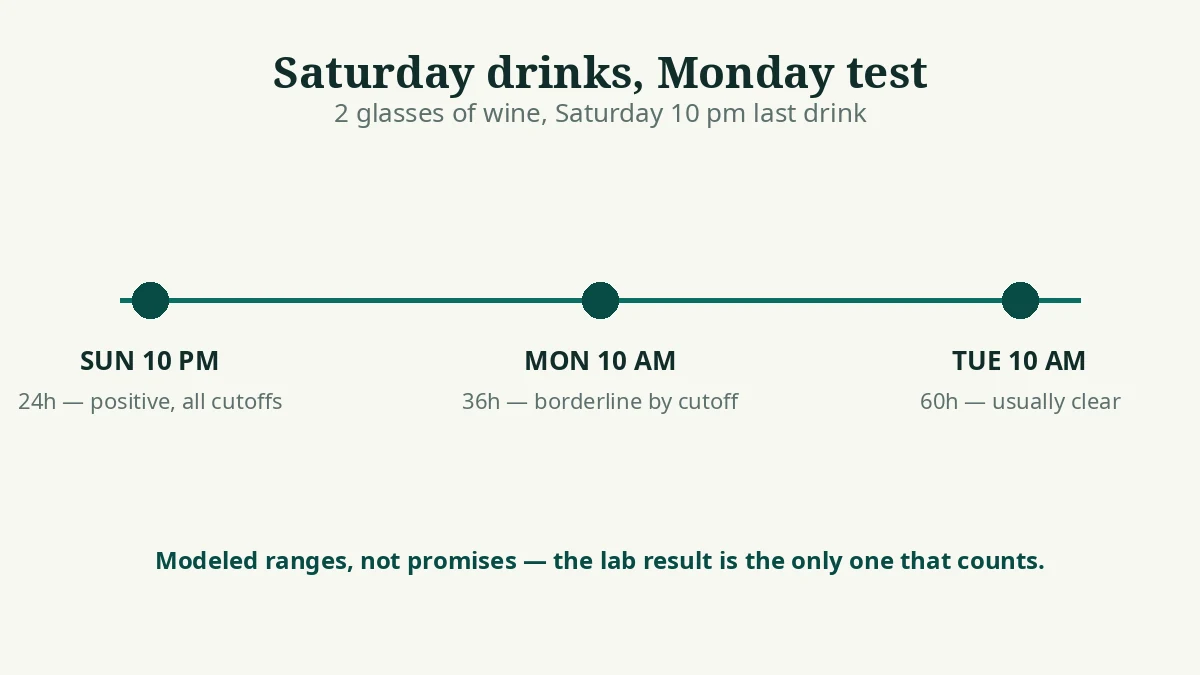
Take the most common version of this question. Maya has two glasses of wine at dinner on Saturday, finishing her second glass at 10 p.m. She has a workplace test on Monday at 10 a.m. — 36 hours later. What should she expect?
At a 500 ng/mL cutoff, 36 hours sits at the far end of the modeled 15–36 hour window, so a negative result is the more likely outcome, though not certain. At 200 ng/mL, 36 hours sits inside the 20–46 hour window, so a positive is plausible. At 100 ng/mL, 36 hours sits comfortably inside the 22–52 hour window, so a positive is the expected outcome. The same Saturday night, the same Monday test, three different answers — decided entirely by the cutoff she may never have been told.
Now change one detail: Maya's test is a random probation test on Sunday at 10 p.m., 24 hours after her last drink. At 24 hours, two drinks are inside the window at every cutoff, so a positive is likely at 100, 200, and 500 ng/mL alike. And if the test slips to Tuesday at 10 a.m., 60 hours out, the picture flips: 60 hours is beyond all three modeled windows, so a negative is the expected outcome at every cutoff — with the caveat that heavier pours, a slower metabolism, or a very concentrated sample can stretch the tail.
Two drinks vs one drink vs four drinks
Two drinks sit in the middle of a steep curve. One drink produces a low peak that often clears a 500 ng/mL cutoff within about a day and a 100 ng/mL cutoff within roughly a day and a half. Four drinks roughly double the peak of two, and because EtG declines by halves rather than by a fixed amount, doubling the peak adds about one half-life — roughly 2.5 hours — plus the longer drinking period itself. In practice, our modeled windows show four drinks lasting about 30–68 hours at 100 ng/mL and 20–46 hours at 500 ng/mL, versus 22–52 and 15–36 hours for two drinks. The practical lesson: the jump from two drinks to four matters more at sensitive cutoffs than at screening cutoffs, because the sensitive cutoff sits much closer to the tail of the curve.
| Dose | 100 ng/mL window | 500 ng/mL window |
|---|---|---|
| 1 standard drink | About 18–40 hours | About 12–28 hours |
| 2 standard drinks | About 22–52 hours | About 15–36 hours |
| 4 standard drinks | About 30–68 hours | About 20–46 hours |
These are modeled ranges from the same calculator model used throughout this site, kept consistent across our dose posts so readers can compare one, two, and four drinks directly. If you had more than two drinks, use the row that matches your real total — including the generous pours.
What a positive after two drinks does not prove
A positive EtG result proves ethanol exposure within the detection window. It does not prove how many drinks you had, exactly when you had them, or whether you were impaired. Two drinks three days ago and four drinks yesterday can produce similar numbers, and a low positive near the cutoff can come from incidental exposure — hand sanitizer, mouthwash, or cooking with alcohol — as well as from drinking. That is why screening positives are supposed to be confirmed by a more specific laboratory method, LC-MS/MS, which measures EtG and its companion marker EtS directly and rules out most immunoassay cross-reactions. If you face consequences from a result, ask whether it was confirmed and what cutoff was used before accepting the interpretation.
It is also worth saying plainly what no article can do: no calculator, no table, and no amount of water can guarantee that a test will be negative. Anyone promising a certain pass is selling something the science does not support. The ranges here exist to help you understand a result, not to engineer one.
How to estimate your own window
Use our EtG calculator with your real drink count, your real drinking window, and the cutoff your program actually uses — if you do not know the cutoff, run the estimate at all three and note how much the answer changes. That spread is itself useful information: if your test date falls inside the window at 100 ng/mL but outside it at 500 ng/mL, the single most valuable thing you can learn before the test is which cutoff applies. Ask the program, the lab, or your probation officer directly; it is a routine question and it changes the meaning of the result completely.
Keep the estimate in perspective. It is built from group-level pharmacokinetics, and your personal result depends on factors no calculator knows — your exact pour sizes, your metabolism, your hydration, and the concentration of the sample you give. Treat the calculator as a planning tool and the lab result as the only result that counts.
Frequently asked questions
How long does EtG stay in urine after 2 drinks?+
After two standard drinks, EtG typically remains detectable for about 22–52 hours at a 100 ng/mL cutoff, 20–46 hours at 200 ng/mL, and 15–36 hours at 500 ng/mL. These are modeled ranges for healthy adults, not a personal prediction — pace, body size, hydration, and the sample's concentration all move the result within the range.
Will 2 drinks show up on an EtG test the next day?+
Very likely yes. A test 24 hours after two drinks falls inside the modeled window at every common cutoff (100, 200, and 500 ng/mL), so a positive is the expected outcome at 24 hours. The borderline zone for two drinks starts around 36–48 hours, depending on the cutoff.
Can I pass an EtG test 48 hours after 2 drinks?+
It depends on the cutoff. At 500 ng/mL, 48 hours is beyond the modeled 15–36 hour window, so a negative is likely. At 100 ng/mL, 48 hours is still inside the 22–52 hour window, so a positive is plausible. No article or calculator can promise a pass — the lab result is the only one that counts.
Does 2 beers show up the same as 2 glasses of wine on an EtG test?+
Yes, if they are truly standard servings — two 12 oz beers at 5% and two 5 oz glasses of wine at 12% each contain about 28 grams of alcohol, so the EtG peak is similar. The difference comes from pour size: a large restaurant wine glass or a strong beer can exceed one standard drink, pushing the window toward the heavier end.
Does drinking water help pass an EtG test after 2 drinks?+
Drinking water before a test lowers the EtG concentration in that sample, but research shows it does not reliably change the EtG-to-creatinine ratio, which labs use to correct for dilution. A very dilute sample can also be flagged as dilute on its own, which some programs treat as a problem regardless of the EtG result.
What EtG level does probation use for 2 drinks?+
There is no single probation cutoff — programs commonly use 100, 200, or 500 ng/mL, and the choice is set by the program, not by national law. Because 48 hours after two drinks is positive at 100 ng/mL but usually negative at 500 ng/mL, asking your program which cutoff it uses is the single most useful question before interpreting any result.
Is an EtG test after 2 drinks confirmed by a lab?+
Screening positives should be confirmed by LC-MS/MS, a more specific laboratory method that measures EtG and EtS directly and rules out most immunoassay cross-reactions from incidental exposure. If a result carries consequences, ask whether it was confirmed and what cutoff was applied before accepting the interpretation.
Evidence and limitations
This article summarizes published research on ethyl glucuronide formation, detection windows, cutoffs, dilution, and confirmation testing. Group-level findings cannot predict one person’s result, and this article is educational only — it is not medical or legal advice.
- SAMHSA Advisory: The Role of Biomarkers in the Treatment of Alcohol Use Disorders (2006, revised 2012)
- Dahl et al. (2002) — Comparison of urinary excretion characteristics of ethanol and ethyl glucuronide (J Anal Toxicol 26(4):201–204); EtG detectable 22.5–31.5 h after ~0.5 g/kg ethanol, EtG/creatinine ratio unaffected by water diuresis, half-life ~2.5 h
- Goll et al. (2002) — Excretion profiles of ethyl glucuronide in human urine after internal dilution (J Anal Toxicol 26(5):262–266); 25 g ethanol, EtG measurable the following day
- McDonell et al. (2015) — EtG immunoassay cutoff sensitivity in alcohol-dependent outpatients (1,589 samples)
- Mackus et al. — EtG/EtS detection and cutoff performance in alcohol research samples
- Jatlow et al. — EtG/EtS as markers of recent alcohol use, cutoff and confirmation context