The short answer: yes, EtG can still show up at 48 hours — for some drinkers, not all
How long does EtG stay in urine after 48 hours? The honest answer is that 48 hours is not a finish line; it is a checkpoint inside a window running from roughly one day to more than three days, depending on dose and cutoff. After one or two standard drinks, most people test negative at 500 ng/mL long before 48 hours, and many are negative at 100 ng/mL by about 48 hours. After four to seven drinks, EtG commonly remains above 100 ng/mL at 48 hours. After a heavy, multi-day episode, detection can stretch toward the often-quoted 80-hour upper bound — occasionally beyond it at the most sensitive cutoffs.
That spread is why a single number for "how long EtG lasts" is misleading. The test does not measure time since drinking directly; it measures a concentration in one urine sample and compares it with a cutoff. Everything that changes the peak — drink count, pace, session length — and everything that changes how fast it falls — cutoff, dilution, metabolism — moves the moment the result flips from positive to negative.
Why EtG can still be there two days later
EtG, or ethyl glucuronide, is a direct metabolite of ethanol. When you drink, your liver converts a small fraction of the ethanol — roughly 0.02 to 0.4 percent of the dose — into EtG, which is water-soluble and leaves the body in urine. Ethanol itself is gone from blood and breath within roughly 12 to 24 hours of moderate drinking, at about one standard drink per hour. EtG lingers far longer, and the reason is arithmetic, not mystery.
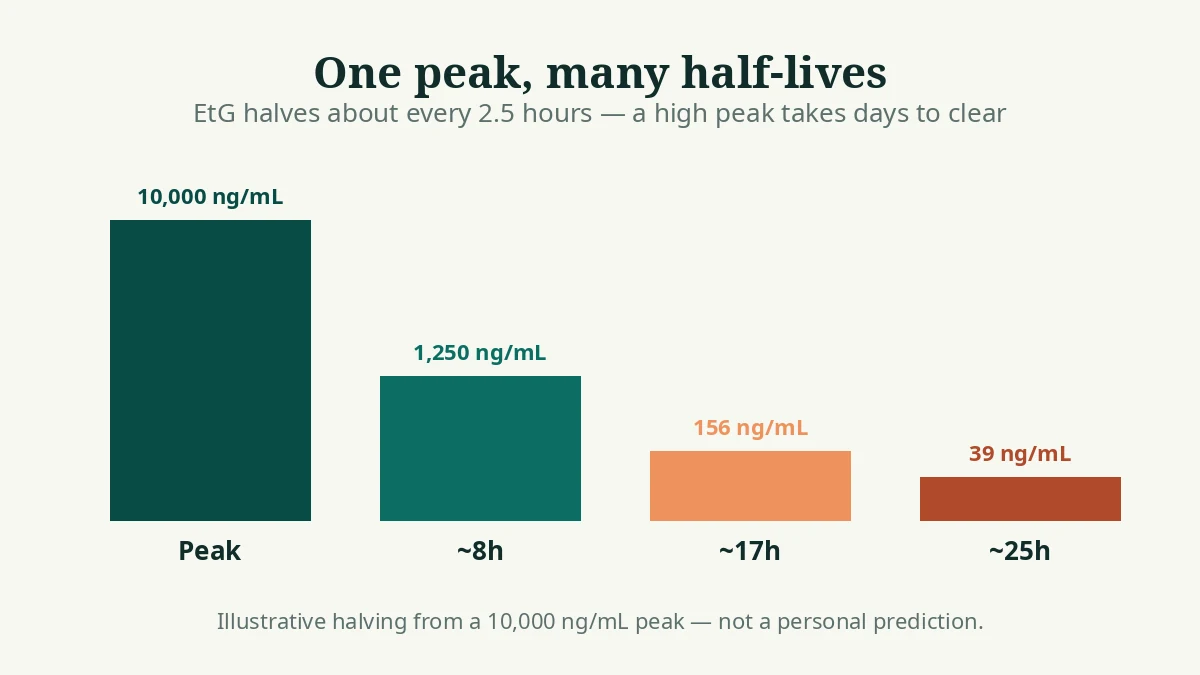
In controlled studies, EtG's elimination half-life in urine is about 2.5 hours once the peak has passed. That sounds fast — but a high peak needs many half-lives to fall below a low cutoff. Halve a 10,000 ng/mL peak repeatedly and you pass 5,000, 2,500, 1,250, 625, 312, 156, then 78 ng/mL after seven half-lives, roughly 17 to 18 hours of elimination. Start higher after heavy drinking and the same process takes proportionally longer to reach 100 ng/mL. The peak also does not fall immediately: EtG typically peaks a few hours after drinking ends and, after larger doses, can stay elevated through the first day.
Two controlled studies anchor this picture. In Dahl and colleagues' 2002 study, six volunteers drank about 0.5 grams of ethanol per kilogram as beer — roughly two to three standard drinks — and EtG remained detectable for 22.5 to 31.5 hours, albeit at low levels near the end. That was a moderate dose measured with a sensitive laboratory method, not a program cutoff. In Goll and colleagues' 2002 study, seven volunteers drank 250 milliliters of wine (25 grams of ethanol, about two standard drinks) and EtG was still measurable the following day. Larger doses push both the peak and the tail further out — exactly why the 48-hour question has no single answer.
How long does EtG stay in urine after 48 hours? The dose table
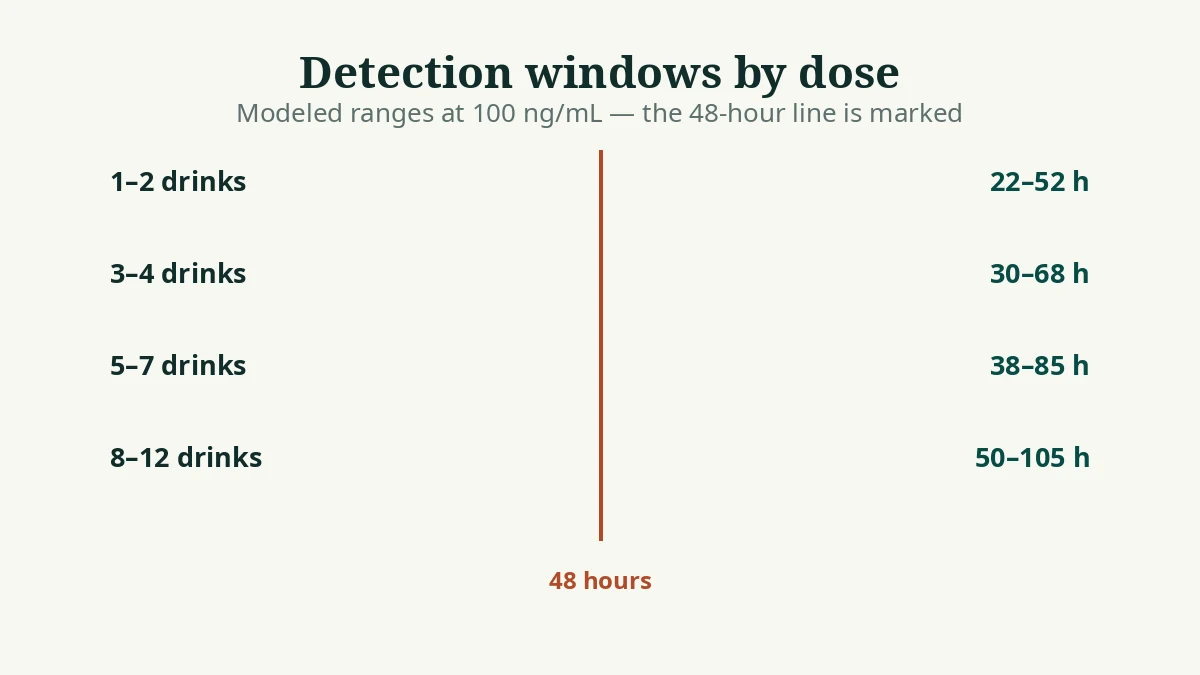
The table below gives modeled detection windows — not guarantees — for a single evening's drinking, using the same honest-range model as this site's calculator. Ranges are wide on purpose: they cover typical variation between people, not a promise for any one person. The key column is the last one: what the 48-hour mark usually looks like at each dose and cutoff.
| Drinks in one evening | Modeled window at 100 ng/mL | Modeled window at 500 ng/mL | At 48 hours |
|---|---|---|---|
| 1–2 standard drinks | About 22–52 hours | About 15–36 hours | Usually negative at 500; borderline at 100 |
| 3–4 standard drinks | About 30–68 hours | About 20–46 hours | Often still positive at 100; usually negative at 500 |
| 5–7 standard drinks | About 38–85 hours | About 26–58 hours | Often positive at both cutoffs |
| 8–12 standard drinks | About 50–105 hours | About 34–71 hours | Usually positive at both cutoffs |
| Heavy drinking over 2+ days | Up to and beyond 80 hours, sometimes longer | Often past 48 hours, sometimes toward 80 | Expect positive; timing estimates get unreliable |
Read the table as a pattern, not a prediction: each extra round of drinks lifts the peak, buying roughly another half-day to a day of detection at a sensitive cutoff. The 500 ng/mL cutoff — the level SAMHSA's 2012 advisory recommends for monitoring programs, to reduce false positives from incidental exposure — shortens every window by roughly a third versus 100 ng/mL. That is why two people who drank the same amount can get opposite results at 48 hours: different cutoffs.
What changes the 48-hour answer
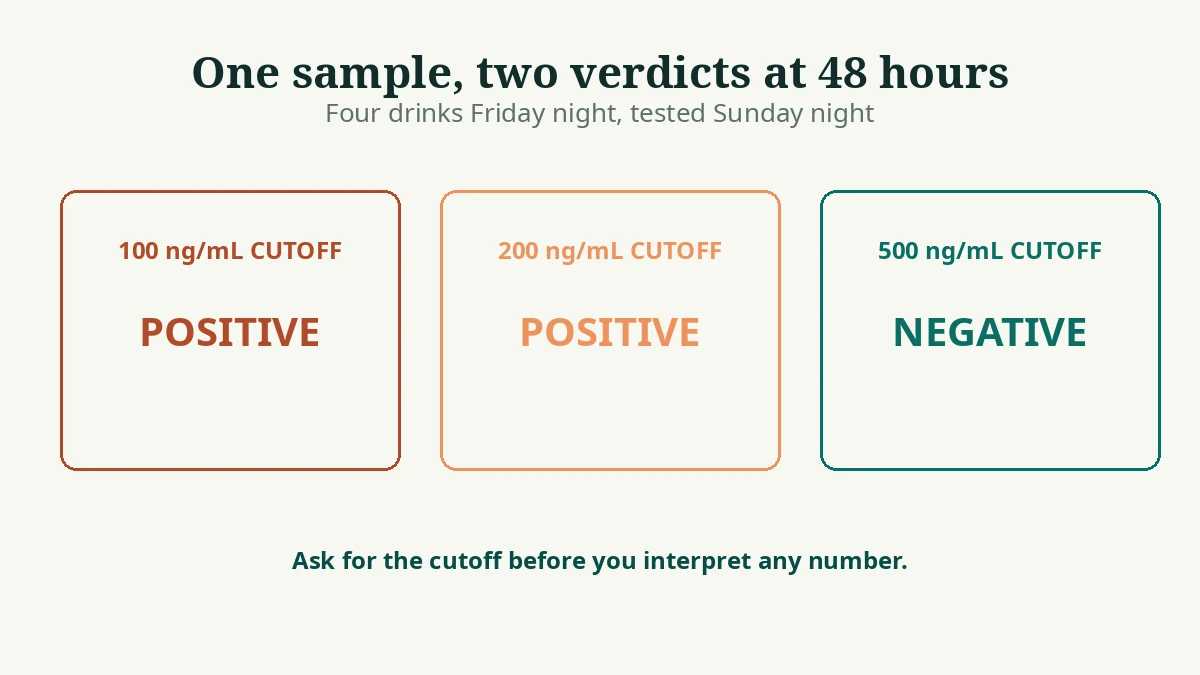
The cutoff. This is the single biggest lever, and it is also the one most people never ask about. Programs use 100, 200, 250, or 500 ng/mL, and the same urine sample can be positive at one and negative at another. Before you interpret any 48-hour result, find out which cutoff was used; without it, the number means very little.
How the drinking was spread out. Four drinks in one hour produce a higher peak than four drinks across six hours with food, and a higher peak lasts longer. Repeated drinking across two or three days adds each day's EtG to a still-falling tail, so the clock restarts from a higher baseline. Multi-day episodes are the ones that reach 80-hour territory.
Hydration and creatinine. Drinking a lot of water before a sample lowers its EtG concentration — Dahl's study showed a distinct drop after water-induced diuresis. But the same study showed the EtG-to-creatinine ratio was essentially unaffected, because creatinine falls alongside EtG when urine is diluted. Labs that flag dilute samples (typically creatinine below 20–25 mg/dL) are not easily bypassed this way, and a dilute result can itself be treated as failed or invalid. Our water-and-EtG article covers this science in full.
Individual metabolism. Liver function, body composition, sex, age, medications, and food eaten with the drinks all shift the peak and the elimination rate. Controlled studies report wide variation at identical doses — the reason every range here is a range, and why no calculator can tell you your personal result.
Screening versus confirmation. A screening immunoassay can cross-react with look-alike molecules, most famously propyl glucuronides from some hand sanitizers, and produce a positive that is not genuine EtG. LC-MS/MS confirmation measures EtG itself. A 48-hour positive that matters — for a job, a court, or a program — should always be confirmed before consequences follow.
Real-world scenario: Friday night drinks, Sunday night test
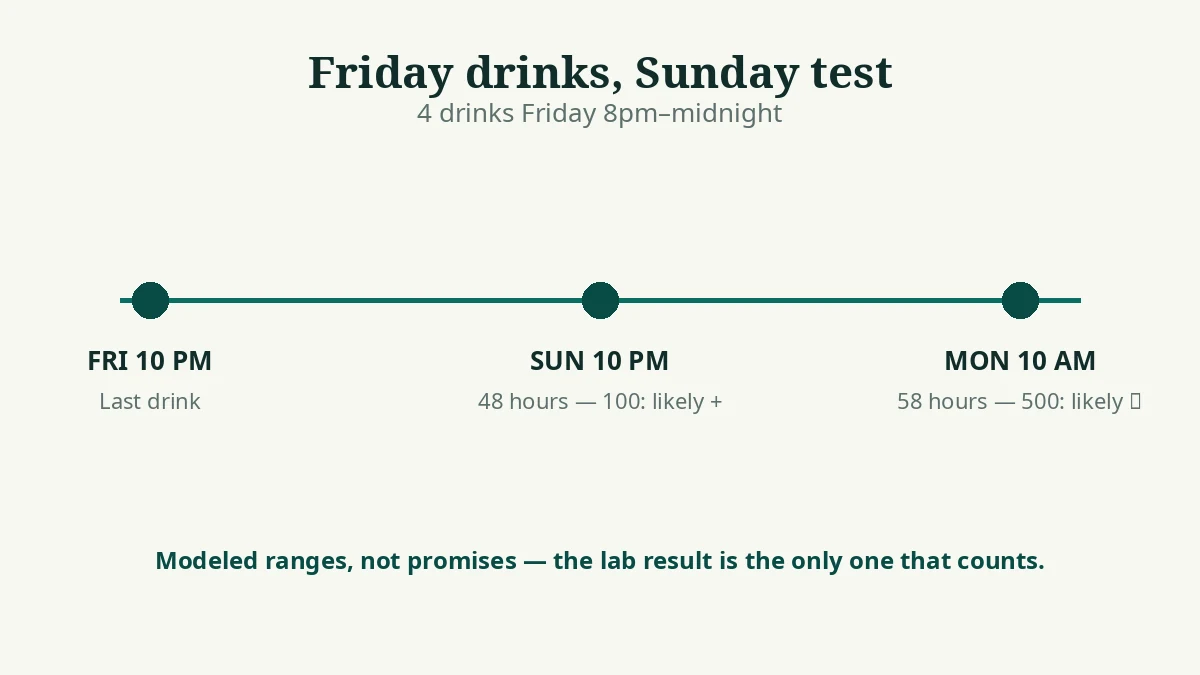
Take a concrete case. Maya has four standard drinks — two glasses of wine with dinner and two cocktails after — on Friday between 8 p.m. and midnight, and is tested on Sunday at 10 p.m., almost exactly 48 hours after her last drink.
At a 100 ng/mL cutoff, the modeled window for four drinks runs about 30 to 68 hours. At 48 hours she is squarely inside it, so a positive would be unsurprising — though not certain, since individual variation could put her on either side. At 500 ng/mL, the window runs about 20 to 46 hours, so at 48 hours she is just past the top: a negative is more likely, but not assured.
Move the test to Monday at 10 a.m., about 58 hours after the last drink. At 100 ng/mL she is still inside the modeled window, so a positive remains plausible. At 500 ng/mL she is well past it, and a negative is expected. That is the practical shape of the 48-hour question: not "am I clear yet?" but "clear at which cutoff, and with how much margin?" Never treat a modeled window as a promise — the only result that counts is the lab's, confirmed by LC-MS/MS if positive.
What a positive result at 48 hours does — and does not — prove
A positive EtG result at 48 hours proves one thing: ethanol was metabolized within the window, at a level producing EtG above the cutoff at sampling time. It does not prove how many drinks were consumed — the same level can come from different doses in different people. It does not prove exactly when drinking happened, because EtG cannot date-stamp an episode. And it does not prove impairment: by 48 hours, ethanol itself is long gone from blood and breath.
That limitation cuts both ways. A negative at 48 hours does not prove abstinence — only that EtG was below the cutoff in that sample, which can follow light drinking, dilution, or simply a closed window. Programs that treat one EtG result as a complete drinking history over-read the test, which is why SAMHSA's advisory cautions against using EtG alone for legal or disciplinary decisions.
How to read your own result at the 48-hour mark
If you are staring at a result from a test taken about two days after drinking, work through these steps. First, confirm the cutoff: a "positive" at 100 ng/mL and at 500 ng/mL are different findings. Second, check whether the result is a screening result or an LC-MS/MS confirmation — a screen alone is preliminary, and confirmation can overturn it, especially at low levels. Third, look at the creatinine: a very low value means a dilute sample, which weakens any concentration-based reading. Fourth, reconstruct the dose honestly — drinks, hours, days — and compare it with the dose table above, not the "80-hour" slogan. Fifth, if the result carries consequences, ask how the program treats low positives and exposure history; incidental sources such as mouthwash, sanitizer vapor, and certain foods and medicines can produce low-level EtG.
None of this is a way to beat a test. Diluting a sample, timing fluids around a test, or substituting a sample can be detected and can carry worse consequences than the result itself. The honest use of this information is narrower: understanding what your result means, asking the right questions, and making informed decisions about drinking before any future test.
Estimate your own 48-hour point with the calculator
Tables give the pattern; a calculator applies it to your numbers. Enter your drink count and hours since your last drink into this site's EtG calculator for a modeled window at your cutoff, built from the same honest-range model as the table above — wide ranges, no false precision, an estimate, not a prediction. For the longer view, the realistic detection times guide explains why the "80-hour test" label misleads, and the elimination calculator walks through how EtG falls hour by hour. Use all three together: the calculator for your scenario, the guides for context, the lab for the only result that counts.
Frequently asked questions
How long does EtG stay in urine after 48 hours?+
It depends on dose and cutoff. After one or two drinks, EtG is usually below a 500 ng/mL cutoff well before 48 hours and often below 100 ng/mL around 48 hours. After four to seven drinks, EtG commonly remains above 100 ng/mL at 48 hours, and after heavy or multi-day drinking it can stay detectable toward 80 hours or longer. There is no single number that fits every drinker.
Can you fail an EtG test 48 hours after drinking?+
Yes, if the dose was large enough and the cutoff is sensitive enough. Four drinks on Friday night can still produce a positive at a 100 ng/mL cutoff on Sunday night, 48 hours later, because the modeled window for that dose runs about 30 to 68 hours. At a 500 ng/mL cutoff the same scenario is usually negative by 48 hours, since that window runs about 20 to 46 hours.
Does EtG stay in urine for 80 hours?+
Eighty hours is an upper bound for heavy drinking, not a typical figure. Controlled studies with moderate doses found EtG detectable for roughly 22 to 32 hours. Light drinking clears much sooner; only heavy or repeated drinking stretches detection toward 80 hours, and even then the exact figure depends on the cutoff and the person.
Does drinking water help pass an EtG test at 48 hours?+
Not reliably. Drinking water before a test lowers the EtG concentration in that sample, but studies show the EtG-to-creatinine ratio is essentially unaffected, because creatinine falls alongside EtG when urine is diluted. Labs also flag dilute samples, and a dilute result can itself be treated as failed or invalid by a testing program.
Is EtG still detectable after 48 hours at a 500 ng/mL cutoff?+
Usually not after light or moderate drinking — the modeled 500 ng/mL window for up to four drinks ends around 46 hours. After five or more drinks, or multi-day drinking, EtG can still exceed 500 ng/mL at 48 hours. The 500 ng/mL cutoff is deliberately less sensitive, which is why SAMHSA recommends it for monitoring programs.
Can an EtG test tell exactly when you drank?+
No. EtG confirms ethanol exposure within a window of days, but it cannot date-stamp an episode. Similar levels can come from different doses at different times, and individual metabolism varies widely. A result at 48 hours cannot distinguish drinking two days ago from a larger dose three days ago.
Should a positive EtG result at 48 hours be confirmed?+
Yes. Screening immunoassays can cross-react with look-alike molecules and produce false positives, so any positive that carries consequences should be confirmed by LC-MS/MS, which measures EtG itself. Confirmation, the cutoff used, and the creatinine level should all be reviewed before a result is acted on.
Evidence and limitations
This article summarizes published research on ethyl glucuronide formation, detection windows, cutoffs, dilution, and confirmation testing. Group-level findings cannot predict one person’s result, and this article is educational only — it is not medical or legal advice.
- SAMHSA Advisory: The Role of Biomarkers in the Treatment of Alcohol Use Disorders (2006, revised 2012)
- Dahl et al. (2002) — Comparison of urinary excretion characteristics of ethanol and ethyl glucuronide (J Anal Toxicol 26(4):201–204); EtG detectable 22.5–31.5 h after ~0.5 g/kg ethanol, EtG/creatinine ratio unaffected by water diuresis, half-life ~2.5 h
- Goll et al. (2002) — Excretion profiles of ethyl glucuronide in human urine after internal dilution (J Anal Toxicol 26(5):262–266); 25 g ethanol, EtG measurable the following day
- McDonell et al. (2015) — EtG immunoassay cutoff sensitivity in alcohol-dependent outpatients (1,589 samples)
- Mackus et al. — EtG/EtS detection and cutoff performance in alcohol research samples
- Jatlow et al. — EtG/EtS as markers of recent alcohol use, cutoff and confirmation context