The short answer: an ETG test for security guards is employer-policy testing, not a federal program
An ETG test for security guards is a urine test for ethyl glucuronide, a direct metabolite of alcohol. It answers one question: has this guard drunk alcohol in roughly the past one to three days? It does not measure impairment on duty.
More than a million Americans work as security guards — at malls, hospitals, warehouses, and events — and for almost all of them, testing is company policy: the employer, or the client whose site the guard protects, writes the rules on when testing happens, which cutoff applies, and what a positive costs. No federal agency sets an EtG standard for private guards. The exceptions are airport transportation security officers, who are federal employees, and armed officers at nuclear plants, under the Nuclear Regulatory Commission's fitness-for-duty rule.
When a security guard faces an ETG test
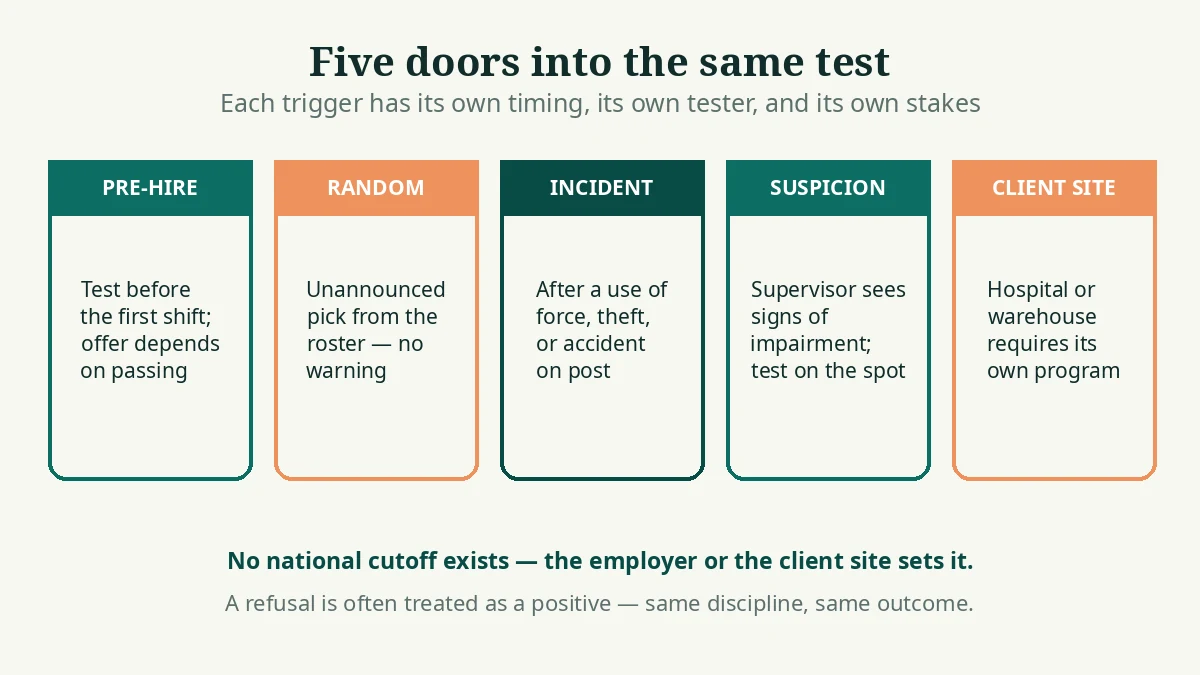
Guard alcohol testing follows the same four triggers as most safety-sensitive workplaces — pre-employment, random, post-incident, and reasonable suspicion — plus the client site's own requirement.
| Trigger | Who orders it | Typical timing | What is at stake |
|---|---|---|---|
| Pre-employment | The guard company | After a conditional job offer | The job offer itself |
| Random | The employer | Unannounced, during the year | The job; a refusal is often treated as a positive |
| Post-incident | Employer, client, or police | As soon as possible after the incident | The job, the client contract, a criminal case |
| Reasonable suspicion | A supervisor observing impairment | Immediately, same shift | The job; the guard is usually pulled from post first |
| Client-site requirement | The site being guarded | Before access is granted, or on the client's schedule | The assignment — and the employer's contract |
Pre-employment testing is the most common. Random testing is where EtG matters most: it is unannounced, and EtG's multi-day window means drinking days earlier still shows up. Post-incident testing follows anything that goes wrong on post — a use-of-force event, a theft, a patrol-car accident, or an injury. Reasonable suspicion is the fastest trigger: a supervisor who smells alcohol can order a test on the spot and pull the guard off post first. The client-site requirement is the one guards underestimate: a hospital or data center can require every guard on its property to pass its own testing program, even if the guard company tests rarely — and losing access to a site can mean losing the job.
Who is — and is not — covered by a federal testing rule
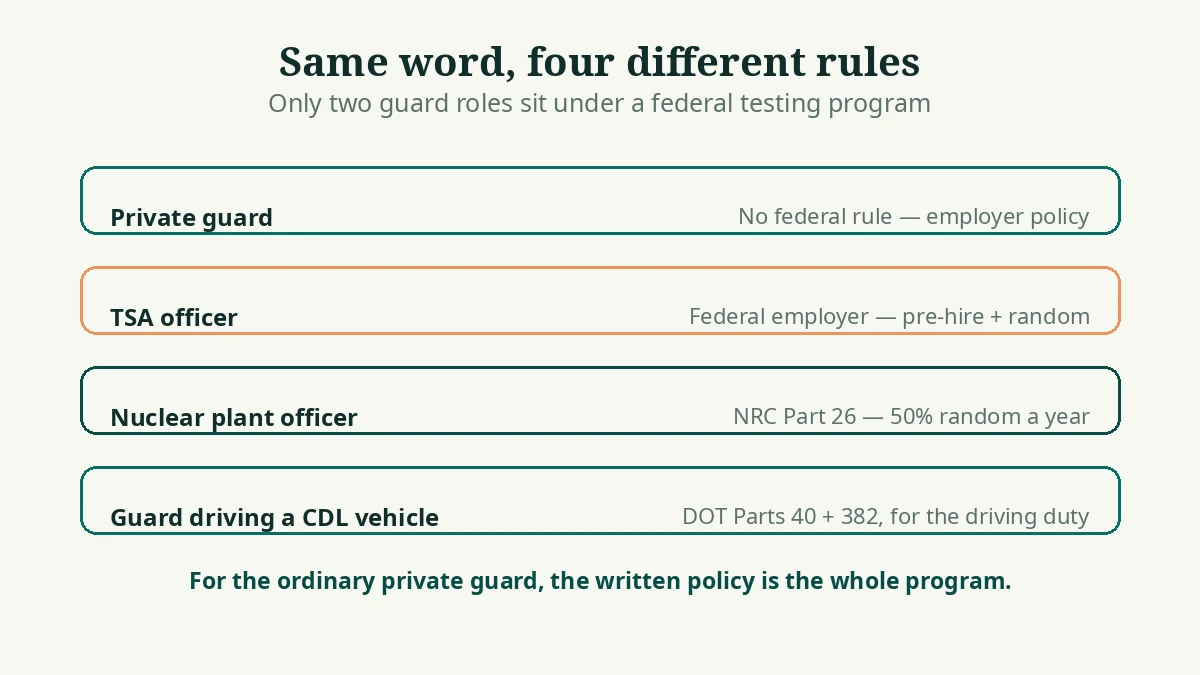
Several different jobs share the word "security", and only some sit under a federal program.
| Role | Federal testing rule | Who sets the test | What testing looks like |
|---|---|---|---|
| Private security guard | None | Employer or client site | Pre-hire, random, post-incident, or suspicion — policy-set |
| TSA officer | Federal employment rules | TSA, as a federal employer | Pre-employment urine drug screening; post-hire random drug and alcohol testing |
| Nuclear plant armed officer | NRC fitness-for-duty, 10 CFR Part 26 | The plant licensee, under federal rule | Pre-access, random (50% annual rate), for-cause, post-event, follow-up |
| Guard driving a CDL vehicle | DOT, 49 CFR Parts 40 and 382 | DOT rules, for the driving duty | Pre-employment, random, post-accident, suspicion, return-to-duty |
For the ordinary private guard, the consequence is simple: your testing program is whatever your employer's written policy says it is. If it is vague on any point, ask for the details in writing before a test, not after a result.
The nuclear exception: what 10 CFR Part 26 actually requires
Armed officers at nuclear power plants are the one group of private-sector guards under a detailed federal testing rule. Under the Nuclear Regulatory Commission's fitness-for-duty rule, 10 CFR Part 26, everyone with unescorted access to a reactor's protected area who performs a listed duty is covered — including armed security force officers, alarm station operators, response team leaders, and watchmen.
The program is not optional: pre-access testing, random testing of at least 50% of the covered population a year, for-cause, post-event, and follow-up testing. The policy must prohibit drinking within 5 hours before a scheduled tour, and during the tour itself. Alcohol is tested by breath and drugs by urine, with laboratory confirmation. The contrast is the point: a mall guard's random test happens because the employer chose to run one; a nuclear plant guard's happens because federal law requires the plant to test half its covered workforce every year.
What cutoff applies to a guard's EtG test
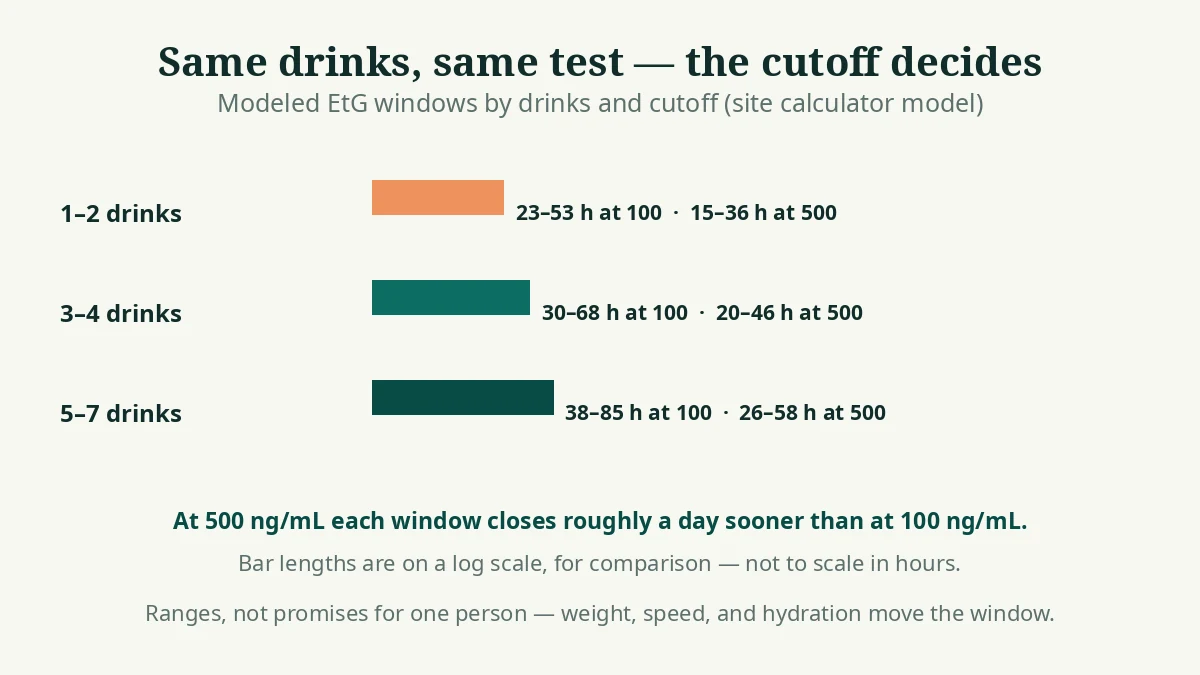
There is no national EtG cutoff for security guards: the employer or the client site picks one, usually 100, 200, or 500 ng/mL. The cutoff is the biggest factor in whether a given drinking history produces a positive, because a lower cutoff catches drinking from further back.
| Drinking | At 100 ng/mL | At 200 ng/mL | At 500 ng/mL |
|---|---|---|---|
| 1–2 drinks | 23–53 hours | 19–44 hours | 15–36 hours |
| 3–4 drinks | 30–68 hours | 26–59 hours | 20–46 hours |
| 5–7 drinks | 38–85 hours | 33–75 hours | 26–58 hours |
These are modeled ranges from the site's calculator, not promises for one person. But the pattern is what matters: at 500 ng/mL, each window closes roughly a day sooner than at 100 ng/mL, so the same Saturday-night drinking can be positive at 100 and negative at 500 by Tuesday morning. That is why the first question after any result should be "which cutoff was used?" The SAMHSA advisory on alcohol biomarkers agrees: EtG is "scientifically unsupportable as the sole basis for legal or disciplinary action" — which is why a responsible program confirms a positive screen with LC-MS/MS laboratory testing before acting on it.
How long EtG stays detectable before a guard's test
EtG can be detected in urine for up to about 80 hours after drinking, per the SAMHSA advisory — roughly three days for heavier drinking. Light drinking clears faster; a single drink may be detectable for roughly a day at a low cutoff, and not at all at 500 ng/mL. EtG is produced as the liver processes alcohol.
How much was drunk, the cutoff, and the individual all stretch or shrink the window — but no formula predicts one person's result. Drinking water before a test does not help: it lowers the EtG concentration in one sample, but labs measure the EtG-to-creatinine ratio to catch dilution, and a dilute sample can itself be flagged. There is no reliable way to shorten the window — only to avoid opening it. And EtG is not a breathalyzer: a breath test measures alcohol right now, while EtG measures a metabolite from days ago. A guard can blow zero on Monday morning and still test positive for Saturday night's drinks.
Real-world scenario: five drinks Saturday, a random test Tuesday
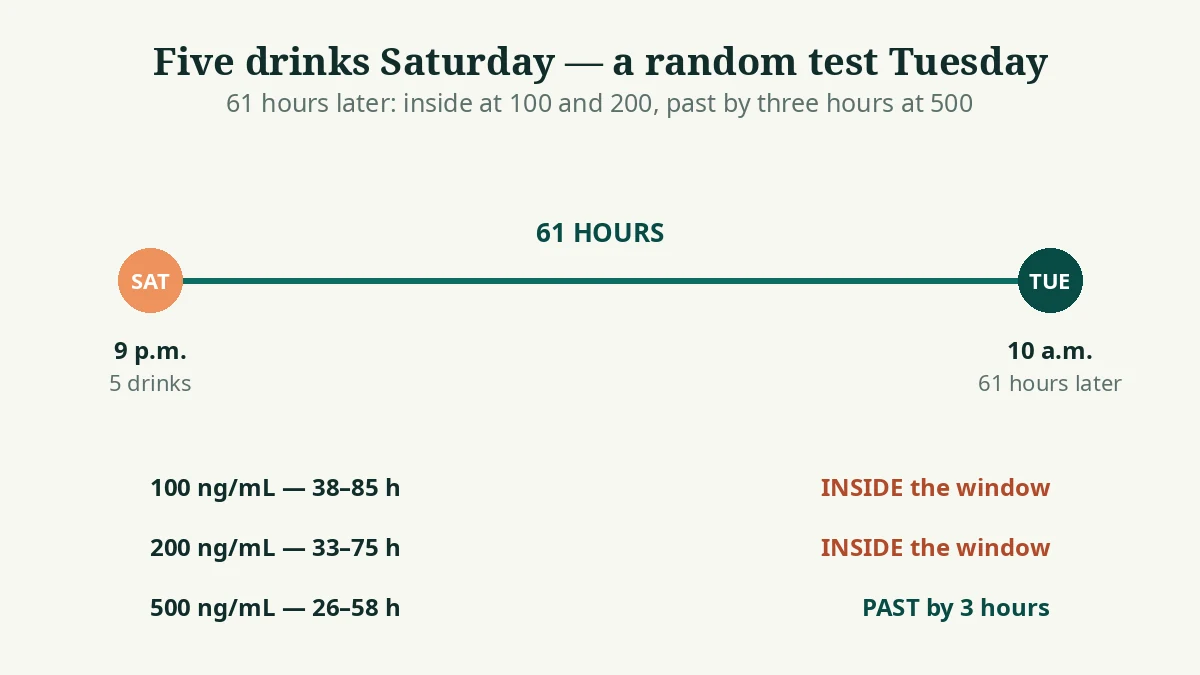
Marcus works the overnight shift at a warehouse. He finishes his last shift Saturday morning and has five drinks with friends that night, between 9 p.m. and midnight. He is off Sunday and Monday; on Tuesday at 10 a.m., his name comes up in the random testing pool — 61 hours after his last drink.
At 100 ng/mL, the modeled window for five to seven drinks is 38–85 hours — Marcus is inside it. At 200 ng/mL (33–75 hours) he is still inside it; at 500 ng/mL (26–58 hours) he is past it by three hours, and a screen is likely negative. One night out, one random draw, three different outcomes depending on a number he was never told. The lesson is not that 500 ng/mL is safe to drink under — it is that the cutoff decides the result as much as the drinking does. A guard who drinks on a Saturday and works a random-tested post on Tuesday is gambling on a policy detail, and the only way to stop gambling is to know the policy.
Armed guards, licenses, and state rules
Most states license security guards — a background check, fingerprinting, and a training course, not a drug test. What matters for keeping the license is whatever the employer and the client require, not the licensing statute. Armed guards face a stricter world: an armed post typically means extra training, a firearms qualification, and a client or insurer that insists on testing.
A positive EtG result usually costs the job before it costs the license. Most guard employers treat a confirmed positive as grounds for discipline up to termination, and a refusal to test is often treated the same way. Whether the licensing authority ever hears about it depends on the state, and the license is rarely revoked for a single alcohol test result — the risk is indirect: lose the job, lose the post, and the license becomes a card with nowhere to use it. State law also shapes what the employer can do: some states restrict testing times, require written notice, or give the employee a split-sample retest right. This article is educational only, not legal advice — a guard facing a positive result should check the law in their own state and talk to a local employment attorney.
What a positive — or a refusal — can cost a guard
The immediate cost is the job: most guard companies run lean rosters, so a guard pulled from post is often replaced the same week, and the termination follows the confirmation. The secondary cost is the next job: a failed test in a safety-sensitive role follows a guard into the next application, where the same pre-employment test is waiting.
Refusal is not a way around this: most policies treat a refusal as a positive, with the same discipline. A guard who believes a test was ordered unfairly is better served by taking it and challenging the process afterward, in writing — the sample is evidence. The protections worth using: ask for the cutoff and the lab, ask whether a positive screen was confirmed by LC-MS/MS, and ask for a split-sample retest if the policy allows it.
What to do if you are selected for a test
Respond the same day: a random selection has a reporting deadline, and missing it can count as a refusal. Check the policy first — cutoff, lab, confirmation step, consequence — then give the sample. If the result comes back positive, ask three questions in writing: which cutoff, whether the screen was confirmed by LC-MS/MS, and whether a split-sample retest is available.
Do not try to beat the test: water, supplements, and "detox" drinks do not reliably clear EtG, and a dilute sample can be flagged as cheating — which many policies punish more harshly than a positive. The simplest protection is the oldest one: know the policy and the cutoff, and do not drink in the days before a possible test. For a guard on a random-tested post, that means treating every shift as a possible test day. This article is educational only, not legal or medical advice; talk to a local attorney about a live case.
Using the EtG calculator before a test
The EtG calculator estimates the same windows the tables above use — read the result as a range, never a pass date. Run your numbers through the calculator.
Frequently asked questions
Do security guards get EtG tested?+
Usually only if your employer's policy says so. Most private security guards are tested at hire, at random, after an incident, or on reasonable suspicion — all set by the employer or the client site, not by a national rule. There is no federal EtG testing program for ordinary private guards. The one big exception is nuclear power plant security, which falls under the NRC's federal fitness-for-duty rule.
Are security guards subject to DOT random drug testing?+
No, not for ordinary guard work. Federal DOT drug and alcohol testing under 49 CFR Parts 40 and 382 applies to drivers who operate a commercial motor vehicle that requires a commercial driver's license. A guard on foot patrol, at a gate, or in a patrol car that is not a commercial motor vehicle is not in the DOT random-testing pool. If a guard also drives a CDL vehicle for the employer, the DOT rules apply to that driving duty.
What cutoff is used for a security guard EtG test?+
There is no national cutoff for security guards — the employer or the client site sets it. The common screening cutoffs are 100, 200, and 500 ng/mL. A 100 ng/mL cutoff catches drinking from further back than 500 ng/mL, so the same drinking history can be positive at one cutoff and negative at another. Ask the lab or your employer which cutoff applies before you interpret a result.
Can a security guard lose their license over a positive EtG test?+
It depends on the state and the employer. A positive usually costs the job first — most guard employers treat a confirmed positive as grounds for discipline up to termination, and a refusal to test is often treated the same way. The guard license itself is state-issued, and licensing consequences depend on state rules and whether the employer reports the result; armed posts and client sites with their own requirements are stricter. This article is educational only, not legal advice.
Do nuclear power plant security officers get tested differently?+
Yes — nuclear plant security is the exception that proves the rule. Under the Nuclear Regulatory Commission's fitness-for-duty rule (10 CFR Part 26), armed security force officers, alarm station operators, response team leaders, and watchmen at nuclear power plants are subject to a federal program: pre-access testing, random testing at a rate of at least 50% of the covered population per year, for-cause, post-event, and follow-up testing, plus a rule against drinking within 5 hours before a scheduled shift. Ordinary mall, hospital, or event guards are not covered by that rule.
How long before a shift should a security guard stop drinking?+
There is no number of hours that guarantees a negative EtG result. EtG can be detected for up to about 80 hours after drinking, and the window depends on how much you drank, the cutoff, and your body. The only reliable approach is to know your employer's policy and testing schedule, and not to drink in the days before a shift where a test is possible. Drinking water does not clear EtG faster — it lowers the concentration in one sample but not the EtG-to-creatinine ratio labs use to spot dilution.
Can handling alcohol at work cause a positive EtG test?+
No. Handling alcohol is not drinking it. EtG is made only when the body metabolizes alcohol you swallowed. Working a bar, a liquor store, or a venue where alcohol is served does not produce EtG in your urine. What can produce a positive is drinking — including alcohol in mouthwash or hand sanitizer in large or repeated amounts — not touching a bottle on the job.
Evidence and limitations
This article summarizes published guidance and research on EtG testing for security guards, plus the science of alcohol biomarkers. Group-level findings cannot predict one person’s result, and this article is educational only — it is not legal or medical advice. Testing rules vary by employer, client site, and state; talk to a local attorney about a live case, a termination, or a license question.
- Nuclear Regulatory Commission — 10 CFR Part 26, Fitness-for-Duty Programs: armed security force officers, alarm station operators, response team leaders, and watchmen are covered; pre-access, random (at least 50% of the covered population per year), for-cause, post-event, and follow-up testing; no alcohol within 5 hours before a scheduled working tour
- American Screening Corporation — 10 CFR Part 26 Drug Testing: 50% Random Rate Explained: the five categories of required testing and the 50% annual random rate that sets Part 26 apart from voluntary programs
- TSA Career — TSA Drug Test: Marijuana & Screening Rules: federal pre-employment urine drug screening for transportation security officer candidates, with post-hire random drug and alcohol testing as a continuing condition of employment
- On Point Drug Testing — Employer Drug Testing Resources: pre-employment, random, post-accident, and reasonable-suspicion testing for non-DOT employers, including collections for security guard companies (patrol, event, and armed-security teams)
- FMCSA — Applicability: DOT drug and alcohol programs apply to all drivers operating a commercial motor vehicle that requires a CDL, including independent owner-operators
- SAMHSA Advisory: The Role of Biomarkers in the Treatment of Alcohol Use Disorders (2006, revised 2012) — EtG detectable up to ~80 hours; EtG “scientifically unsupportable as the sole basis for legal or disciplinary action”
- McDonell et al. (2015) — EtG immunoassay cutoff sensitivity in alcohol-dependent outpatients (1,589 samples)
- Mackus et al. (2017) — EtG detection and elimination kinetics after controlled alcohol intake
- Jatlow et al. — EtG and EtS in urine after controlled alcohol administration
- EtG Calculator Pro — ETG Testing for Police Officers: the law-enforcement version of the same employer-policy pattern
- EtG Calculator Pro — ETG Testing for Firefighters: random testing in another safety-sensitive uniformed role
- EtG Calculator Pro — ETG Testing for Employment: consent and consequences in the workplace
- EtG Calculator Pro — DOT EtG Testing: the federal rules for the commercial drivers they do reach