The short answer: an ETG test for rideshare drivers is incident-driven, not routine
An ETG test for rideshare drivers is a urine test for ethyl glucuronide, a direct metabolite of alcohol. It answers one question: has this driver drunk alcohol in roughly the past one to three days? It does not measure impairment at the wheel.
Most rideshare drivers never face one: Uber and Lyft do not run routine drug tests — drivers are independent contractors, not employees, and onboarding is a background check, not a lab test. Testing shows up only when something triggers it.
When a rideshare driver faces an ETG test
Rideshare alcohol testing is policy-set, and the policy depends on what triggered it.
| Trigger | Who orders it | Typical timing | What is at stake |
|---|---|---|---|
| Rider impairment report | Uber or Lyft, after a complaint | Account held the same day; test offered before a final decision | Account access, up to permanent deactivation |
| NYC TLC licensing | New York City Taxi and Limousine Commission | Every year, within 90 days before the license anniversary | TLC license, fines, suspension |
| Accident while driving | Platform, insurer, or police | As soon as possible after the crash | Account access, insurance claim, criminal case |
| Court order after a DUI | Court or probation department | On the schedule the court sets | License, probation standing, freedom |
| Fleet-partner policy | The fleet owner or rental partner | At hire or after an incident | Access to the rented vehicle |
None of these is random: a driver who never draws a complaint can drive for years without a sample, and one complaint can trigger a test within hours. Our DUI testing guide covers drinking and the law; our DOT testing guide covers the commercial drivers who do face federal random testing.

How Uber handles an impairment report
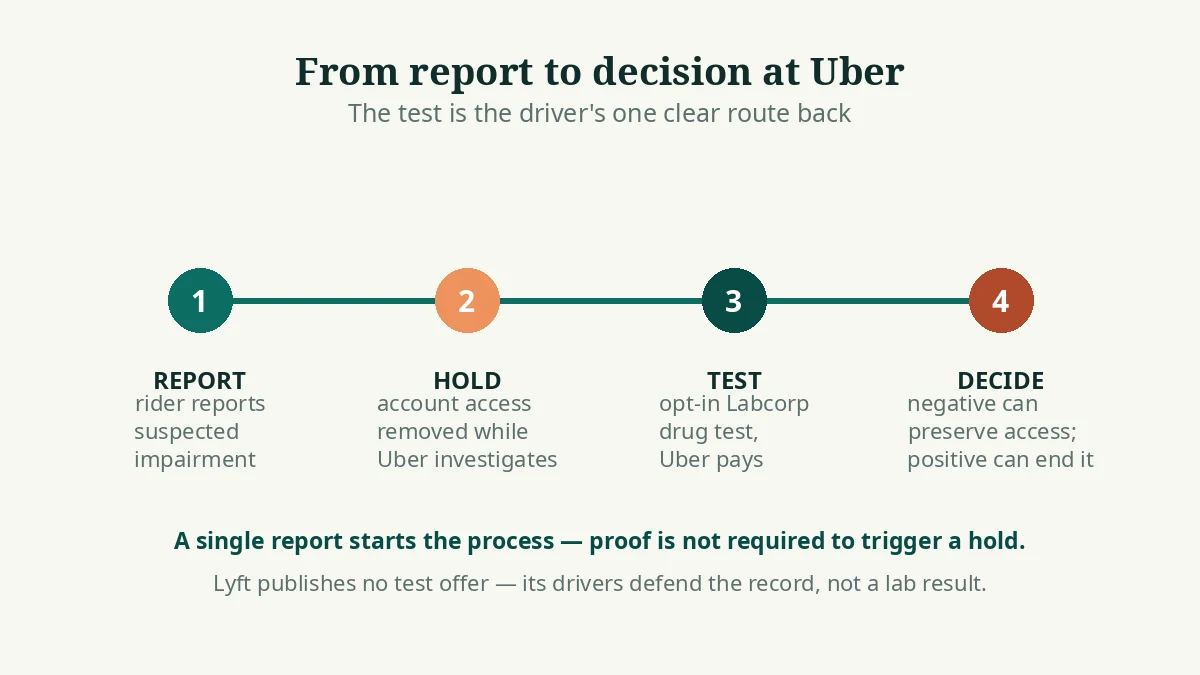
Uber's zero-tolerance policy bans drivers from operating a vehicle while impaired by alcohol or drugs. When any person reports suspected impaired driving — the driver appeared impaired, or drugs, alcohol, or the smell of them were in the car — Uber removes the driver's app access while it investigates. Enough evidence means permanent loss of access.
That is where testing enters. Uber has partnered with Labcorp to offer drug testing to drivers at risk of permanent deactivation for drug-impaired driving. The test is opt-in, offered at Uber's discretion, and Uber covers the cost. A negative can preserve account access; a positive can mean permanent deactivation.
Three details matter. A report needs no proof to trigger a hold. The smell of alcohol counts too: Uber notes that smells left by riders can be read as impairment. And the test is the driver's one clear route back — the only evidence that can turn a hold into a reinstatement. The exact panel is set by Uber and Labcorp, and Uber does not publish whether EtG is included, so a driver should ask the lab what the screen covers.
How Lyft handles it
Lyft runs the same zero-tolerance drug and alcohol policy. A passenger who suspects a driver is under the influence is told to contact Lyft's Critical Response Line, and Lyft immediately suspends the driver's platform access while it investigates, contacting the passenger and prior passengers for details.
Definitive evidence — or even a strong suspicion — of a violation means permanent deactivation. Lyft also monitors passenger feedback proactively: flagged comments suspend the driver while the Trust and Safety team reviews them.
The practical difference from Uber is the test. Lyft publishes no test offer like Uber's Labcorp program, so a Lyft driver has no published route to clear the record with a lab result. The defense is the record itself: trip logs, dashcam footage, and the driver's own account.
New York City: the one place testing is routine
New York City is the one market where rideshare testing is routine rather than reactive. Every driver holding a Taxi and Limousine Commission license — medallion taxis, street-hail liveries, and for-hire vehicles, which includes every Uber and Lyft driver in the city — must take and pass a drug test every year to keep the license current. New applicants must pass one first, at a TLC-approved LabCorp location, for a $34 fee.
The timing is strict: in an interim year the test must be taken no more than 90 days before the license anniversary; in a renewal year, within 90 days before expiration. Missing the window means suspension until a test is taken and passed, and a test 30 days or more late adds a $200 fine.
The TLC test screens for illegal substances — a licensing drug test, not an EtG-specific alcohol test. But where a city regulates rideshare like taxis, testing follows taxi rules.
Why rideshare drivers are not in DOT random testing
Federal DOT drug and alcohol testing under 49 CFR Parts 40 and 382 applies to drivers who operate a commercial motor vehicle that requires a commercial driver's license. A standard Uber or Lyft trip in a personal car meets neither condition, so there is no random testing pool for rideshare drivers, no pre-employment DOT test, and no DOT return-to-duty process after a complaint.
The distinction is about the vehicle and the license, not the work. A driver who also holds a CDL and hauls freight for Uber Freight in a truck is DOT-tested for that work; the same person in their own sedan on UberX is not. New York's Vehicle and Traffic Law adds one edge: for-hire vehicles carrying nine or more passengers must follow DOT-style pre-employment and random testing, with no drinking within eight hours before duty — a rule for large vans and shuttles, not a standard rideshare car.
What cutoff applies to a rideshare EtG test
No national EtG cutoff exists for rideshare drivers: the cutoff is set by whoever orders the test — the platform's lab, the city's licensing program, or the court. A lower cutoff catches lighter and older drinking but also more incidental exposure; a higher one rarely flags anything but real drinking. Our 100 vs 500 ng/mL cutoff guide explains how the three standard levels compare.
| Cutoff | What it catches | What it misses | Where it shows up |
|---|---|---|---|
| 100 ng/mL | Light drinking and drinking up to about 80 hours back | Almost nothing recent | Strict or zero-tolerance programs |
| 200 ng/mL | Moderate drinking over roughly two to three days | One drink more than about a day earlier | Middle-ground policies |
| 500 ng/mL | Heavier or recent drinking | Light drinking and anything older than about two days | Standard lab screens, SAMHSA's suggested level |
The same drinking can be a positive under one order and a negative under another: five drinks on Saturday can still top 100 ng/mL on Tuesday morning and fall under 500 ng/mL by Monday. The cutoff, not the drinking, decides the result. SAMHSA's advisory warns that EtG is "scientifically unsupportable as the sole basis for legal or disciplinary action." A positive screen should be confirmed by LC-MS/MS with EtS measured, the screen-then-confirm pattern our monitoring programs guide describes.
How long EtG stays detectable before a rideshare test
Detection windows are ranges, not dates: weight, drinking speed, hydration, and liver function move them. The table uses the same modeled ranges our EtG calculator uses — honest ranges for a typical adult, never a promise for one person.
| Drinking | At 100 ng/mL | At 200 ng/mL | At 500 ng/mL |
|---|---|---|---|
| 1–2 drinks | 23–53 hours | 20–46 hours | 15–36 hours |
| 3–4 drinks | 30–68 hours | 26–59 hours | 20–46 hours |
| 5–7 drinks | 38–85 hours | 33–75 hours | 26–58 hours |
Heavier drinking stretches the window by roughly a day at every cutoff, and the cutoff moves it by about a day too.

Real-world scenario: five drinks Saturday, a rider report, a test Tuesday
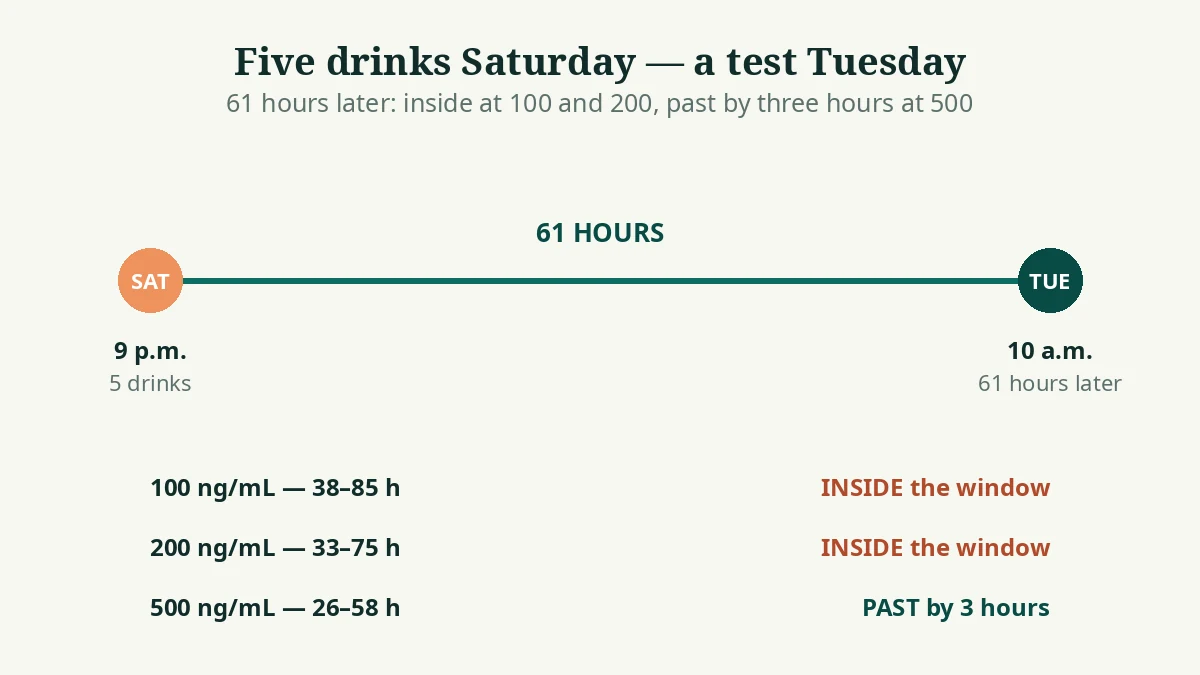
A driver has five drinks at a Saturday barbecue, finishing around 9 p.m., and does not drive that night. On Sunday the driver is back on the road, sober — but a rider reports smelling alcohol. Uber holds the account on Monday and offers the opt-in Labcorp test; the driver takes it Tuesday at 10 a.m., 61 hours after the last drink.
At 100 ng/mL the window for five to seven drinks is 38 to 85 hours, so 61 hours is inside it: likely positive. At 200 ng/mL the window is 33 to 75 hours, so the same sample is inside it too. At 500 ng/mL the window is 26 to 58 hours, so it is past by three hours: likely negative. One Saturday night, three different answers — and none says anything about how that driver drove on Sunday. EtG measures recent drinking, not driving ability.
What a positive — or a refusal — can cost a driver
A positive lands differently depending on who ordered the test. With Uber, a positive on the offered Labcorp test can mean permanent deactivation — the account is the driver's income, with no return-to-duty program. With Lyft, the investigation itself can end the account on strong suspicion alone. In New York City, a failed TLC test means license suspension and fines. After a DUI, a positive on a court-ordered test can mean probation consequences up to jail.
Refusing is not neutral either. Uber's test is opt-in, so declining is allowed — but it leaves the investigation with only the rider's report. Refusing a court-ordered test can itself be a violation. There is no move that makes a report disappear.
Incidental exposure comes up for drivers too: at 100 ng/mL, heavy use of alcohol-based mouthwash or hand sanitizer can push EtG over the line; at 500 ng/mL it is unlikely. Disclose sanitizer use before the sample and ask for LC-MS/MS confirmation with EtS. Our employment testing guide covers the same pattern in the workplace.
What to do if you are reported
Respond the same day: the hold starts fast, and a driver who answers promptly with trip details and dashcam footage gives the investigator something to weigh against the report. Keep the record: save trip logs, keep a dashcam running, and keep receipts from the night in question if you drank off duty.
If Uber offers the Labcorp test, understand the stakes first: a negative can preserve your account, a positive can end it permanently, and the test is opt-in. Ask the lab what the screen covers and which cutoff applies, and ask for LC-MS/MS confirmation of any positive. For Lyft, where no test is published, the record is the whole defense — submit trip logs and footage through the appeal process.
The simplest protection is the oldest one: never drive after drinking, even a little, and never drive with alcohol or an open container in the car — a report can start from a smell left by a previous passenger. This article is educational only, not legal or medical advice; talk to a local attorney about a live case or a deactivation appeal.
Using the EtG calculator before a test
The EtG calculator estimates the same windows the table above uses — read the result as a range, never a pass date. Run your numbers through the calculator.
Frequently asked questions
Do Uber drivers get EtG tested?+
Not routinely. Uber does not drug test drivers to join the platform or on a schedule. Testing comes after a rider reports suspected impaired driving: Uber holds the account, investigates, and may offer an opt-in drug test at a Labcorp location at Uber's cost. A negative result can preserve account access; a positive can mean permanent deactivation. Uber does not publish whether EtG is in the panel, so ask the lab what the screen covers.
Does Lyft drug test its drivers?+
Not routinely. Lyft's zero-tolerance policy means a passenger report leads to immediate suspension while the Trust and Safety team investigates. Definitive evidence — or even a strong suspicion — of a violation means permanent deactivation. Lyft publishes no test offer like Uber's Labcorp program, so a driver facing a report should rely on trip logs and dashcam footage.
Are Uber and Lyft drivers subject to DOT random drug testing?+
No. Federal DOT drug and alcohol testing under 49 CFR Parts 40 and 382 applies to drivers who operate a commercial motor vehicle that requires a commercial driver's license. A personal car on Uber or Lyft is neither, so rideshare drivers are not in the DOT random-testing pool. Narrow exceptions exist: transit-contract trips under FTA rules, and for-hire vehicles carrying nine or more passengers under New York law.
What is the New York City TLC drug test?+
An annual drug test for every TLC-licensed driver, including Uber and Lyft for-hire drivers. It must be taken within 90 days before the license anniversary in an interim year, or before expiration in a renewal year, at a TLC-approved LabCorp location, for a $34 fee. Missing the window means suspension until a test is taken and passed; a test 30 days or more late adds a $200 fine.
What cutoff does Uber use for its drug test?+
Uber does not publish it. The test panel and cutoff are set by Uber and Labcorp; the driver does not choose. Standard EtG cutoffs are 100, 200, and 500 ng/mL, and the cutoff changes the result — five drinks can still top 100 ng/mL two days later and fall under 500 ng/mL within a day. Ask the lab which cutoff applies before giving a sample.
Can a false rider report get a driver deactivated?+
A report alone triggers a hold and an investigation, not automatic deactivation. Uber may check phone sensor data, and its Labcorp test offer lets a driver clear the record with a negative result. With Lyft, strong suspicion alone can end the account, which is why trip logs and a dashcam matter. Respond the same day and keep copies of everything you submit.
How long after drinking can an EtG test detect it for a rideshare driver?+
It depends on how much was drunk and the cutoff. Modeled ranges: one to two drinks, 23 to 53 hours at 100 ng/mL; three to four drinks, 30 to 68 hours; five to seven drinks, 38 to 85 hours. Each window closes about a day sooner at 500 ng/mL, and heavy drinking can be detectable up to about 80 hours. These are ranges for a typical adult, not a promise for one person.
Evidence and limitations
This article summarizes published guidance and research on EtG testing for rideshare drivers, plus the science of alcohol biomarkers. Group-level findings cannot predict one person’s result, and this article is educational only — it is not legal or medical advice. Testing rules vary by platform, city, and court; talk to a local attorney about a live case or a deactivation appeal.
- Uber — Zero Tolerance Policy (United States): a report of suspected impaired driving leads to loss of app access while Uber investigates; drivers at risk of permanent deactivation for drug-impaired driving may be offered an opt-in drug test at a Labcorp location, paid for by Uber; a negative screen can preserve access, a positive can mean permanent deactivation; drivers are independent third-party providers, not employees
- Lyft — Colorado Driver Information (zero-tolerance policy): Lyft has a zero-tolerance drug and alcohol policy; a passenger report leads to immediate suspension pending investigation; definitive evidence or even strong suspicion of a violation means permanent deactivation
- New York City Taxi and Limousine Commission — Drug Testing Requirements: TLC-licensed drivers (Medallion, Street Hail Livery, For-Hire Vehicle) must take and pass a drug test every year; new applicants must test; $34 fee at TLC-approved LabCorp locations; interim test within 90 days before the anniversary date, renewal test within 90 days before expiration; late tests bring suspension and a $200 fine
- FMCSA — When are drivers subject to the DOT drug and alcohol testing requirements? All drivers that operate a commercial motor vehicle requiring a CDL are subject to 49 CFR Parts 40 and 382
- FMCSA — Applicability: DOT drug and alcohol programs apply to all drivers operating a commercial motor vehicle that requires a CDL, including independent owner-operators
- Federal Transit Administration — Shared Mobility FAQs: ridesourcing companies contracting with a public transit agency can fall under DOT drug and alcohol testing (49 CFR part 655) for the drivers doing that contracted work
- N.Y. Vehicle and Traffic Law § 507-A: for-hire vehicle motor carriers must conduct pre-employment and random drug and alcohol testing for drivers of for-hire vehicles seating nine or more passengers; no alcohol within eight hours before duty
- SAMHSA Advisory: The Role of Biomarkers in the Treatment of Alcohol Use Disorders (2006, revised 2012) — EtG detectable up to ~80 hours; EtG “scientifically unsupportable as the sole basis for legal or disciplinary action”
- McDonell et al. (2015) — EtG immunoassay cutoff sensitivity in alcohol-dependent outpatients (1,589 samples)
- Mackus et al. (2017) — EtG detection and elimination kinetics after controlled alcohol intake
- Jatlow et al. — EtG and EtS in urine after controlled alcohol administration
- EtG Calculator Pro — DOT EtG Testing: the federal rules for the commercial drivers they do reach
- EtG Calculator Pro — How EtG Testing Works in DUI/DWI Cases: when drinking meets the law instead of a platform policy
- EtG Calculator Pro — ETG Testing for Employment: consent and consequences in the workplace
- EtG Calculator Pro — ETG Testing in Monitoring Programs: the same screen-then-confirm pattern in professional programs