The quick answer: there is no single EtG rule for teachers
If you search for an EtG test for teachers, you are probably expecting one national rule — a federal standard, a fixed cutoff, a set schedule — but there is none. Teachers are tested under their own school district's board policy, shaped by state education law and the union contract. California has no statewide law requiring drug tests for public school teachers — screening depends almost entirely on the local district. The justification is always the same: teachers stand in loco parentis, in the place of parents, and the board must make sure no one in that position is impaired by drugs or alcohol.
EtG — ethyl glucuronide, the alcohol metabolite urine tests can find for days after drinking — enters a teacher's life through that policy. It is not the test at a traffic stop: police test drivers with breath tests, not EtG. For a teacher, EtG matters most in fitness-for-duty and return-to-duty testing after an alcohol concern. A doctor's testing runs through a physician health program; a teacher's runs through the district. The general workplace-testing rules are a useful comparison — but the board policy is the authority.
Why EtG fits school monitoring better than a breath test
A breath test measures alcohol right now — useful at a traffic stop, useless the morning after. A standard urine drug panel screens for drugs of abuse, but not alcohol. EtG fills the gap: a direct metabolite of alcohol, found in urine for up to about 80 hours.
| Test | Detects | Window | Used for |
|---|---|---|---|
| Breath test | Alcohol in breath — current impairment | A few hours | On-duty suspicion, post-incident checks |
| Standard urine drug panel | Drugs of abuse (THC, cocaine, opiates, amphetamines, PCP) | Days for most drugs | Pre-employment and random screening |
| Urine EtG | Alcohol consumed since the last test | Up to about 80 hours | Abstinence verification, return-to-duty monitoring |
That is why EtG is the natural tool for return-to-duty monitoring: the agreement asks whether the teacher drank at all since the last check, not whether the teacher is drunk right now. But an EtG positive does not prove a teacher was impaired in front of students, only that alcohol was consumed inside the window.
The five moments a teacher gets tested
District policies name the same five triggers.
1. Pre-employment. Districts can require a drug test as a condition of a job offer — California courts have upheld it when it applies uniformly to all applicants. Fail it and the offer is rescinded. EtG is usually not in the standard pre-employment panel; it appears later, in fitness-for-duty and return-to-duty testing.
2. Reasonable suspicion. A supervisor who sees signs of impairment — slurred speech, bloodshot eyes, an odor of alcohol, unsteady movement — orders a test, with the facts documented. In many districts the building principal must observe the employee first, and Pennsylvania's model board policy lists testing positive for alcohol and refusing a sample as violations in themselves.
3. Post-incident. After an accident or an allegation, testing is often automatic: district policies require it after a work-related injury, when district property is damaged, and when a student-safety allegation is made.
4. Fitness for duty. When a teacher's fitness is in doubt, the district can order a fitness-for-duty medical examination, with drug and alcohol testing as part of it. "Unfit for duty" means any use of drugs or alcohol that jeopardizes the employee's ability to work safely or efficiently.
5. Return to duty and follow-up. After a violation, a teacher who keeps the job faces a return-to-duty test, then unannounced follow-up testing for months. Nurses face the same structure under their licensing programs, and people on probation face the same logic: random EtG tests to verify abstinence.

Can a school randomly EtG test teachers?
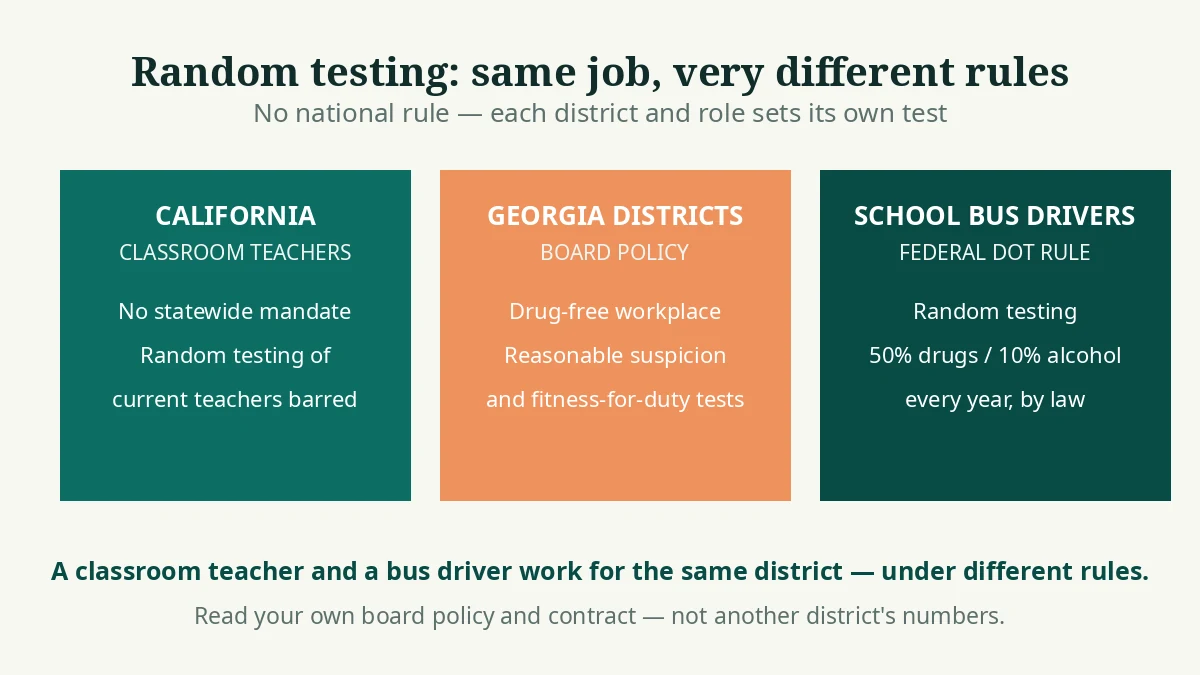
For a classroom teacher, the short answer in many states is no — and the reason is a court decision. The California Supreme Court drew the line in Loder v. City of Glendale: pre-employment screening upheld, blanket testing of current employees in non-safety-sensitive positions struck down. Teaching involves no heavy machinery, hazardous materials, or duties where a moment of impairment could cause immediate physical harm — so for a classroom teacher or school counselor, the district almost certainly cannot pull a name from a hat and send the teacher to a testing facility.
Other states differ: Georgia districts run drug-free-workplace programs, and Pennsylvania's model policy authorizes testing on reasonable suspicion. The pattern holds everywhere: the district's authority is strongest at hiring, on observed suspicion, after an incident, and in a return-to-duty agreement — and weakest as a random trawl of the whole staff. The exception: bus drivers work for the same district under federal random testing, covered below, and a teacher already in a return-to-duty agreement can be randomly tested as a condition of keeping the job.
What an EtG test for teachers actually measures
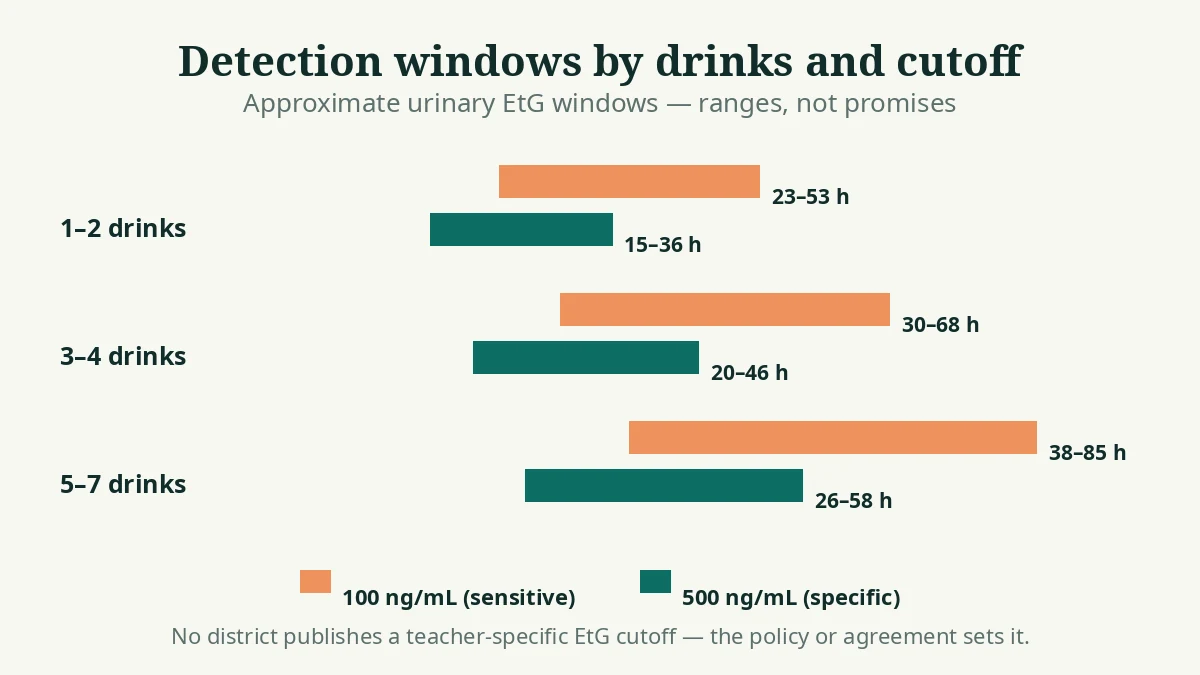
No district policy we checked publishes a teacher-specific EtG cutoff. Policies say "urinalysis" and leave the analyte and cutoff to the lab; where EtG is used, the cutoff lives in the monitoring agreement — 100 ng/mL where abstinence must be verified, 500 ng/mL where the program wants to screen out incidental exposure.
The cutoff changes the answer completely: 180 ng/mL is positive at 100 and negative at 500. The table uses the same modeled ranges as our calculator.
| Drinks | 100 ng/mL | 200 ng/mL | 500 ng/mL |
|---|---|---|---|
| 1–2 drinks | 23–53 hours | 20–46 hours | 15–36 hours |
| 3–4 drinks | 30–68 hours | 26–59 hours | 20–46 hours |
| 5–7 drinks | 38–85 hours | 33–75 hours | 26–58 hours |
Two things the number does not mean. First, an EtG level is not a blood alcohol level: there is no 0.08 equivalent, and a positive does not prove the teacher was drunk at work — only that alcohol was consumed inside the window. Second, the window is a range: body weight, drinking speed, hydration, and liver function all move it. The cutoff guide explains the levels, and the formula page shows how the windows are modeled. Monitoring programs use the same science.
What happens after a positive EtG test?
The immediate consequence is usually the same: suspension, with or without pay, while an investigation proceeds. One incident can trigger three tracks at once — a police report, a board investigation, and a state licensing review — running simultaneously, not in sequence.
Inside the district, the outcome turns on the board policy, the union contract, and the teacher's history. Termination is common, especially if students were directly exposed — but it is not automatic. Tenured teachers have a protected property interest in their jobs, and the U.S. Supreme Court held in Cleveland Board of Education v. Loudermill that a public employee with that interest must receive due process before being terminated. Some districts offer the treatment route instead.
Separate from whatever the district does, the state licensing agency can independently review the teacher's fitness to hold a credential. In California, the Commission on Teacher Credentialing reviews each case on its own facts — a DUI is not on the list of offenses that trigger automatic denial or revocation; outcomes range from no action to a private admonition, a public reproval, suspension, or full revocation. In Texas, the State Board for Educator Certification can suspend or revoke a certificate over a DWI. West Virginia's statute is blunter: "intemperance" is listed as grounds for revoking or suspending a teaching certificate. A credential action does not stay local: the NASDTEC Clearinghouse is a national database of disciplinary actions every participating jurisdiction reports into, and appeal deadlines are typically 10 to 35 days.
Refusing a required test is usually the worst option: policies treat refusal as a violation in itself, and a refusal can end a career faster than a positive result would.
School bus drivers and other CDL staff: a different rulebook
Anyone who drives a school bus or another commercial vehicle for the district works under federal law. The Federal Motor Carrier Safety Administration's rules, 49 CFR Part 382, require pre-employment drug testing with a verified negative result, unannounced random testing through the year — minimum annual rates of 50 percent for drugs and 10 percent for alcohol — plus reasonable-suspicion, post-accident, return-to-duty, and follow-up testing: at least six follow-up tests in the first 12 months, up to 60 months. A driver at 0.02 to 0.04 alcohol is removed from safety-sensitive functions until the next regularly scheduled duty period, and not less than 24 hours. No driver performs safety-sensitive functions within eight hours of using alcohol.
One honest correction: the DOT alcohol test is a breath test, not an EtG test — EtG is not part of the federal DOT panel. When a district EtG-tests a bus driver, that is the district's own program layered on top of the federal one — the same way truck drivers face EtG in return-to-duty monitoring on top of their DOT tests.
Real-world scenario: three drinks Friday, fitness-for-duty test Monday
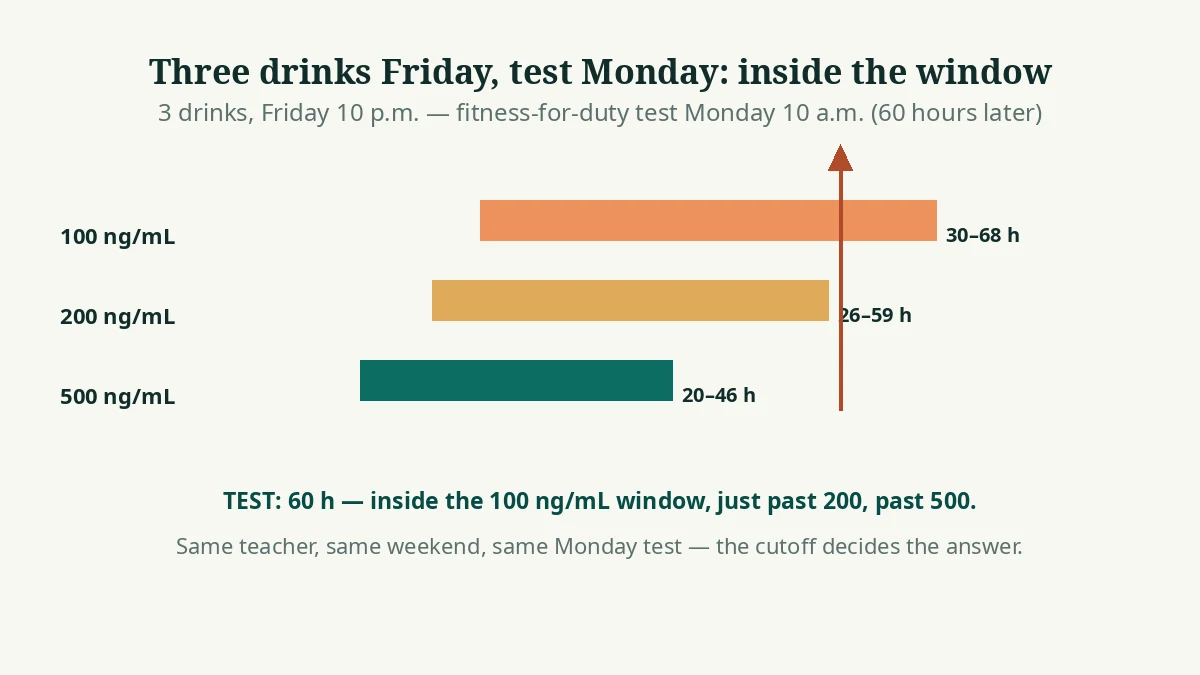
A teacher has three drinks on Friday night, the last at 10 p.m. Monday at 10 a.m. — 60 hours later — the teacher is called for a fitness-for-duty test.
At 100 ng/mL, three drinks are modeled at roughly 30 to 68 hours — inside the window, and a positive is likely. At 200 ng/mL (26 to 59 hours) the window has just closed, so a negative is the likely result, but at the very edge. At 500 ng/mL (20 to 46 hours) the window closed a day earlier. Same teacher, same weekend, same Monday test — the cutoff decides the answer.
The scenario does not say the teacher was impaired on Monday: EtG says nothing about impairment, only that alcohol was consumed inside the window.
What teachers should know before a test
Read your own district's board policy and union contract — those documents, not a website, are the authority.
Incidental exposure matters at the sensitive cutoff: mouthwash and hand sanitizer can produce low EtG levels that cross a 100 ng/mL threshold, so contested results should be confirmed by LC-MS/MS.
Drinking water does not erase EtG, and labs check creatinine, so dilution is caught rather than rewarded. Do not try to beat the test: refusing, adulterating, or tampering with a sample is a violation in itself. If a result is disputed, document the cutoff and the collection conditions, and talk to the union representative or an attorney — the appeal clock on a credential action can be as short as 10 days.
Using the EtG calculator before a test
The EtG calculator estimates the same detection windows the table above uses, from your own numbers: drinks, hours since your last drink, and your district's cutoff. Read the result as a range, never a pass date. It models EtG urine tests only — it cannot tell you whether you are fit for duty — and timing drinking around a schedule is not viable, because testing is unannounced and return-to-duty testing requires abstinence, not timing. To check your own scenario, run your numbers through the calculator.
Frequently asked questions
Can my school randomly drug test me as a teacher?+
It depends on your state and your role. In California, the Supreme Court struck down blanket random testing of current employees in non-safety-sensitive jobs (Loder v. City of Glendale), so a classroom teacher there is almost never randomly tested. Districts can still test on reasonable suspicion, before hiring, after an incident, for fitness for duty, and in a return-to-duty agreement. School bus drivers and other CDL staff are different: federal DOT rules require random testing every year.
Do teachers get EtG tested before hiring?+
Districts can require a drug test as a condition of a job offer, and courts have upheld pre-employment screening when it applies uniformly to all applicants for a position. The standard pre-employment panel screens for drugs of abuse and does not usually include EtG. EtG typically appears later — in fitness-for-duty testing and in return-to-duty monitoring after an alcohol concern.
How long after drinking can a teacher fail an EtG test?+
Up to about 80 hours after drinking, depending on how much was drunk and the cutoff. Three drinks are modeled at roughly 30 to 68 hours at 100 ng/mL, 26 to 59 hours at 200 ng/mL, and 20 to 46 hours at 500 ng/mL. These are ranges, not promises for one person — body weight, drinking speed, hydration, and liver function all move the window.
Can a positive EtG test cost a teacher their teaching license?+
Yes, potentially — and the credential track is separate from the district's discipline. The state licensing agency (for example, California's Commission on Teacher Credentialing or Texas's State Board for Educator Certification) can review a teacher's fitness independently, with outcomes ranging from no action to a private admonition, public reproval, suspension, or full revocation. Adverse actions are reported to the NASDTEC Clearinghouse, which all 50 states check, and appeal deadlines are typically 10 to 35 days.
Does a positive EtG test prove a teacher was drunk at work?+
No. EtG shows that alcohol was consumed inside the detection window — it says nothing about impairment at any particular moment, and there is no EtG equivalent of a 0.08 blood alcohol level. A Friday-night drink can produce a Monday-morning positive. Where a district tests for abstinence, that is enough to matter; where it tests for fitness, the result is the start of the question, not the answer.
Can mouthwash or hand sanitizer fail a teacher's EtG test?+
At the sensitive 100 ng/mL cutoff, yes, it is possible: mouthwash and hand sanitizer can produce low EtG levels that cross that threshold, especially with repeated use in an enclosed space. At 500 ng/mL it is unlikely. Any contested result should be confirmed by LC-MS/MS before it becomes the basis for discipline.
What should a teacher do if asked to take an EtG test?+
Comply with the test, note the cutoff and the collection conditions, and contact your union representative or an attorney. Do not refuse the test or tamper with a sample — district policies treat refusal as a violation in itself. If the result is positive, remember the district process and the credential process are separate, and the appeal clock on a credential action can be as short as 10 days.
Evidence and limitations
This article summarizes published research and public guidance on EtG testing for teachers, school district drug-and-alcohol testing policies, and teacher credential discipline. Group-level findings cannot predict one person’s result, and this article is educational only — it is not medical or legal advice. District policies, union contracts, and state education codes change; check your own district’s board policy and your state’s credentialing agency.
- LegalClarity — Do Teachers Get Drug Tested in California? What to Know: no statewide law requiring drug tests for public school teachers; pre-employment screening upheld by California courts when applied uniformly; Loder v. City of Glendale bars blanket testing of current employees in non-safety-sensitive positions; reasonable-suspicion observations (slurred speech, bloodshot eyes, odor of alcohol, unsteady movement); AB 2188 (2024) cannabis-metabolite protections
- LegalClarity — Teacher Drinking at School: Legal Consequences and Rights: suspension with or without pay during investigation; Cleveland Board of Education v. Loudermill due process for tenured teachers; state licensing boards review fitness independently; NASDTEC Educator Identification Clearinghouse (all 50 states, DC, territories); appeal deadlines typically 10 to 35 days; voluntary rehabilitation as a mitigating factor
- LegalClarity — Can You Be a Teacher With a DUI in California?: California Commission on Teacher Credentialing reviews each DUI on its own facts; DUI is not on the automatic denial/revocation list; outcomes from no action to private admonition, public reproval, suspension, or revocation
- Walton County (GA) School District Board Policy GAMA — Drug-Free Workplace: Drug-Free Workplace Act of 1988 and Drug-Free Schools and Communities Act Amendments of 1989; in loco parentis rationale; “unfit for duty” definition; testing on reasonable suspicion and after work-related injury or property damage
- Pennsylvania school board Policy 351 — Drug and Substance Abuse (model policy): reasonable-suspicion testing by supervisor observation; testing positive for alcohol and refusing to submit a sample are violations in themselves
- FMCSA — Requirements While Not Performing Safety-Sensitive Functions: 49 CFR 382.305(m) — a driver shall only be tested for alcohol while performing, just before, or just after safety-sensitive functions
- Oakland Unified School District Board Policy 4112.42 — Drug and Alcohol Testing for School Bus Drivers: 49 CFR Part 382 program for CDL drivers; pre-employment, random, reasonable-suspicion, post-accident, return-to-duty, and follow-up testing; refusal treated as a positive
- West Virginia Code §18A-3-6 — Grounds for revocation or suspension of certificates: “intemperance” listed among the causes for revoking or suspending a teaching certificate
- SAMHSA Advisory: The Role of Biomarkers in the Treatment of Alcohol Use Disorders (2006, revised 2012)
- McDonell et al. (2015) — EtG immunoassay cutoff sensitivity in alcohol-dependent outpatients (1,589 samples)
- Mackus et al. (2017) — EtG detection and elimination kinetics after controlled alcohol intake