The short answer: doctors are not tested like other workers
If you search for an EtG test for doctors, you are probably picturing a routine workplace drug screen — the kind a truck driver or a warehouse employee takes. That is not how physician testing works. There is no single federal mandate that drug-tests physicians, and no national EtG cutoff for doctors. Testing depends on a patchwork of state regulations, institutional policies, and employment contracts.
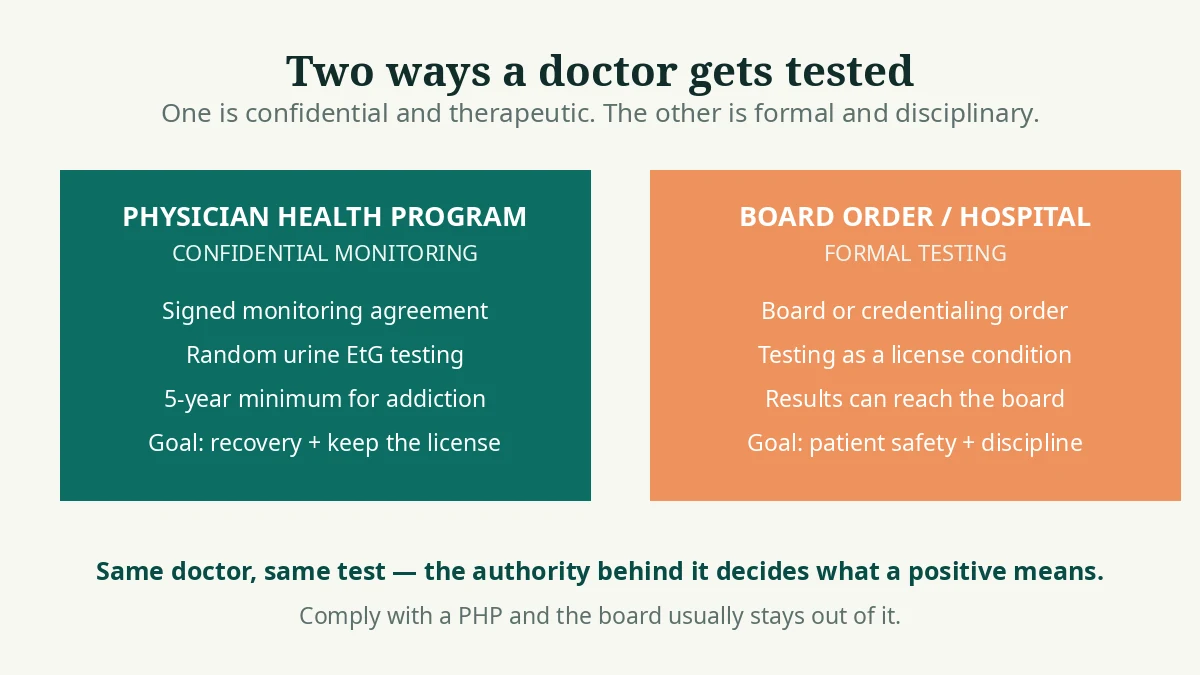
EtG — ethyl glucuronide, the alcohol metabolite found in urine for days after drinking — reaches a doctor through one of three doors. The first is a physician health program, or PHP: a confidential state program that monitors physicians in recovery under a signed agreement. The second is a board order: a state medical board that requires testing as a condition of keeping or restoring a license. The third is the hospital: credentialing, peer review, and employment policies that can require testing when impairment is suspected or after an incident. A doctor can pass a breath test and fail an EtG test on the same day — and in a monitoring program, the EtG result is the one that matters.
Where EtG comes in: physician health programs
A physician health program is a confidential resource run in nearly every state for physicians — and in many states, other licensed health professionals — whose addictive, psychiatric, or medical conditions may impair their practice. The programs are coordinated nationally by the Federation of State Physician Health Programs (FSPHP), whose member programs operate in 47 states and the District of Columbia. Their role is diversionary by design: a therapeutic alternative to disciplinary action, with the support of organized medicine in the state.
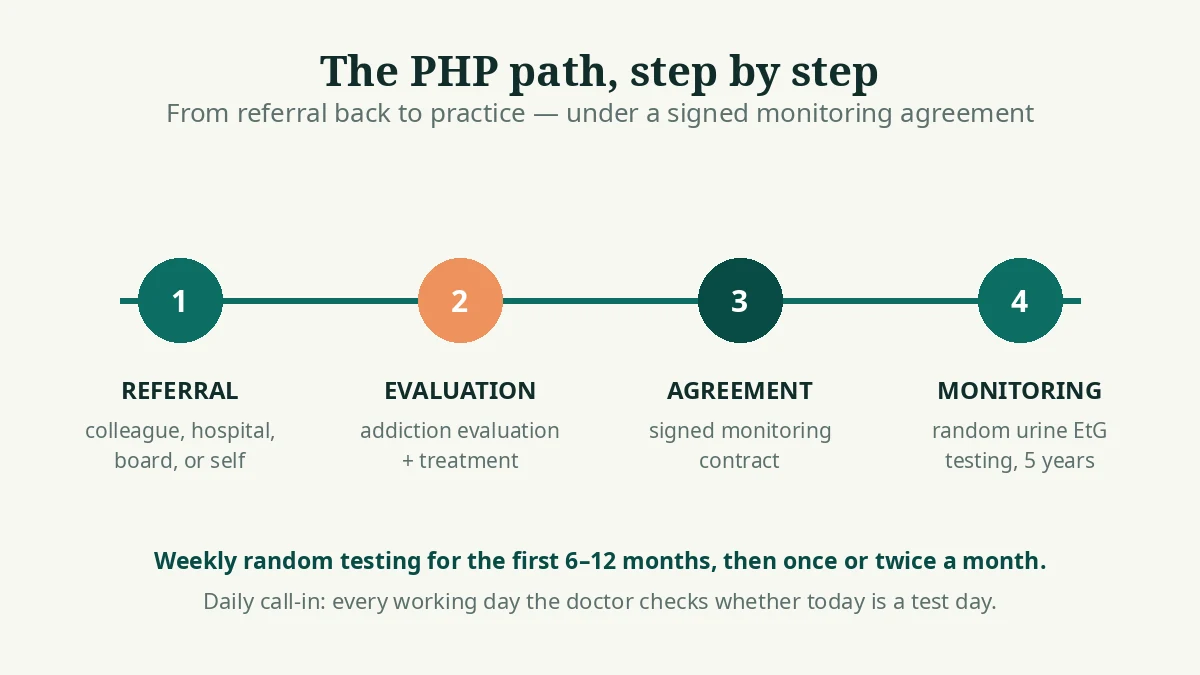
A doctor enters a PHP after a referral — from a colleague, a hospital, the licensing board, or by self-referral — when substance use or another impairing condition is suspected. The program arranges evaluation, coordinates treatment, then manages long-term monitoring under a written agreement covering abstinence, treatment, support-group attendance, workplace monitoring, and biological testing.
This is where EtG appears. ASAM's drug-testing pocket guide states it plainly: most PHP programs routinely use ethyl glucuronide testing to better detect alcohol use. A standard urine panel does not catch a glass of wine from two days ago; EtG does, which is why abstinence programs rely on it. The same guide notes monitoring involves periodic interviews plus random urine and hair testing, with witnessed collection as the gold standard. Our guide to EtG testing for nurses covers the parallel system for nursing boards, which works the same way.
How PHP monitoring works day to day
Once a doctor signs a monitoring agreement, testing becomes part of the working week. The average participant receives weekly random drug testing for the first 6 to 12 months, then once or twice per month for the rest of the agreement. Testing is random, meaning that typically every day of the work week the physician calls a phone number to see whether that day they need to submit a sample. Being tested yesterday does not exempt you today.
The minimum period of monitoring for addiction is five years, according to the same ASAM guidance; for harmful substance use without dependence, the minimum is one year and a maximum of two, assuming no additional concerns arise during monitoring. The contract requires abstinence, immediate reporting of any alcohol or mood-altering chemical use, and submission to biological specimen monitoring without question.
Urine is the basic standard, with PEth blood testing and hair testing used alongside it in many programs. EtG and EtS are the urine markers for alcohol; PEth reaches back two to four weeks. The program publishes no single EtG cutoff — the cutoff lives in the monitoring agreement, and programs verifying abstinence use the sensitive end of the range. See our 100 vs 500 ng/mL cutoff guide for how the two ends of the range change a result.
The medical license: state medical boards
Everything in a PHP runs in the shadow of the medical license, and the license belongs to the state medical board. When impairment is suspected, the board may mandate testing and monitoring as a condition of continued licensure or to avoid formal discipline. The PHP is the confidential path: a doctor who completes the program and complies with the agreement generally keeps the board out of it. A doctor who refuses the program or fails to comply faces the board directly — and the board can suspend, restrict, or revoke a license.
There is no published statewide EtG cutoff for doctors in any state, because no state sets one. The cutoff is set program by program, in the monitoring agreement or the board order. Serious disciplinary actions land in the National Practitioner Data Bank, which follows a physician across state lines. A doctor facing a board matter needs a health-law attorney, not a blog post — this article is educational only, not medical or legal advice.
Hospital credentialing and employment testing
Outside the PHP and the board, hospitals test doctors through credentialing and employment. Hospital bylaws and credentialing can require drug testing when impairment is suspected, after an incident, or as part of a return-to-practice plan — and peer review can make testing a condition of keeping privileges. Employment contracts add another layer: the Department of Veterans Affairs, for example, systematically conducts random drug tests on physicians it employs.
The difference for doctors is the stakes: a warehouse worker who fails a test loses a job; a physician who fails a test in a monitoring program can lose the license the job depends on. That is why the testing is more frequent, more random, and more closely watched than in almost any other profession — and why the EtG window, which reaches back days, matters more than the breath test, which reaches back hours. Our guide to EtG testing for employment covers the general workplace side in full.
How far back does an EtG test for doctors reach?
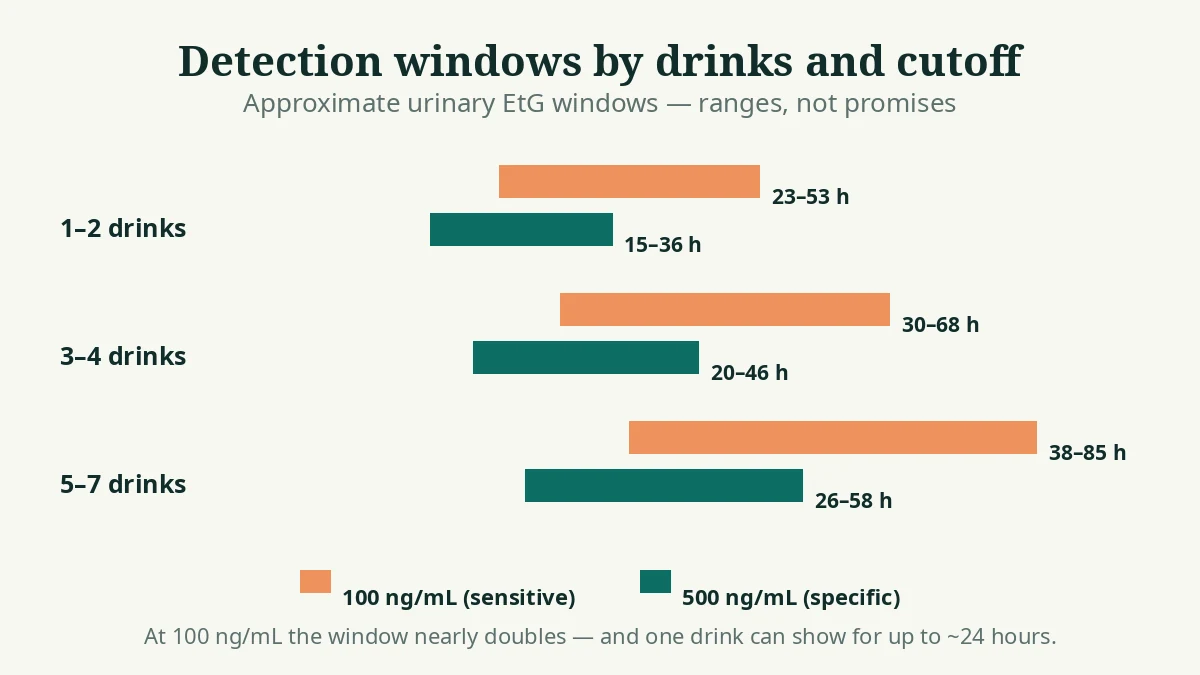
The table below gives approximate urinary EtG detection windows from controlled dosing research, at the cutoffs monitoring programs use — ranges, not promises, from the same model our calculator uses; see the EtG calculation formula page. PHP documents publish no single EtG cutoff; the exact cutoff is in the doctor's monitoring agreement.
| Drinks (one session) | 100 ng/mL cutoff | 200 ng/mL cutoff | 500 ng/mL cutoff |
|---|---|---|---|
| 1–2 drinks | 23–53 hours | 20–46 hours | 15–36 hours |
| 3–4 drinks | 30–68 hours | 26–59 hours | 20–46 hours |
| 5–7 drinks | 38–85 hours | 33–75 hours | 26–58 hours |
| Heavy / binge episode | Up to ~80 hours | Up to ~72 hours | Up to ~48 hours |
Real-world scenario: three drinks Saturday, PHP test Monday
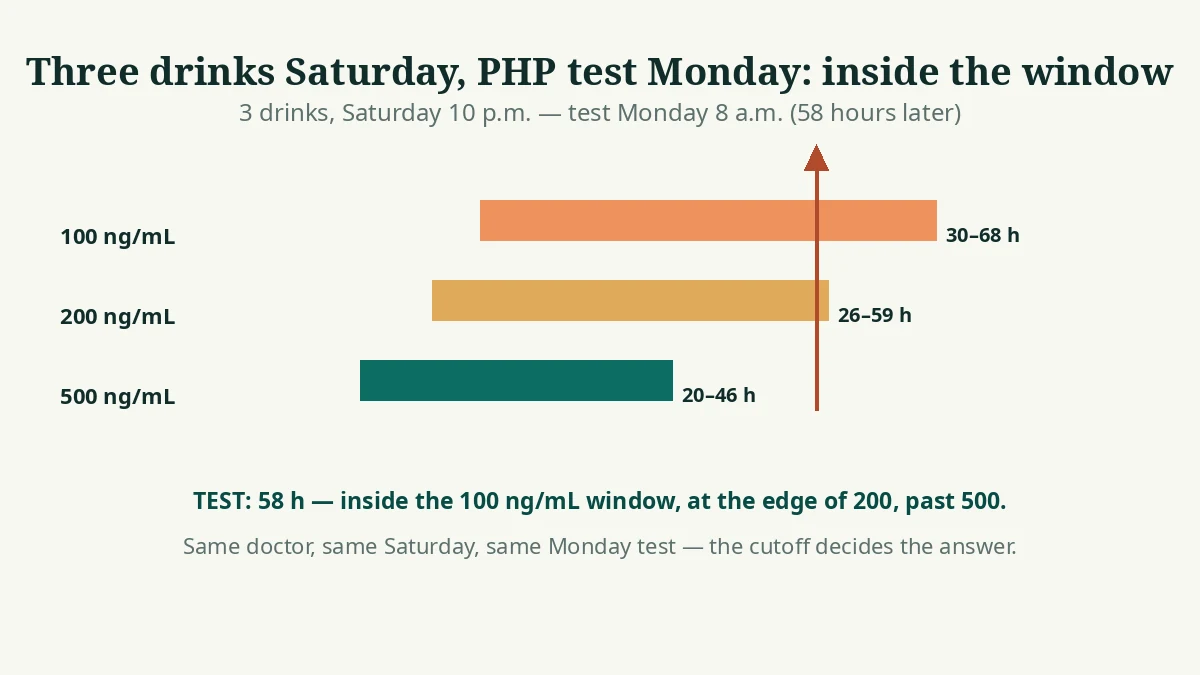
Take a surgeon in a PHP monitoring agreement, back at work after treatment. On Saturday evening she has three drinks over three hours, finishing at 10 p.m. She is not on call that weekend. On Monday at 8 a.m., 58 hours after the last drink, she calls the daily check-in number and is told today is a test day. She must provide a urine sample the same day, under observation.
At 100 ng/mL, three drinks sit in a roughly 30 to 68 hour window, so 58 hours is inside it. At 200 ng/mL (26 to 59 hours) it is inside too, but at the very edge. At 500 ng/mL (20 to 46 hours) the test would likely be negative.
The surgeon does not know which Monday she will be selected — there is no safe gap to aim for, because selection is unannounced by design and the daily call-in gives no warning. The question is not whether she was fit to operate; she was not operating. It is whether she kept the abstinence condition her monitoring agreement depends on.
What a positive EtG test means in a PHP
A positive EtG test in a PHP is a program violation, and the consequences run through the agreement first and the license second. The usual outcomes are a return to treatment, extended monitoring, more frequent testing, or — if the program reports the violation — board action that can restrict or suspend the license. A relapse does not automatically end a medical career: a positive test triggers more care, not expulsion, and the path back gets longer rather than closing.
The evidence for that model is strong. McLellan and colleagues followed 802 physicians treated through 16 state PHPs for five years: 647 (80.7%) completed treatment and returned to practice under monitoring, and at five-year follow-up 631 (78.7%) were licensed without restriction and working. Among those who completed treatment and returned to practice, 126 — 19% — had alcohol or drug use detected by urine testing at some point across the five years, and a third of those tested positive again.
The stakes are why PHP testing uses confirmation: SAMHSA's biomarker advisory (2006, revised 2012) called using EtG as the sole basis for legal or disciplinary action "inappropriate and scientifically unsupportable," and confirmatory LC-MS/MS testing is the expected follow-up. The same standard applies in nursing monitoring programs and in probation testing — see our guide to EtG testing for probation.
If you are a doctor facing an EtG test
Ask who ordered the test and under what authority, what cutoff applies, whether the positive was confirmed by LC-MS/MS, whether there is a retest or appeal path, and whether the sample was valid. A result of 180 ng/mL is positive at 100 and negative at 500 — in a PHP, the cutoff is in your monitoring agreement.
Document everything: the cutoff, the confirmation method, and the collection conditions. Never refuse a required test — refusal of a monitoring test is a violation of the agreement in itself, and a missed test can be treated the same as a positive. If a result threatens your license, talk to your PHP case manager and a health-law attorney.
Using the EtG calculator before a test
The EtG calculator estimates the same detection windows the table above uses, from your own numbers: drinks, hours spent drinking, hours since your last drink, and the cutoff your program uses — usually 100 ng/mL for abstinence testing. Read the result as a range, never a pass date. Two warnings matter: the calculator models EtG urine tests only — it cannot tell you whether you are fit to practise — and timing drinking around a monitoring schedule is not viable, because PHP testing is random and unannounced. To check your own scenario, run your numbers through the calculator.
Frequently asked questions
Do doctors get EtG tested?+
Yes — mainly through a state physician health program (PHP) monitoring agreement, a state medical board order, or a hospital's credentialing and employment policies. There is no federal rule that requires routine EtG testing of all physicians, so whether a doctor is tested depends on the state, the hospital, and whether the doctor is in a monitoring program.
What is a physician health program (PHP)?+
A PHP is a confidential state program that evaluates, treats, and monitors physicians — and in many states other licensed health professionals — whose substance use or other conditions may impair practice. Member programs operate in 47 states and the District of Columbia under the Federation of State Physician Health Programs (FSPHP). A PHP is a therapeutic alternative to disciplinary action: the doctor signs a monitoring agreement and keeps the board out of it by complying.
What EtG cutoff do physician health programs use?+
There is no single published cutoff. The cutoff lives in the doctor's monitoring agreement or board order, and programs verifying abstinence use the sensitive end of the range — typically 100 ng/mL. A result of 180 ng/mL is positive at 100 and negative at 500, so the cutoff in the agreement decides the answer.
How long does a PHP monitoring agreement last?+
For a substance use disorder, the minimum period of monitoring is five years, according to ASAM's drug-testing guidance. For harmful substance use without dependence, the minimum is one year and a maximum of two, assuming no additional concerns arise during monitoring. Individual agreements can run longer if the program extends them.
How often are doctors tested in a PHP?+
The average participant receives weekly random drug testing for the first 6 to 12 months, then once or twice per month for the remainder of the agreement, per ASAM's guidance. Every working day the physician calls a phone number to find out whether that day is a test day, and collection is usually witnessed. Urine EtG and EtS are the alcohol markers; PEth blood testing and hair testing are also used.
Does a positive EtG test mean losing a medical license?+
Not automatically. A positive in a PHP is a program violation: the usual outcomes are a return to treatment, extended monitoring, and more frequent testing. The license is at risk if the program reports the violation to the board, or if the doctor refuses the program or fails to comply. In the largest five-year study, 78.7% of 802 physicians were licensed without restriction and working at five years, even though 19% had use detected by urine testing at some point.
Can a doctor refuse an EtG test in a PHP?+
Refusing or missing a required test is a violation of the monitoring agreement in itself and can be treated the same as a positive — it can trigger extended monitoring or a report to the medical board. If a result is disputed, the right move is to ask for LC-MS/MS confirmation, document the cutoff and collection conditions, and talk to the PHP case manager and a health-law attorney.
Evidence and limitations
This article summarizes published research and public guidance on EtG testing for doctors, physician health programs, and medical licensing. Group-level findings cannot predict one person’s result, and this article is educational only — it is not medical or legal advice. State programs and board rules change; check your own monitoring agreement and your state medical board’s published guidance.
- Federation of State Physician Health Programs — State Programs: member PHPs in 47 states and the District of Columbia; PHPs as a confidential resource and therapeutic alternative to disciplinary action
- FS PHP — FAQs: what a physician health program is, 501(c)(3) nonprofit established 1991
- ASAM Drug Testing Pocket Guide — Physician’s Health Programs: 5-year minimum monitoring for addiction, weekly random testing first 6–12 months, daily call-in, witnessed collection, “Most PHP programs routinely use ethyl glucuronide testing”
- McLellan AT, Skipper GS, Campbell M, DuPont RL (2008) — Five year outcomes in a cohort study of physicians treated for substance use disorders in the United States. BMJ 337:a2038 (802 physicians, 78.7% licensed without restriction and working at 5 years; 19% had use detected by urine testing)
- DuPont RL, McLellan AT, White WL, Merlo LJ, Gold MS (2009) — How are addicted physicians treated? A national survey of Physician Health Programs. Journal of Substance Abuse Treatment 37:1–7
- Merlo LJ, Campbell MD, Shea C (2023) — Essential components of physician health program monitoring for substance use disorder: outcomes sustained 5 years after successful program completion
- West Virginia Medical Professionals Health Program — Toxicology Program & Monitoring: urine and PEth as the basic standard; monitoring agreements individualized, up to 5 years for moderate and severe disorders
- SAMHSA Advisory: The Role of Biomarkers in the Treatment of Alcohol Use Disorders (2006, revised 2012)
- McDonell et al. (2015) — EtG immunoassay cutoff sensitivity in alcohol-dependent outpatients (1,589 samples)
- Mackus et al. (2017) — EtG detection and elimination kinetics after controlled alcohol intake