The quick answer: parole EtG testing runs on your conditions, not a national rule
If you search for an EtG test for parole, you are probably expecting one national rule — a federal standard, a fixed cutoff, a set schedule — but there is none. Parole testing runs on the conditions attached to your release, set by the parole board or commission that granted it and enforced by your parole officer. At the end of 2023, about 680,400 adults were on parole in the United States — roughly 1 in 387 adults — and each answers to a different board, agency, and set of conditions.
EtG — ethyl glucuronide, the alcohol metabolite urine tests can find for days after drinking — is the standard tool for checking abstinence on parole. For a parolee, EtG matters because the question is not whether you are drunk right now, but whether you drank at all since the last check. The general probation-testing rules are a useful comparison — but the parole board's conditions are the authority, and parole is stricter than probation in one way that matters: a violation can send you back to prison to finish the sentence you were released from.
Parole vs probation: why the test works differently
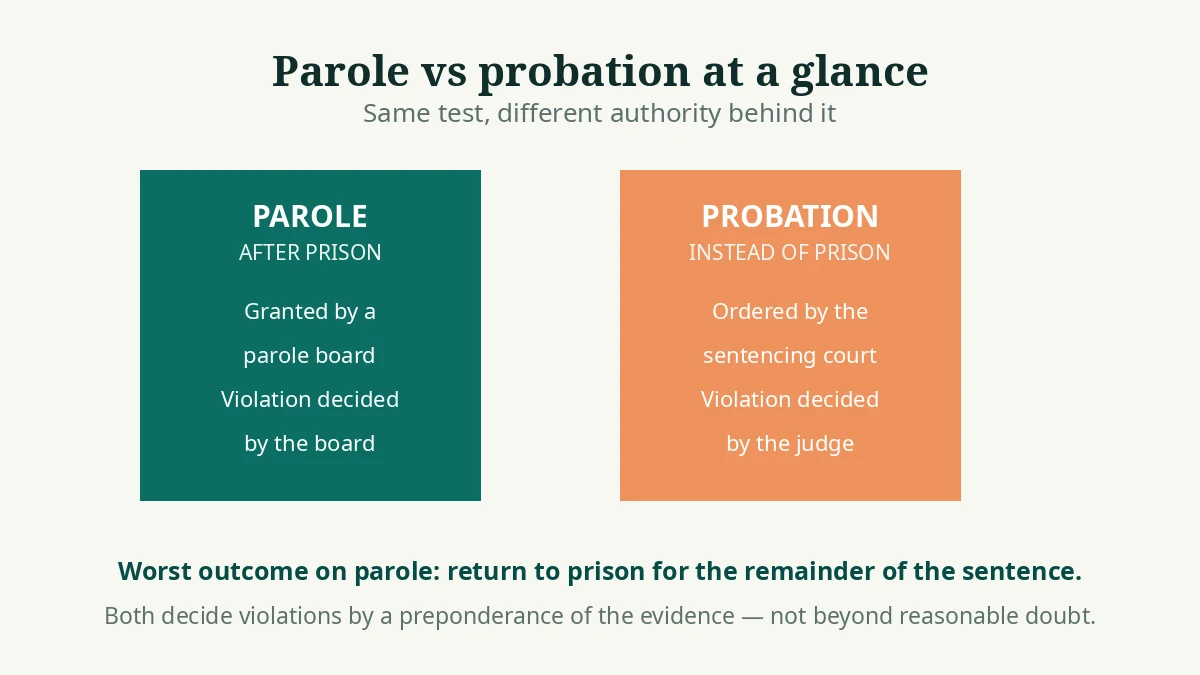
People use "parole" and "probation" interchangeably. The testing logic is similar, but the authority behind it is not — and that changes what a positive result can cost you.
| Parole | Probation | |
|---|---|---|
| When it starts | After serving part of a prison sentence | Instead of a prison sentence |
| Who grants it | A parole board or commission | The sentencing court |
| Who supervises | Parole officer, under the board | Probation officer, under the court |
| Who decides a violation | The parole board | The judge |
| Standard of proof | Preponderance of the evidence | Preponderance of the evidence |
| Worst outcome | Return to prison for the remainder of the sentence | Jail or prison time imposed by the court |
The practical difference for testing: a parole officer's authority comes from the board's conditions, which commonly include abstinence plus random testing. Federal supervised release — the federal equivalent of parole — makes the structure explicit: the standard condition bans drinking "to excess" (28 C.F.R. § 2.204), while a special condition can ban alcohol completely, and courts add the total ban when the offense involved alcohol or substance abuse was a factor. A DUI conviction or a crime committed while drinking almost guarantees the total ban. The same pattern holds in the states: Tennessee's parole conditions include not using intoxicants to excess and submitting to drug screens as directed, and Michigan requires substance-abuse testing at least twice a month for parolees on intensive, maximum, or medium supervision (MCL 791.240).
The four moments a parolee gets tested
Parole testing is random by design — that is what makes it work. But the testing falls into four recognizable moments.
1. The first test after release. Federal law requires at least one drug test within 15 days of release, plus at least two additional periodic tests afterward (18 U.S.C. § 3583). State systems do the same: the first weeks after release are the highest-risk window, and the first test sets the baseline. A positive in this window is treated seriously, because it suggests drinking started immediately.
2. Random testing. This is the core of parole monitoring. There is no published schedule — your officer can call you in at any check-in, or direct you to a lab with a same-day window. Some states set a floor: Michigan's twice-a-month minimum for higher supervision levels is one example. The randomness is the point: EtG reaches back days, so a test on any given Monday covers the whole weekend.
3. After a violation or a concern. A missed check-in, a failed breath test, a report from a treatment provider, or a new arrest can all trigger immediate testing — and a higher testing frequency afterward. A first positive usually moves a parolee from monthly testing to weekly or even random daily testing.
4. Return-to-duty and treatment monitoring. After a positive, the board or officer often orders treatment — outpatient counseling, an intensive outpatient program, or inpatient rehabilitation — and EtG testing becomes the way the program verifies abstinence. Follow-up testing can run for months after the violation, and a second positive during that period is weighed much more heavily than the first.

What an EtG test for parole actually measures
No parole board or supervising agency we checked publishes a parole-specific EtG cutoff. Conditions say "drug screening" or "submit to testing" and leave the analyte and cutoff to the agency and its lab; where EtG is used, the cutoff lives in the supervision agreement — 100 ng/mL where abstinence must be verified, 500 ng/mL where the program wants to screen out incidental exposure.
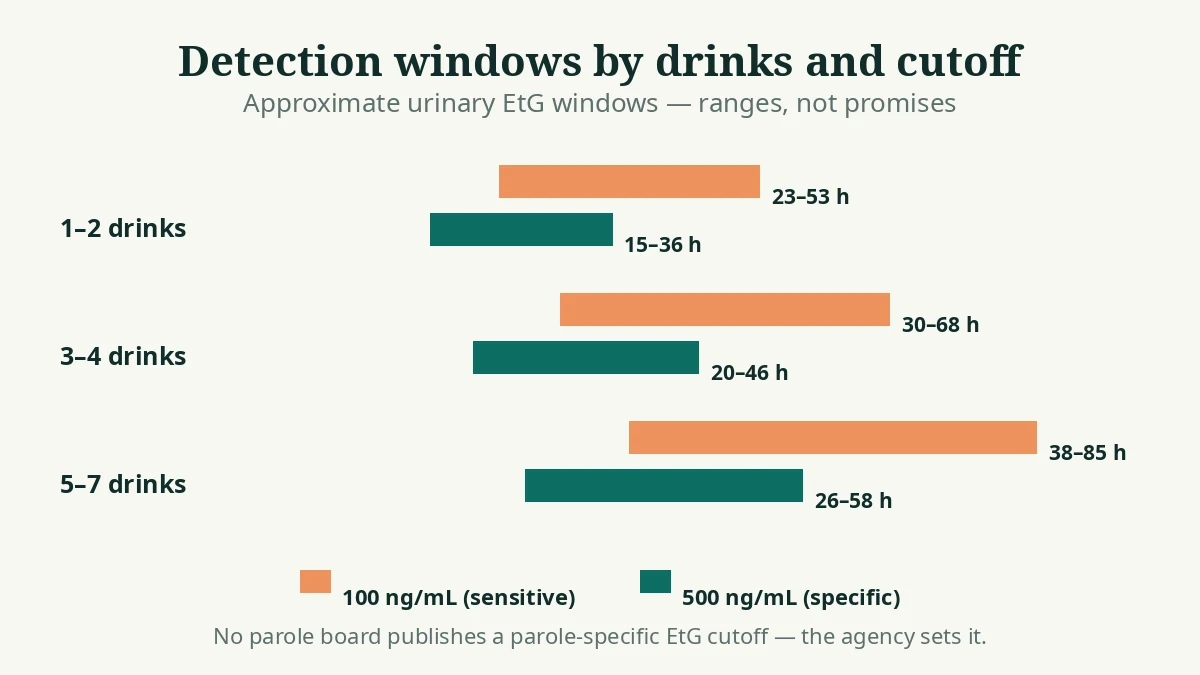
The cutoff changes the answer completely: 180 ng/mL is positive at 100 and negative at 500. The table uses the same modeled ranges as our calculator, and the research behind it is consistent: at the commonly used 500 ng/mL cutoff, EtG detects heavy drinking from the previous day; at the more sensitive 100 ng/mL cutoff, it can flag light drinking for up to about two days and heavy drinking for up to about five days (McDonell et al.).
| Drinks | 100 ng/mL | 200 ng/mL | 500 ng/mL |
|---|---|---|---|
| 1–2 drinks | 23–53 hours | 20–46 hours | 15–36 hours |
| 3–4 drinks | 30–68 hours | 26–59 hours | 20–46 hours |
| 5–7 drinks | 38–85 hours | 33–75 hours | 26–58 hours |
Two things the number does not mean. First, an EtG level is not a blood alcohol level: there is no 0.08 equivalent, and a positive does not prove the parolee was drunk at any particular moment — only that alcohol was consumed inside the window. Second, the window is a range: body weight, drinking speed, hydration, and liver function all move it. The cutoff guide explains the levels, and the formula page shows how the windows are modeled. Monitoring programs use the same science, and the realistic detection times page corrects the "80-hour" shorthand that gets quoted as a fixed number.
What happens after a positive EtG test?
A failed EtG test on parole is a technical violation — a breach of a condition, not a new crime. What happens next depends on the board, the officer, and your history, and most systems now use graduated sanctions: the response matches the severity and the frequency of the violation.
For a first positive with no other compliance problems, the officer can usually impose low-level sanctions without going to the board at all: increased testing (monthly to weekly, or random daily), mandatory substance-abuse treatment, more frequent check-ins, a curfew of 7 to 30 days, or community service. More intensive sanctions — electronic monitoring, residential treatment placement, or a short jail stay of 30 to 90 days — generally need supervisor approval or a board order, and are reserved for repeated violations or more serious circumstances. Hawaii's HOPE program runs on a "swift, certain, and fair" model: a first failed test brings an immediate but brief jail stay, often just a few days, and residential treatment only after a third or fourth positive.
The most severe consequence is full revocation: the board orders the person back to prison to serve the remainder of the original sentence. That outcome is most likely with repeated violations or when the drinking is linked to new criminal activity. In the federal system, the Parole Commission decides by a preponderance of the evidence — more likely than not — and can restore you to supervision with modified conditions, refer you to a residential treatment center, or revoke parole entirely; revocation is listed as the final option, not the default (28 C.F.R. § 2.105). There is also a federal tripwire worth knowing: more than three positive drug tests in one year requires the court to revoke supervised release and impose a prison sentence (18 U.S.C. § 3583).
Refusing a test is not a way around any of this. A refusal to submit a sample, or a diluted sample, is typically treated as a violation in its own right — the same as a positive result. And the board's decision is not a criminal trial: it does not need proof beyond a reasonable doubt, only a preponderance of the evidence.
Real-world scenario: four drinks Friday, random test Monday
A parolee has four drinks on Friday night, the last at 11 p.m. Monday at 9 a.m. — 58 hours later — the parole officer calls for a random EtG test.
At 100 ng/mL, four drinks are modeled at roughly 30 to 68 hours — inside the window, and a positive is likely. At 200 ng/mL (26 to 59 hours) the window is still open, but by a single hour: 58 hours is inside, and one hour later it would not be. At 500 ng/mL (20 to 46 hours) the window closed more than half a day earlier. Same parolee, same weekend, same Monday test — the cutoff decides the answer, and at 200 ng/mL it is decided by an hour.
The scenario does not say the parolee was impaired on Monday: EtG says nothing about impairment, only that alcohol was consumed inside the window. But on parole, impairment is not the question — abstinence is. That is why an ordinary Friday night can become a technical violation.

What parolees should know before a test
Read your own conditions — those documents, not a website, are the authority. If your conditions ban alcohol entirely, that is the rule; if they ban drinking "to excess," ask your officer what that means before you test it.
Incidental exposure matters at the sensitive cutoff: mouthwash and hand sanitizer can produce low EtG levels that cross a 100 ng/mL threshold, so tell your officer about heavy use before testing and ask for any contested result to be confirmed by LC-MS/MS.
Drinking water does not erase EtG, and labs check creatinine, so dilution is caught rather than rewarded. Do not try to beat the test: refusing, adulterating, or tampering with a sample is a violation in itself. If a result is disputed, document the cutoff and the collection conditions, and talk to an attorney — the board's standard is preponderance of the evidence, so a documented challenge to the result matters. And remember the federal tripwire: a fourth positive test within 12 months can force revocation.
Using the EtG calculator before a test
The EtG calculator estimates the same detection windows the table above uses, from your own numbers: drinks, hours since your last drink, and your agency's cutoff. Read the result as a range, never a pass date. It models EtG urine tests only — it cannot tell you whether you are in compliance — and timing drinking around a schedule is not viable, because parole testing is random and unannounced and your conditions require abstinence, not timing. To check your own scenario, run your numbers through the calculator.
Frequently asked questions
Can you drink alcohol while on parole?+
It depends on your conditions. The federal standard condition bans drinking "to excess" (28 C.F.R. § 2.204), while a special condition can ban alcohol completely. A DUI conviction or a crime committed while drinking almost always means a total ban. State parole boards work the same way: the board sets the condition, and your parole officer enforces it. Never assume a drink is allowed — read your conditions or ask your officer.
How often do parole officers EtG test?+
There is no fixed schedule — testing is random and unannounced, which is the point. Federal law requires at least one drug test within 15 days of release and at least two additional periodic tests afterward (18 U.S.C. § 3583), and courts can order far more. Some states set a floor: Michigan requires substance-abuse testing at least twice a month for parolees on intensive, maximum, or medium supervision (MCL 791.240). Expect a test at any check-in.
How long after drinking will an EtG test be positive on parole?+
It depends on how much was drunk and the cutoff. At 100 ng/mL, light drinking is flagged for up to about two days and heavy drinking for up to about five days (McDonell et al.). Our modeled ranges: 1–2 drinks, 23–53 hours at 100 ng/mL; 3–4 drinks, 30–68 hours; 5–7 drinks, 38–85 hours. At 500 ng/mL the same amounts clear roughly a day sooner. These are ranges, not promises for one person.
Will one positive EtG test send you back to prison?+
Rarely for a first positive. Most parole systems use graduated sanctions: a first failed test usually brings increased testing, mandatory treatment, a curfew, or more frequent check-ins — not immediate revocation. The board decides by a "preponderance of the evidence" standard, and it can restore you to supervision with modified conditions instead of revoking. Revocation — return to prison to serve the remainder of your sentence — becomes likely with repeated violations or a new crime.
Does refusing an EtG test on parole count as a violation?+
Yes — a refusal to submit a sample, or a diluted sample, is typically treated as a violation in its own right, the same as a positive result. Federal supervised-release conditions and most state parole conditions say so plainly. Refusing also removes any chance of a low-level sanction: the officer has no result to weigh, only a refusal to report.
What EtG cutoff does parole use?+
There is no national EtG cutoff for parole. The cutoff is set by the supervising agency or the parole board, and it is usually 100 or 500 ng/mL — 100 where abstinence must be verified, 500 where the program wants to screen out incidental exposure. A level of 180 ng/mL is positive at 100 and negative at 500, so the cutoff decides the answer. Your conditions or your officer can tell you which one applies to you.
Can mouthwash or hand sanitizer fail a parole EtG test?+
At the sensitive 100 ng/mL cutoff, yes, it is possible: mouthwash and hand sanitizer can produce low EtG levels that cross that threshold, especially with repeated use in an enclosed space. At 500 ng/mL it is unlikely. Tell your officer about heavy sanitizer or mouthwash use before testing, and ask for any contested result to be confirmed by LC-MS/MS before it becomes the basis for a violation.
Evidence and limitations
This article summarizes published research and public guidance on EtG testing on parole, parole supervision conditions, and parole revocation. Group-level findings cannot predict one person’s result, and this article is educational only — it is not medical or legal advice. Parole conditions, board procedures, and state statutes change; check your own release conditions and your state’s parole board.
- Bureau of Justice Statistics — Probation and Parole in the United States, 2023 (NCJ 310118): 680,400 adults on parole at year-end 2023, down 2.9% from 700,800; 1 in 387 U.S. adults on parole
- LegalClarity — Can You Drink on Parole? Rules, Tests, and Violations: federal standard condition “must not drink alcoholic beverages to excess” (28 C.F.R. § 2.204); special condition total alcohol ban; EtG the standard urine test in supervised release; 500 ng/mL detects heavy drinking from the previous day, 100 ng/mL flags light drinking up to about two days and heavy drinking up to about five days; 18 U.S.C. § 3583 first test within 15 days of release plus at least two additional periodic tests
- LegalClarity — What Happens If You Fail a Drug Test on Parole?: failed test as a technical violation; refusal or diluted sample treated as a violation; board decides by a preponderance of the evidence; graduated sanctions (warning, increased testing, treatment, curfew, electronic monitoring, 30–90 day jail stay, revocation to serve the remainder of the sentence)
- LegalClarity — First Dirty Urine on Parole: graduated sanctions framework; first positive rarely means immediate revocation; federal Parole Commission options under 28 C.F.R. § 2.105 (restore with modified conditions, residential treatment, or revoke); Hawaii HOPE swift-certain-fair model
- LegalClarity — Legal Consequences of Failing a Court-Ordered Drug Test: more than three positive drug tests in one year requires revocation of supervised release (18 U.S.C. § 3583) and of probation (18 U.S.C. § 3565)
- EtG Calculator Pro — EtG Test Michigan: MCL 791.240 requires substance-abuse testing at least twice a month for parolees on intensive, maximum, or medium supervision; no statewide Michigan EtG cutoff
- EtG Calculator Pro — EtG Test Tennessee: parole under the Tennessee Board of Parole with Tennessee Department of Correction supervision; standard conditions include not using intoxicants to excess and submitting to drug screens as directed; failed test as a technical violation (TCA 40-28-305)
- SAMHSA Advisory: The Role of Biomarkers in the Treatment of Alcohol Use Disorders (2006, revised 2012)
- McDonell et al. (2015) — EtG immunoassay cutoff sensitivity in alcohol-dependent outpatients (1,589 samples)
- Mackus et al. (2017) — EtG detection and elimination kinetics after controlled alcohol intake