The short answer: it depends on what you drive
An ETG test for delivery drivers is a urine test for ethyl glucuronide, a direct metabolite of alcohol. It shows whether the driver drank in roughly the past one to three days. But whether a delivery driver ever faces one depends mostly on the vehicle they drive, not the company logo on the van.
The dividing line is the commercial driver's license. A driver who needs a CDL falls under the FMCSA testing program, 49 CFR Part 382. A driver in a cargo van under 10,001 pounds does not — their testing is whatever their employer writes in policy. A gig courier using their own car is usually not tested at all.
When an ETG test for delivery drivers actually happens
The circumstances that trigger a test are set by the program that ordered it. A DOT test has six fixed triggers; a company-policy test has whatever the employer wrote down.
| Driver type | Program | When testing happens |
|---|---|---|
| CDL delivery driver | FMCSA / DOT (49 CFR Part 382) | Pre-employment, random, post-accident, reasonable suspicion, return-to-duty, follow-up |
| Amazon DSP driver | Amazon contract / DSP policy | Pre-employment, post-accident, reasonable suspicion — no random pool |
| UPS package car driver | UPS policy / Teamsters contract | Pre-employment screening, post-accident, reasonable suspicion |
| FedEx Ground driver | FedEx Ground / contractor policy | Pre-employment drug test, post-accident, reasonable suspicion; random only for CDL roles |
| Gig courier (DoorDash, Uber Eats, Instacart) | Platform background check | No drug test at sign-up; deactivation after a DUI or arrest |
EtG itself is rarely named in these policies — it enters as a test an employer adds after an accident or for return-to-duty monitoring.
CDL delivery drivers and the FMCSA program
Under 49 CFR Part 382, every employer of CDL drivers must run a drug and alcohol testing program. Coverage turns on the vehicle: a commercial motor vehicle is one rated 26,001 pounds or more, one designed to carry 16 or more passengers, or one of any size that needs hazmat placards. That line puts a UPS feeder driver inside the federal program and keeps a UPS package car driver outside it.
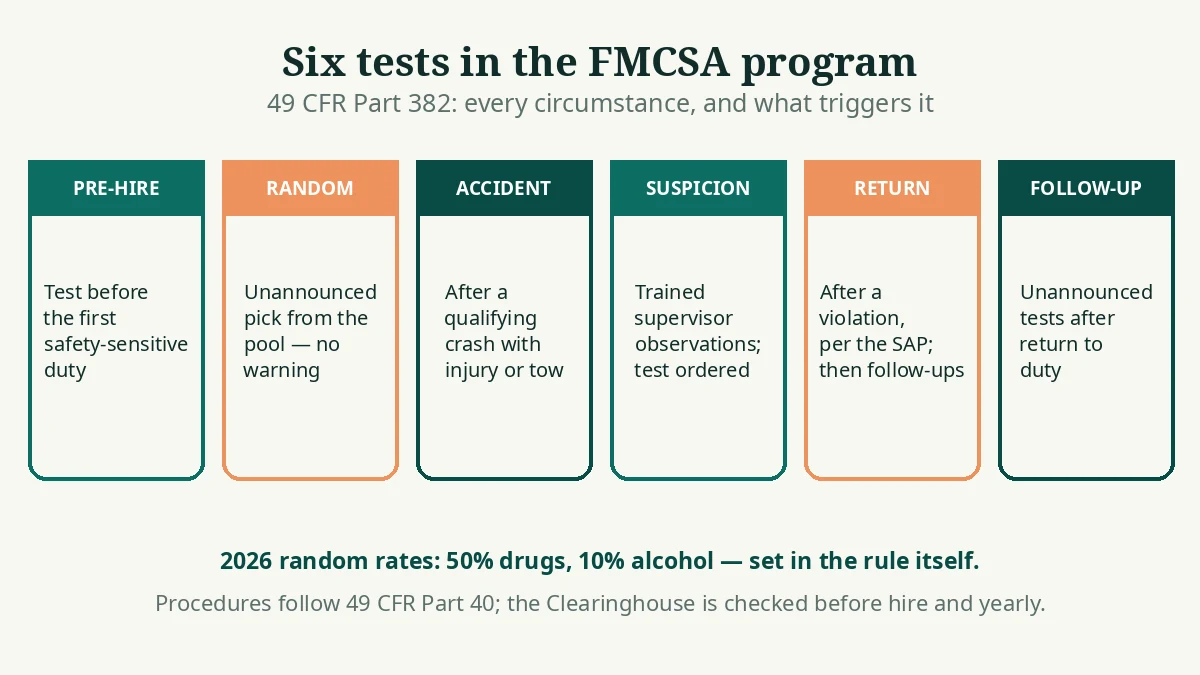
The program requires six kinds of test: pre-employment, random, post-accident, reasonable suspicion, return-to-duty, and follow-up. For 2026, the minimum random testing rates are 50 percent of the average number of driver positions for drugs and 10 percent for alcohol. Procedures follow 49 CFR Part 40, and the employer must check the FMCSA Clearinghouse before hiring and yearly after that.
The part drivers most often misunderstand is the alcohol test itself. The DOT alcohol test is a breath test. Part 40 does not authorize blood, urine, EtG, or any other specimen for DOT alcohol testing — so a CDL driver is never EtG-tested by the DOT. If a CDL driver faces an EtG test, it is the employer's own add-on or part of a return-to-duty plan. A DOT violation is recorded in the Clearinghouse, and a prohibited status can cost the CDL.
Amazon DSP drivers: tested, but not by the DOT
Amazon does not employ most of its van drivers directly. Independent Delivery Service Partners hire, pay, and schedule them under an Amazon contract, and that contract — not federal law — sets the testing. The DSP contract requires a 4-panel drug screen for every driver candidate before they get on a route, covering cocaine, opiates, amphetamines, and PCP. THC left the required panel in June 2021, though some DSPs add it back for insurance reasons.
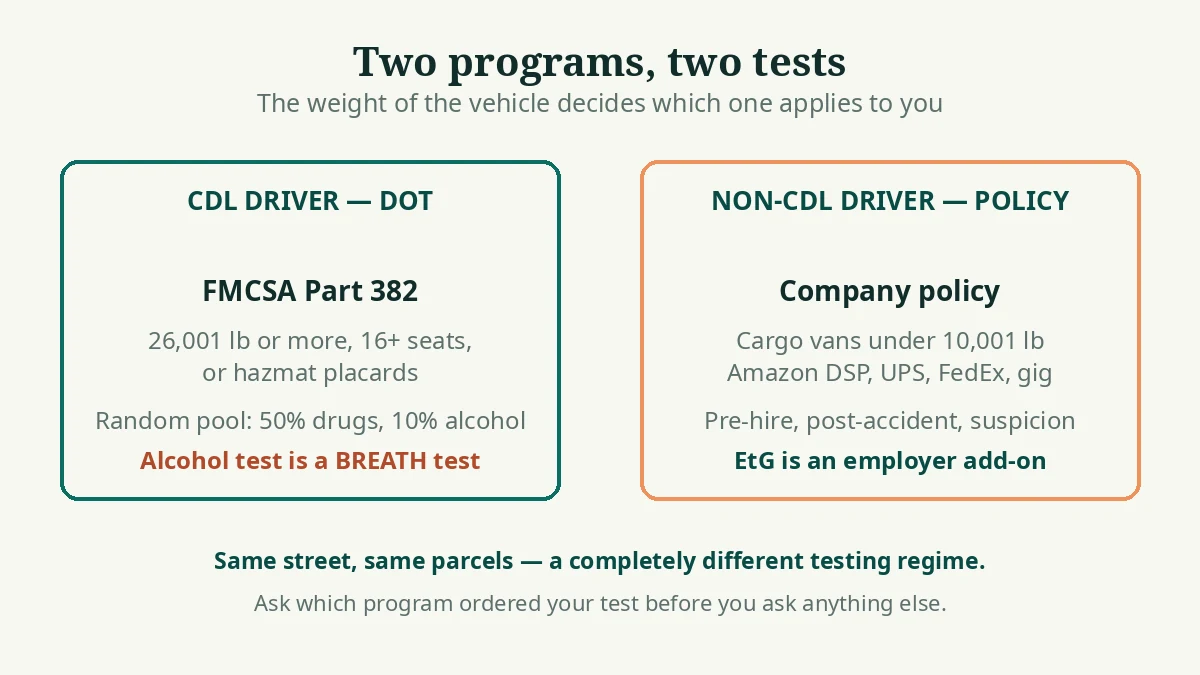
Beyond pre-employment, the contract requires two more situations: post-accident testing after a qualifying accident — injury, significant vehicle damage, or a fatality — and reasonable-suspicion testing when a manager observes behaviour suggesting impairment. That is the full required scope. There is no random drug testing pool, because the contract does not require one and the fleet is not subject to FMCSA Part 382 either: the cargo vans operate below the 10,001-pound threshold that triggers federal testing.
Some guides describe DSP drivers as DOT random-tested; for sub-10,001-pound vans, the weight threshold says otherwise. The contract also requires a DOT-equivalent physical exam, performed by an examiner on the FMCSA National Registry. Background checks and motor vehicle records are handled centrally by Amazon. EtG is nowhere in the contract by name — a DSP that wants to check recent drinking after an accident orders it under its own policy, at a cutoff of its choice, usually 100, 200, or 500 ng/mL.
UPS and FedEx: same packages, different rules
UPS hires its drivers directly, under the Teamsters contract, and the rules split by role. Package car drivers face pre-employment drug screening under company policy; driver guides report the standard 5-panel urine screen, which includes THC. Inside warehouse staff are a different story: the Teamsters contract generally protects them from pre-employment and random testing, so a package handler is rarely tested at hire. The split is role-based.
Feeder drivers are the exception that proves the rule. They drive tractor-trailers between hubs, they hold CDLs, and they are fully inside the FMCSA program: DOT-compliant pre-employment screening, a random pool at the 50 percent drug and 10 percent alcohol rates, and Clearinghouse enrollment. Same employer — a completely different regime, decided by the vehicle.
FedEx works the other way round. FedEx Ground uses a contractor model, like Amazon's DSPs: independent businesses operate the routes. A FedEx Ground driver applicant must be 21 or older, pass a background check, and take a drug test authorized by FedEx Ground. Driving jobs at FedEx Ground, Freight, and Express require a DOT urine drug test, and CDL roles go into the DOT random pool. Non-CDL delivery drivers generally do not face random tests, and FedEx Ground package handlers usually do not take a drug test at all. EtG, again, is not the DOT test — a contractor adds it under its own policy, usually after an accident.
Gig couriers: a background check, not a drug test
DoorDash, Uber Eats, and Instacart do not drug-test couriers at sign-up. What they run is a background check, almost always through Checkr: a seven-year criminal history search across county, state, and federal courts and a motor vehicle record check. DoorDash does not require a drug test as part of the application process, and neither does Uber Eats or Instacart for a standard courier sign-up.
A courier's record still matters. A DUI within the past five years is an automatic disqualifier on DoorDash, and Uber re-runs background checks periodically once a courier is active — usually every year. Instacart looks back seven years and weighs theft and fraud offences more heavily, because shoppers handle payment cards inside stores. Amazon Flex adds one wrinkle: a drug screening is required in some markets. And a DUI arrest while active can mean deactivation, even without a test — the background check catches the arrest, not the drinking.
What the EtG test actually measures
Ethyl glucuronide is a direct metabolite of ethanol: the liver makes it only after alcohol is consumed, and it leaves the body in urine. An EtG test does not measure impairment — it measures whether alcohol was consumed in roughly the past one to three days. The SAMHSA advisory on alcohol biomarkers puts EtG's detection window at up to about 80 hours, and warns that EtG is "scientifically unsupportable as the sole basis for legal or disciplinary action."
Testing runs in two steps: an immunoassay screen flags a sample above the cutoff, and a positive screen is confirmed by LC-MS/MS, the laboratory method that identifies EtG specifically. The cutoff is the number that decides the result: 100 ng/mL is the most sensitive and catches the lightest drinking, 500 ng/mL is the least sensitive and catches only heavier or more recent drinking, and 200 ng/mL sits between them. No federal agency or state sets a national EtG cutoff — the employer or program picks one, and the same sample can pass at 500 and fail at 100.
Detection windows by drinks and cutoff
The table below uses the same modeled ranges as our EtG calculator: the window after the last drink during which a urine EtG test can still read positive. They are ranges — weight, drinking speed, food, and hydration move the window.
| Drinks (standard) | 100 ng/mL | 200 ng/mL | 500 ng/mL |
|---|---|---|---|
| 1–2 drinks | 23–53 hours | 20–46 hours | 15–36 hours |
| 3–4 drinks | 30–68 hours | 26–59 hours | 20–46 hours |
| 5–7 drinks | 38–85 hours | 33–75 hours | 26–58 hours |
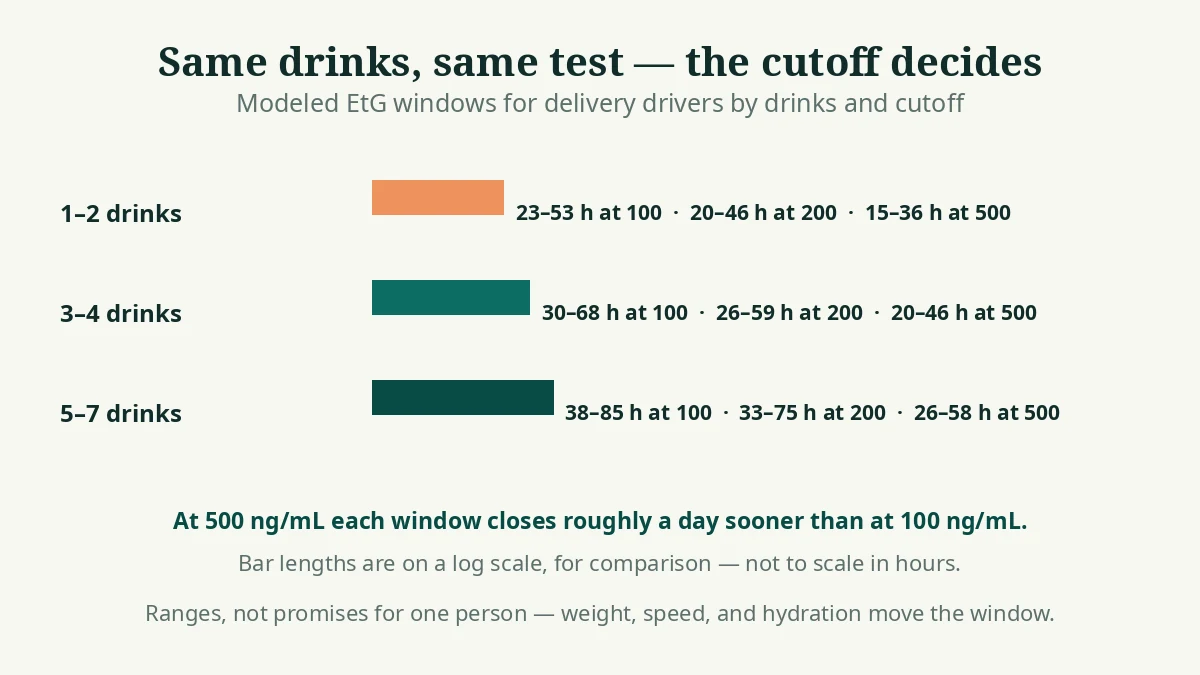
Read the table across, not down: three or four drinks stays inside the window at 100 ng/mL for up to 68 hours — nearly three days — but is past it at 500 ng/mL after 46 hours. So the first question after any positive is "which cutoff?" — and a driver should ask for it in writing before the test, not after the result.
Real-world scenario: four drinks Saturday, a random test Monday
A DSP driver finishes a route on Saturday, has four drinks with friends at 9 p.m., and is called for a random test on Monday at 9 a.m. — 60 hours after the last drink. Random selection gives no warning.
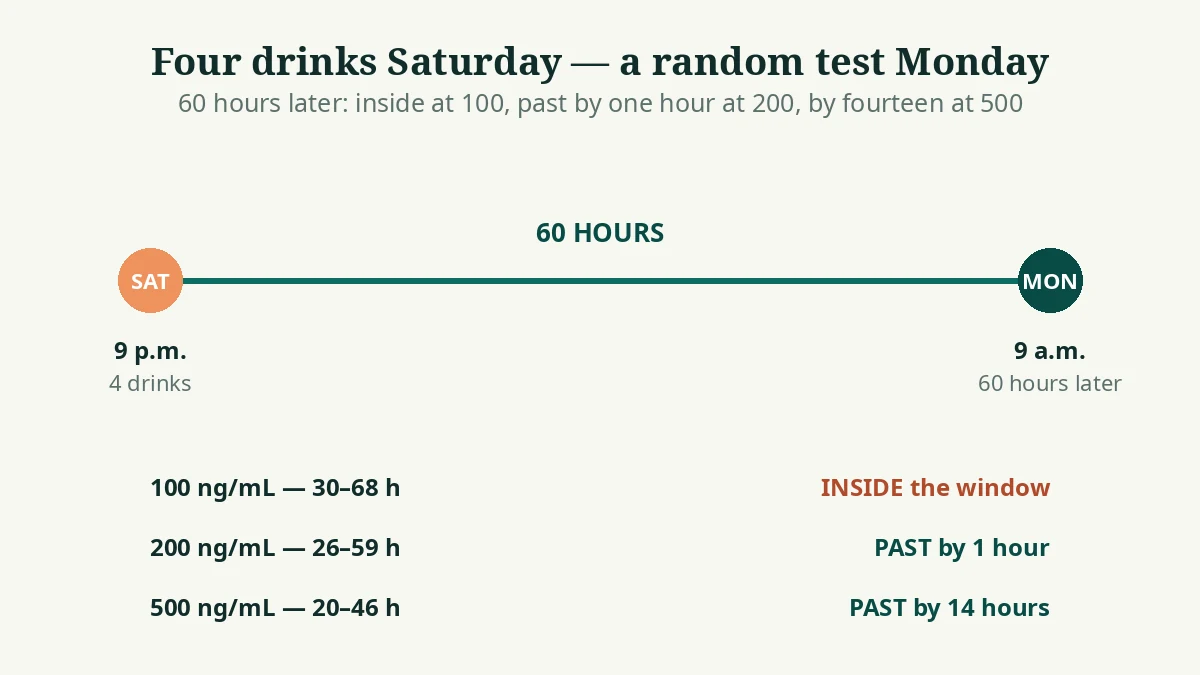
Four drinks is in the 3–4 drink band. At 100 ng/mL the modeled window is 30–68 hours, so 60 hours is inside it. At 200 ng/mL the window is 26–59 hours, so 60 hours is past it — by one hour. At 500 ng/mL the window is 20–46 hours, so 60 hours is past it by fourteen hours. Same driver, same Saturday, same test: positive at one cutoff, negative at the other two. The lesson is not that 500 ng/mL is safe to drink under — the cutoff, not the drinking alone, decides the result, and a random test leaves no room to plan around it.
What to do if you are facing a test
Respond the same day — a random selection has a reporting deadline, and missing it counts as a refusal, often treated as a positive. Check the policy first: which program ordered the test, which cutoff, which lab, whether the screen is confirmed by LC-MS/MS, and what the consequence is. If it is positive, ask in writing: which cutoff, whether the screen was confirmed, and whether a split-sample retest is available.
Do not try to beat the test: water, supplements, and "detox" drinks do not reliably clear EtG, and a dilute sample can be flagged as cheating — punished more harshly than a positive. The simplest protection: know the policy and the cutoff, and do not drink in the days before a possible test.
Using the EtG calculator before a test
The EtG calculator estimates the same windows as the tables — read it as a range, never a pass date. Run your numbers.
Frequently asked questions
Do Amazon delivery drivers get EtG tested?+
Amazon's DSP contract requires a 4-panel drug screen at hire (cocaine, opiates, amphetamines, PCP), plus post-accident and reasonable-suspicion testing — but it does not name EtG, and there is no random testing pool. A DSP can order an EtG test under its own policy, most often after an accident, and the cutoff would be the DSP's choice, usually 100, 200, or 500 ng/mL. There is no Amazon-wide EtG cutoff.
Do UPS drivers get EtG tested?+
UPS package car drivers face pre-employment drug screening under company policy, and feeder (tractor-trailer) drivers are DOT-tested because they hold CDLs. EtG itself is not a DOT test — the DOT alcohol test is a breath test — so an EtG test for a UPS driver would come from company policy or a return-to-duty plan, not from the federal program. Inside warehouse staff are generally not tested at hire under the Teamsters contract.
Does DoorDash drug test drivers?+
No. DoorDash does not require a drug test as part of the application process. Applicants pass a background check through Checkr — a seven-year criminal history search and a motor vehicle record check. A DUI within the past five years is an automatic disqualifier, and a DUI arrest while active can lead to deactivation, but DoorDash itself does not order an EtG test.
Do CDL delivery drivers get random EtG tests?+
The DOT random program requires 50% of the average driver pool for drugs and 10% for alcohol in 2026 — but the DOT alcohol test is a breath test, not EtG. A CDL driver can face a random EtG test only if the employer's own non-DOT policy adds one. A DOT violation is recorded in the FMCSA Drug and Alcohol Clearinghouse, where a prohibited status can lead to the state downgrading the CDL.
What cutoff do delivery companies use for EtG?+
There is no national EtG cutoff for delivery drivers. Employers and programs typically use 100, 200, or 500 ng/mL. The same sample can pass at 500 ng/mL and fail at 100 ng/mL, so the cutoff is as important as the drinking — ask for it in writing before the test, not after the result.
How long after drinking can a delivery driver test positive on EtG?+
It depends on how much was drunk and the cutoff. Modeled ranges: 1–2 drinks, 23–53 hours at 100 ng/mL, 20–46 at 200, 15–36 at 500; 3–4 drinks, 30–68 hours at 100, 26–59 at 200, 20–46 at 500; 5–7 drinks, 38–85 hours at 100, 33–75 at 200, 26–58 at 500. These are ranges — weight, drinking speed, food, and hydration move the window for one person.
Will one drink show up on an EtG test for a delivery driver?+
It can, at the most sensitive cutoff. One to two drinks can stay detectable for roughly 23–53 hours at 100 ng/mL, but only 15–36 hours at 500 ng/mL. At a 500 ng/mL cutoff, a single drink is usually clear within about a day and a half; at 100 ng/mL it can take more than two days. The cutoff and the timing both matter.
Evidence and limitations
This article summarizes published guidance and research on EtG testing for delivery drivers, plus the science of alcohol biomarkers. Group-level findings cannot predict one person’s result, and this article is educational only — it is not legal or medical advice. Testing rules vary by employer, contractor, program, and state; talk to a local attorney about a live case or a termination.
- Fleetive — 49 CFR Part 382 Explained: six required test categories; Clearinghouse check before hire and at least once every 12 months; 2026 random rates 50% drugs / 10% alcohol under § 382.305(b)
- Foley Carrier Services — DOT Random Drug Test Frequency 2026: minimum 50% drugs / 10% alcohol of the average driver pool; drug rate unchanged since 2020 (raised from 25% in 2020)
- Simplex Group — Substance Abuse Testing for Trucking Companies: Part 382 covers vehicles of 26,001 lb GVWR or more, 16+ passengers, or hazmat placards; six tests listed
- VerticalID — What New Amazon DSP Owners Must Know About Drug Testing (2026): DSP contract requires a 4-panel pre-employment screen (cocaine, opiates, amphetamines, PCP); THC dropped June 2021; post-accident and reasonable-suspicion testing; no random pool; vans under 10,001 lb GVWR below the FMCSA Part 382 threshold
- HappyFleet — DOT Compliance and Driver Eligibility Checklist Every Amazon DSP Owner Needs: DOT-equivalent physical by a National Registry examiner; pre-employment, post-accident, and reasonable-suspicion testing; background checks and MVRs handled centrally by Amazon
- Gridwise — UPS Pay Guide (2026): UPS conducts pre-employment drug testing for all positions, including marijuana; feeder (tractor-trailer) drivers require a CDL and reach up to $49/hr top rate
- The Future Warehouse — UPS Warehouse Drug Test: Teamsters contract governs testing; inside warehouse workers generally not pre-employment or random tested; DOT-regulated feeder drivers face mandatory DOT screening and random pools; 5-panel urine test (THC, cocaine, opiates, PCP, amphetamines)
- Best Career Guide — FedEx Delivery Driver Job Description: FedEx Ground requires a drug test authorized by FedEx Ground, age 21+, and a full background check for driver applicants
- HireFelonsJobs — Does FedEx Drug Test Package Handlers in 2026?: driving jobs at FedEx Ground, Freight, and Express require a DOT urine drug test; CDL roles face random testing; non-CDL delivery drivers generally do not; package handlers usually not tested
- Gridwise — DoorDash Background Check: Checkr 7-year criminal history + MVR; DoorDash does not require drug testing as part of the application process
- GigWorkerMoney — Delivery Driver Background Check Guide 2026: DoorDash DUI within 5 years is an automatic disqualifier; Uber re-runs background checks periodically; Amazon Flex requires a drug screening in some markets (delivery station and Whole Foods roles)
- SAMHSA Advisory: The Role of Biomarkers in the Treatment of Alcohol Use Disorders (2006, revised 2012) — EtG detectable up to ~80 hours; EtG “scientifically unsupportable as the sole basis for legal or disciplinary action”
- McDonell et al. (2015) — EtG immunoassay cutoff sensitivity in alcohol-dependent outpatients (1,589 samples)
- Mackus et al. (2017) — EtG detection and elimination kinetics after controlled alcohol intake
- Jatlow et al. — EtG and EtS in urine after controlled alcohol administration
- EtG Calculator Pro — ETG Testing for Rideshare Drivers: the passenger-side version of the same gig split
- EtG Calculator Pro — DOT EtG Test: the DOT/non-DOT split explained
- EtG Calculator Pro — ETG Testing for Employment: consent and consequences in the workplace