The short answer: an ETG test for construction workers is employer-policy testing, not a federal program
An ETG test for construction workers is a urine test for ethyl glucuronide, a direct metabolite of alcohol. It answers one question: has this worker drunk alcohol in roughly the past one to three days? It does not measure impairment.
Roughly 8 million Americans work in construction, and for almost all of them, testing is company policy: the employer, the general contractor, or the project owner writes the rules on when testing happens, which cutoff applies, and what a positive costs. No federal agency sets an EtG standard for construction work in general. The exceptions are the driving duty, which falls under the Department of Transportation when a worker drives a commercial vehicle, and federal projects, where the contract usually requires a drug-free workplace program.
When a construction worker faces an ETG test
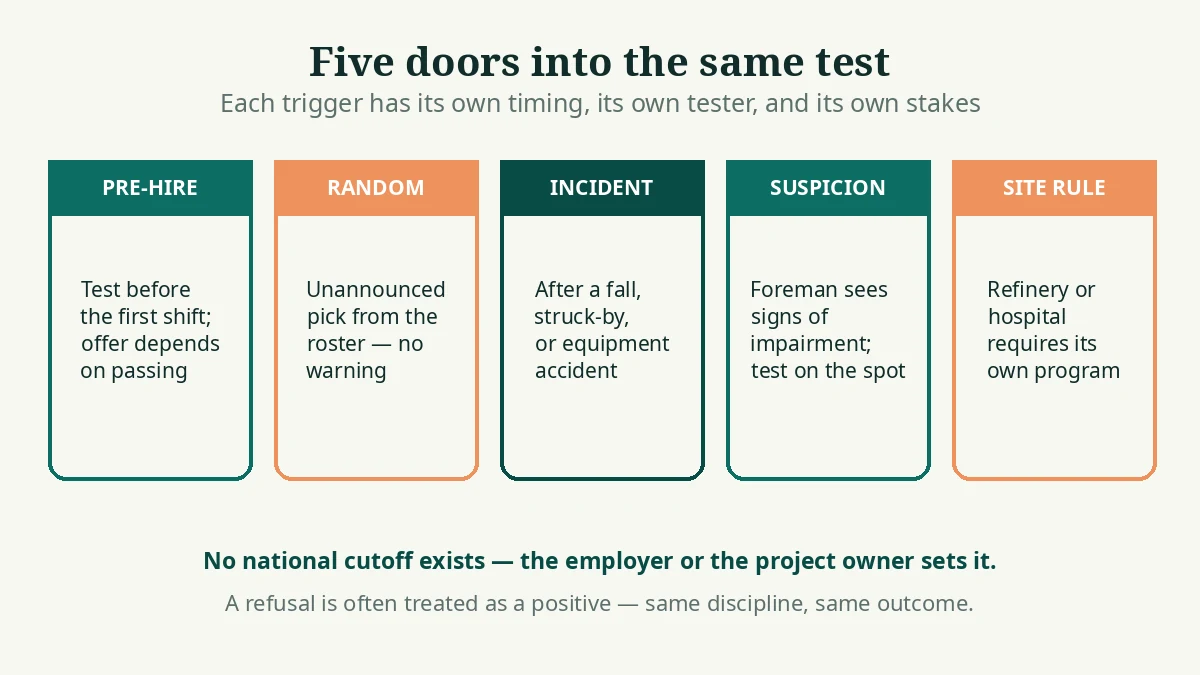
Construction alcohol testing follows four triggers — pre-employment, random, post-incident, and reasonable suspicion — plus the project owner's own requirement.
| Trigger | Who orders it | Typical timing | What is at stake |
|---|---|---|---|
| Pre-employment | The employer | After a conditional job offer | The job offer itself |
| Random | The employer | Unannounced, during the year | The job; a refusal is often treated as a positive |
| Post-incident | Employer, general contractor, or insurer | As soon as possible after the incident | The job, the workers' comp claim, the project contract |
| Reasonable suspicion | A supervisor observing impairment | Immediately, same shift | The job; the worker is usually pulled off the site first |
| Site or project requirement | The project owner | Before access is granted, or on the owner's schedule | The assignment — and the employer's contract |
Pre-employment testing is the most common: most large construction employers test every new hire before the first shift. Random testing is where EtG matters most — it is unannounced, and EtG's multi-day window means drinking days earlier still shows up. Post-incident testing follows anything that goes wrong on site. Reasonable suspicion is the fastest trigger: a foreman who smells alcohol can order a test on the spot. The project-owner requirement is the one workers underestimate: a refinery or hospital can require every worker on its property to pass its own program, even if the employer tests rarely — and losing site access can mean losing the job.
Who is — and is not — covered by a federal testing rule
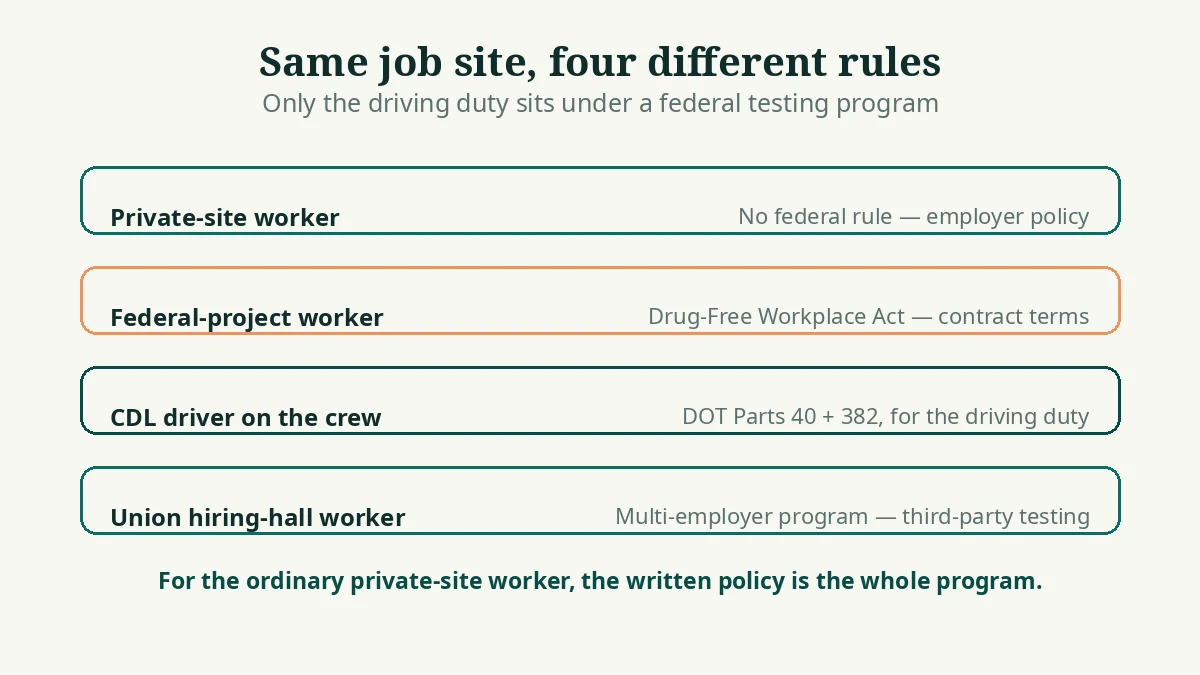
Several roles share the same job site, and only some sit under a federal program.
| Role | Federal testing rule | Who sets the test | What testing looks like |
|---|---|---|---|
| Private-site worker | None | Employer, general contractor, or project owner | Pre-hire, random, post-incident, or suspicion — policy-set |
| Federal-project worker | Drug-Free Workplace Act | The contractor, under federal contract terms | Testing per the contract and company policy, often pre-hire plus random |
| CDL driver on the crew | DOT, 49 CFR Parts 40 and 382 | DOT rules, for the driving duty | Pre-employment, random (50% drug, 10% alcohol), post-accident, suspicion, return-to-duty |
| Union hiring-hall worker | None | The union program or multi-employer plan | Testing through a third-party administrator; results can follow the worker across signatory employers |
For the ordinary private-site worker, your testing program is whatever your employer's written policy says it is. If it is vague, ask for the details in writing before a test, not after a result.
The OSHA limit on post-incident testing
OSHA does not require drug or alcohol testing on construction sites — but it does limit when an employer can test a worker who reports an injury. Under the injury-reporting rule, 29 CFR 1904.35(b)(1)(iv), an employer may not use drug testing, or the threat of it, to retaliate against an employee for reporting a work-related injury or illness.
OSHA's commentary is blunt about blanket post-incident testing: testing every worker who reports any injury can discourage reporting, and the agency views it as retaliation when there is no reasonable basis to believe drug or alcohol use contributed. Testing is acceptable when there is a reasonable possibility that use was a contributing factor — and OSHA adds a second condition that matters for EtG: the test should be able to identify impairment. EtG detects drinking from days earlier, not impairment on the job, and OSHA's commentary flags tests that "do not identify impairment but only use at some time in the recent past."
That does not make post-incident EtG testing illegal: testing under a DOT rule or a state workers' compensation law is not retaliation, and random and pre-employment testing are not covered. OSHA's own example: a crane accident injures nearby workers, not the operator — testing the operator is only reasonable if there is a basis to believe the operator's use contributed. If you are tested after an incident, ask in writing what the basis was.
What cutoff applies to a construction worker's EtG test
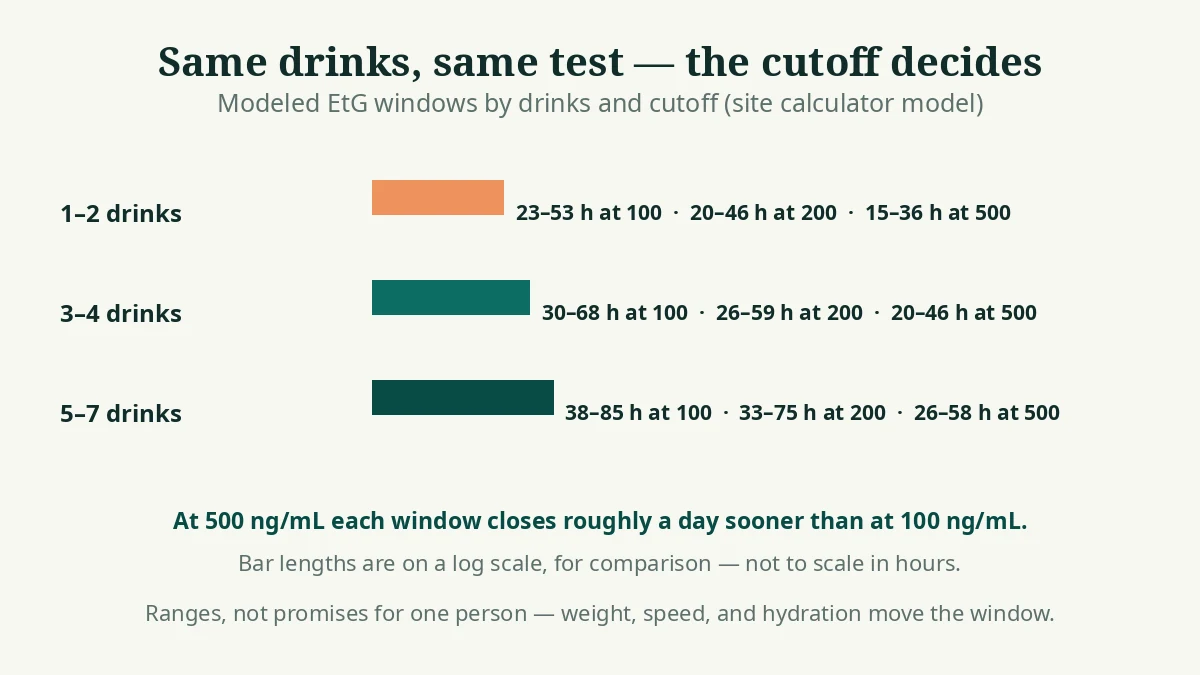
There is no national EtG cutoff for construction workers: the employer, the general contractor, or the project owner picks one, usually 100, 200, or 500 ng/mL. The cutoff decides whether a drinking history produces a positive, because a lower cutoff catches drinking from further back.
| Drinking | At 100 ng/mL | At 200 ng/mL | At 500 ng/mL |
|---|---|---|---|
| 1–2 drinks | 23–53 hours | 20–46 hours | 15–36 hours |
| 3–4 drinks | 30–68 hours | 26–59 hours | 20–46 hours |
| 5–7 drinks | 38–85 hours | 33–75 hours | 26–58 hours |
These are modeled ranges from the site's calculator, not promises for one person. But the pattern is what matters: at 500 ng/mL, each window closes roughly a day sooner than at 100 ng/mL, so the same Saturday-night drinking can be positive at 100 and negative at 500 by Monday morning. That is why the first question after any result should be "which cutoff was used?" The SAMHSA advisory agrees: EtG is "scientifically unsupportable as the sole basis for legal or disciplinary action" — which is why a responsible program confirms a positive screen with LC-MS/MS before acting on it.
How long EtG stays detectable before a construction worker's test
EtG can be detected in urine for up to about 80 hours after drinking, per the SAMHSA advisory — roughly three days for heavier drinking. Light drinking clears faster; a single drink may be detectable for roughly a day at a low cutoff, and not at all at 500 ng/mL.
How much was drunk, the cutoff, and the individual all stretch or shrink the window — but no formula predicts one person's result. Drinking water before a test does not help: it lowers the EtG concentration in one sample, but labs measure the EtG-to-creatinine ratio to catch dilution, and a dilute sample can be flagged. There is no reliable way to shorten the window. And EtG is not a breathalyzer: a breath test measures alcohol right now, while EtG measures a metabolite from days ago. A worker can blow zero on Monday morning and still test positive for Saturday night's drinks.
Real-world scenario: four drinks Saturday, a random test Monday
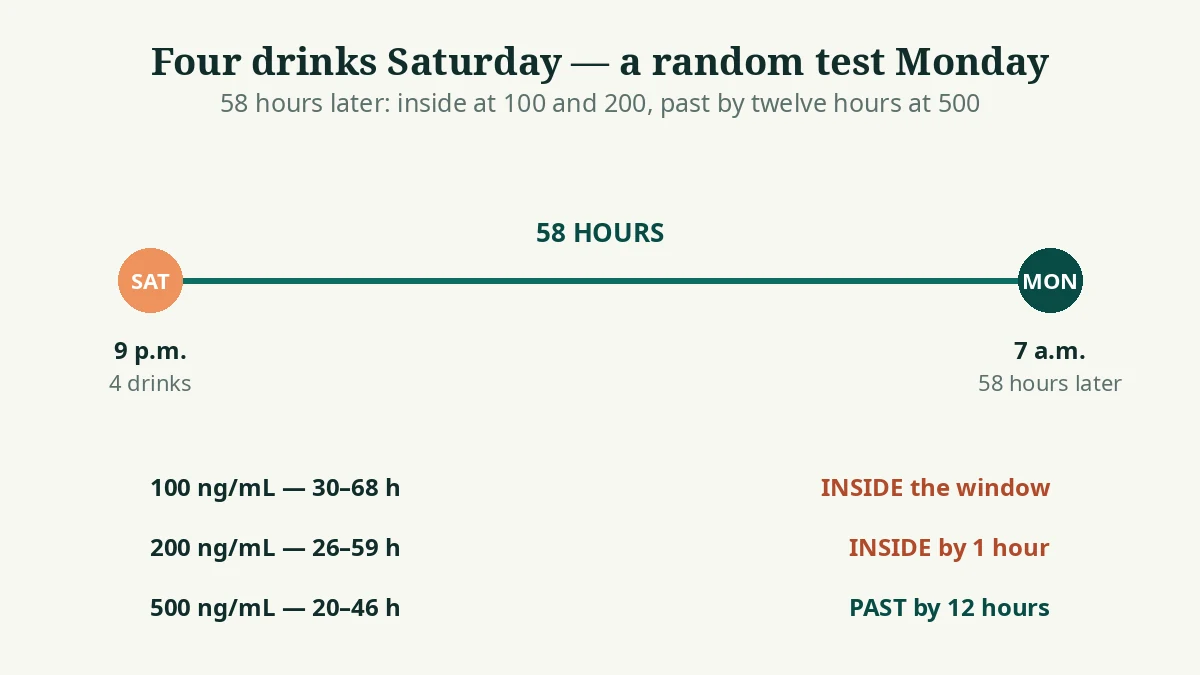
Dana is a carpenter on a build. She finishes her shift Saturday afternoon and has four drinks with friends that night, from 9 p.m. to midnight. On Monday at 7 a.m., her name comes up in the random pool — 58 hours after her last drink.
At 100 ng/mL, the modeled window for three to four drinks is 30–68 hours — Dana is inside it. At 200 ng/mL (26–59 hours) she is still inside it, by a single hour; at 500 ng/mL (20–46 hours) she is past it by twelve hours, and a screen is likely negative. One weekend, one random draw, three outcomes depending on a number she was never told. The lesson is not that 500 ng/mL is safe to drink under — it is that the cutoff decides the result as much as the drinking does. A worker who drinks on a Saturday and works a random-tested site on Monday is gambling on a policy detail.
Federal projects, unions, and drug-free workplace programs
Three structures catch workers who never see a federal testing rule directly. First, the Drug-Free Workplace Act of 1988 requires federal contractors to maintain a drug-free workplace — it does not itself order testing, but federal construction contracts commonly require a testing program, and the contractor's policy then governs the crew. Second, several states run certified drug-free workplace programs tied to workers' compensation discounts — Ohio and Florida are the best-known — so an employer may test because the program pays for itself.
Third, the union hall. Multi-employer programs run by a union and its signatory contractors often test through a third-party administrator, and a result can follow a worker from one employer to the next — a positive on one job can block dispatch to the next. Add the project owner: refineries, hospitals, and data centers routinely require every worker on their property to pass the owner's own program, whatever the employer does. The worker answers to more than one testing authority, and the strictest one matters.
What a positive — or a refusal — can cost a construction worker
The immediate cost is the job: crews run lean, so a worker pulled off a site is often replaced the same week, and the termination follows the confirmation. The secondary cost is the next job: a failed test in a safety-sensitive trade follows a worker into the next application, where the same pre-employment test is waiting — and in a union program, it can follow the worker across employers.
Refusal is not a way around this: most policies treat a refusal as a positive, with the same discipline. A worker who believes a test was ordered unfairly is better served by taking it and challenging the process afterward, in writing — the sample is evidence, and the OSHA rule gives a real ground to challenge a blanket test. The protections worth using: ask for the cutoff and the lab, whether a positive screen was confirmed by LC-MS/MS, and whether a split-sample retest is available.
What to do if you are selected for a test
Respond the same day: a random selection has a reporting deadline, and missing it counts as a refusal. Check the policy first — cutoff, lab, confirmation step, consequence — then give the sample. If the result comes back positive, ask three questions in writing: which cutoff, whether the screen was confirmed by LC-MS/MS, and whether a split-sample retest is available. If the test followed an incident, add a fourth: what was the basis for ordering it.
Do not try to beat the test: water, supplements, and "detox" drinks do not reliably clear EtG, and a dilute sample can be flagged as cheating — which many policies punish more harshly than a positive. The simplest protection is the oldest one: know the policy and the cutoff, and do not drink in the days before a possible test. For a worker on a random-tested site, that means treating every shift as a possible test day. This article is educational only, not legal or medical advice.
Using the EtG calculator before a test
The EtG calculator estimates the same windows as the tables above — read the result as a range, never a pass date. Run your numbers through the calculator.
Frequently asked questions
Do construction workers get EtG tested?+
Yes — most large construction employers test, usually at hire, at random, after an incident, or on reasonable suspicion. Testing is set by the employer's policy, the general contractor, or the project owner, not by a national rule. There is no federal EtG testing program for construction work in general; the exceptions are the driving duty (DOT rules for CDL drivers) and federal projects that require a drug-free workplace program.
Does OSHA require EtG testing on construction sites?+
No. OSHA does not require drug or alcohol testing of any kind. What OSHA does do, under 29 CFR 1904.35(b)(1)(iv), is limit post-incident testing: an employer may not use drug testing to retaliate against a worker who reports an injury, and blanket testing after every incident is discouraged. Testing is acceptable when there is a reasonable possibility that use contributed to the incident, or when it is done under a DOT rule or a state workers' compensation law.
What cutoff do construction companies use for EtG?+
There is no standard cutoff. Employers, general contractors, and project owners usually pick 100, 200, or 500 ng/mL. The cutoff matters more than the drinking: four drinks are modeled at 30–68 hours at 100 ng/mL but only 20–46 hours at 500 ng/mL, so the same weekend can be positive at one cutoff and negative at another.
How long after drinking will a construction worker test positive on an EtG test?+
It depends on how much was drunk and the cutoff. Modeled windows from the site's calculator: one to two drinks, 23–53 hours at 100 ng/mL and 15–36 hours at 500; three to four drinks, 30–68 hours at 100 and 20–46 at 500; five to seven drinks, 38–85 hours at 100 and 26–58 at 500. SAMHSA's advisory puts the outer limit at about 80 hours. These are ranges, not predictions for one person.
Can I be tested after an accident on site even if I was not hurt?+
Yes, if the employer has a reasonable basis to believe your drug or alcohol use could have contributed to the incident — OSHA's rule allows testing on that basis, and testing under a DOT rule or state workers' compensation law is also allowed. What OSHA questions is blanket testing of everyone after every incident, whatever happened. If you are tested after an incident, ask in writing what the basis for the test was.
Does holding a CDL change the rules for a construction worker?+
Yes, for the driving duty. A construction worker who drives a commercial motor vehicle falls under DOT rules (49 CFR Parts 40 and 382) for that work: pre-employment testing, random testing at a 50% annual drug rate and 10% alcohol rate, post-accident testing (alcohol within 8 hours, drugs within 32), reasonable-suspicion testing, and return-to-duty testing. The DOT rules cover the driving, not the rest of the construction job.
What happens if I refuse an EtG test on a construction job?+
Most policies treat a refusal as a positive, with the same discipline — usually termination. A refusal also removes your best evidence: the sample itself. If you believe a test was ordered unfairly, for example a blanket test after an incident you had nothing to do with, take the test and challenge the process afterward in writing, asking for the cutoff, the lab, LC-MS/MS confirmation, and the basis for ordering it.
Evidence and limitations
This article summarizes published guidance and research on EtG testing for construction workers, plus the science of alcohol biomarkers. Group-level findings cannot predict one person’s result, and this article is educational only — it is not legal or medical advice. Testing rules vary by employer, general contractor, project owner, and state; talk to a local attorney about a live case, a termination, or a workers’ compensation question.
- Much — Drug Testing an Employee Who Reports a Work-Related Accident? Special Rules Apply: OSHA rule 29 CFR 1904.35(b)(1)(iv) bars using drug testing to retaliate against a worker who reports an injury; testing needs an objectively reasonable basis to believe use contributed
- American Contractors Organization — OSHA Discourages Post-Incident Drug Testing: blanket post-accident testing can deter injury reporting; OSHA limits testing to situations where drug use was likely a contributing factor
- LegalClarity — Do Construction Companies Drug Test? When and Why: pre-employment, random, and post-accident testing in construction; DOT random rates (50% drug, 10% alcohol) and post-accident timeframes (alcohol within 8 hours, drugs within 32)
- Health Street — Construction Drug Testing & Background Checks: SAMHSA survey data — about 1 in 7 construction workers had a substance use disorder in 2023, and about 1 in 6 reported heavy drinking, nearly twice the rate of other full-time workers
- FMCSA — Applicability: DOT drug and alcohol programs apply to all drivers operating a commercial motor vehicle that requires a CDL, including independent owner-operators
- SAMHSA Advisory: The Role of Biomarkers in the Treatment of Alcohol Use Disorders (2006, revised 2012) — EtG detectable up to ~80 hours; EtG “scientifically unsupportable as the sole basis for legal or disciplinary action”
- McDonell et al. (2015) — EtG immunoassay cutoff sensitivity in alcohol-dependent outpatients (1,589 samples)
- Mackus et al. (2017) — EtG detection and elimination kinetics after controlled alcohol intake
- Jatlow et al. — EtG and EtS in urine after controlled alcohol administration
- EtG Calculator Pro — DOT EtG Testing: the federal rules for the commercial drivers they do reach
- EtG Calculator Pro — ETG Testing for Employment: consent and consequences in the workplace
- EtG Calculator Pro — ETG Testing for Firefighters: random testing in another safety-sensitive uniformed role